TGViewer
Channel Public Channel
Air crash. Investigations ✈️

Air crash. Investigations ✈️

@enmayday

About air crashes and air accidents, their causes and significance for flight safety.

Russian version @rumayday

Contact @Safetyofficerr
Subscribers
344
Photos
22
Videos
4
Links
59

Showing posts older than #48 · Back to latest

Older Posts 20 shown
Post #46 462
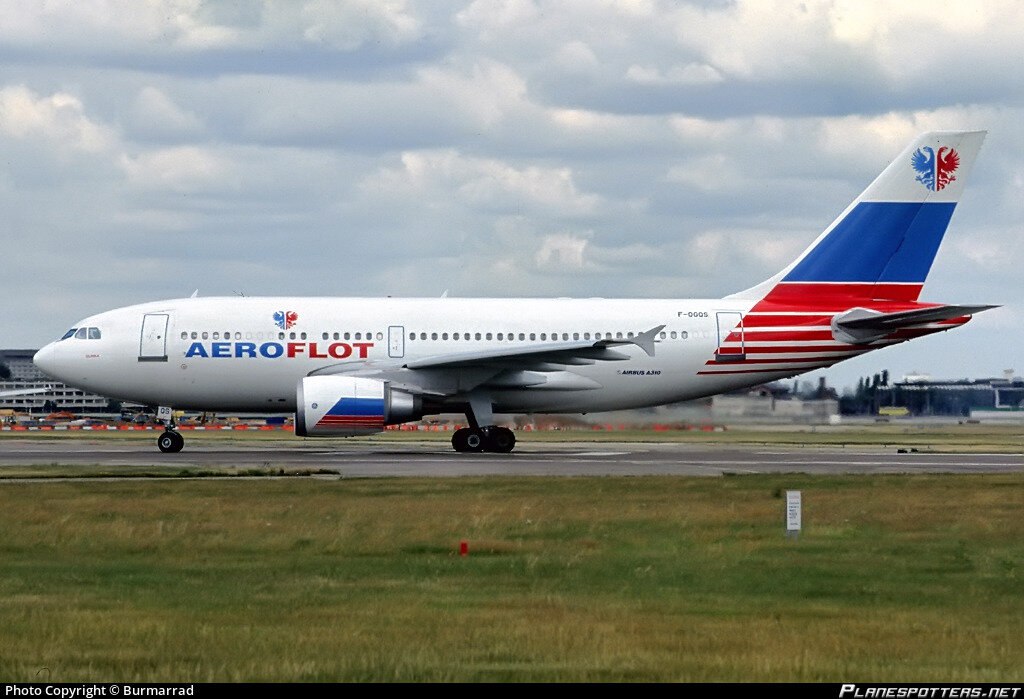
​​Children at the control wheel and crash of Airbus A310 in Russia, 1994

Part 3

The co-pilot finally took a working position and lowers the airplane’s nose to get out of the spin. The captain was able to pull the child out and sit in the left seat. The struggle for control began. But at this moment plane went into a dive and rushed towards the ground at high speed.

Captain: I turned on the thrust!
Co-pilot: Full throttle!
Captain: I gave it!
Co-pilot: Full throttle.
Captain: I turned on the thrust, I did.
Captain: What's the speed?
Co-pilot: I haven't looked at the device!
Captain: So.
Captain: So
Captain: Full throttle!
Co-pilot: Very high speed!
Captain: Big, yes?
Co-pilot: Big, of course!
Captain: I turned it on…
Co-pilot: All right, let's go out, let's go out.
Co-pilot: To the right! Right leg!
Co-pilot: High speed.
Co-pilot: Thrust idle!
Captain: Done!
Co-pilot: Slowly, slowly!


At the last moment, at an altitude of 400 meters, the pilots managed to put the aircraft into horizontal flight. But it was dark outside, they didn’t understand where they were. And suddenly, at full speed, they crashed into the slope of a 600-meter hill.

Co-pilot: again!
Captain: Don't turn to the right.
Captain: Added speed…
Captain: Let's go out now! It's okay!
Captain: Slowly pull up.
Captain: Slowly.
Captain: Slowly, damn it!
The sound of a blow, a short crack
~End of recording~


The conclusion of the Interstate Aviation Committee cited numerous crew errors as the cause. The crash of the aircraft occurred as a result of a combination of factors that led to the aircraft entering stall mode with a corkscrew transition and collision with the ground.

The most important factor was that the captain allowed his son to occupy his workstation and interfere with the control of the aircraft. In the course of this, the aircraft performed demonstration manoeuvres using the autopilot that were not foreseen in the flight plan and flight situation. The captain's son and co-pilot then applied forces to the controls that prevented the autopilot from operating normally on roll, which is not recommended by the flight operations manual. This circumstance led to overboosting and disconnection of the autopilot from the aileron control wiring. At the same time, none of the crew members noticed it.

Subsequently, the captain's son turned the steering wheel slightly, which led to the development of a right roll. The captain and co-pilot detected it too late. A conspicuous signalling would have attracted the attention of the crew in this situation.

The autopilot, which continued to perform its functions of maintaining altitude even after disconnecting the rudder, brought the aircraft into the aerodynamic shake mode and high angles of attack. In this situation, the co-pilot's actions were inadequate and ineffective. He did not switch off the autopilot in time and did not give the steering wheel "away from himself".

A criminal investigation was started on the fact of the disaster, but it was discontinued due to the death of the accused. The Deputy Director General of Aeroflot stated that in accordance with international standards, compensation will be paid to all relatives of the victims — $ 20,000 for each deceased and $ 20 for 1 kilogram of luggage. Subsequently, he claimed that the airline had satisfied 80% of the requirements, except for a few relatives who had requested "hundreds of thousands of dollars".
Post #45 342
​​Children at the control wheel and crash of Airbus A310 in Russia, 1994

Part 2

Then his son sat down there. Father allowed him to turn the control wheel and he immediately began to do it actively. At that time, the co-pilot moved back in his seat and did not monitor the instruments, while the passenger pilot filmed everything on camera.

VM (Vladimir Makarov — passenger pilot) holding a camera in his hands
Eldar sat down in the captain’s chair
Eldar: Are you filming?
VM: I'm filming.
Eldar: Is it possible to turn it?
Captain: Yes! If you turn left, where will the plane go?
Eldar: To the left.
Captain: Turn around! Turn to the left! So, watch the ground, where you're going to turn. Let's go left, turn left!
Eldar: That's great.
Captain: Went, right?
Eldar turned the steering wheel to the left by 3-4°
Captain: Is the plane going to the left?
Eldar: It's coming.
Captain: It's not visible, is it?
Captain: It's going to go right now.
VM: Put the attitude indicator properly for him.
The plane began turning right


The plane was flying with the engaged autopilot and small fluctuations in the steering wheel did not affect the course. But Eldar persistently, for about 30 seconds, pressed on the control wheel, which was the reason for the autopilot to turn off. This was a feature of the A310, but the crew knew nothing about it. The situation was aggravated by the lack of an audible alarm to turn off the autopilot. Anyway, the 15-year-old son of the captain was now controlling the plane. The Airbus began to enter into an increasing right bank. Pilots didn't notice anything. Suddenly Eldar asked why the plane began to turn itself.

Captain: What do you want, Yana?
Yana: (unreadable)
Captain: Why?
Yana: (unreadable)
Captain: In the first class you will only sleep.
Captain: Don't run there, or we will be kicked out of the work.
The aircraft's roll to the right increased, neither the captain nor the co-pilot noticed this
Eldar: Why is it turning around?
Captain: Does he turn himself?
Eldar: Yes.
Captain: And why is he turning?
Eldar: I don't know.
Captain: Can't you change the course?
VM: It is in the holding area, guys.
Co-pilot: We went to the holding pattern.
Captain: Yes?
Co-pilot: Of course.


While they were trying to identify what was going on, the roll increased and reached 45 degrees, which was above the limit. There was a strong overload. Because of it, the co-pilot could not return the seat to its working position, and the captain could not return to the control wheel. Contradictory commands rained down on the Eldar: “Hold the control wheel!”, “In the opposite direction!”, “Turn left", “Right!”. The boy took the control wheel being turned to the right, then he was confused and did not understand what was required of him.

VM: Guys!
Captain: Here you go! Hold the control wheel, hold it!
Co-pilot: Speed!
Co-pilot: In the opposite direction.
Co-pilot: Back!
Captain: Turn left! To the left! To the right! To the left!
Eldar: To the right?
Co-pilot: Can't you see that?
The autopilot shutdown sound (sounded until the end of the recording)
Co-pilot: Turn to the right.
Co-pilot: To the right!
Co-pilot: Yes, to the left! Here's the terrain!


Meanwhile, the plane reached a 90-degree roll and began to lose altitude. The autopilot tried to correct the situation and turned up its nose. The speed dropped, the Airbus went into stall, and then into a spin. The captain trying to get back to the control wheel shouted to his son “Come out!”.

Captain: Eldar, come out!
Captain: Crawl back out.
Captain: Crawl back, Eldar.
Captain: Do you see (unreadable) no?
Co-pilot: Thrust idle!
Captain: Come out!
Captain: Come out (unreadable)
Captain: Come out.
Captain: Come out.
Captain: (unreadable)
Captain: Come out.
Captain: Come out, I say.
Co-pilot: Full throttle! Full throttle! Full throttle!
Eldar left the captain’s seat
Post #44 261
​​Children at the control wheel and crash of Airbus A310 in Russia, 1994

Part 1

This disaster occurred not far from the author's hometown, so it was very well imprinted in his memory.

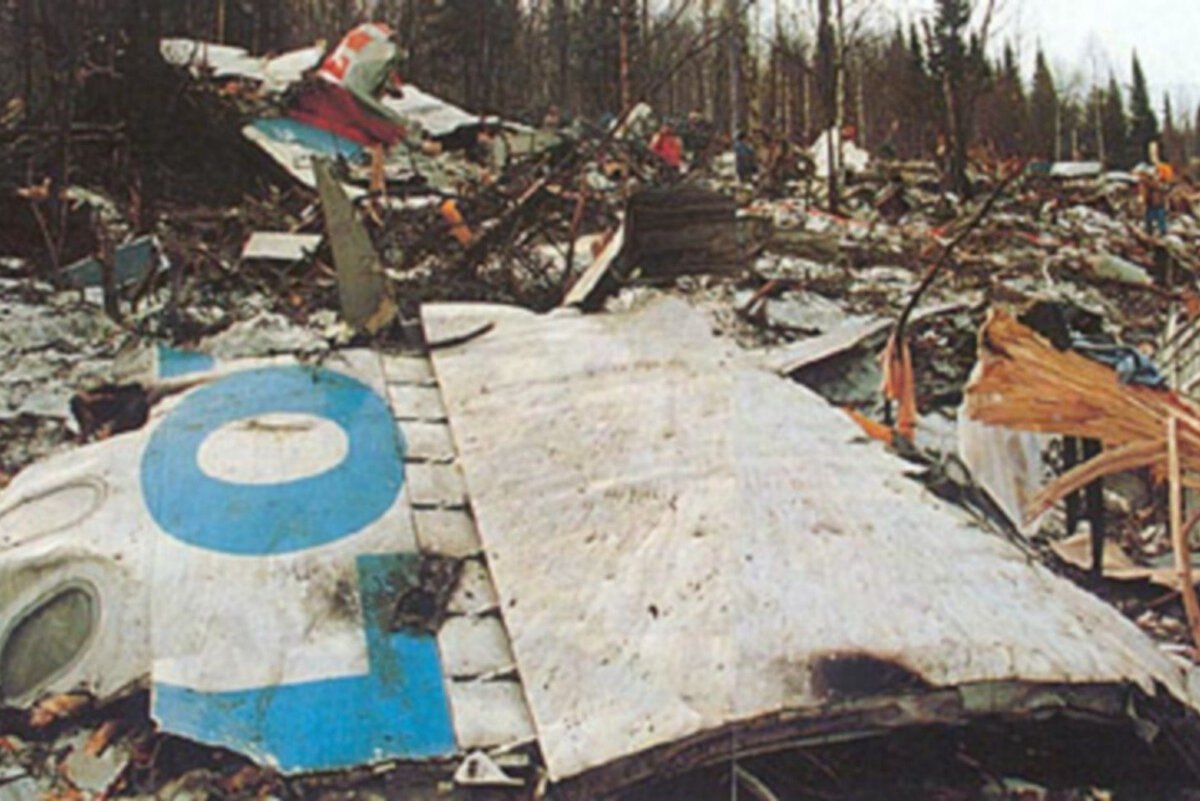
On March 23, 1994, Aeroflot's Airbus A310 performed a flight from Moscow to Hong Kong. Flying in the Novokuznetsk area, it suddenly started to fall from an altitude of more than 10 kilometers. It wasn't easy to get to the wreckage of the aircraft. They were in the snow-covered Siberian taiga. The first group of emergency services was able to get there on skis only 4 hours after receiving a message from eyewitnesses.

75 people were killed - all of the people on board. The plane shattered into many pieces on impact, which were scattered within a radius of 2 kilometers. They were taken to the Novokuznetsk airport hangar, where they were fixed to the frame in the shape of an airplane. There was a large amount of money, gold jewelry and other valuables of the passengers at the crash site. Novokuznetsk police was involved to prevent looting.

The nature of the disaster was misterious. The weather was good. The plane was at standard altitude, following its route. The crew was competent and experienced. The captain - 40-year-old Andrey Danilov, who had been the captain of the Airbus A310 since November 1992. He flew 9 675 hours, over 950 of them on an Airbus A310 (895 as a captain). The co-pilot was 33-year-old Igor Piskarev. He had been a co-pilot of the Airbus A310 since October 1993. He flew 5 885 hours, over 440 of them on an Airbus A310. There was also a reserve captain, 39-year-old Yaroslav Kudrinsky. He had been the captain of the Airbus A310 since November 1992. He had flown over 8 940 hours, 907 of them on an Airbus A310 (735 as a captain).

The crew did not report any problems. No malfunctions were detected. There were no signs of a terrorist attack or explosive decompression either. The crazy version of the UFO encounter was dismissed. Only the investigation of the flight data recorder allowed to clarify the reasons of that crash.

It happened at night, during the flight in the vicinity of Novokuznetsk, when the children of Captain Kudrinsky - 13-year-old Yana and 15-year-old Eldar – were inside the cockpit. Their father decided to take them on vacation to Hong Kong (family members of airline employees were eligible with discounted tickets). In the cockpit was a friend of the captain, also a pilot, who flew as a passenger, and a co-pilot. The captain in charge was resting outside the cockpit. Kudrinsky invited his children to sit in the captain’s place. At first, his daughter sat down, but she quickly got bored.

Captain: Come sit here now, on my chair, do you want?
Captain was leaving the pilot's seat
Yana sat down in the captain’s chair
Yana: Dad, pick me up.
Co-pilot: Novokuznetsk, Aeroflot 593, passing your point at 10 100 meters.
Captain: Well, Yana, will you lift?
Yana: No!
Captain: Don't press the buttons. Don't touch that red one!
Yana: Dad, can you turn this?
Captain: Novokuznetsk is on the left side, do you see it?
Yana: Are we flying so low?
Captain: 10 100 meters.
Yana: That's a lot, right?
Captain: A lot.
Yana was trying to leave the captain’s chair
Captain: Wait, be careful.
Yana: I'm already careful.
Yana left the captain’s seat
Post #43 438
​​Despite the signs of approaching a stall (noticeable stick shaking), the captain did not recognize the real danger and did not initiate a descent by pushing the control column forward. As a result, the aircraft entered a regime of aerodynamic stall at angles of attack exceeding the operational limits, which led to involuntary pitch-up (aerodynamic stall condition). The aircraft pitched up and climbed almost 400 meters in five seconds. During this time, the right bank angle reached 50°, and the pitch angle reached 45.7°. At this moment, the indicated airspeed dropped to zero (a complete loss of lift occurred), the side engines shut down automatically, and the Tu-154 entered a flat spin.

CAPT: Tell them severe turbulence, damn it.
NAV: Severe turbulence.
ATC: Pulkovo 612, descend to flight level 360.
CAPT: Descending, damn it.
Stall warning sound.
AAAOS sound signal.
CAPT: Calm down, hold everything.
CAPT: Hold it, damn it.
CREW: Generators are shutting down.
CREW: Compressor stall. Descend, Vanya. Compressor stall.
CAPT: Look at the KI-13. Bank angles.
CREW: (unintelligible) fine, fine (unintelligible).
CAPT: Watch the speeds, watch the speeds!
CREW: Well, it's dropped a bit.
Stall warning sound.
CAPT: (unintelligible) damn it, we’ll fall into a spin.


At this stage, the crew had lost control of their aircraft, which entered an uncontrollable descent. There was no recorded attempt by the crew to push the control column forward; instead, the pilots kept pulling it back. The analysis of the crew's communication indicates a complete lack of understanding of what was happening and the helplessness of the pilots, primarily the captain.

CAPT: Everything's out.
CREW: I understand.
CREW: We're just horsing around.
CREW: Correct.
CAPT: Vova, take command.
COP: I don’t know, maybe we should go left.
NAV: Left, Vanya.
CAPT: Turning left.
CREW: Lower the gear?
NAV: Descending, descending.
CREW: Yeah, yeah, go left, come on, come on, it’s fine.
CREW: (unintelligible) up, up.
CREW: Altimeters.
CAPT: Activate SOS.
CAPT: Report that we are in SOS.
TRAINEE CO: SOS, Pulkovo 612, SOS.


Realizing the catastrophic situation, the captain ordered to transmit the distress signal "SOS," which the trainee co-pilot did. The aircraft remained in a spin for 2.5 minutes, after which the recorder stopped.

CAPT: Pull back, pull back, pull back, pull back, pull back. Andrey, pull back. Andrey, pull back. Pull back, Andrey now (unintelligible).
CREW: (unintelligible).
CAPT: Takeoff power.
CREW: Left rudder, remove the bank.
TRAINEE CO: (unintelligible) (Don’t kill us).
CAPT: Andrey, don’t panic!
CREW: ...
CAPT: (Ground).

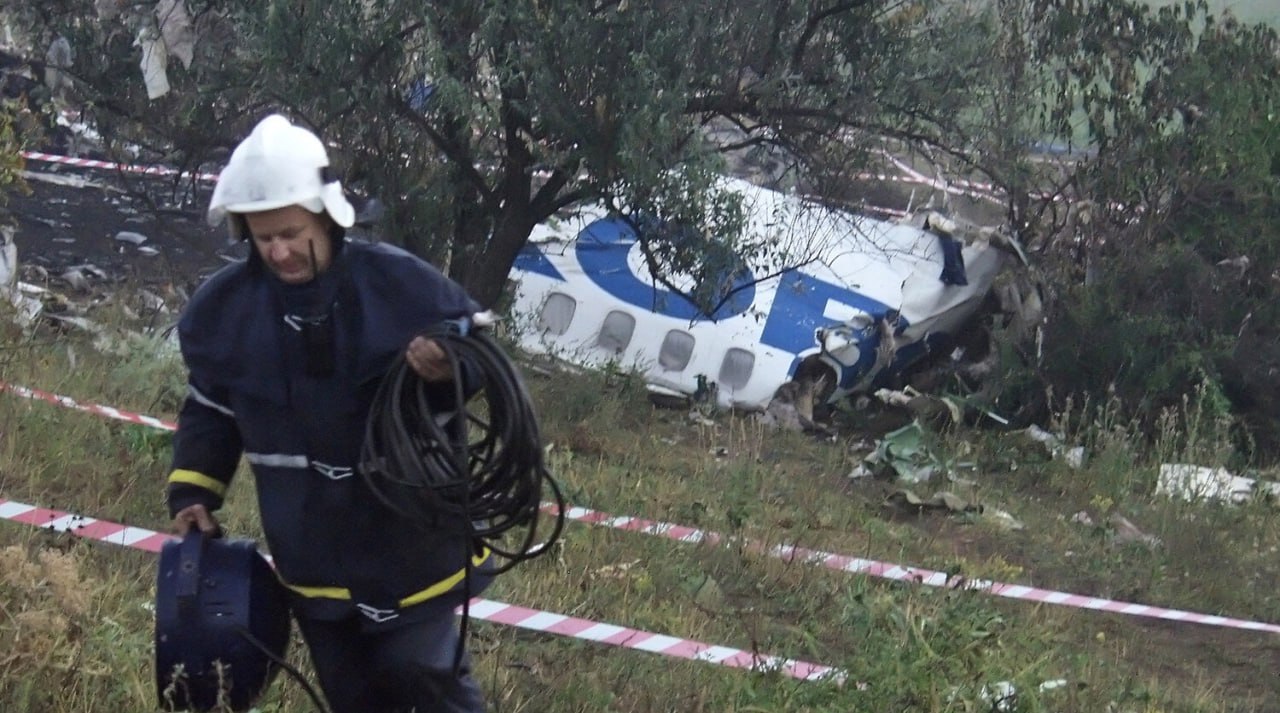
The Tu-154 crashed into the ground at high speed near the village of Sukhaya Balka in the Donetsk region. The fuel tanks exploded on impact, and the fuselage broke into pieces. There were no survivors.

Ukraine declared August 23 a day of mourning, and celebrations for Ukraine's Independence Day (August 24) were canceled. In Russia, a day of mourning was declared on August 24.

The cause of the crash was the aircraft entering a stall due to exceeding critical angles of attack while in manual flight mode, followed by a flat spin and a high-vertical-speed collision with the ground. The crew allowed the aircraft to pitch oscillate and exceed operational angles of attack while avoiding thunderstorm activity and turbulence.

Such scenarios were not practiced due to the lack of suitable simulators and corresponding recommendations in the flight operations manual and training program. The situation became critical due to the lack of airspeed monitoring and non-compliance with the flight operations manual's instructions to prevent the aircraft from entering a stall, exacerbated by poor crew coordination.
Post #42 319
​​When the aircraft entered the thunderstorm front, accompanied by moderate turbulence, there were fluctuations in vertical g-forces and angles of attack and bank. The crew continued flying at a speed below the recommended (450 km/h). It seems the captain understood that further altitude gain would narrow the range of speeds for piloting, increase the likelihood of oscillations, especially in turbulence, reduce the margin for angle of attack, and decrease the available engine thrust. Yet, he aimed to escape the storm, so he ordered to request permission to climb even higher, to 11,900 meters.

CAPT: Let's temporarily go to 400 or something, damn it, or else this is complete crap, yeah. Ask for 390, or we won't make it around.
NAV: Switched.
NAV: "Control," Pulkovo 612.
ATC: Pulkovo 612, go ahead.
CAPT: Increase, yeah.
NAV: Pulkovo 612, request temporary climb to flight level 390.
CAPT: Say it's severe turbulence, etc.
ATC: Pulkovo 612, climb to flight level 390.
NAV: Climbing to flight level 390. Thank you very much, Pulkovo 612.
CAPT: We won't make it there either.
CAPT: 390.
CAPT: Climbing.
CAPT: Where can we escape from them, damn it?
CREW: The storm is below.
CAPT: It's pounding here at 380.
CREW: Also (unintelligible).
CAPT: And here (unintelligible), let's go left.


During the climb, the aircraft was hit by hail. The flight speed dropped, partly due to the activation of the engine anti-icing system. When the aircraft reached the assigned flight level, the crew likely engaged the altitude stabilization mode. The autopilot deflected the elevator for a descent, leading to fluctuations in vertical g-forces. The control column was pulled back, causing an increase in the angle of attack to critical values, triggering the angle of Attack Angle and Aircraft Overload System (AAAOS).

CAPT: Damn, it's pounding hard, f...ck.
CAPT: Hell of a storm, damn it.
CAPT: Oh, damn it, now hail too, damn it.
CAPT: I'm (unintelligible).
CAPT: Can we move somewhere to the side, Igor, move away a bit more.
CAPT: Igor.
CAPT: Igor!
NAV: What?
CAPT: Can we move somewhere else to the side, damn it?
CREW: (unintelligible) No.
CAPT: Tell them we reached 390, Andrey, damn it.
TRAINEE CO: Pulkovo 612, reached flight level 390.
AAAOS sound signal.


Then the crew disengaged the automatic stabilization mode. At this moment, the indicated airspeed was 420 km/h and continued to decrease, and the angle of attack was 6°. The aircraft became unbalanced in the longitudinal and lateral axes, leading to further uncoordinated manual piloting for about 1 minute.

The correct decision, which would have increased the margin for the angle of attack, would have been to initiate a descent, as suggested by one of the crew members (likely the co-pilot) during the next activation of the AAAOS. However, the main danger perceived by the captain was entering the center of thunderstorm activity, which he associated with descending. Therefore, he refused and ordered to set the engines to FLEX mode. Other crew members did not monitor the indicated airspeed, angle of attack, and other flight parameters adequately and did not inform the captain timely when these parameters exceeded the operational limits.

AAAOS sound signal.
CREW: Descending (unintelligible). Angles, angles.
CAPT: Descending where, you damn fools! Damn it.
CAPT: Set nominal on engines.
CREW: Nominal set.
AAAOS sound signal.


The captain tried to dampen the oscillations after disengaging the automation by moving the control column back and forth and keeping the aircraft at the assigned altitude. These unskillful actions, combined with others, led to the development of divergent oscillations in pitch, angle of attack, and g-forces. There was a tendency for the mean angle of attack to shift towards nose-up, resulting in further speed decreasing.
Post #41 282
​​"Andrey, don't panic!" - Crash of Tu-154 near Donetsk

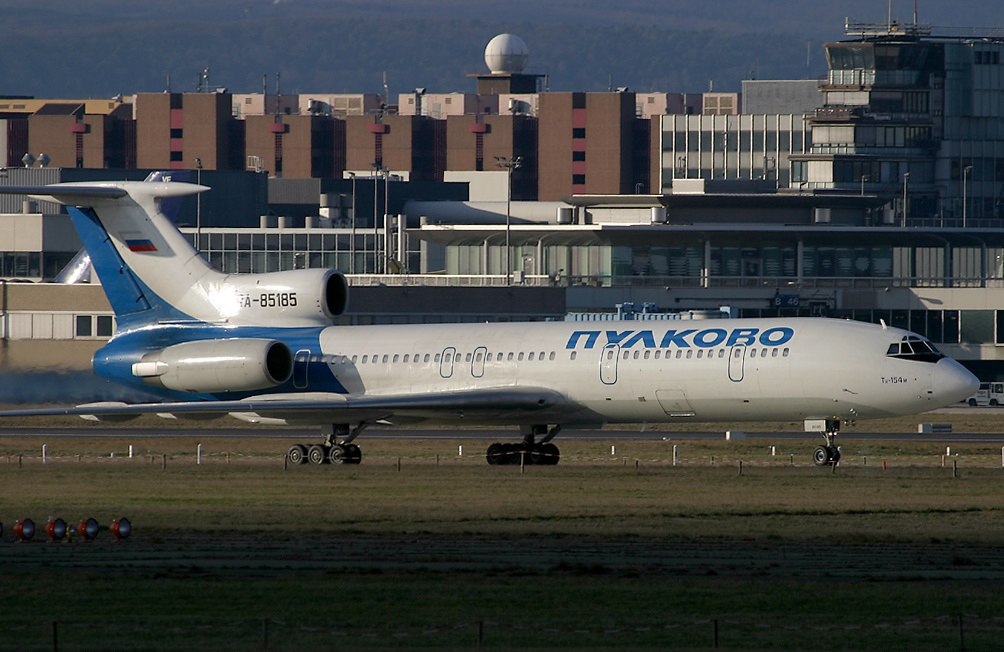
On August 22, 2006, a Tu-154M aircraft of russian Pulkovo Airlines departed from Anapa to Saint Petersburg.

The captain of the aircraft was a very experienced pilot, 49-year-old Ivan Korogodin. He had logged 12,312 flight hours, 5,956 of which were on the Tu-154 (2,349 of those as captain). The co-pilot, 59-year-old Vladimir Onishchenko, had 11,876 flight hours, 2,200 of which were on the Tu-154. Although present in the cockpit, he did not participate in the piloting. On his place, in the right seat, sat the 23-year-old trainee co-pilot Andrey Khodnevich. Also in the cockpit were the navigator, 36-year-old Igor Levchenko, and the flight engineer, 51-year-old Viktor Makarov. In the cabin, 5 flight attendants were serving 160 passengers.

The takeoff was smooth. When the aircraft entered Ukrainian airspace, the Kharkiv controllers did not inform the crew about a thunderstorm ahead on their flight path, approximately 100 kilometers away at the time. As a result, the flight was heading directly towards the thunderstorm front, and the pilots had no information about its size. This prevented the crew from accurately assessing the situation and deciding to change the route.

When the aircraft reached 11,000 meters, the navigator likely realized that the cloud height did not allow the storm to be avoided from above and requested permission from the controller to climb to 11,600 meters. The captain asked to specify the reason: "due to the storm...". The controller granted the permission.

NAV: We need to climb quickly now.
CREW: Set to 90.
CREW: Control will be in twenty (unintelligible).
CREW: (unintelligible)
CAPT: Maintain the mode.
NAV: "Kharkiv-Radar", Pulkovo 612, request climb to FL380.
CAPT: Tell them it's due to the storm.
ATC: Pulkovo 612, proceed to flight level 360 LISPO.
Sound signal.
NAV: Request climb to FL380.
ATC: Pulkovo 612, climb to flight level 380.
FE: (unintelligible) Well (unintelligible).
NAV: Climbing to flight level 380, Pulkovo 612.


The aircraft flew directly into the storm, at an altitude close to the maximum allowable for the aircraft given its current weight and balance (=12,100 meters). At that moment, there were about 50 km left to the storm front, leaving an opportunity to avoid it or return to the departure airport. However, the captain continued the climb on the same path. Later, the commission would find that he had a tendency to take risks, underestimate consequences, and deny negative information.

NAV: (unintelligible) with drops, fu..
CAPT: We need to go higher, probably (unintelligible).
CREW: Oh, Andrey got scared.
CREW: (laughter)
CREW: Andrey
CREW: It looks light now.
CREW: It's fine.
NAV: From above here (unintelligible).


According to the flight operations manual, the altitude clearance when avoiding thunderstorms from above should be not less than 500 meters, which was not ensured at the current flight level. Apparently, realizing this, the crew requested permission to bypass the storm from the left. The controller granted permission, but by this time, the storm core was already directly on the aircraft's flight path. The crew changed route, but this was insufficient to avoid the storm clouds.
Post #40 331
Drunken Captain

January 13, 1977, early morning. Three people arrived by taxi at the airport Anchorage, Alaska. They were the crew members of Douglas DC-8-62F, cargo plane of Japan Air Lines (JAL). The captain was an experienced 53-year–old American Hugh Marsh, the flight engineer and the first officer were young Japanese.

The captain’s condition caused concern to the taxi driver: a glassy stare, a red face, uncoordinated movements and slurred speech were an evidence of alcohol intoxication. When disembarking from the taxi, the pilot almost fell down handing on the car door. The driver reported the pilot's strange behavior to his dispatcher, and he passed the information to an airport agent. He promised that if the intoxication was confirmed, they would take action. But during the pre-flight preparation, no one noticed anything suspicious in the captain’s behavior.

The crew had to fly to Tokyo with a cargo consisting of cattle and two accompanying it workers. Earlier, this DC-8 departed from Moses Lake (USA) and landed in Anchorage around five o’clock in the morning for a crew change and refueling. Captain Hugh Marsh takeover the plane without remarks. During the inspection of the engines, ice was found on their elements, so the crew turned on the anti-icing system.

After all the preparation and checks, according to the instruction of a air traffic controller the aircraft began moving towards runway 24L. However, the captain missed the taxi route and directed the plane to runway 24R. Then he reported being ready for takeoff. Only after the controller’s remark he realized the mistake and taxied to the left runway. After receiving permission to take off, the plane started the take-off roll.

Everything went smoothly at first. However, after the rotation from the runway, an unusual noise appeared in the cockpit. It was caused by a strong vibration of the aircraft before going into stall. The airspeed reached 303 km/h, after which it began to fall. The plane climbed to 48 meters height and, entering the left bank, began to rapidly lose altitude. After hitting the ground, the plane skidded along, crossed an access road, crashed into a hill and completely collapsed. All 5 people on board were killed.

During the investigation, it was found that icing could have been one of the causes of the disaster. The ice formed on the wings during the previous landing and parking noticeably worsened the airplane’s aerodynamic characteristics that reduced lift.

However, even in this case, the disaster could have been avoided in case of current captain’s actions. During takeoff, he began to raise the nose of the plane too steeply. Together with icing, this led to a disruption of the air flow. When there was stickshaking, captain was unable to recognize the stall and take the necessary actions.

A medical examination helped to clarify the reasons of that crash. A blood test of the captain showed that the alcohol content in him reached 298 mg/100 ml. Later tests established a lower value — 210 mg/100 ml. At the same time, according to the laws of the state of Alaska, the car driver was considered drunk if the blood alcohol content exceeded 100 mg/100 ml (~ 1 ppm). Thus, the suspicion of the taxi driver was confirmed: the captain was drunk and he could not physically and judiciously perform that flight.

A concomitant factor of the disaster was the inaction of the rest of the crew. Young first officer and flight engineer did not object to the captain, despite the fact that he was in an inadequate condition and poorly aware of his actions. After all, he was older than them and had much more experience. Thus, reverence for age and high authority played a fatal role and led to tragedy.
Post #39 461
​​Uncontrolled increase in the speed of rotation

On October 22, 1962, Douglas DC-7CF equipped with 4 piston engines and operated by Northwest Airlines, chartered by the US Department of Defense, was flying from McCord Air Force Base (Washington State) to Elmendorf Air Force Base (Alaska). It was a passenger flight carrying military personnel and their family members. There were 7 crew members and 95 passengers on board.

After departure, the plane was flying in clouds for about two hours. Icing from low to moderate was observed there. When the crew decided to change the flight level from 4.2 kilometers to 6.1 kilometers, they had to increase the engine power to takeoff thrust, as ice deposits appeared on the fuselage.

Having reached the assigned altitude, the flight engineer began to reduce the power of the engines. When he tried to do it with the inner left engine, he suddenly understood that its thrust dropped by half, and then to idle mode. The flight engineer thought that the carburetor icing was the reason of the strange engine behavior. In order to defrost it, he used ethanol injection, then heating, and then both options simultaneously. Finally, he applied emergency fuel enrichment. Nothing helped.

Half a minute after the malfunction occurred, the flight engineer discovered that the propeller of the faulty engine suddenly began to increase the rotation speed above the permissible one. They tried to deflect the screw, that is, to move the blades to a position where they would not create resistance. Meanwhile, the speed of the aircraft dropped, and the propeller continued to rotate faster and faster. In addition, due to the rapid rotation, the oil level began to drop sharply.

The captain declared an emergency and began to descend. Since there were no airports nearby, ditching into the Pacific Ocean was considered as the main option. When the plane descended to 150 meters height above the water, the crew discovered that the front part of the engine with a faulty propeller had turned cherry red due to heating. Moreover, metal particles began to fly away from it.

It was impossible to waste time. The pilots extended flaps and began to descend into the water. The touch happened at a speed of 176 km/h and was quite smooth. In general, the landing was successful, the aircraft looked outwardly intact, except for bent propeller blades. The crew immediately began the evacuation. In five minutes, all passengers and crew members plunged into inflatable rafts, from which they were soon removed by rescuers. No one was died. The aircraft remained above the water level for about 24 minutes. Then it sank at a depth of 76 meters.

The investigation found that the left internal engine failed due to component failure in the two-speed drive supercharger assembly. According to the flight manuals, in the event of such a failure, it is necessary to seal the screw as soon as possible to avoid further destruction of the engine. But the crew considered that the malfunction was caused by icing due to flying in the clouds, so they fluted the propeller when it was too late. This led to an uncontrolled increase in the speed of rotation of the propeller.

The decision to land an airplane with a collapsing engine on water was recognized as the only correct one. The members of the investigation recognized the actions of the flight crew in the ditching and further evacuation, as a result of which no one died, as an outstanding achievement. The successful outcome was facilitated by almost ideal weather conditions and a flat sea surface. A positive role was also played by the fact that the passengers were military people, who clearly and timely carried out the crew's instructions.
Post #38 431
​​The engine of the largest passenger aircraft collapsed in the air

September 30, 2017. Paris, Charles de Gaulle Airport.
10:30 a.m. local time.


A huge white-colored Airbus A380 operated by Air France was preparing to perform a long-haul flight from Paris to Los Angeles (USA). The airplane would have to fly for almost 12 hours and it would be operated by an enhanced and very experienced flight crew consisting of three pilots and 21 cabin crew members. A thorough pre-flight maintenance check had not revealed any malfunctions and the aircraft was allowed to fly this route. At 10:50 a.m. the giant airplane took off from its native airport in the direction to the west.

It was the fifth hour of the flight. Some of the passengers had been sleeping for a long time and someone was enjoying the beautiful views outside. The plane was flying along the southern shores of Greenland over the Atlantic Ocean and there were many places to admire.

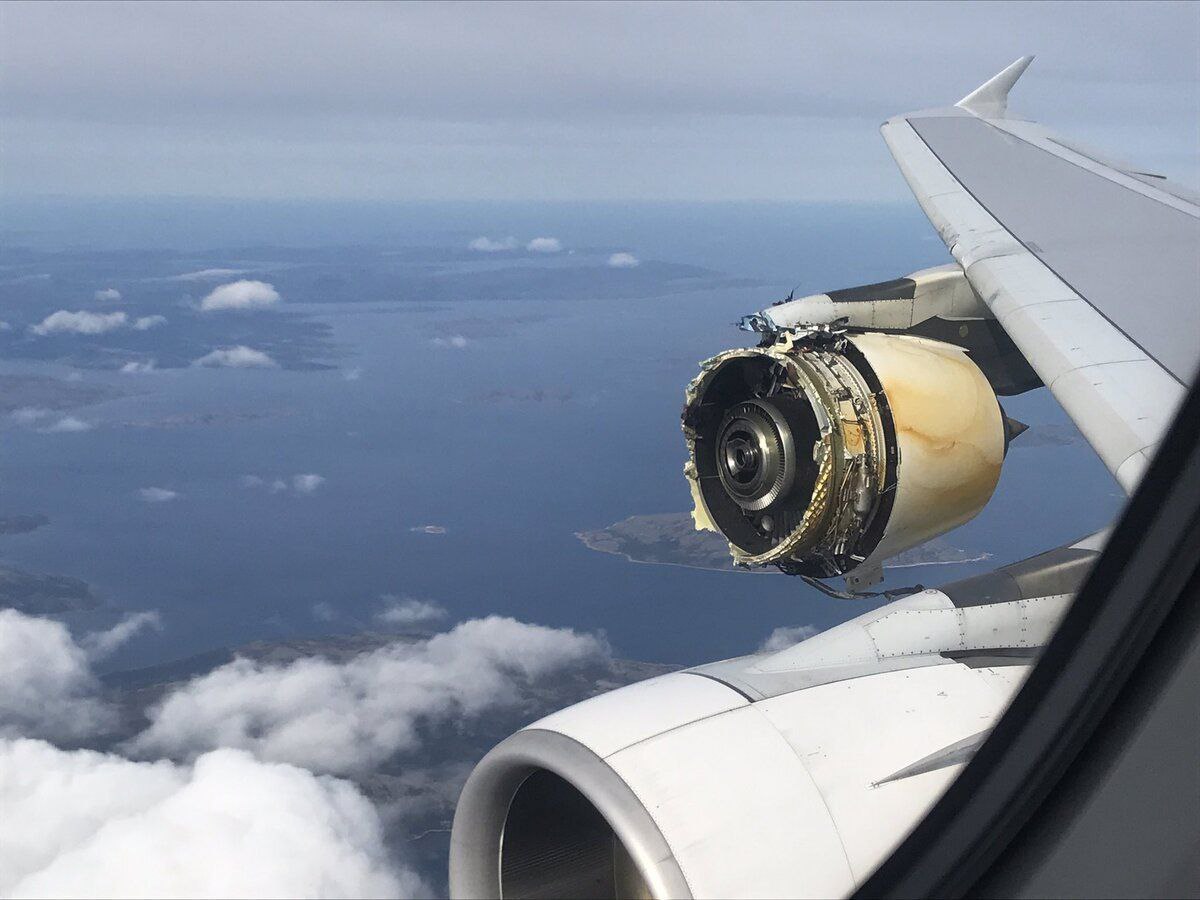
Suddenly the passengers heard a loud bang. The plane began rocking and people sitting on the right side of the cabin saw something they would rather never see in their lives. They have remembered the picture forever – a part of one engine fell off. The flight attendants tried to calm down the passengers. Soon the voice of 60-year-old captain David Wallsworth was heard via the internal communication. During his career, he accumulated over 19,500 flight hours and was considered one of the most experienced pilots in the airline. He told passengers to remain calm and assured that he and his crew were preparing the plane for an emergency landing.

2 hours later, the giant airplane successfully landed at the Canadian military base Goose Bay. No one among 521 people on board was injured. The new problem appeared: the small airfield was not designed to accommodate such a large number of guests, so passengers were forbidden to leave their seats. The next morning, two other Air France planes arrived at the base and took all the passengers to the point of their final destination.

The French Bureau of Investigation and Analysis of Civil Aviation Safety (BEA), together with representatives of the Airbus concern and investigators from Denmark, the USA and Canada, took part in clarifying the causes of the incident. It was almost immediately established that the uncontrolled failure of engine No. 4 occurred due to the destruction of the fan of this engine, which caused the air intake detaching and falling down to the ground. 6 days after the incident, the wreckage of the engine was discovered in Greenland.

The BEA stated that "the recovery of missing parts, especially fragments of the fan hub, is key to the investigation." The missing part weighing 150 kilograms was discovered only in July 2019. After conducting all the tests and researches, on September 27, 2020, BEA stated in its final report that engine No. 4 failed due to low-temperature fatigue failure of the part. Even during the research, the Engine Alliance manufacturing company informed the Airbus A380 operating airlines about an imminent engine inspection campaign.

In December 2017, the damaged Airbus A380-861 (F-HPJE) flew from Goose Bay Air Base to Charles de Gaulle Airport using four operative engines. The damaged engine No. 4 was brought to the UK for repair. In January 2018, the F-HPJE returned to the skies and continued to be operated by Air France until the COVID-19 pandemic. In May 2020, the airline had to write off all its A380 fleet. The F-HPJE made its last flight on April 28 from Paris to Tarbes-Lourdes Airport, where it now remains in storage.
Post #37 419
A hole in the floor

On June 8, 1983, the Lockheed L-188C Electra operated by Reeve Aleutian Airways was flying from Cold Bay (Alaska) to Seattle. The 23-year-old aircraft was equipped with four turboprop engines. The flight was over the ocean. There were 5 crew members and 10 passengers on board.

Right after departure, when the plane reached 7,600 meters, the crew felt an uncommon vibration and a strange noise. Flight engineer checked engines through the windows in the cabin, but found nothing unusual. Level of vibration was increasing. Pilots' steering wheels began shacking and flight crew decided to return to the departure airport. Flight attendant looked out of the window and saw that the propeller of engine №4 had separated. It also ripped the bottom of the plane causing explosive depressurization. There was a hole in the floor providing a view of the ocean below.

Airplane was getting filled with the thick fog because of rapid air temperature and pressure changes. Soon the fog disappeared and the pilots discovered that aircraft was making a right turn on its own. Attempts to level off the aircraft were unsuccessful because both steering wheels did not move. Captain engaged the autopilot and the plane suddenly leveled off. Pilots started to descend to 3000 meters with the assistance of autopilot and at the same time they understood that engine power did not reduce by moving the throttles. In addition, trying to make a right turn the aircraft abruptly went into huge overloads. Only one action remained: flying in one direction, moving away from the shore.

Crew declared an emergency situation. At an altitude of 3,000 meters, the first officer was able to turn the steering wheel to the right and the plane began rolling. As it was impossible to reduce speed, the crew began to search for the longest runway in the area. The pilots considered a ditching but an air traffic controller suggested them fly to Anchorage with 3,200-meter-long runway. The distance to Anchorage was long, there were many high mountains in the vicinity and weather was unpredictable, but it was safer than ditching. That’s why captain agreed.

All emergency services in Anchorage had been informed beforehand and properly prepared for the distress traffic. Captain disengaged the autopilot and the first officer discovered that he could partially control the aircraft manually. In order to reduce the speed before landing, crew shut off the engine №2. At the moment before touching down captain realized that speed was too high and decided to go around. Pilots started the second approach from a height of 240 meter in order not to exceed the speed. After touching down, both remaining engines were shut down and aborted landing became totally impossible. Due to the emergency brakes, one of the landing gears caught fire. The plane lost control and veered off the runway. Luckily no one was injured in the incident.

The investigation failed to determine the cause of the propeller separation in flight. Control problems appeared due to the damage to the floor of the cabin, where the control cables were located. Explosive decompression bent the fuselage. As a result, the control cables were clamped and blocked. The autopilot's hydraulics pulled the cables with greater force, which is why it could partially control the aircraft. Pilots made much effort to move the both steering wheels. As a result, the manual control cables cut channels in the debris that clamped them and began to move. Thus, at the final stage of the flight, manual control was partially resumed.

Captain, first officer and flight engineer received awards. The captain continued his flying career until the age of retirement.
YouTube Lockheed Electra emergency landing #aircraft #aviation #landing
Post #35 399
​​Boeing 727 pilot attempted to land on a highway

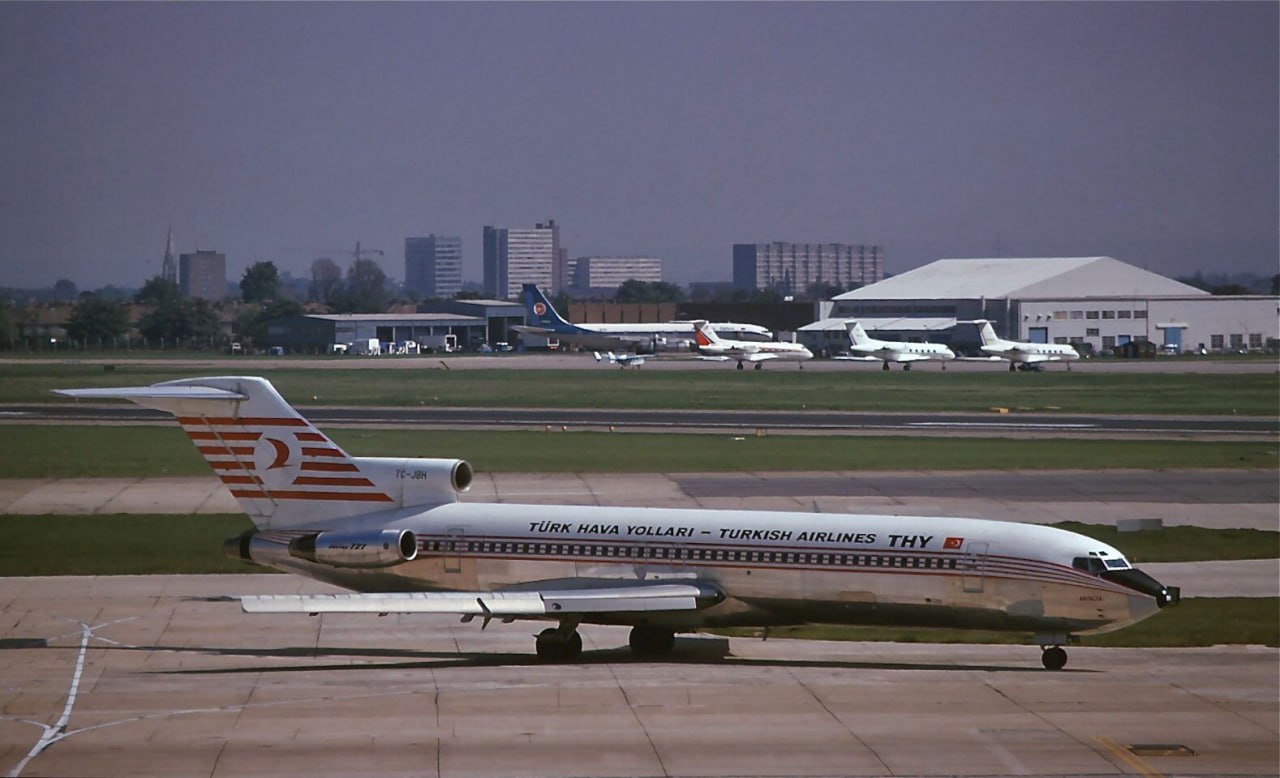
On the evening of September 19, 1976, Boeing 727-2F2 aircraft belonging to Turkish Airlines was operating a flight from Istanbul to Antalya. There were 8 crew members and 146 passengers on board.

Aircraft was being piloted by the first officer. Also in the cockpit were captain, flight engineer and technician. At some point, captain left the cockpit. The first officer saw lights ahead of the Turkish city Isparta. He assumed that the aircraft was already approaching its destination – Antalya. Pilot contacted the airport dispatcher and requested a straight-in approach for landing. Subsequently, without permission from the absent captain, he began descending.

During the descent, pilot switched from instrument to visual flight. Shortly after, the airport tower dispatcher informed that the aircraft was neither visually observed nor on radar. However, at 4000 meters above ground, the first officer saw runway lights and began a visual approach for landing. He then responded to controller: "Should I believe you or my own eyes?"

Aircraft was 150 meters above ground when the captain entered the cockpit. He horrifiedly discovered that the plane was descending onto a busy highway in Isparta. The first officer mistook the lights on this highway for those of the runway. Pilots pulled the controls back and set the engines to takeoff thurst... But it was too late. Systems responded too slowly, causing the aircraft unable to gain altitude. It struck a hill with its right wing, then crashed into the ground and completely destroyed. All 154 people on board died.

The sequence of events was reconstructed thanks to the "black box" recordings. Investigators found that the first officer, instead of strictly flying by instruments as required at night, switched to visual flight. Crew believed that dark area in front of the aircraft was Mediterranean Sea, but it was actually mountains. Additionally, crew mistakenly identified city lights of Isparta as those of Antalya. Furthermore, three days before the crash, system informing pilots of the aircraft's distance to Antalya airport malfunctioned, which contributed to the disaster.
Post #34 377
Miracle over Athens and the ground effect

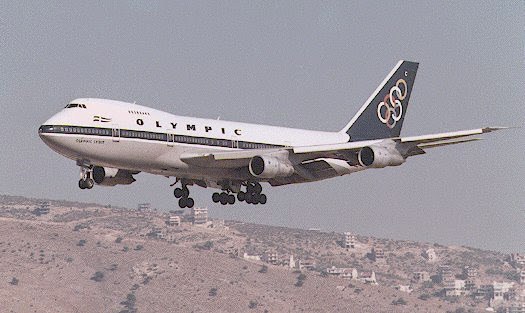
On August 9, 1978, a Boeing 747 of Greek airline Olympic Airways was preparing for an intercontinental flight from Athens to New York. On board the "Queen of the Skies" were 400 passengers and 18 crew members. Experienced commander Sifis Migadis was at the controls during takeoff.

It was +43°C outside. On such a hot day, the air is less dense, requiring the aircraft to achieve a higher speed for a safe takeoff. The upcoming flight was long, so the airliner was loaded with fuel to the brim, and the takeoff weight was slightly below the maximum allowed. For a successful takeoff, Boeing would need full thrust from all engines, but due to technical reasons, engine No. 2 couldn't produce maximum power.

Another problem was that at full thrust, engines began to overheat, which could lead to their destruction. Therefore, they were equipped with an engine cooling system, controlled by the flight engineer. The system took several minutes to engage, and its operation required increased attention to the engine parameters. However, many crews were unfamiliar with it.

Upon the commander's order, flight engineer activates the cooling system before the takeoff roll begins. Heavy machine starts gaining speed. Boeing reaches decision speed (V1), and captain gives the command for takeoff. Immediately afterward, engine No. 3 fails and begins to disintegrate. It's too late to abort the takeoff, and aircraft, with three engines running (one of which is not producing full power), lifts off. Reaching an altitude of 11 meters, the airliner can't climb higher and flies directly over the rooftops of Athenian houses.

In such a situation, the landing gear cannot be retracted, as the flaps may provide additional resistance, but crew violates the procedure and retracts them. Flight engineer checks the operation of the cooling system but inadvertently disables it completely in the chaos. Maintaining the minimum permissible speed of 290 km/h, captain manages to climb to 64 meters, but flying over the center of Athens, airliner descends to 55 meters. Then pilots notice that the plane is heading straight towards a 60-meter hill. Captain can't turn, as such a maneuver would reduce the speed and altitude of the aircraft. Pitching up is also not an option, as the aircraft is already on the verge of stalling, and any further loss of speed will lead to a crash.

Nevertheless, by sacrificing speed at the last moment, captain manages to pull up the aircraft, clearing the hill with just three meters to spare. Speed is now well below the minimum permissible, but somehow, the aircraft miraculously stays airborne. Most likely, the reason was the "ground effect": an air cushion formed between the wing and the ground, which kept the aircraft aloft. Meanwhile, passengers suspect nothing and believe that flying at low altitude was planned for them to enjoy the sights of Athens. Pilots realize they can't hold out like this for long and need to land urgently.

Aircraft flies farther from the city, and temperature drops to 38°C. Engines cool down slightly and provide more thrust. Flight engineer finally activates the engine cooling system, and they start running at full power. Airliner gains a speed at which maneuvering and climbing higher become possible. Crew turns towards a valley leading to the sea to dump fuel. Half an hour later, the aircraft lands safely at the airport.

An investigation conducted by Boeing showed that the reason for the loss of thrust was the unintentional shutdown of the water pump in the engine cooling system. The company couldn't believe that the aircraft, at a speed of 158 knots (292 km/h) instead of the required 180 (333 km/h), managed to stay in the air and not crash. They attempted to recreate the situation on flight simulators, but the aircraft crashed every time. The exact cause of the engine No. 3 failure could not be determined.

On the same day, captain Migadis and all the passengers eventually completed the flight to New York on another aircraft.
Post #33 349
Mid-air collision of giants

On November 12, 1996, the traffic flow in Indian airspace over Delhi was overloaded. Only one arrival route was used for approaching the airport, so the air traffic controllers had to separate arriving and departing aircrafts by their altitudes.

The Kazakhstan Airlines Ilyushin Il-76TD was flying from Shymkent to Delhi. There were 27 passengers on board, including tourists, and 10 crew members. The air traffic controller instructed the crew to descend to FL150 (about 4,570 meters) and informed about Boeing 747 flying towards, 300 meters below. It was an airplane of Saudi Arabian Airlines just departed from Delhi heading to Saudi Arabia. There were 312 people on board, including 23 crew members. Boeing crew received an instruction to maintain FL140 (about 4260 meters).

The radars of air traffic control services at Delhi Airport did not display the current altitude of the planes. At the moment the controller saw the potential intersection of the routes of two airplanes, he expected that they would continue moving in different directions. But suddenly both dots on his monitor disappeared at the point of intersection.

Soon, the pilot of American military aircraft flying nearby contacted the controller and reported the following:

"We saw something to our right, looks like a big fireball something... looks like a big explosion."

The controller tried to reestablish communication with Il-76TD and Boeing 747, but there was no answer, only silence. The American crew transmitted:

"We see two fires trying to break to our right about 44 miles to your north west... passing through, we saw a big fireball in the cloud and I saw fire debris; Two distinct fires on the ground"

It was obvious that a collision had already occurred. The planes crashed at the distance of 74 kilometers from the airport. Rescuers found no survivors. In total 349 people died.

The specialists investigated that the crew of Il-76 faced difficulties in communications with air traffic controllers. After receiving traffic information (it was about Boeing at FL140), the co-pilot being busy with other duties and listening to the frequency inattentively, got the wrong meaning of this message. He thought they were allowed to descend to FL140. The captain, apparently, perceived it in the same way and did not interfere with the control. The navigator also did not react to the continued descent. The radio operator knew the correct altitude, but from his seat in the cockpit he could not constantly monitor the actions of the pilots and indication of flight instruments.

Later the captain asked the crew at what altitude they must be. This confirmed that he wasn’t aware of the situation. The flight engineer added the misunderstanding by reporting that it was necessary to maintain FL140. The radio operator, however, immediately told: "maintain FL150, do not descend".

Just four seconds before the collision happened, the radio operator understood that the plane was at the wrong flight level and shouted that it was necessary to climb immediately to FL150. IL-76 had started to climb, but it was too late. Most likely, both planes were in the clouds and the crews did not have visual contact until the moment of the collision.

As other circumstances also contributed to the disaster was the fact that a secondary surveillance radar, which provides air traffic controllers with information about the height of aircraft, wasn’t installed at Delhi Airport. In addition, there was no aircraft collision warning system on both planes.

As a result of the investigation, some recommendations were issued. Firstly, improving the ATC procedures in the airspace around Delhi. Secondly, improving the airport infrastructure. Thirdly, since that time the messages about other planes (traffic information) do not contain the altitude or flight level of this plane in order to prevent the possible misunderstanding.
Post #32 330
​​"Shall we play dump and make an approach?"

Investigation

The investigation commission identified two main causes of the incident. The first was the repeated disregard by the crew of wind shear warnings, leading to landing at a great distance and at an increased speed.

From the captain's explanation:
"The erroneous decision to land was made due to an emotional state: I simply didn't hear the wind shear alarm; my body disregarded it as background noise (during the first approach, it worked so loudly and for so long that it interfered with my work and, thus, turned from a danger warning system into unwanted noise)."

The second reason was the landing on a runway whose average coefficient of friction was calculated to be less than 0.3 due to water, which did not allow landing according to the current regulations.

Among the contributing factors were: the use of autopilot and autothrottle in wind shear conditions, late deployment of reverse thrust, inadequate preparation and psychoemotional state of the crew members, insufficient preventive work in the airline following previous cases of crews' untimely response to wind shear warnings, as well as non-compliance by the airport service with requirements for checking the condition of the runway after precipitation.
Post #31 342
​​"Shall we play dump and make an approach?"

Accident

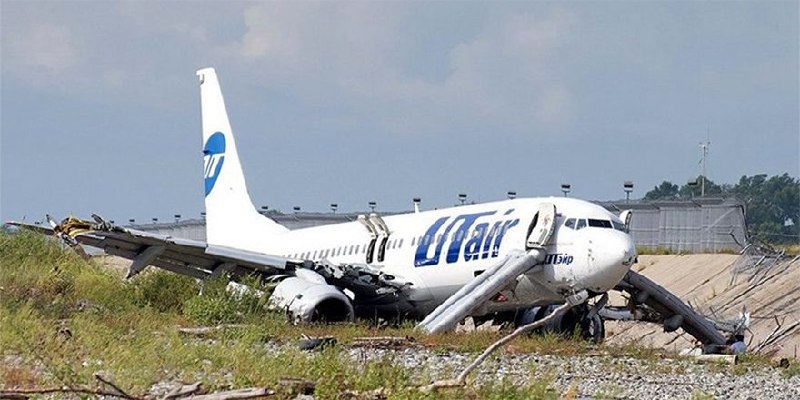
On August 31, 2018, a Boeing 737-800 of UTair airlines was operating a flight from Moscow (Vnukovo) to Adler (Sochi). The aircraft approached Sochi during the night amidst severe weather conditions: thunderstorms, heavy rain, and gusty winds. Some aircraft were unable to land and had to go around. Boeing initiated its landing approach and descended to 700 meters. However, upon receiving updated weather and visibility information at the airport, pilots decided to wait for more favorable conditions and entered a holding pattern.

While in the holding pattern, the crew received further updates on the weather, which remained unsuitable for landing.

After this, the following conversation took place in the cockpit:

Captain: "Shall we play dump and make an approach?"
First Officer: "(so that) we don't have to go around"


After this, the first officer began preparing the aircraft systems for landing. During the approach, when the Boeing was at an altitude of about 260 meters, the "Go around. Wind shear ahead" alarm sounded.

Wind shear is a dangerous weather phenomenon that makes landing very risky. At an altitude of approximately 50 meters, the system signaled an encounter with wind shear. Both times, the crew did not respond to these signals. Only at around 15 meters altitude did the captain initiate a go-around, as the pilots were unable to see the runway due to the rain.

According to the investigation, the decision to go around became stressful for the crew, and they were in a "suboptimal working state." This was evidenced by the difficulties the pilots encountered in engaging the autopilot. Additionally, after its re-engagement, the crew repeatedly changed its modes. Furthermore, the first officer forgot to retract the flaps, although he informed the captain that he had done so.

During the climb, the crew expressed their opinion about the meteorological conditions at the airport:

First Officer: "So, damn, trying to land in such crap in Sochi, damn, forget it, damn it?"
Captain: "Fuck it."
First Officer: "Yeah."
Captain: "Absolutely nothing could be seen there."
First Officer: "Yeah."
Captain: "Absolutely, damn it, nothing."


However, despite this dialogue, the crew decided to attempt another landing. As they approached the runway again, the "Go around. Wind shear ahead" alarm sounded once more. Approximately a minute later, the wind shifted, turning from headwind to tailwind. At that moment, the captain switched to manual control and disengaged the autothrottle before it could reduce engine power due to the changed conditions. As a result, the aircraft's speed began to increase, and the rate of descent decreased. Consequently, the Boeing landed 1285 meters beyond the runway threshold, overshooting by 385 meters.

After touchdown, the first officer reported the activation of reverse thrust, although it was actually engaged only 16 seconds later. The crew applied maximum manual braking. Nevertheless, 26 seconds after landing, the aircraft, at a speed of 140 km/h, rolled off the runway, broke through the airport fence, and stopped in the bed of the Mzymta River. Subsequently, a fuel fire occurred, leaking from the damaged left wing fuel tank. The crew conducted passenger evacuation. The fire was soon extinguished by arriving services. Eighteen people were injured onboard as a result of the incident. Additionally, during passenger rescue, an airport employee died of a heart attack. The aircraft sustained serious damage.
Post #30 391
​​The passenger spent the entire flight hanging upside down outside the aircraft

On October 13, 1977, a Yak-40K (K - convertible modification for cargo-passenger transportation) operated by Aeroflot was flying from Rostov-on-Don to Nikolaev. There were 22 people on board: 18 passengers and 4 crew members.

The aircraft took off and began to climb. When it reached an altitude of 250-300 meters, the cargo hatch, located at the front of the aircraft, suddenly opened. Upon opening, it was caught by the rushing airflow in the upper position. Two rows of seats (second and third) were attached to the hatch. They were immediately torn from their mounts and pulled outside along with the passengers. There, they flipped over and hung almost upside down on the hatch.

In the third row sat a woman and her six-year-old son. The child's seatbelt was adjusted for an adult, and the mother's seatbelt was fastened with a non-standard bolt that came loose from its attachment. Therefore, they both fell from their seats and died. The man sitting in the second row managed to stay in his seat and ended up hanging upside down.

The crew reported the emergency to the ground and began the approach for landing. When the aircraft touched down and slowed down, the rushing airflow also decreased, causing the cargo hatch to descend. The passengers were able to pull the man hanging on it inside and provide assistance to him. Except for the mother and child from the third row, no one else on board died.

During the investigation, it was found that the day before, the aircraft had operated a cargo flight, during which the passenger seats had been removed. The aircraft modification allowed for such operation. After the cargo flight, maintenance staff at Rostov airport converted the aircraft back to the passenger configuration and installed seats in the cabin.

However, after completing the work, the technicians did not check the reliability of the cargo hatch closure and did not monitor it through the cockpit warning system. The aircraft mechanic also did not check the hatch closure position or the warning system before takeoff. The captain and the firs officer only visually inspected the cargo hatch cover from the outside and did not notice anything. As a result, during the flight at an altitude of 250-300 meters, the pressure difference inside and outside the aircraft pushed the cargo hatch outward.

A year later, the same aircraft had an accident in the Krasnodar region during an emergency landing outside the aerodrome and sustained damage that rendered it unfit for further operation.
Post #29 327
​​Jet Fighter Landed on a Container Ship

Ian Watson - a young British the Royal Navy's pilot - was flying a Sea Harrier, a short take-off and vertical landing/vertical take-off and landing jet fighter.

On June 6, 1983, NATO conducted exercises in the Atlantic Ocean. They were held jointly with the British aircraft carrier "HMS Illustrious" which was off the coast of Portugal. Taking off from the carrier deck, a pair of fighters, one piloted by Watson, were tasked with locating a French aircraft carrier while operating in radio silence and with radar off. When the mission was completed, Watson was ordered to return to the carrier HMS Illustrious. At that moment, for unknown reasons, his aircraft experienced a failure in its navigation and radio equipment. As a result, he became disoriented and couldn't find his carrier.

With fuel running critically low, Watson headed towards the nearest shipping lane. He managed to establish visual contact with the container ship "Alraigo." Realizing he couldn't make it back to the carrier and that fuel was about to run out, he decided to eject within the ship's sight, hoping for rescue by the crew. Suddenly, he noticed that the containers on the ship formed a flat surface suitable for vertical landing. The "Alraigo" was carrying a support plate for one of the telescopes of the Isaac Newton group in the Canary Islands. Finding no other way out, Watson landed his aircraft on one of these containers.

Immediately after touchdown, the fighter began sliding down the stack of containers. Watson attempted to stop the slide by raising the fighter's landing gear, but it didn't help. Moments later, the aircraft collided with a van parked on the deck and froze in a ludicrous position. Exactly 4 days later, still in the same position, the fighter arrived in Santa Cruz de Tenerife, Spain. The aircraft was repaired, and the crew and owners of the container ship received compensation of around $700,000.

The investigation commission found that Watson had completed only 75% of his training before being sent to sea. The British government blamed the pilot for inexperience and criticized his commanding officers for allowing an airworthiness issue with the aircraft. The pilot received a severe reprimand and was transferred to office duty. Later, he returned to the sky and amassed nearly 3000 hours of flight time before retiring in 1996. As for the fighter, after the incident, it was upgraded to the FA2 version and operated until September 2003. Currently, this aircraft is exhibited at the Newark Air Museum in England.
Post #28 335
​​Two captains and An-124 crash in Italy

On October 8, 1996, the Antonov An-124-100 transport aircraft of Aeroflot Airlines was performing a commercial cargo flight Moscow (Russia) - Turin (Italy) - Bandar Seri Begawan (Brunei). There were 23 crew members on board. There were two captains in the cockpit, one of whom (the captain of the alternate crew) was acting as the first officer. The first part of the route (Moscow-Turin) was a night flight without loading. Then, in Turin, several "Ferrari" cars were supposed to be loaded, which were the commercial cargo for the flight to Brunei.

At 10:25, the plane began its descent to Turin. At this time, repair work was being carried out on the runway. The length of Turin airport's runway was reduced from 3300 to 2350 meters (the threshold was moved by 950 meters). However, the crew had been previously informed of the runway's shortening by 1300 meters. Due to the repair works, the instrument landing system was only operating in the beacon mode. The weather conditions were poor but above the airport's minimums. The visibility on the runway was 1500 meters in light rain and low cloud cover. Upon emerging from the clouds, the aircraft found itself further than expected from the runway threshold, and the altitude was also higher than calculated.

Believing that there wouldn't be enough runway left for a safe landing, the first officer insisted on going around for another approach, while the pilot-in-command decided to land. The aircraft descended over the runway with reduced engine power to a minimum. However, the first officer managed to persuade the pilot-in-command to go around. At that moment, there was less than a meter between the runway surface and the wheels of the landing gear. The captain initiated a go-around and attempted to increase engine power for takeoff. However, due to design flaws in the engine control system and errors by the captain in the procedure, only one of the four engines went into takeoff mode. Pilots repeated the engine control sequence three times, but all efforts were unsuccessful.

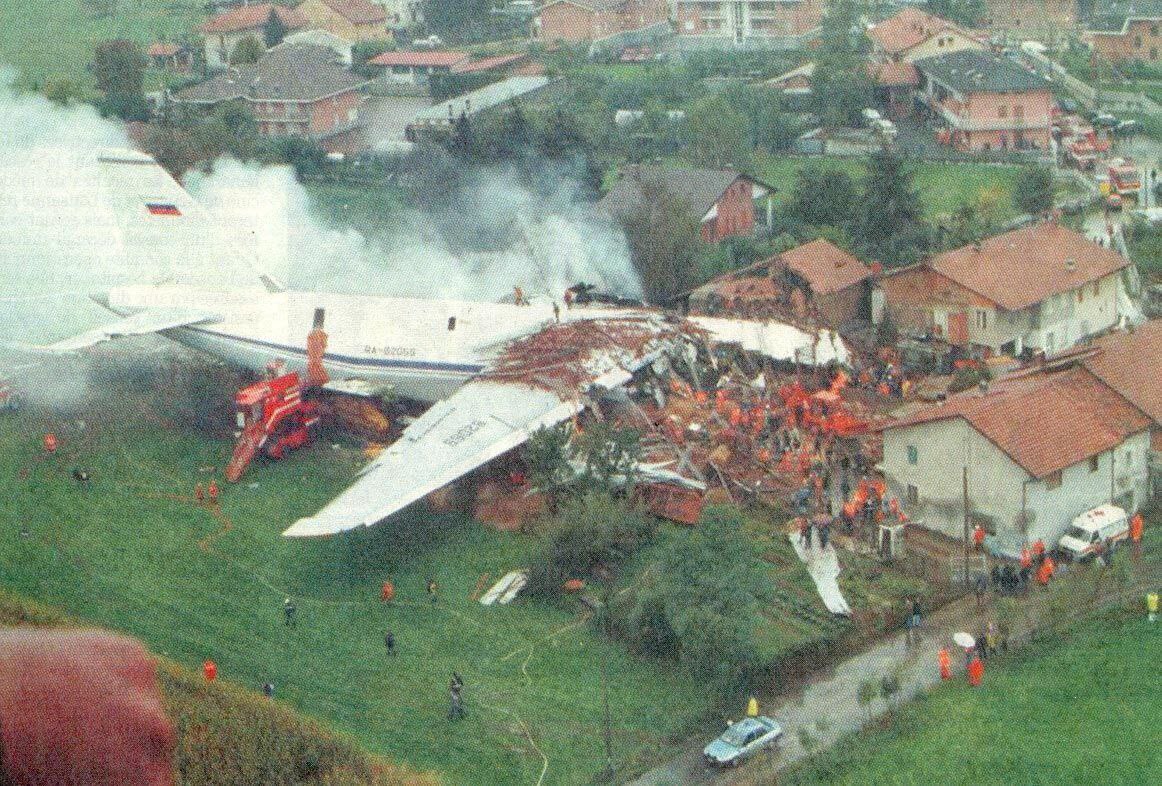
As a result, the aircraft couldn't gain altitude. Approximately one kilometer from the runway at an altitude of 25 meters, the An-124 struck trees. Then it collided with the roof of a two-story building in the town of San Francesco al Campo, crashed to the ground, where it collided nose-first with a farm building and caught fire. Two of the 23 crew members died - the captain and the alternate crew pilot. Thirteen other crew members sustained injuries of varying severity. Additionally, on the ground, two people died, and two others were injured, with one of them later dying in the hospital.

According to the findings of the crash investigation commission, among the causes of the tragedy were insufficient training and poor crew coordination. Secondly, there was poor planning for the approach, delay in deciding to go around, and the captain's indecision. Also, design flaws in the engine control system played a fatal role.
Post #25 1.88K
​​Too transparent ice

On December 27, 1991, a McDonnell Douglas MD-81 aircraft operated by Scandinavian Airlines System (SAS) was flying from Stockholm to Copenhagen. There were 129 people on board, including 123 passengers and 6 crew members. The aircraft was treated with anti-icing fluid before takeoff. However, after inspecting the plane, the captain asked for the procedure to be repeated, which was done. Also, the pilots left the cockpit door open out of habit.

Twenty-five seconds after takeoff, when the plane was at an altitude of about 350 meters, strong vibrations, jolts, and bangs appeared from the direction of engine No. 2 (right). Suspecting compressor surge, the captain reduced its thrust. However, at 76 seconds into the flight, when the plane was at an altitude of about 900 meters, engine No. 2 stopped. A few seconds later, engine No. 1 also stopped. The pilots tried to restart it, but it caught fire, so the fire extinguishing system was activated.

At that time, a 46-year-old captain of SAS was a passenger in the cabin. Through the open door, he saw that his colleagues were having problems. Then he entered the cockpit and offered his assistance. At the commander's direction, he activated the auxiliary power unit and helped release the flaps. At first, the crew planned to return to Stockholm, but they obviously didn't have enough altitude for that maneuver. Then the captain decided to land on the edge of a forest.

At a speed of 193 km/h, the aircraft crashed into the treetops, with its right wing detached. Then the plane turned to the right and a few seconds later, it crashed to the ground, where it was dragged for 110 meters. The fuselage was split into three parts, fuel started leaking from the tanks, but no fire broke out. As a result of the crash, no one was killed. The total number of injuries was 92, of whom 25 suffered serious injuries.

Investigators have concluded that the main culprit of the incident was the airline SAS. It was determined that the compressor surge began due to the ingestion of a large amount of ice from the wings, which damaged the compressor's first-stage blades. Ground services were unable to detect and remove the ice due to its high transparency. Additionally, the airline technicians did not have ladders to inspect the wing from above. At the same time, it was known that MD-81 aircraft were prone to such ice formation. Therefore, the manufacturer sent relevant messages and instructions on how to combat transparent ice to operators several years before the incident. However, SAS did not take the necessary measures.

Another factor in the accident was the Automatic Thrust Restoration (ATR) system. It was supposed to correct the errors of American pilots who reduced engine thrust during takeoff over residential areas. In some cases, the thrust was reduced to the point of stalling. The system was implemented on McDonnell Douglas aircraft shortly before the accident, and SAS was not notified of its existence. Therefore, when the captain reduced the engine thrust in response to the surges, this system restored it again, but the pilots were not aware. As a result, the engines were destroyed, and then a fire broke out.

Investigators concluded that the pilots acted competently and strictly in accordance with instructions. However, the actions of the pilot who entered the cockpit were considered as a violation of the instructions. Nonetheless, the investigation believed that he had a positive influence on the situation's development.

The press called the captain a hero. The Queen of Denmark awarded him the Knight of the Order of Dannebrog, and he received several other awards. However, the incident had an extremely negative impact on him, and he left his pilot career. In turn, the King of Sweden awarded the captain who came to his colleagues' aid with the Royal Medal. He also resigned from the airline several years later. The second pilot continued to work for SAS and eventually became a captain.
Post #24 1.51K
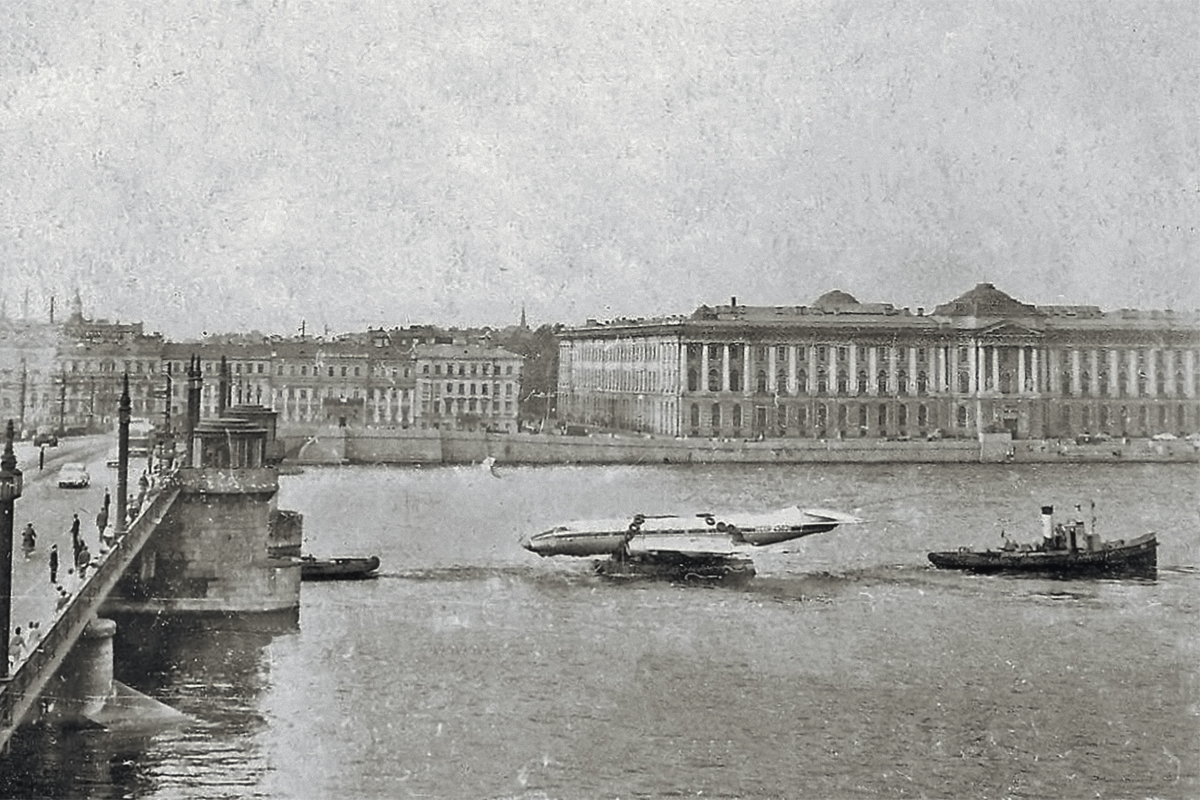
​​The miracle on the Neva river

Investigation

The investigation commission concluded that the main cause of the accident was a malfunction in the landing gear extension and retraction system – a mounting bolt had failed due to poor condition. Similar defective bolts were found in the nose landing gears of seven other Tu-124 aircraft. The exact cause of the engines shutting down could not be determined. Due to punctured fuel tanks and water entering them, it was impossible to determine the remaining fuel at the time of the crash.

One theory suggested that the crew was at fault. There wasn't enough fuel for a normal landing on the runway because the crew had incorrectly calculated the actual fuel consumption and had not taken into account that the flight was at low altitude with the landing gear extended. Moreover, there were contradictions in the crew members' statements. The captain, co-pilot, navigator, and flight engineer disagreed on the engine mode and the exact amount of fuel on board.

According to another theory, there was a failure of the electric fuel gauge. That is, there were readings, but there was no kerosene left. The captain stated that when the engines stopped, the fuel gauge and flow meter showed a remaining 1600 kg. In his opinion, fuel might have still been in the tanks, but for some reason, it was not being supplied to the engines. The co-pilot confirmed this. The flight engineer reported that the red fuel light had come on a few seconds before the engine failure. The navigator explained that the fuel gauge could be inaccurate in either direction, and such observations had already been noted in the aircraft logbook. Since the plane was underwater, it was impossible to determine the instrument's functionality.

The widow of commander Viktor Mostovoy told Izvestia newspaper in an interview that he and his colleagues were nominated for awards (Order of the Red Star), but the award decree was ultimately not signed. Nevertheless, the commander and navigator Viktor Tsaryov received two-room apartments by order of Aeroflot management. Tugboat captain Yuri Porshin was awarded an honorary certificate and a watch.

The aircraft was written off due to the damage. After restoration, it was sent to the Kirsanov Aviation School, where it served as a flight simulator for the students for some time. In 1970, the Tu-124 was dismantled for scrap metal.
Older posts →
Threads Profile ViewerView any public Threads profile without an account.Open ThreadLook →Writing with AI? Make it sound human.Metric37 rewrites AI drafts so they read naturally. Free AI detector, 1,500 words free.Try Metric37 →