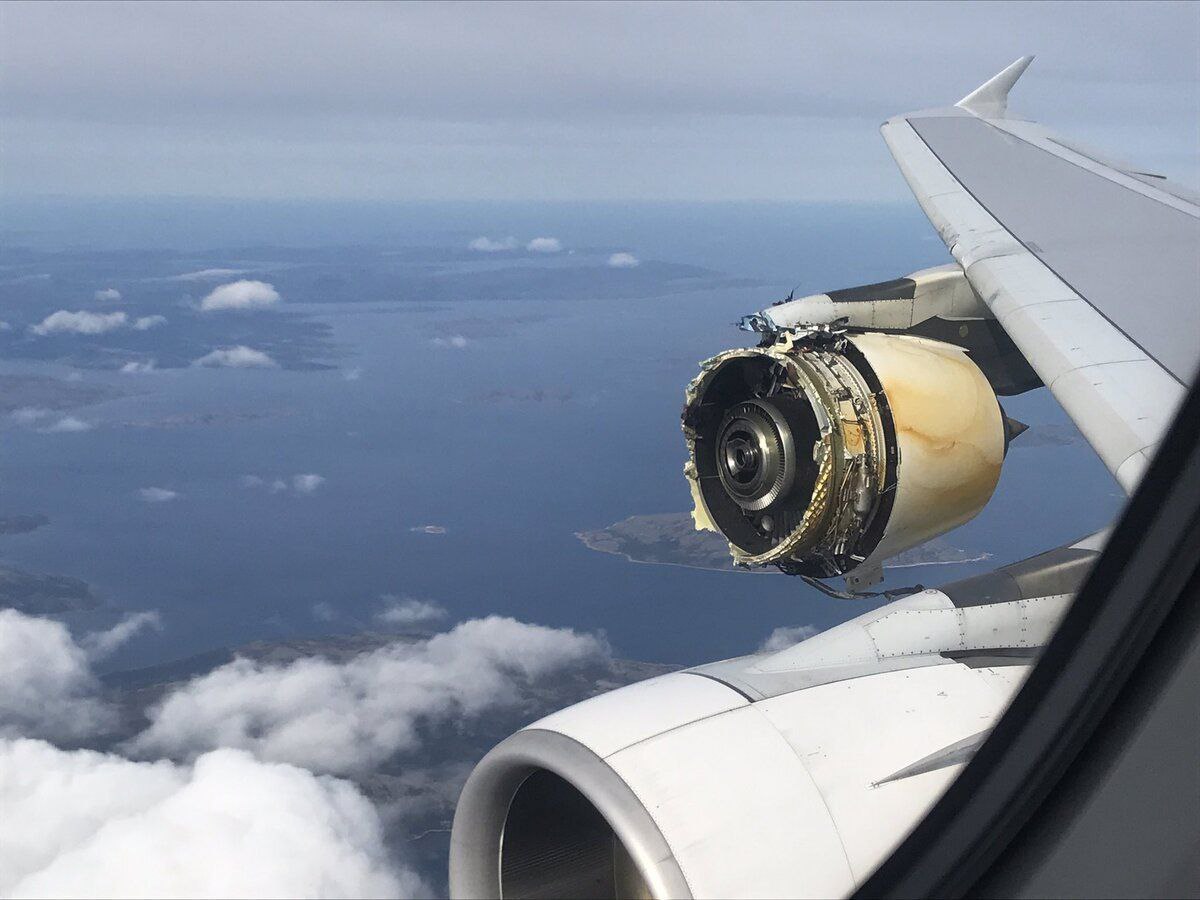
The engine of the largest passenger aircraft collapsed in the air
September 30, 2017. Paris, Charles de Gaulle Airport.
10:30 a.m. local time.
A huge white-colored Airbus A380 operated by Air France was preparing to perform a long-haul flight from Paris to Los Angeles (USA). The airplane would have to fly for almost 12 hours and it would be operated by an enhanced and very experienced flight crew consisting of three pilots and 21 cabin crew members. A thorough pre-flight maintenance check had not revealed any malfunctions and the aircraft was allowed to fly this route. At 10:50 a.m. the giant airplane took off from its native airport in the direction to the west.
It was the fifth hour of the flight. Some of the passengers had been sleeping for a long time and someone was enjoying the beautiful views outside. The plane was flying along the southern shores of Greenland over the Atlantic Ocean and there were many places to admire.
Suddenly the passengers heard a loud bang. The plane began rocking and people sitting on the right side of the cabin saw something they would rather never see in their lives. They have remembered the picture forever – a part of one engine fell off. The flight attendants tried to calm down the passengers. Soon the voice of 60-year-old captain David Wallsworth was heard via the internal communication. During his career, he accumulated over 19,500 flight hours and was considered one of the most experienced pilots in the airline. He told passengers to remain calm and assured that he and his crew were preparing the plane for an emergency landing.
2 hours later, the giant airplane successfully landed at the Canadian military base Goose Bay. No one among 521 people on board was injured. The new problem appeared: the small airfield was not designed to accommodate such a large number of guests, so passengers were forbidden to leave their seats. The next morning, two other Air France planes arrived at the base and took all the passengers to the point of their final destination.
The French Bureau of Investigation and Analysis of Civil Aviation Safety (BEA), together with representatives of the Airbus concern and investigators from Denmark, the USA and Canada, took part in clarifying the causes of the incident. It was almost immediately established that the uncontrolled failure of engine No. 4 occurred due to the destruction of the fan of this engine, which caused the air intake detaching and falling down to the ground. 6 days after the incident, the wreckage of the engine was discovered in Greenland.
The BEA stated that "the recovery of missing parts, especially fragments of the fan hub, is key to the investigation." The missing part weighing 150 kilograms was discovered only in July 2019. After conducting all the tests and researches, on September 27, 2020, BEA stated in its final report that engine No. 4 failed due to low-temperature fatigue failure of the part. Even during the research, the Engine Alliance manufacturing company informed the Airbus A380 operating airlines about an imminent engine inspection campaign.
In December 2017, the damaged Airbus A380-861 (F-HPJE) flew from Goose Bay Air Base to Charles de Gaulle Airport using four operative engines. The damaged engine No. 4 was brought to the UK for repair. In January 2018, the F-HPJE returned to the skies and continued to be operated by Air France until the COVID-19 pandemic. In May 2020, the airline had to write off all its A380 fleet. The F-HPJE made its last flight on April 28 from Paris to Tarbes-Lourdes Airport, where it now remains in storage.
Post #38
431