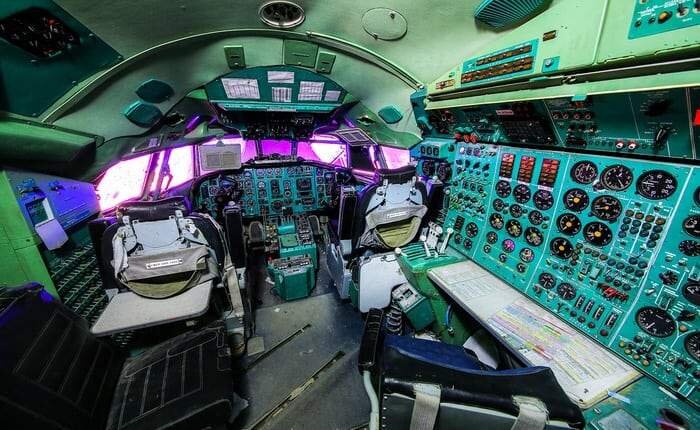
When the aircraft entered the thunderstorm front, accompanied by moderate turbulence, there were fluctuations in vertical g-forces and angles of attack and bank. The crew continued flying at a speed below the recommended (450 km/h). It seems the captain understood that further altitude gain would narrow the range of speeds for piloting, increase the likelihood of oscillations, especially in turbulence, reduce the margin for angle of attack, and decrease the available engine thrust. Yet, he aimed to escape the storm, so he ordered to request permission to climb even higher, to 11,900 meters.
CAPT: Let's temporarily go to 400 or something, damn it, or else this is complete crap, yeah. Ask for 390, or we won't make it around.
NAV: Switched.
NAV: "Control," Pulkovo 612.
ATC: Pulkovo 612, go ahead.
CAPT: Increase, yeah.
NAV: Pulkovo 612, request temporary climb to flight level 390.
CAPT: Say it's severe turbulence, etc.
ATC: Pulkovo 612, climb to flight level 390.
NAV: Climbing to flight level 390. Thank you very much, Pulkovo 612.
CAPT: We won't make it there either.
CAPT: 390.
CAPT: Climbing.
CAPT: Where can we escape from them, damn it?
CREW: The storm is below.
CAPT: It's pounding here at 380.
CREW: Also (unintelligible).
CAPT: And here (unintelligible), let's go left.
During the climb, the aircraft was hit by hail. The flight speed dropped, partly due to the activation of the engine anti-icing system. When the aircraft reached the assigned flight level, the crew likely engaged the altitude stabilization mode. The autopilot deflected the elevator for a descent, leading to fluctuations in vertical g-forces. The control column was pulled back, causing an increase in the angle of attack to critical values, triggering the angle of Attack Angle and Aircraft Overload System (AAAOS).
CAPT: Damn, it's pounding hard, f...ck.
CAPT: Hell of a storm, damn it.
CAPT: Oh, damn it, now hail too, damn it.
CAPT: I'm (unintelligible).
CAPT: Can we move somewhere to the side, Igor, move away a bit more.
CAPT: Igor.
CAPT: Igor!
NAV: What?
CAPT: Can we move somewhere else to the side, damn it?
CREW: (unintelligible) No.
CAPT: Tell them we reached 390, Andrey, damn it.
TRAINEE CO: Pulkovo 612, reached flight level 390.
AAAOS sound signal.
Then the crew disengaged the automatic stabilization mode. At this moment, the indicated airspeed was 420 km/h and continued to decrease, and the angle of attack was 6°. The aircraft became unbalanced in the longitudinal and lateral axes, leading to further uncoordinated manual piloting for about 1 minute.
The correct decision, which would have increased the margin for the angle of attack, would have been to initiate a descent, as suggested by one of the crew members (likely the co-pilot) during the next activation of the AAAOS. However, the main danger perceived by the captain was entering the center of thunderstorm activity, which he associated with descending. Therefore, he refused and ordered to set the engines to FLEX mode. Other crew members did not monitor the indicated airspeed, angle of attack, and other flight parameters adequately and did not inform the captain timely when these parameters exceeded the operational limits.
AAAOS sound signal.
CREW: Descending (unintelligible). Angles, angles.
CAPT: Descending where, you damn fools! Damn it.
CAPT: Set nominal on engines.
CREW: Nominal set.
AAAOS sound signal.
The captain tried to dampen the oscillations after disengaging the automation by moving the control column back and forth and keeping the aircraft at the assigned altitude. These unskillful actions, combined with others, led to the development of divergent oscillations in pitch, angle of attack, and g-forces. There was a tendency for the mean angle of attack to shift towards nose-up, resulting in further speed decreasing.
Post #42
319