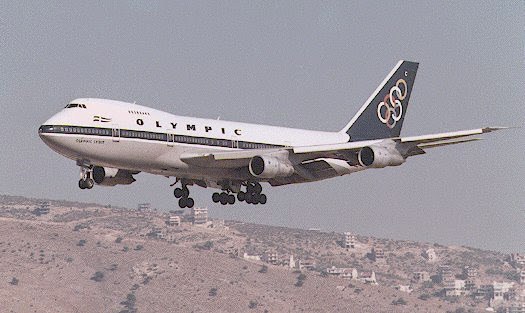
Miracle over Athens and the ground effect
On August 9, 1978, a Boeing 747 of Greek airline Olympic Airways was preparing for an intercontinental flight from Athens to New York. On board the "Queen of the Skies" were 400 passengers and 18 crew members. Experienced commander Sifis Migadis was at the controls during takeoff.
It was +43°C outside. On such a hot day, the air is less dense, requiring the aircraft to achieve a higher speed for a safe takeoff. The upcoming flight was long, so the airliner was loaded with fuel to the brim, and the takeoff weight was slightly below the maximum allowed. For a successful takeoff, Boeing would need full thrust from all engines, but due to technical reasons, engine No. 2 couldn't produce maximum power.
Another problem was that at full thrust, engines began to overheat, which could lead to their destruction. Therefore, they were equipped with an engine cooling system, controlled by the flight engineer. The system took several minutes to engage, and its operation required increased attention to the engine parameters. However, many crews were unfamiliar with it.
Upon the commander's order, flight engineer activates the cooling system before the takeoff roll begins. Heavy machine starts gaining speed. Boeing reaches decision speed (V1), and captain gives the command for takeoff. Immediately afterward, engine No. 3 fails and begins to disintegrate. It's too late to abort the takeoff, and aircraft, with three engines running (one of which is not producing full power), lifts off. Reaching an altitude of 11 meters, the airliner can't climb higher and flies directly over the rooftops of Athenian houses.
In such a situation, the landing gear cannot be retracted, as the flaps may provide additional resistance, but crew violates the procedure and retracts them. Flight engineer checks the operation of the cooling system but inadvertently disables it completely in the chaos. Maintaining the minimum permissible speed of 290 km/h, captain manages to climb to 64 meters, but flying over the center of Athens, airliner descends to 55 meters. Then pilots notice that the plane is heading straight towards a 60-meter hill. Captain can't turn, as such a maneuver would reduce the speed and altitude of the aircraft. Pitching up is also not an option, as the aircraft is already on the verge of stalling, and any further loss of speed will lead to a crash.
Nevertheless, by sacrificing speed at the last moment, captain manages to pull up the aircraft, clearing the hill with just three meters to spare. Speed is now well below the minimum permissible, but somehow, the aircraft miraculously stays airborne. Most likely, the reason was the "ground effect": an air cushion formed between the wing and the ground, which kept the aircraft aloft. Meanwhile, passengers suspect nothing and believe that flying at low altitude was planned for them to enjoy the sights of Athens. Pilots realize they can't hold out like this for long and need to land urgently.
Aircraft flies farther from the city, and temperature drops to 38°C. Engines cool down slightly and provide more thrust. Flight engineer finally activates the engine cooling system, and they start running at full power. Airliner gains a speed at which maneuvering and climbing higher become possible. Crew turns towards a valley leading to the sea to dump fuel. Half an hour later, the aircraft lands safely at the airport.
An investigation conducted by Boeing showed that the reason for the loss of thrust was the unintentional shutdown of the water pump in the engine cooling system. The company couldn't believe that the aircraft, at a speed of 158 knots (292 km/h) instead of the required 180 (333 km/h), managed to stay in the air and not crash. They attempted to recreate the situation on flight simulators, but the aircraft crashed every time. The exact cause of the engine No. 3 failure could not be determined.
On the same day, captain Migadis and all the passengers eventually completed the flight to New York on another aircraft.
Post #34
377