Uncontrolled increase in the speed of rotation
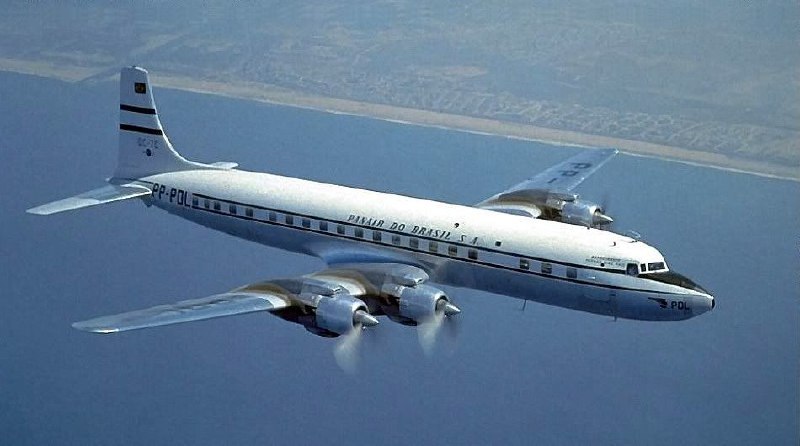
On October 22, 1962, Douglas DC-7CF equipped with 4 piston engines and operated by Northwest Airlines, chartered by the US Department of Defense, was flying from McCord Air Force Base (Washington State) to Elmendorf Air Force Base (Alaska). It was a passenger flight carrying military personnel and their family members. There were 7 crew members and 95 passengers on board.
After departure, the plane was flying in clouds for about two hours. Icing from low to moderate was observed there. When the crew decided to change the flight level from 4.2 kilometers to 6.1 kilometers, they had to increase the engine power to takeoff thrust, as ice deposits appeared on the fuselage.
Having reached the assigned altitude, the flight engineer began to reduce the power of the engines. When he tried to do it with the inner left engine, he suddenly understood that its thrust dropped by half, and then to idle mode. The flight engineer thought that the carburetor icing was the reason of the strange engine behavior. In order to defrost it, he used ethanol injection, then heating, and then both options simultaneously. Finally, he applied emergency fuel enrichment. Nothing helped.
Half a minute after the malfunction occurred, the flight engineer discovered that the propeller of the faulty engine suddenly began to increase the rotation speed above the permissible one. They tried to deflect the screw, that is, to move the blades to a position where they would not create resistance. Meanwhile, the speed of the aircraft dropped, and the propeller continued to rotate faster and faster. In addition, due to the rapid rotation, the oil level began to drop sharply.
The captain declared an emergency and began to descend. Since there were no airports nearby, ditching into the Pacific Ocean was considered as the main option. When the plane descended to 150 meters height above the water, the crew discovered that the front part of the engine with a faulty propeller had turned cherry red due to heating. Moreover, metal particles began to fly away from it.
It was impossible to waste time. The pilots extended flaps and began to descend into the water. The touch happened at a speed of 176 km/h and was quite smooth. In general, the landing was successful, the aircraft looked outwardly intact, except for bent propeller blades. The crew immediately began the evacuation. In five minutes, all passengers and crew members plunged into inflatable rafts, from which they were soon removed by rescuers. No one was died. The aircraft remained above the water level for about 24 minutes. Then it sank at a depth of 76 meters.
The investigation found that the left internal engine failed due to component failure in the two-speed drive supercharger assembly. According to the flight manuals, in the event of such a failure, it is necessary to seal the screw as soon as possible to avoid further destruction of the engine. But the crew considered that the malfunction was caused by icing due to flying in the clouds, so they fluted the propeller when it was too late. This led to an uncontrolled increase in the speed of rotation of the propeller.
The decision to land an airplane with a collapsing engine on water was recognized as the only correct one. The members of the investigation recognized the actions of the flight crew in the ditching and further evacuation, as a result of which no one died, as an outstanding achievement. The successful outcome was facilitated by almost ideal weather conditions and a flat sea surface. A positive role was also played by the fact that the passengers were military people, who clearly and timely carried out the crew's instructions.
Post #39
461