Despite the signs of approaching a stall (noticeable stick shaking), the captain did not recognize the real danger and did not initiate a descent by pushing the control column forward. As a result, the aircraft entered a regime of aerodynamic stall at angles of attack exceeding the operational limits, which led to involuntary pitch-up (aerodynamic stall condition). The aircraft pitched up and climbed almost 400 meters in five seconds. During this time, the right bank angle reached 50°, and the pitch angle reached 45.7°. At this moment, the indicated airspeed dropped to zero (a complete loss of lift occurred), the side engines shut down automatically, and the Tu-154 entered a flat spin.
CAPT: Tell them severe turbulence, damn it.
NAV: Severe turbulence.
ATC: Pulkovo 612, descend to flight level 360.
CAPT: Descending, damn it.
Stall warning sound.
AAAOS sound signal.
CAPT: Calm down, hold everything.
CAPT: Hold it, damn it.
CREW: Generators are shutting down.
CREW: Compressor stall. Descend, Vanya. Compressor stall.
CAPT: Look at the KI-13. Bank angles.
CREW: (unintelligible) fine, fine (unintelligible).
CAPT: Watch the speeds, watch the speeds!
CREW: Well, it's dropped a bit.
Stall warning sound.
CAPT: (unintelligible) damn it, we’ll fall into a spin.
At this stage, the crew had lost control of their aircraft, which entered an uncontrollable descent. There was no recorded attempt by the crew to push the control column forward; instead, the pilots kept pulling it back. The analysis of the crew's communication indicates a complete lack of understanding of what was happening and the helplessness of the pilots, primarily the captain.
CAPT: Everything's out.
CREW: I understand.
CREW: We're just horsing around.
CREW: Correct.
CAPT: Vova, take command.
COP: I don’t know, maybe we should go left.
NAV: Left, Vanya.
CAPT: Turning left.
CREW: Lower the gear?
NAV: Descending, descending.
CREW: Yeah, yeah, go left, come on, come on, it’s fine.
CREW: (unintelligible) up, up.
CREW: Altimeters.
CAPT: Activate SOS.
CAPT: Report that we are in SOS.
TRAINEE CO: SOS, Pulkovo 612, SOS.
Realizing the catastrophic situation, the captain ordered to transmit the distress signal "SOS," which the trainee co-pilot did. The aircraft remained in a spin for 2.5 minutes, after which the recorder stopped.
CAPT: Pull back, pull back, pull back, pull back, pull back. Andrey, pull back. Andrey, pull back. Pull back, Andrey now (unintelligible).
CREW: (unintelligible).
CAPT: Takeoff power.
CREW: Left rudder, remove the bank.
TRAINEE CO: (unintelligible) (Don’t kill us).
CAPT: Andrey, don’t panic!
CREW: ...
CAPT: (Ground).
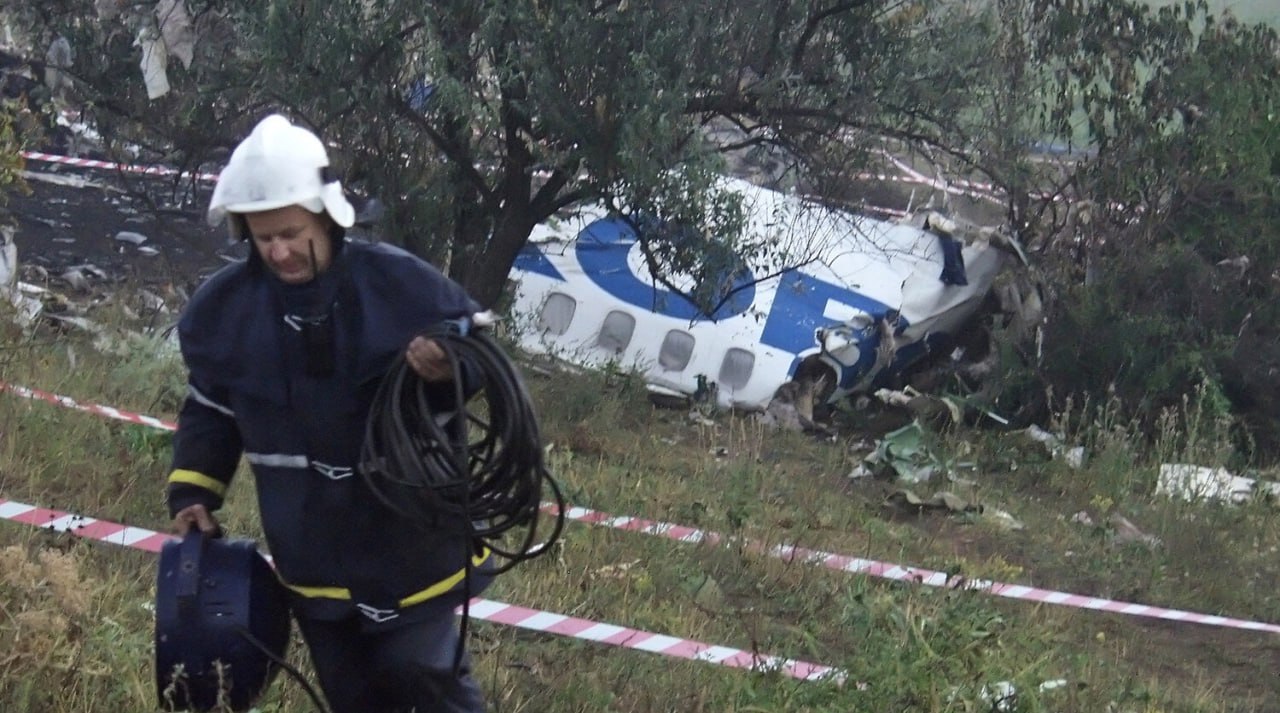
The Tu-154 crashed into the ground at high speed near the village of Sukhaya Balka in the Donetsk region. The fuel tanks exploded on impact, and the fuselage broke into pieces. There were no survivors.
Ukraine declared August 23 a day of mourning, and celebrations for Ukraine's Independence Day (August 24) were canceled. In Russia, a day of mourning was declared on August 24.
The cause of the crash was the aircraft entering a stall due to exceeding critical angles of attack while in manual flight mode, followed by a flat spin and a high-vertical-speed collision with the ground. The crew allowed the aircraft to pitch oscillate and exceed operational angles of attack while avoiding thunderstorm activity and turbulence.
Such scenarios were not practiced due to the lack of suitable simulators and corresponding recommendations in the flight operations manual and training program. The situation became critical due to the lack of airspeed monitoring and non-compliance with the flight operations manual's instructions to prevent the aircraft from entering a stall, exacerbated by poor crew coordination.
Post #43
438