Too transparent ice
On December 27, 1991, a McDonnell Douglas MD-81 aircraft operated by Scandinavian Airlines System (SAS) was flying from Stockholm to Copenhagen. There were 129 people on board, including 123 passengers and 6 crew members. The aircraft was treated with anti-icing fluid before takeoff. However, after inspecting the plane, the captain asked for the procedure to be repeated, which was done. Also, the pilots left the cockpit door open out of habit.
Twenty-five seconds after takeoff, when the plane was at an altitude of about 350 meters, strong vibrations, jolts, and bangs appeared from the direction of engine No. 2 (right). Suspecting compressor surge, the captain reduced its thrust. However, at 76 seconds into the flight, when the plane was at an altitude of about 900 meters, engine No. 2 stopped. A few seconds later, engine No. 1 also stopped. The pilots tried to restart it, but it caught fire, so the fire extinguishing system was activated.
At that time, a 46-year-old captain of SAS was a passenger in the cabin. Through the open door, he saw that his colleagues were having problems. Then he entered the cockpit and offered his assistance. At the commander's direction, he activated the auxiliary power unit and helped release the flaps. At first, the crew planned to return to Stockholm, but they obviously didn't have enough altitude for that maneuver. Then the captain decided to land on the edge of a forest.
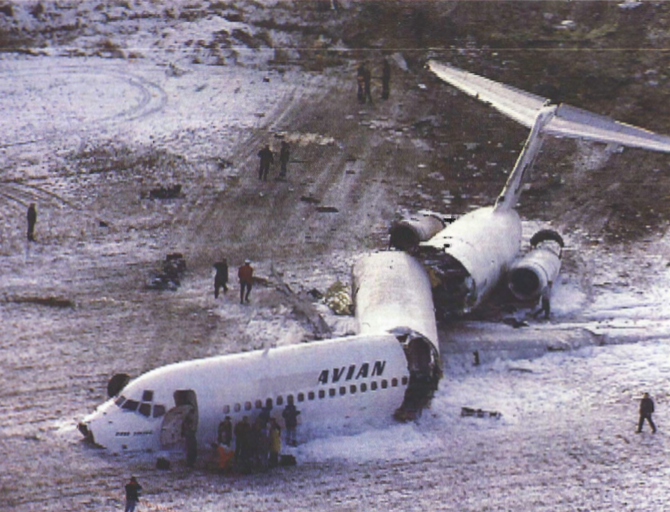
At a speed of 193 km/h, the aircraft crashed into the treetops, with its right wing detached. Then the plane turned to the right and a few seconds later, it crashed to the ground, where it was dragged for 110 meters. The fuselage was split into three parts, fuel started leaking from the tanks, but no fire broke out. As a result of the crash, no one was killed. The total number of injuries was 92, of whom 25 suffered serious injuries.
Investigators have concluded that the main culprit of the incident was the airline SAS. It was determined that the compressor surge began due to the ingestion of a large amount of ice from the wings, which damaged the compressor's first-stage blades. Ground services were unable to detect and remove the ice due to its high transparency. Additionally, the airline technicians did not have ladders to inspect the wing from above. At the same time, it was known that MD-81 aircraft were prone to such ice formation. Therefore, the manufacturer sent relevant messages and instructions on how to combat transparent ice to operators several years before the incident. However, SAS did not take the necessary measures.
Another factor in the accident was the Automatic Thrust Restoration (ATR) system. It was supposed to correct the errors of American pilots who reduced engine thrust during takeoff over residential areas. In some cases, the thrust was reduced to the point of stalling. The system was implemented on McDonnell Douglas aircraft shortly before the accident, and SAS was not notified of its existence. Therefore, when the captain reduced the engine thrust in response to the surges, this system restored it again, but the pilots were not aware. As a result, the engines were destroyed, and then a fire broke out.
Investigators concluded that the pilots acted competently and strictly in accordance with instructions. However, the actions of the pilot who entered the cockpit were considered as a violation of the instructions. Nonetheless, the investigation believed that he had a positive influence on the situation's development.
The press called the captain a hero. The Queen of Denmark awarded him the Knight of the Order of Dannebrog, and he received several other awards. However, the incident had an extremely negative impact on him, and he left his pilot career. In turn, the King of Sweden awarded the captain who came to his colleagues' aid with the Royal Medal. He also resigned from the airline several years later. The second pilot continued to work for SAS and eventually became a captain.
Post #25
1.88K