Post #135
55
Channel Public Channel
WO - Subscribers
- 592
- Photos
- 99
- Videos
- 5
- Links
- 54
Recent Posts 20 shown
Post #134
80

Czech and Slovak: neighbouring populations with nearly half their ancestry modeled as Western Steppe Herder.
The Czech reference has 48.5% Western Steppe Herder, 37.7% Anatolian Neolithic Farmer and 13.8% Western Hunter-Gatherer. The Slovak reference has the same three components: 49.5%, 36.0% and 14.5%, respectively. The largest difference is just 1.7 percentage points in the farmer-related component.
These labels describe deep layers of ancestry connected to steppe populations, early farmers and hunter-gatherers. Their similar proportions give both references a closely related Central European profile.
Modern matches add regional detail. Czech is closest to German Lower Silesia (0.877) and Hungarian Vojvodina and Banat (0.956), both rated extremely close. German Thuringia (1.054), northern Croatian Kajkavian (1.133) and Austrian Carinthia (1.250) are also extremely close. The carousel selects the nearest German and Hungarian references to keep the national flags distinct, alongside Slovak.
Slovak is closest to Polish Ukraine Podolia (1.305), followed by Czech (1.972) and Ukrainian Ternopil (2.009), all rated very close. Those are also the three displayed cards. Polish Silesia (2.098), German Lower Silesia (2.145) and Ukrainian Zakarpattia (2.150) extend that similarity across neighbouring regions. “Polish Ukraine Podolia” names a Polish reference from Podolia, not the whole Ukrainian population.
The Czech–Slovak distance is 1.972 in both directions. These are model-based population averages: the Czech reference has 175 samples, Slovak 6, and the Podolia and Ternopil references just 2 each. Regional sampling can affect the ranking, and genetic distance is not a percentage of shared DNA.
🧬 Curious about your own ancestry?
🌍 Explore your DNA at https://www.worldgenetics.app/
The Czech reference has 48.5% Western Steppe Herder, 37.7% Anatolian Neolithic Farmer and 13.8% Western Hunter-Gatherer. The Slovak reference has the same three components: 49.5%, 36.0% and 14.5%, respectively. The largest difference is just 1.7 percentage points in the farmer-related component.
These labels describe deep layers of ancestry connected to steppe populations, early farmers and hunter-gatherers. Their similar proportions give both references a closely related Central European profile.
Modern matches add regional detail. Czech is closest to German Lower Silesia (0.877) and Hungarian Vojvodina and Banat (0.956), both rated extremely close. German Thuringia (1.054), northern Croatian Kajkavian (1.133) and Austrian Carinthia (1.250) are also extremely close. The carousel selects the nearest German and Hungarian references to keep the national flags distinct, alongside Slovak.
Slovak is closest to Polish Ukraine Podolia (1.305), followed by Czech (1.972) and Ukrainian Ternopil (2.009), all rated very close. Those are also the three displayed cards. Polish Silesia (2.098), German Lower Silesia (2.145) and Ukrainian Zakarpattia (2.150) extend that similarity across neighbouring regions. “Polish Ukraine Podolia” names a Polish reference from Podolia, not the whole Ukrainian population.
The Czech–Slovak distance is 1.972 in both directions. These are model-based population averages: the Czech reference has 175 samples, Slovak 6, and the Podolia and Ternopil references just 2 each. Regional sampling can affect the ranking, and genetic distance is not a percentage of shared DNA.
🧬 Curious about your own ancestry?
🌍 Explore your DNA at https://www.worldgenetics.app/
Post #133
96
Post #132
104

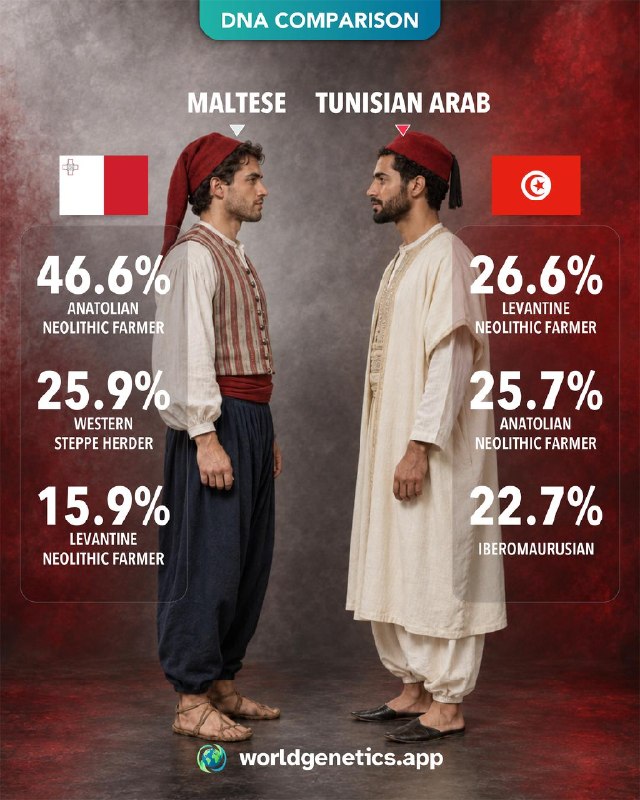
Malta and Tunisia face each other across the Mediterranean—but their closest genetic matches tell different stories.
The Maltese reference is modeled as 46.6% Anatolian Neolithic Farmer, 25.9% Western Steppe Herder and 15.9% Levantine Neolithic Farmer, plus 7.0% Zagros Neolithic Farmer, 3.2% Iberomaurusian, 0.8% West African and 0.6% Caucasus Hunter-Gatherer.
Tunisian Arab has 26.6% Levantine Neolithic Farmer, 25.7% Anatolian Neolithic Farmer and 22.7% Iberomaurusian, followed by 9.5% Western Steppe Herder, 8.2% West African, 4.3% Zagros Neolithic Farmer, 1.7% Caucasus Hunter-Gatherer and 1.3% Nilotic.
Both share ancient farmer-related layers, but Maltese has more modeled Anatolian farmer and steppe ancestry. Tunisian Arab has a larger Iberomaurusian-related component, associated with prehistoric North Africa. These ancient model labels are not percentages of modern nationalities.
Maltese's nearest match is Italian Pantelleria (1.616), followed by western Sicily (1.687), Trapani (1.702) and Ashkenazi Jew Romania (1.731), all very close. Other Sicilian and Mediterranean Jewish references follow. The national-flag cards select Pantelleria and the Romanian Ashkenazi reference, alongside Tunisian Arab.
Tunisian Arab is nearest to Tunisian Arab Tunis (1.183, extremely close). Algerian Arab (1.269), Tunisia's Sened Berber reference (1.626), Moroccan Arab Oujda (2.000) and Libyan Arab Tripoli (2.020) are very close. Tunis and Sened share Tunisia's flag, so the cards select Algerian Arab and Oujda, alongside Maltese.
The mutual distance is 15.171, rated somewhat distant. Regional Tunisian references vary: Sfax is closer to Maltese at 9.391. That doesn't replace the exact Tunisian Arab reference used here. Both target averages have 8 samples; some nearby references have only 1–3. Rankings depend on reference coverage, and distance is not a percentage of shared DNA.
🧬 Curious about your own ancestry?
🌍 Explore your DNA at https://www.worldgenetics.app/
The Maltese reference is modeled as 46.6% Anatolian Neolithic Farmer, 25.9% Western Steppe Herder and 15.9% Levantine Neolithic Farmer, plus 7.0% Zagros Neolithic Farmer, 3.2% Iberomaurusian, 0.8% West African and 0.6% Caucasus Hunter-Gatherer.
Tunisian Arab has 26.6% Levantine Neolithic Farmer, 25.7% Anatolian Neolithic Farmer and 22.7% Iberomaurusian, followed by 9.5% Western Steppe Herder, 8.2% West African, 4.3% Zagros Neolithic Farmer, 1.7% Caucasus Hunter-Gatherer and 1.3% Nilotic.
Both share ancient farmer-related layers, but Maltese has more modeled Anatolian farmer and steppe ancestry. Tunisian Arab has a larger Iberomaurusian-related component, associated with prehistoric North Africa. These ancient model labels are not percentages of modern nationalities.
Maltese's nearest match is Italian Pantelleria (1.616), followed by western Sicily (1.687), Trapani (1.702) and Ashkenazi Jew Romania (1.731), all very close. Other Sicilian and Mediterranean Jewish references follow. The national-flag cards select Pantelleria and the Romanian Ashkenazi reference, alongside Tunisian Arab.
Tunisian Arab is nearest to Tunisian Arab Tunis (1.183, extremely close). Algerian Arab (1.269), Tunisia's Sened Berber reference (1.626), Moroccan Arab Oujda (2.000) and Libyan Arab Tripoli (2.020) are very close. Tunis and Sened share Tunisia's flag, so the cards select Algerian Arab and Oujda, alongside Maltese.
The mutual distance is 15.171, rated somewhat distant. Regional Tunisian references vary: Sfax is closer to Maltese at 9.391. That doesn't replace the exact Tunisian Arab reference used here. Both target averages have 8 samples; some nearby references have only 1–3. Rankings depend on reference coverage, and distance is not a percentage of shared DNA.
🧬 Curious about your own ancestry?
🌍 Explore your DNA at https://www.worldgenetics.app/
- ❤ 1
Post #131
101
Post #130
112

Armenian vs Azeri: shared West Asian ancestry, different balances within it.
The Armenian reference is modeled as 30.7% Anatolian Neolithic Farmer, 24.4% Caucasus Hunter-Gatherer, 21.0% Levantine Neolithic Farmer, 18.5% Zagros Neolithic Farmer and 5.4% Western Steppe Herder.
The Azeri Azerbaijan reference has 25.3% Anatolian Neolithic Farmer, 21.6% Zagros Neolithic Farmer, 17.9% Caucasus Hunter-Gatherer, 15.3% Western Steppe Herder and 13.9% Levantine Neolithic Farmer. Smaller assignments are 4.1% East Asian, 1.4% Siberian and 0.5% Amerindian.
Anatolian farmer ancestry is the largest component in both. Armenian has higher modeled Caucasus hunter-gatherer and Levantine farmer contributions; Azeri has nearly three times the Steppe component and a higher Zagros farmer contribution. The smaller eastern components are model affinities, not exact recent genealogical shares—the 0.5% Amerindian label does not by itself establish an Indigenous American ancestor.
Armenian's nearest non-self matches overall are Armenian Yerevan at 0.757, Gesaria at 0.810 and Ararat at 0.914, all Extremely close. Kharberd, Erzurum, Van and Lebanon are also Extremely close. Under the distinct-national-flags rule, the selected matches are Turkish Bayburt at 1.523 and Greek Armenian Highland Erzurum at 1.745, both Very close.
Azeri Azerbaijan is closest overall to Karapapakh Turkey Kars at 1.209 and Azeri Iran at 1.239, both Extremely close. Gabala at 1.343 and Azeri Turkey Kars at 1.387 are Very close. Its selected distinct-name/national-flag matches are Karapapakh Kars and Tat Dagestan Nyugdi at 1.413 (Very close). Armenian Shamakhi, at 4.769 (Close), is closer than the broad Armenian average used here.
The two exact references are 6.113 apart, classified as Somewhat close. These are population-average similarities and deep ancestry estimates from one model, not definitions of identity. Regional references and individuals vary.
🧬 Curious about your own ancestry?
🌍 Explore your DNA at https://www.worldgenetics.app/
The Armenian reference is modeled as 30.7% Anatolian Neolithic Farmer, 24.4% Caucasus Hunter-Gatherer, 21.0% Levantine Neolithic Farmer, 18.5% Zagros Neolithic Farmer and 5.4% Western Steppe Herder.
The Azeri Azerbaijan reference has 25.3% Anatolian Neolithic Farmer, 21.6% Zagros Neolithic Farmer, 17.9% Caucasus Hunter-Gatherer, 15.3% Western Steppe Herder and 13.9% Levantine Neolithic Farmer. Smaller assignments are 4.1% East Asian, 1.4% Siberian and 0.5% Amerindian.
Anatolian farmer ancestry is the largest component in both. Armenian has higher modeled Caucasus hunter-gatherer and Levantine farmer contributions; Azeri has nearly three times the Steppe component and a higher Zagros farmer contribution. The smaller eastern components are model affinities, not exact recent genealogical shares—the 0.5% Amerindian label does not by itself establish an Indigenous American ancestor.
Armenian's nearest non-self matches overall are Armenian Yerevan at 0.757, Gesaria at 0.810 and Ararat at 0.914, all Extremely close. Kharberd, Erzurum, Van and Lebanon are also Extremely close. Under the distinct-national-flags rule, the selected matches are Turkish Bayburt at 1.523 and Greek Armenian Highland Erzurum at 1.745, both Very close.
Azeri Azerbaijan is closest overall to Karapapakh Turkey Kars at 1.209 and Azeri Iran at 1.239, both Extremely close. Gabala at 1.343 and Azeri Turkey Kars at 1.387 are Very close. Its selected distinct-name/national-flag matches are Karapapakh Kars and Tat Dagestan Nyugdi at 1.413 (Very close). Armenian Shamakhi, at 4.769 (Close), is closer than the broad Armenian average used here.
The two exact references are 6.113 apart, classified as Somewhat close. These are population-average similarities and deep ancestry estimates from one model, not definitions of identity. Regional references and individuals vary.
🧬 Curious about your own ancestry?
🌍 Explore your DNA at https://www.worldgenetics.app/
- ❤ 1
Post #129
108
Post #128
114

Dominican vs Afro-Haitian: one island, markedly different ancestry balances.
The Dominican reference combines 33.5% Senegambian, 31.4% Anatolian Neolithic Farmer and 16.8% Western Steppe Herder in the Core ancestral model. Its smaller components are 6.3% Amerindian, 5.9% Western Hunter-Gatherer, 4.7% African Hunter-Gatherer and 1.4% Iberomaurusian.
The Afro-Haitian reference has 47.6% Senegambian, 34.5% West African and 7.3% African Hunter-Gatherer. The remainder is 6.0% Anatolian Neolithic Farmer, 2.6% Western Steppe Herder and 2.0% Western Hunter-Gatherer.
The contrast goes beyond the top three components. The model's sub-Saharan African-related categories total 38.2% for Dominican and 89.4% for Afro-Haitian. The farmer, Steppe and western hunter-gatherer components associated with European ancestry total 54.1% and 10.6%, respectively. Dominican also retains a 6.3% Indigenous American-related component; none is assigned to Afro-Haitian in this fit.
Dominican's nearest non-self match overall is Cuban Mestizo (Highly SSA-Mixed), at 3.353. Next come Ramapough Lenape (European+SSA-Mixed), at 4.590, and Hassanamisco Nipmuc (European+SSA-Mixed), at 4.597—all Close. The first two are also the selected distinct-country matches. Similarity to these particular mixed-ancestry references does not establish direct descent from those communities.
Afro-Haitian is closest to Afro-Grenadian at 2.713 and Afro-Brazilian at 2.782, the two selected national matches. Afro-Barbadian at 3.541 and Afro-Jamaican at 4.894 are also Close.
The Dominican–Afro-Haitian distance is 37.575, classified as Distant. Sharing Hispaniola does not make these reference averages interchangeable. These are model-based population estimates and deep ancestry affinities; individuals vary, and the labels are not literal recent genealogical percentages.
🧬 Curious about your own ancestry?
🌍 Explore your DNA at https://www.worldgenetics.app/
The Dominican reference combines 33.5% Senegambian, 31.4% Anatolian Neolithic Farmer and 16.8% Western Steppe Herder in the Core ancestral model. Its smaller components are 6.3% Amerindian, 5.9% Western Hunter-Gatherer, 4.7% African Hunter-Gatherer and 1.4% Iberomaurusian.
The Afro-Haitian reference has 47.6% Senegambian, 34.5% West African and 7.3% African Hunter-Gatherer. The remainder is 6.0% Anatolian Neolithic Farmer, 2.6% Western Steppe Herder and 2.0% Western Hunter-Gatherer.
The contrast goes beyond the top three components. The model's sub-Saharan African-related categories total 38.2% for Dominican and 89.4% for Afro-Haitian. The farmer, Steppe and western hunter-gatherer components associated with European ancestry total 54.1% and 10.6%, respectively. Dominican also retains a 6.3% Indigenous American-related component; none is assigned to Afro-Haitian in this fit.
Dominican's nearest non-self match overall is Cuban Mestizo (Highly SSA-Mixed), at 3.353. Next come Ramapough Lenape (European+SSA-Mixed), at 4.590, and Hassanamisco Nipmuc (European+SSA-Mixed), at 4.597—all Close. The first two are also the selected distinct-country matches. Similarity to these particular mixed-ancestry references does not establish direct descent from those communities.
Afro-Haitian is closest to Afro-Grenadian at 2.713 and Afro-Brazilian at 2.782, the two selected national matches. Afro-Barbadian at 3.541 and Afro-Jamaican at 4.894 are also Close.
The Dominican–Afro-Haitian distance is 37.575, classified as Distant. Sharing Hispaniola does not make these reference averages interchangeable. These are model-based population estimates and deep ancestry affinities; individuals vary, and the labels are not literal recent genealogical percentages.
🧬 Curious about your own ancestry?
🌍 Explore your DNA at https://www.worldgenetics.app/
- 🔥 2
- ❤ 1
Post #127
127
Post #126
124

Kabyle and Algerian Arab: two identities, a shared Maghrebi foundation—and different balances of deep ancestry.
In this model, the Kabyle reference has 42.7% Anatolian Neolithic Farmer ancestry, 28.0% Iberomaurusian, 10.1% Western Steppe Herder and 9.1% Levantine Neolithic Farmer. The remaining components are 5.6% West African, 2.0% Zagros Neolithic Farmer, 1.0% Nilotic, 0.9% Western Hunter-Gatherer and 0.6% Caucasus Hunter-Gatherer.
The Algerian Arab reference has 29.2% Anatolian Neolithic Farmer, 24.5% Iberomaurusian and 22.2% Levantine Neolithic Farmer. It also includes 10.2% Western Steppe Herder, 8.1% West African, 3.3% Zagros Neolithic Farmer, 1.8% Nilotic and 0.7% Western Hunter-Gatherer.
The clearest contrast is the higher modeled Anatolian farmer contribution in Kabyle and higher Levantine farmer contribution in Algerian Arab. Both retain a substantial Iberomaurusian component, representing ancestry related to prehistoric North African references; their Steppe proportions are almost identical.
Their mutual genetic distance is 2.515, classified as Close. Kabyle's nearest non-self reference overall is Moroccan Riffian at 0.964 (Extremely close), followed by Algerian Shawiya at 1.572 and Moroccan Arab-Berber at 1.747 (both Very close). The selected distinct-country matches are Riffian and Tunisian Zenati Berber from Matmata, at 1.764.
Algerian Arab is closest overall to Tunisian Arab at 1.269, then Tunisian Arab Tunis at 1.310 and Algerian Arab Algiers at 1.480 (all Very close). Its selected distinct-country matches are Tunisian Arab and Moroccan Arab Oujda at 1.853. Nearby Amazigh references also include Tunisian Zenati Sened at 2.061.
These are population-average similarities and model-based estimates, not exact historical mixture percentages or a definition of anyone's identity.
🧬 Curious about your own ancestry?
🌍 Explore your DNA at https://www.worldgenetics.app/
In this model, the Kabyle reference has 42.7% Anatolian Neolithic Farmer ancestry, 28.0% Iberomaurusian, 10.1% Western Steppe Herder and 9.1% Levantine Neolithic Farmer. The remaining components are 5.6% West African, 2.0% Zagros Neolithic Farmer, 1.0% Nilotic, 0.9% Western Hunter-Gatherer and 0.6% Caucasus Hunter-Gatherer.
The Algerian Arab reference has 29.2% Anatolian Neolithic Farmer, 24.5% Iberomaurusian and 22.2% Levantine Neolithic Farmer. It also includes 10.2% Western Steppe Herder, 8.1% West African, 3.3% Zagros Neolithic Farmer, 1.8% Nilotic and 0.7% Western Hunter-Gatherer.
The clearest contrast is the higher modeled Anatolian farmer contribution in Kabyle and higher Levantine farmer contribution in Algerian Arab. Both retain a substantial Iberomaurusian component, representing ancestry related to prehistoric North African references; their Steppe proportions are almost identical.
Their mutual genetic distance is 2.515, classified as Close. Kabyle's nearest non-self reference overall is Moroccan Riffian at 0.964 (Extremely close), followed by Algerian Shawiya at 1.572 and Moroccan Arab-Berber at 1.747 (both Very close). The selected distinct-country matches are Riffian and Tunisian Zenati Berber from Matmata, at 1.764.
Algerian Arab is closest overall to Tunisian Arab at 1.269, then Tunisian Arab Tunis at 1.310 and Algerian Arab Algiers at 1.480 (all Very close). Its selected distinct-country matches are Tunisian Arab and Moroccan Arab Oujda at 1.853. Nearby Amazigh references also include Tunisian Zenati Sened at 2.061.
These are population-average similarities and model-based estimates, not exact historical mixture percentages or a definition of anyone's identity.
🧬 Curious about your own ancestry?
🌍 Explore your DNA at https://www.worldgenetics.app/
- 👍 2
Post #124
133

One island, two communities—and each other’s closest genetic match.
The Greek Cypriot and Turkish Cypriot references have a genetic distance of just 1.158 in World Genetics’ Modern G25 comparison, classified as “Extremely close.” Each is the other’s nearest match in this reference set.
Their deep ancestry models tell a similar story. The same three components are the largest in both: Anatolian Neolithic Farmer, Levantine Neolithic Farmer and Zagros Neolithic Farmer ancestry.
The clearest difference is the balance between the first two. The Greek Cypriot reference has a higher Anatolian farmer-related estimate: 40.2%, compared with 34.2% for Turkish Cypriots. The Turkish Cypriot reference has more Levantine farmer-related ancestry in this model: 29.6%, compared with 25.8%.
Zagros farmer-related ancestry is much closer: 13.8% for Greek Cypriots and 14.6% for Turkish Cypriots. These are the three largest components; the rest of the model includes Caucasus hunter-gatherer and Western Steppe herder-related ancestry.
Their other nearby matches also point toward the eastern Mediterranean: Kastellorizo Greeks and Syrian Jews appear among the closest references for both.
Shared genetic proximity can sit alongside distinct languages and community histories. These are population averages and model estimates, so they don’t describe every person or define anyone’s identity.
🧬 Curious about your own ancestry?
🌍 Explore your DNA at https://www.worldgenetics.app/
The Greek Cypriot and Turkish Cypriot references have a genetic distance of just 1.158 in World Genetics’ Modern G25 comparison, classified as “Extremely close.” Each is the other’s nearest match in this reference set.
Their deep ancestry models tell a similar story. The same three components are the largest in both: Anatolian Neolithic Farmer, Levantine Neolithic Farmer and Zagros Neolithic Farmer ancestry.
The clearest difference is the balance between the first two. The Greek Cypriot reference has a higher Anatolian farmer-related estimate: 40.2%, compared with 34.2% for Turkish Cypriots. The Turkish Cypriot reference has more Levantine farmer-related ancestry in this model: 29.6%, compared with 25.8%.
Zagros farmer-related ancestry is much closer: 13.8% for Greek Cypriots and 14.6% for Turkish Cypriots. These are the three largest components; the rest of the model includes Caucasus hunter-gatherer and Western Steppe herder-related ancestry.
Their other nearby matches also point toward the eastern Mediterranean: Kastellorizo Greeks and Syrian Jews appear among the closest references for both.
Shared genetic proximity can sit alongside distinct languages and community histories. These are population averages and model estimates, so they don’t describe every person or define anyone’s identity.
🧬 Curious about your own ancestry?
🌍 Explore your DNA at https://www.worldgenetics.app/
Post #123
135

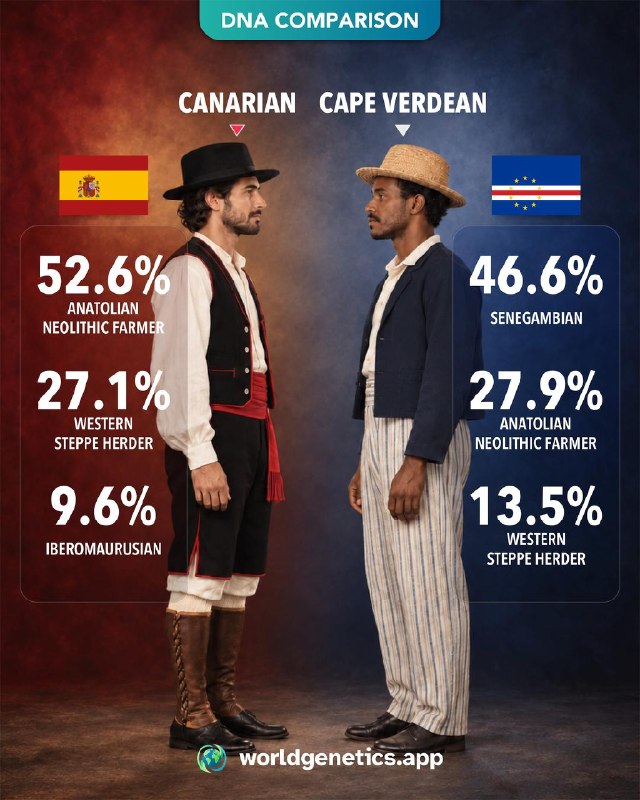
Two Atlantic archipelagos, two very different ancestry profiles: Canarian carries a 9.6% Iberomaurusian component, while Cape Verdean is led by 46.6% Senegambian.
In the Core ancestral model, Spanish Canarias (Canarian) is 52.6% Anatolian Neolithic Farmer, 27.1% Western Steppe Herder and 9.6% Iberomaurusian, alongside 9.4% Western Hunter-Gatherer, 0.9% Nilotic and 0.4% West African. Farmer and steppe-related ancestry dominate, with a North African-related signal represented by Iberomaurusian.
Cape Verdean is modeled as 46.6% Senegambian, 27.9% Anatolian Neolithic Farmer, 13.5% Western Steppe Herder, 6.5% African Hunter-Gatherer and 5.5% Western Hunter-Gatherer. Its profile combines a strong African-related contribution with farmer, steppe and hunter-gatherer components also present in Iberian ancestry. These are model components, not percentages of modern nationalities or a literal list of recent ancestors.
Canarian's nearest matches overall are other Canary Island references: Tenerife (0.962) and Gran Canaria (1.146), both extremely close, followed by La Palma (1.448), El Hierro (1.493), Fuerteventura (1.715), Lanzarote (1.766) and La Gomera (2.411), all very close. For the carousel's distinct national flags, the two nearest eligible matches are Hispano-Uruguayan (2.426, very close) and Portuguese Azores (2.531, close). Portuguese (2.931) and Hispano-Cuban (3.079) are also close.
Cape Verdean's closest match is Afro-Guadeloupean (4.787, close), followed by Afro-Cuban (6.983, somewhat close)—the two shown on its cards. Afro-Martinican (8.368), Afro-Puerto Rican (8.885) and the Hartani/Gnawa Berber Fez-Meknes reference (8.960) are also somewhat close.
The exact Canarian and Cape Verdean references are 34.693 apart, rated Distant. Both ancestry fits are rated Good. These are averages of 19 and 14 samples, respectively, so individual and island variation matter. Genetic distance measures similarity in this model; it is not a percentage of shared DNA.
🧬 Curious about your own ancestry?
🌍 Explore your DNA at https://www.worldgenetics.app/
In the Core ancestral model, Spanish Canarias (Canarian) is 52.6% Anatolian Neolithic Farmer, 27.1% Western Steppe Herder and 9.6% Iberomaurusian, alongside 9.4% Western Hunter-Gatherer, 0.9% Nilotic and 0.4% West African. Farmer and steppe-related ancestry dominate, with a North African-related signal represented by Iberomaurusian.
Cape Verdean is modeled as 46.6% Senegambian, 27.9% Anatolian Neolithic Farmer, 13.5% Western Steppe Herder, 6.5% African Hunter-Gatherer and 5.5% Western Hunter-Gatherer. Its profile combines a strong African-related contribution with farmer, steppe and hunter-gatherer components also present in Iberian ancestry. These are model components, not percentages of modern nationalities or a literal list of recent ancestors.
Canarian's nearest matches overall are other Canary Island references: Tenerife (0.962) and Gran Canaria (1.146), both extremely close, followed by La Palma (1.448), El Hierro (1.493), Fuerteventura (1.715), Lanzarote (1.766) and La Gomera (2.411), all very close. For the carousel's distinct national flags, the two nearest eligible matches are Hispano-Uruguayan (2.426, very close) and Portuguese Azores (2.531, close). Portuguese (2.931) and Hispano-Cuban (3.079) are also close.
Cape Verdean's closest match is Afro-Guadeloupean (4.787, close), followed by Afro-Cuban (6.983, somewhat close)—the two shown on its cards. Afro-Martinican (8.368), Afro-Puerto Rican (8.885) and the Hartani/Gnawa Berber Fez-Meknes reference (8.960) are also somewhat close.
The exact Canarian and Cape Verdean references are 34.693 apart, rated Distant. Both ancestry fits are rated Good. These are averages of 19 and 14 samples, respectively, so individual and island variation matter. Genetic distance measures similarity in this model; it is not a percentage of shared DNA.
🧬 Curious about your own ancestry?
🌍 Explore your DNA at https://www.worldgenetics.app/
- 👌 3
- ❤ 1
Post #122
230

Different identities, closely neighboring ancestry profiles: Greek Macedonia and Macedonian North Macedonia are just 1.466 apart, rated Very close.
Both are led by Anatolian Neolithic Farmer ancestry: 52.1% for Greek Macedonia and 53.5% for Macedonian. Western Steppe Herder follows at 36.4% and 40.2%, respectively. The Macedonian reference has 3.8 percentage points more steppe-related ancestry in this model, while their farmer proportions differ by only 1.4 points.
Greek Macedonia's full breakdown also includes 4.2% Levantine Neolithic Farmer, 3.6% Western Hunter-Gatherer, 2.8% Zagros Neolithic Farmer, 0.7% Caucasus Hunter-Gatherer and 0.2% East Asian. Macedonian includes 3.1% Western Hunter-Gatherer, 3.1% Levantine Neolithic Farmer and 0.1% East Asian. These deep-ancestry components are estimates, not modern nationality percentages; very small signals are especially model-sensitive.
Greek Macedonia's nearest match overall is Greek Western Macedonia (0.780), followed by Macedonian Greece Florina (0.970), Greek Eastern Macedonia and Thrace (1.056), Greek Central Greece Boeotia (1.114) and Greek Central Macedonia (1.183), all extremely close. Its cards instead show the exact Macedonian partner, Albanian Tosk North Macedonia (1.639) and Albanian Gheg Kosovo (1.757), selected for distinct national flags.
Macedonian's nearest overall match is Macedonian Greece Florina (0.851), followed by Greek Western Macedonia (0.932) and Albanian Gheg Montenegro (1.142), all extremely close. Greek Eastern Macedonia and Thrace (1.284), Moldovan Ștefan Vodă (1.411), Greek Macedonia (1.466), Turkish Balkans (1.467) and Bulgarian (1.488) are very close. Its cards use Albanian Gheg Montenegro, Moldovan Ștefan Vodă and the exact Greek Macedonia partner.
These references average 6 and 47 samples. Their ancestry fits are rated Very good and Good. Genetic similarity does not decide language or identity, and distance is not a percentage of shared DNA.
🧬 Curious about your own ancestry?
🌍 Explore your DNA at https://www.worldgenetics.app/
Both are led by Anatolian Neolithic Farmer ancestry: 52.1% for Greek Macedonia and 53.5% for Macedonian. Western Steppe Herder follows at 36.4% and 40.2%, respectively. The Macedonian reference has 3.8 percentage points more steppe-related ancestry in this model, while their farmer proportions differ by only 1.4 points.
Greek Macedonia's full breakdown also includes 4.2% Levantine Neolithic Farmer, 3.6% Western Hunter-Gatherer, 2.8% Zagros Neolithic Farmer, 0.7% Caucasus Hunter-Gatherer and 0.2% East Asian. Macedonian includes 3.1% Western Hunter-Gatherer, 3.1% Levantine Neolithic Farmer and 0.1% East Asian. These deep-ancestry components are estimates, not modern nationality percentages; very small signals are especially model-sensitive.
Greek Macedonia's nearest match overall is Greek Western Macedonia (0.780), followed by Macedonian Greece Florina (0.970), Greek Eastern Macedonia and Thrace (1.056), Greek Central Greece Boeotia (1.114) and Greek Central Macedonia (1.183), all extremely close. Its cards instead show the exact Macedonian partner, Albanian Tosk North Macedonia (1.639) and Albanian Gheg Kosovo (1.757), selected for distinct national flags.
Macedonian's nearest overall match is Macedonian Greece Florina (0.851), followed by Greek Western Macedonia (0.932) and Albanian Gheg Montenegro (1.142), all extremely close. Greek Eastern Macedonia and Thrace (1.284), Moldovan Ștefan Vodă (1.411), Greek Macedonia (1.466), Turkish Balkans (1.467) and Bulgarian (1.488) are very close. Its cards use Albanian Gheg Montenegro, Moldovan Ștefan Vodă and the exact Greek Macedonia partner.
These references average 6 and 47 samples. Their ancestry fits are rated Very good and Good. Genetic similarity does not decide language or identity, and distance is not a percentage of shared DNA.
🧬 Curious about your own ancestry?
🌍 Explore your DNA at https://www.worldgenetics.app/
- ❤ 3
Post #121
152

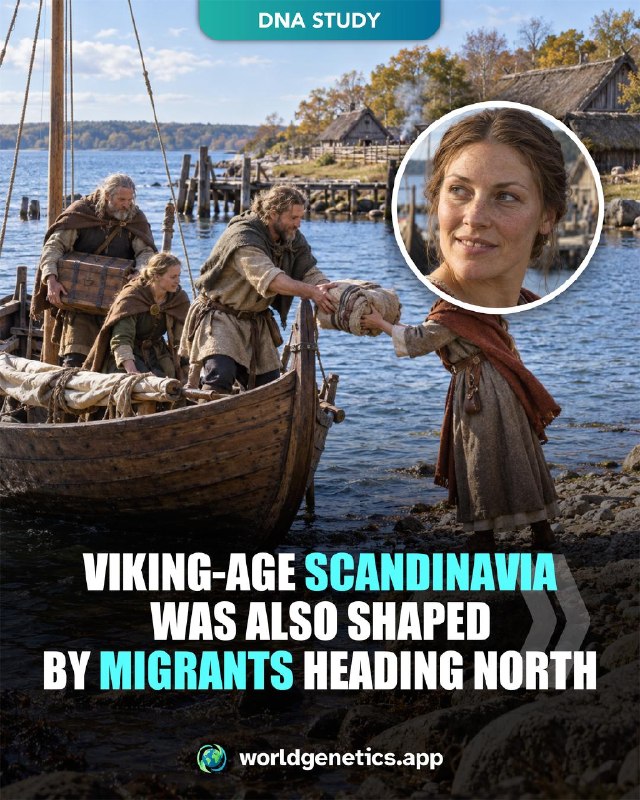
Vikings sailed out of Scandinavia. But people moving into Scandinavia also helped shape its Viking Age population.
A study of 1,556 ancient genomes traces a story of movement in both directions across early medieval Europe.
First came expansions south. In present-day Poland, sampled people associated with the Wielbark culture, around AD 1–500, require more than 75% ancestry related to early Iron Age Scandinavia in the study's models. Several are close to 100%. These are estimates for sampled burials, not everyone living in Poland; cremation leaves many people invisible to ancient-DNA studies.
Even Roman York had a man, dated to around AD 100–400, with about 25% Scandinavian-related ancestry—centuries before Viking raids. Whether he was a soldier or gladiator remains uncertain.
Farther south, incoming and local ancestries mixed. Later medieval Poland shows another major transformation, rather than simple continuity from the sampled Wielbark groups.
Then Scandinavia changed too. By around AD 800, ancestry related to central European groups appears in Denmark. During the Viking Age, it is detected in 25 of 53 sampled people from Denmark, 20 of 62 from Sweden, and just 2 of 24 from Norway. Those are counts of people with a detectable signal, NOT average ancestry percentages.
On Öland, five people whose models assign all ancestry to continental-related sources have tooth chemistry consistent with growing up locally. The genetic change had become part of local communities.
The references are ancient genetic comparisons, not literal nationalities, and DNA cannot establish a person's language or prove a “Viking” identity. The exact origins and routes of the incoming ancestry remain uncertain.
📚 Source: Speidel et al. (2025), Nature
High-resolution genomic history of early medieval Europe
🧬 Curious about your own ancestry?
🌍 Explore your DNA at https://www.worldgenetics.app/
A study of 1,556 ancient genomes traces a story of movement in both directions across early medieval Europe.
First came expansions south. In present-day Poland, sampled people associated with the Wielbark culture, around AD 1–500, require more than 75% ancestry related to early Iron Age Scandinavia in the study's models. Several are close to 100%. These are estimates for sampled burials, not everyone living in Poland; cremation leaves many people invisible to ancient-DNA studies.
Even Roman York had a man, dated to around AD 100–400, with about 25% Scandinavian-related ancestry—centuries before Viking raids. Whether he was a soldier or gladiator remains uncertain.
Farther south, incoming and local ancestries mixed. Later medieval Poland shows another major transformation, rather than simple continuity from the sampled Wielbark groups.
Then Scandinavia changed too. By around AD 800, ancestry related to central European groups appears in Denmark. During the Viking Age, it is detected in 25 of 53 sampled people from Denmark, 20 of 62 from Sweden, and just 2 of 24 from Norway. Those are counts of people with a detectable signal, NOT average ancestry percentages.
On Öland, five people whose models assign all ancestry to continental-related sources have tooth chemistry consistent with growing up locally. The genetic change had become part of local communities.
The references are ancient genetic comparisons, not literal nationalities, and DNA cannot establish a person's language or prove a “Viking” identity. The exact origins and routes of the incoming ancestry remain uncertain.
📚 Source: Speidel et al. (2025), Nature
High-resolution genomic history of early medieval Europe
🧬 Curious about your own ancestry?
🌍 Explore your DNA at https://www.worldgenetics.app/
- 👍 2
Post #120
166

Two Mediterranean islands. A 35.4-point gap in their largest ancestry component.
The Sicilian and Sardinian references both have Anatolian Neolithic Farmer ancestry as their largest component, but the model assigns 46.6% to the Sicilian reference and 82.0% to the Sardinian reference.
The rest of the picture differs too. For Sicilians, Western Steppe Herder ancestry reaches 25.2%, followed by Levantine Neolithic Farmer ancestry at 16.9%. For Sardinians, Western Hunter-Gatherer ancestry is 12.9%, while Western Steppe Herder ancestry is just 3.9%. These are the three largest components for each reference, rather than complete breakdowns.
Modern population comparisons tell another part of the story. Among the distinct regional matches shown here, the Sicilian reference is very close to Campanians from Naples (2.126) and Calabrese from Reggio Calabria (2.325). The Sardinian reference is closer to Corsicans (7.466) and Lombards from Brescia (8.152) than to the Sicilian reference itself (10.621).
These results describe population averages using the same ancestry model. Genetic distance measures similarity in the comparison model; it is not a percentage of shared DNA, and individual family histories can differ.
🧬 Curious about your own ancestry?
🌍 Explore your DNA at https://www.worldgenetics.app/
The Sicilian and Sardinian references both have Anatolian Neolithic Farmer ancestry as their largest component, but the model assigns 46.6% to the Sicilian reference and 82.0% to the Sardinian reference.
The rest of the picture differs too. For Sicilians, Western Steppe Herder ancestry reaches 25.2%, followed by Levantine Neolithic Farmer ancestry at 16.9%. For Sardinians, Western Hunter-Gatherer ancestry is 12.9%, while Western Steppe Herder ancestry is just 3.9%. These are the three largest components for each reference, rather than complete breakdowns.
Modern population comparisons tell another part of the story. Among the distinct regional matches shown here, the Sicilian reference is very close to Campanians from Naples (2.126) and Calabrese from Reggio Calabria (2.325). The Sardinian reference is closer to Corsicans (7.466) and Lombards from Brescia (8.152) than to the Sicilian reference itself (10.621).
These results describe population averages using the same ancestry model. Genetic distance measures similarity in the comparison model; it is not a percentage of shared DNA, and individual family histories can differ.
🧬 Curious about your own ancestry?
🌍 Explore your DNA at https://www.worldgenetics.app/
- 👏 2
- ❤ 1
Post #119
158

English and Irish ancestry: how much separates them?
Their genetic profiles are remarkably close. In World Genetics’ Modern G25 calculator, the English and Irish population references have a distance of 1.354, classified as “Very close.”
The ancient ancestry breakdown helps explain that similarity. Both references are modeled with the same three major components: Western Steppe Herder, Anatolian Neolithic Farmer and Western Hunter-Gatherer ancestry.
Steppe-related ancestry is the largest component in both: 50.1% in the Irish reference and 46.8% in the English reference. The English reference has a slightly higher Anatolian farmer-related estimate—39.0%, compared with 36.0% for the Irish reference.
Hunter-gatherer-related ancestry is almost identical: 14.2% in the English reference and 13.9% in the Irish reference. The main difference in this model is a small shift between the Steppe- and farmer-related components.
These are population reference profiles and model estimates, rather than results for every English or Irish person. Your own ancestry can differ from the population average.
🧬 Curious about your own ancestry?
🌍 Explore your DNA at https://www.worldgenetics.app/
Their genetic profiles are remarkably close. In World Genetics’ Modern G25 calculator, the English and Irish population references have a distance of 1.354, classified as “Very close.”
The ancient ancestry breakdown helps explain that similarity. Both references are modeled with the same three major components: Western Steppe Herder, Anatolian Neolithic Farmer and Western Hunter-Gatherer ancestry.
Steppe-related ancestry is the largest component in both: 50.1% in the Irish reference and 46.8% in the English reference. The English reference has a slightly higher Anatolian farmer-related estimate—39.0%, compared with 36.0% for the Irish reference.
Hunter-gatherer-related ancestry is almost identical: 14.2% in the English reference and 13.9% in the Irish reference. The main difference in this model is a small shift between the Steppe- and farmer-related components.
These are population reference profiles and model estimates, rather than results for every English or Irish person. Your own ancestry can differ from the population average.
🧬 Curious about your own ancestry?
🌍 Explore your DNA at https://www.worldgenetics.app/
- ❤ 3
- 🔥 1
Post #117
153

How did Bantu-speaking populations take shape in Zambia and Malawi? Ancient DNA points to at least two dispersals into the region—and an older local legacy that never completely disappeared.
This new preprint reports DNA from 71 ancient and historical people, with 62 retained for the main analyses. Their genomes reveal a history of migration, mixing and connections reaching across south central Africa.
One striking example comes from Kalala Island in Zambia’s Kafue River. A person dated to 1516–1667 CE is modeled as about 62% Bantu-related and 38% local hunter-gatherer-related. That is one individual, not an average for Zambia. The older component is represented by ancient foragers from Malawi.
The researchers also identify two broad genetic patterns among ancient and present-day Bantu-related groups. One has closer reference affinities to Luba-Lulua in southern DR Congo; the other to Ovimbundu in Angola and Wambo in Namibia. These matches help trace population connections, but they do not turn modern communities into literal ancient source populations.
Even one ethnic community can span both patterns: among 23 sampled Lozi, 13 fall in one cluster and 10 in the other. Those are counts of people, not ancestry percentages.
The southern Congo-linked pattern also shares stronger genetic connections with Bantu-speaking populations farther south, supporting a further expansion into southern Africa.
The result is a layered history: earlier foragers, incoming farmers, repeated movements and continued mixing. Two clusters do not mean only two migrations ever happened, and genetic groups are not ethnic or language boundaries.
This study has not yet been peer reviewed. Sparse ancient sampling leaves the exact routes and timing open.
📚 Source: Choin et al. (2026), bioRxiv (preprint)
The south Congo Basin was critical to Bantu settlement of south central Africa
🧬 Curious about your own ancestry?
🌍 Explore your DNA at https://www.worldgenetics.app/
This new preprint reports DNA from 71 ancient and historical people, with 62 retained for the main analyses. Their genomes reveal a history of migration, mixing and connections reaching across south central Africa.
One striking example comes from Kalala Island in Zambia’s Kafue River. A person dated to 1516–1667 CE is modeled as about 62% Bantu-related and 38% local hunter-gatherer-related. That is one individual, not an average for Zambia. The older component is represented by ancient foragers from Malawi.
The researchers also identify two broad genetic patterns among ancient and present-day Bantu-related groups. One has closer reference affinities to Luba-Lulua in southern DR Congo; the other to Ovimbundu in Angola and Wambo in Namibia. These matches help trace population connections, but they do not turn modern communities into literal ancient source populations.
Even one ethnic community can span both patterns: among 23 sampled Lozi, 13 fall in one cluster and 10 in the other. Those are counts of people, not ancestry percentages.
The southern Congo-linked pattern also shares stronger genetic connections with Bantu-speaking populations farther south, supporting a further expansion into southern Africa.
The result is a layered history: earlier foragers, incoming farmers, repeated movements and continued mixing. Two clusters do not mean only two migrations ever happened, and genetic groups are not ethnic or language boundaries.
This study has not yet been peer reviewed. Sparse ancient sampling leaves the exact routes and timing open.
📚 Source: Choin et al. (2026), bioRxiv (preprint)
The south Congo Basin was critical to Bantu settlement of south central Africa
🧬 Curious about your own ancestry?
🌍 Explore your DNA at https://www.worldgenetics.app/
- 👍 1
Post #116
166

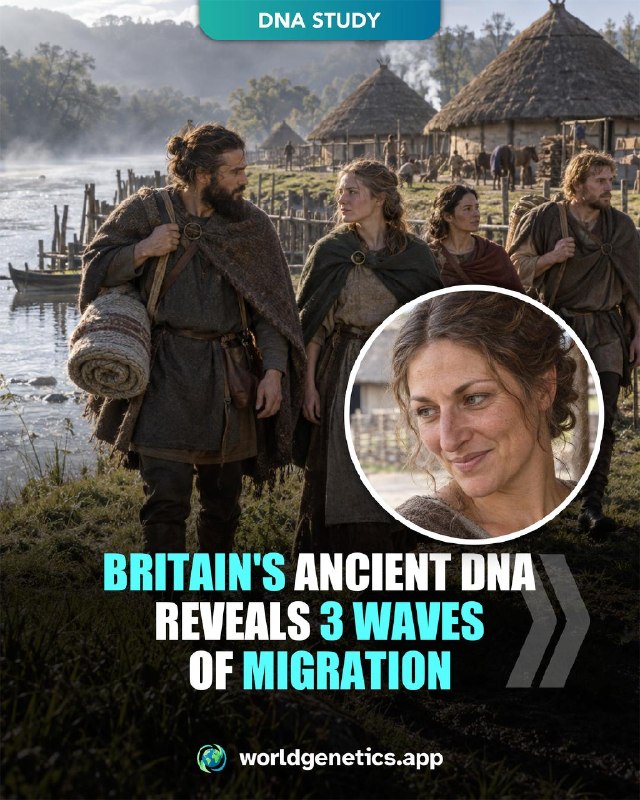
Britain's ancient DNA tells a story of repeated arrivals—not one founding migration.
This preprint identifies at least three migration phases in ancient England, within a wider analysis of 4,587 ancient genomes.
First came Bell Beaker-associated migrants around 2400 BC, carrying ancestry shaped by earlier steppe movements. During the Middle Bronze Age, roughly 2050–1250 BC, another shift linked people in England to ancient groups in France and Iberia.
Meanwhile, a different mixture was forming in eastern Central Europe. The researchers track a genetic profile associated with people of the Knovíz culture in present-day Czechia, using them as a reference for a wider population movement.
Related ancestry spread westward during roughly 1250–850 BC. It appears in Britain by around 850 BC and in Iberia by around 550 BC.
But newcomers did not erase everyone already there. Substantial local Bronze Age ancestry continued into the Iron Age in Britain, France and Iberia. These were changing, mixed populations—not a single uniform “Celtic people.”
The authors propose that the later expansion helped spread Celtic languages. DNA can reveal movement and shared ancestry; it cannot tell us which language an individual spoke. Ancient reference groups are genetic stand-ins, not proof of exact birthplaces or modern national ancestry percentages.
The dates are approximate, and this is the uploaded March 2025 preprint, not a peer-reviewed conclusion. Ireland's large sampling gap also leaves part of the story unresolved.
📚 Source: McColl et al. (2025), bioRxiv (preprint)
Tracing the Spread of Celtic Languages using Ancient Genomics
🧬 Curious about your own ancestry?
🌍 Explore your DNA at https://www.worldgenetics.app/
This preprint identifies at least three migration phases in ancient England, within a wider analysis of 4,587 ancient genomes.
First came Bell Beaker-associated migrants around 2400 BC, carrying ancestry shaped by earlier steppe movements. During the Middle Bronze Age, roughly 2050–1250 BC, another shift linked people in England to ancient groups in France and Iberia.
Meanwhile, a different mixture was forming in eastern Central Europe. The researchers track a genetic profile associated with people of the Knovíz culture in present-day Czechia, using them as a reference for a wider population movement.
Related ancestry spread westward during roughly 1250–850 BC. It appears in Britain by around 850 BC and in Iberia by around 550 BC.
But newcomers did not erase everyone already there. Substantial local Bronze Age ancestry continued into the Iron Age in Britain, France and Iberia. These were changing, mixed populations—not a single uniform “Celtic people.”
The authors propose that the later expansion helped spread Celtic languages. DNA can reveal movement and shared ancestry; it cannot tell us which language an individual spoke. Ancient reference groups are genetic stand-ins, not proof of exact birthplaces or modern national ancestry percentages.
The dates are approximate, and this is the uploaded March 2025 preprint, not a peer-reviewed conclusion. Ireland's large sampling gap also leaves part of the story unresolved.
📚 Source: McColl et al. (2025), bioRxiv (preprint)
Tracing the Spread of Celtic Languages using Ancient Genomics
🧬 Curious about your own ancestry?
🌍 Explore your DNA at https://www.worldgenetics.app/
- ❤ 1
Post #115
163

Europe’s later hunter-gatherers may owe much of their ancestry to people who survived the Ice Age in the Balkans.
A new, not yet peer-reviewed preprint reports nine ancient genomes from Romania, Bosnia and Herzegovina, Greece and Italy. They help identify a previously poorly sampled Balkan ancestry source that spread across much of Europe.
The westward story runs through Italy. Migrants related to Balkan hunter-gatherers mixed with people whose ancestry survived from before the coldest part of the Ice Age. One model for later Italian hunter-gatherers estimates roughly 75% Balkan-related, 20% earlier Italian-related and 5% earlier Spanish-related ancestry. That supports mixing, not complete replacement.
From Italy, descendants contributed to hunter-gatherers farther west. Later Iberian groups show roughly 30–75% Balkan-related ancestry in the models, with substantial variation across time and place.
The north followed a different path. Scandinavian and northeastern European hunter-gatherers carry a Balkan-related component that the models do not require to have passed through Italy. Farther east, it mixed with ancestry related to ancient Siberians. These are inferred population movements, not exact routes traced by DNA.
Another connection crossed the Aegean before farming. Two people from Maroulas on Kythnos, who lived about 9,000–8,400 years ago, are modeled with roughly 30% Balkan-related and 70% Anatolian-related ancestry. Their ancestors’ mixing dates to about 1,034 ± 266 years before they lived.
The legacy continued: the authors estimate about 16% Balkan-related ancestry in Yamnaya steppe herders, who later contributed ancestry across Europe and parts of Asia.
All these percentages are model estimates using ancient reference groups. They are not modern national identities—or percentages that apply to everyone living in these regions today.
📚 Source: Tabin et al. (2026), bioRxiv (preprint)
The Pan-European Impact of the Balkan Hunter-Gatherers
🧬 Curious about your own ancestry?
🌍 Explore your DNA at https://www.worldgenetics.app/
A new, not yet peer-reviewed preprint reports nine ancient genomes from Romania, Bosnia and Herzegovina, Greece and Italy. They help identify a previously poorly sampled Balkan ancestry source that spread across much of Europe.
The westward story runs through Italy. Migrants related to Balkan hunter-gatherers mixed with people whose ancestry survived from before the coldest part of the Ice Age. One model for later Italian hunter-gatherers estimates roughly 75% Balkan-related, 20% earlier Italian-related and 5% earlier Spanish-related ancestry. That supports mixing, not complete replacement.
From Italy, descendants contributed to hunter-gatherers farther west. Later Iberian groups show roughly 30–75% Balkan-related ancestry in the models, with substantial variation across time and place.
The north followed a different path. Scandinavian and northeastern European hunter-gatherers carry a Balkan-related component that the models do not require to have passed through Italy. Farther east, it mixed with ancestry related to ancient Siberians. These are inferred population movements, not exact routes traced by DNA.
Another connection crossed the Aegean before farming. Two people from Maroulas on Kythnos, who lived about 9,000–8,400 years ago, are modeled with roughly 30% Balkan-related and 70% Anatolian-related ancestry. Their ancestors’ mixing dates to about 1,034 ± 266 years before they lived.
The legacy continued: the authors estimate about 16% Balkan-related ancestry in Yamnaya steppe herders, who later contributed ancestry across Europe and parts of Asia.
All these percentages are model estimates using ancient reference groups. They are not modern national identities—or percentages that apply to everyone living in these regions today.
📚 Source: Tabin et al. (2026), bioRxiv (preprint)
The Pan-European Impact of the Balkan Hunter-Gatherers
🧬 Curious about your own ancestry?
🌍 Explore your DNA at https://www.worldgenetics.app/
- ❤ 2
Post #114
200

Two Gothic-associated communities in ancient Bulgaria shared cultural traditions—but their DNA tells different ancestry stories.
Researchers studied 37 people from Aquae Calidae near Burgas and an inland site near Shumen, with burial horizons spanning roughly AD 320–489. These are archaeological associations, not identities diagnosed from DNA.
The inland community has stronger links to ancient groups north of the Black Sea. One accepted model estimates 65.2% Chernyakhov-related and 34.8% Late Antique Balkan ancestry. Chernyakhov describes a diverse archaeological horizon, not a single biological people.
On the coast, both main subgroups also require ancestry related to Anatolia or the Marmara region, in present-day Turkey. Northern ancestry alone cannot explain them. The reference sites are genetic proxies, not proven hometowns.
The timing is striking: a pooled analysis dates north–south mixing to about 12.4 generations before burial. Its calendar estimate falls in the first century AD, with a wide 95% interval from 85 BC to AD 183. That dates ancestry mixing—not arrival in Bulgaria or an exact migration route.
Diversity also exists within cemeteries. One coastal individual shows unusually strong Levant-related affinity. Close relatives occur within the sites, but none are confirmed between them in the sampled data.
The picture is of migration, mixing and community formation. Shared Gothic-associated customs could connect people with different ancestry histories. The study does not establish ancestry percentages for modern Bulgarians.
📚 Source: Stamov et al. (2026), Frontiers in Genetics
Paleogenomic evidence for genetic heterogeneity and prior admixture in Gothic-associated communities of late antique Bulgaria
🧬 Curious about your own ancestry?
🌍 Explore your DNA at https://www.worldgenetics.app/
Researchers studied 37 people from Aquae Calidae near Burgas and an inland site near Shumen, with burial horizons spanning roughly AD 320–489. These are archaeological associations, not identities diagnosed from DNA.
The inland community has stronger links to ancient groups north of the Black Sea. One accepted model estimates 65.2% Chernyakhov-related and 34.8% Late Antique Balkan ancestry. Chernyakhov describes a diverse archaeological horizon, not a single biological people.
On the coast, both main subgroups also require ancestry related to Anatolia or the Marmara region, in present-day Turkey. Northern ancestry alone cannot explain them. The reference sites are genetic proxies, not proven hometowns.
The timing is striking: a pooled analysis dates north–south mixing to about 12.4 generations before burial. Its calendar estimate falls in the first century AD, with a wide 95% interval from 85 BC to AD 183. That dates ancestry mixing—not arrival in Bulgaria or an exact migration route.
Diversity also exists within cemeteries. One coastal individual shows unusually strong Levant-related affinity. Close relatives occur within the sites, but none are confirmed between them in the sampled data.
The picture is of migration, mixing and community formation. Shared Gothic-associated customs could connect people with different ancestry histories. The study does not establish ancestry percentages for modern Bulgarians.
📚 Source: Stamov et al. (2026), Frontiers in Genetics
Paleogenomic evidence for genetic heterogeneity and prior admixture in Gothic-associated communities of late antique Bulgaria
🧬 Curious about your own ancestry?
🌍 Explore your DNA at https://www.worldgenetics.app/
- 👍 1
About this channel
- How can I read @worldgenetics without a Telegram account?
- TGViewer shows the public web preview Telegram publishes for World Genetics: recent posts, photos, videos and the subscriber count, with no app, login or account.
- How many subscribers does World Genetics have?
- World Genetics (@worldgenetics) has 592 subscribers on Telegram, refreshed roughly every 30 minutes.
- Does World Genetics know I viewed it here?
- No. Public channel previews carry no viewer identity, and TGViewer has no accounts or tracking of what you look up.