
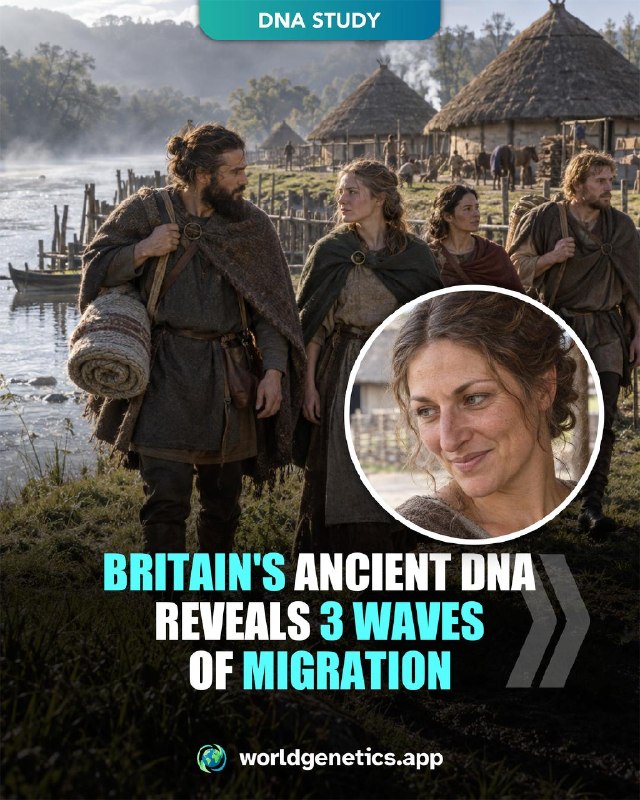
Britain's ancient DNA tells a story of repeated arrivals—not one founding migration.
This preprint identifies at least three migration phases in ancient England, within a wider analysis of 4,587 ancient genomes.
First came Bell Beaker-associated migrants around 2400 BC, carrying ancestry shaped by earlier steppe movements. During the Middle Bronze Age, roughly 2050–1250 BC, another shift linked people in England to ancient groups in France and Iberia.
Meanwhile, a different mixture was forming in eastern Central Europe. The researchers track a genetic profile associated with people of the Knovíz culture in present-day Czechia, using them as a reference for a wider population movement.
Related ancestry spread westward during roughly 1250–850 BC. It appears in Britain by around 850 BC and in Iberia by around 550 BC.
But newcomers did not erase everyone already there. Substantial local Bronze Age ancestry continued into the Iron Age in Britain, France and Iberia. These were changing, mixed populations—not a single uniform “Celtic people.”
The authors propose that the later expansion helped spread Celtic languages. DNA can reveal movement and shared ancestry; it cannot tell us which language an individual spoke. Ancient reference groups are genetic stand-ins, not proof of exact birthplaces or modern national ancestry percentages.
The dates are approximate, and this is the uploaded March 2025 preprint, not a peer-reviewed conclusion. Ireland's large sampling gap also leaves part of the story unresolved.
📚 Source: McColl et al. (2025), bioRxiv (preprint)
Tracing the Spread of Celtic Languages using Ancient Genomics
🧬 Curious about your own ancestry?
🌍 Explore your DNA at https://www.worldgenetics.app/
Post #116
167
- ❤ 1