TGViewer
Channel Public Channel
NeuroInk Lab

NeuroInk Lab

@neuroinklab

NeuroInk Virtual Lab is a vibrant, collaborative space where we explore the fascinating realms of vision, perception, and behavior.
neuroinklab@gmail.com

Support our research:
https://hamibash.com/NeuroInk
Subscribers
498
Photos
132
Videos
9
Links
239
Recent Posts 20 shown
Post #369 78
NeuroInk Lab ‏مطالعات قدیمی نشان داده بودند که پس از آسیب دائمی به FEF یا SC، توانایی ایجاد ساکاد بعد از مدتی تا حدی برمیگردد. حتی در برخی مطالعات، پس از برداشتن کامل SC، تحریک الکتریکی FEF همچنان می ‌توانست ساکاد ایجاد کند. این یافته ‌ها باعث شد این فرض مطرح شود که دو…
این مدل ارائه شده توسط آقای Monuz در سال 2002، نمای کلی شبکه‌ تولید ساکاد را نشان می ‌دهد. اطلاعات دیداری از Retina و Visual Cortex به نواحی قشری مانند LIP و FEF و همچنین به SC می ‌رسد. در کنار این مسیر، عقده ‌های قاعده ‌ای و Cerebellum در انتخاب، آغاز و دقت حرکت نقش تنظیمی دارند. در نهایت، فرمان ساکاد از طریق SC و نواحی قشری به Reticular Formation در ساقه‌ مغز می ‌رسد و در آنجا به فرمان حرکتی لازم برای اجرای ساکاد تبدیل می ‌شود.
نکته‌ مهم در ارتباط با مطالعه‌ قبلی این است که در این مدار، هم مسیر مستقیم FEF به Reticular Formation و هم مسیر غیرمستقیم FEF از طریق SC به Reticular Formation وجود دارد؛ آزمایش Wurtz دقیقا بررسی کرد که این مسیر مستقیم در مغز سالم تا چه حد می ‌تواند مستقل از SC عمل کند.


#Eye_Movements
#Douglas_Munoz

https://pubmed.ncbi.nlm.nih.gov/12508584/

📱نورواینک (NeuroInk Lab)
تلگرام | اینستاگرام | توییتر(ایکس) | لینکدین‌
  • ❤ 1
Post #368 108
‏مطالعات قدیمی نشان داده بودند که پس از آسیب دائمی به FEF یا SC، توانایی ایجاد ساکاد بعد از مدتی تا حدی برمیگردد. حتی در برخی مطالعات، پس از برداشتن کامل SC، تحریک الکتریکی FEF همچنان می ‌توانست ساکاد ایجاد کند. این یافته ‌ها باعث شد این فرض مطرح شود که دو مسیر نسبتا مستقل برای تولید ساکاد وجود دارد: یک مسیر مستقیم از FEF به مدارهای حرکتی ساقه‌ مغز و یک مسیر دیگر که از FEF به SC می‌ رسد و سپس به ساقه‌ مغز ادامه پیدا می ‌کند.
اما این تفسیر یک محدودیت مهم داشت. در آسیب های دائمی، مغز زمان کافی برای سازگاری شبکه ‌های عصبی را دارد. بنابراین بازگشت عملکرد پس از آسیب لزوما نشان نمی ‌دهد که مسیر مستقیم FEF به ساقه‌ مغز از ابتدا و به ‌تنهایی برای تولید ساکاد کافی بوده است. ممکن است مسیر های دیگر در طول زمان تقویت شده باشند و عملکرد از دست ‌رفته را جبران کرده باشند، فرآیندی که با نام نوروپلاستیسیتی هم شناخته می شود.
آقای Wurtz و همکاران برای بررسی مستقیم این مسئله، به‌جای ایجاد ضایعه دائمی، SC را به ‌طور موقت و برگشت ‌پذیر غیرفعال کردند. همزمان، FEF را به‌صورت الکتریکی تحریک کردند تا ببینند آیا هنوز می‌توان ساکاد ایجاد کرد یا نه. ناحیه‌ای از SC انتخاب می ‌شد که تقریبا همان جهت و دامنه‌ ساکادی را نمایندگی می ‌کرد که با تحریک FEF ایجاد می ‌شد.
منطق آزمایش ساده بود: اگر مسیر مستقیم FEF به ساقه‌ مغز به ‌تنهایی کافی باشد، خاموش کردن SC نباید اثر زیادی بر ساکاد ناشی از تحریک FEF داشته باشد. اما اگر FEF برای تولید ساکاد به SC وابسته باشد، غیرفعال کردن SC باید این ساکاد را مختل کند.
نتایج نشان دادند که وقتی ناحیه‌ی غیر فعال ‌شده در SC با ناحیه ‌ای که با تحریک FEF فعال می ‌شد هم ‌راستا بود، تحریک FEF دیگر نمی‌ توانست ساکاد ایجاد کند. حتی افزایش شدت تحریک FEF هم نتوانست این اثر را جبران کند.
در شرایطی که ناحیه غیرفعال ‌شده در SC دقیقا با بردار ساکاد ناشی از تحریک FEF منطبق نبود، ساکاد به‌ طور کامل حذف نمی ‌شد، اما جهت و دامنه‌ آن تغییر می‌ کرد. این تغییرات با این دیدگاه سازگار بود که مشخصات نهایی ساکاد از فعالیت جمعیتی نورون ‌ها در نقشه SC به دست می ‌آید
در مجموع، این مطالعه نشان داد که در مغز سالم، مسیر مستقیم FEF به ساقه مغز به‌ تنهایی برای تولید یک ساکاد دقیق کافی نیست. FEF و SC به ‌صورت تعاملی با یکدیگر همکاری می‌کنند و SC بخش مهمی از انتقال و شکل ‌دهی فرمان ساکاد پیش از رسیدن آن به مدارهای حرکتی ساقه‌ مغز است. به همین دلیل، بازگشت عملکرد در مطالعات ضایعه ‌ای قدیمی احتمالا بیشتر نتیجه‌ سازگاری عصبی بوده است تا وجود دو مسیر کاملا مستقل.


#Eye_Movements
#Robert_Wurtz

https://journals.physiology.org/doi/full/10.1152/jn.2001.85.2.804

📱نورواینک (NeuroInk Lab)
تلگرام | اینستاگرام | توییتر(ایکس) | لینکدین‌
Journal of Neurophysiology Interaction of the Frontal Eye Field and Superior Colliculus for Saccade Generation | Journal of Neurophysiology | American Physiological… Both the frontal eye field (FEF) in the prefrontal cortex and the superior colliculus (SC) on the roof of the midbrain participate in the generation of rapid or saccadic eye movements and both have projections to the premotor circuits of the brain stem where…
Post #367 83
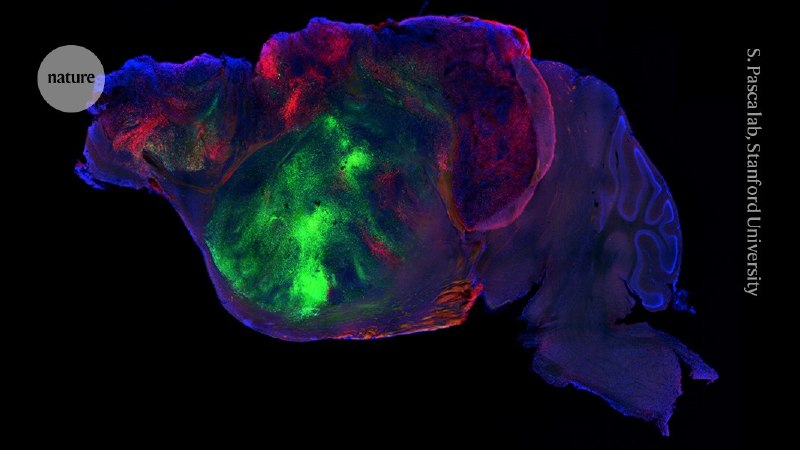
NeuroInk Lab Developmental xenocortication using human-derived organoids in mice Abstract The inaccessibility of human brain tissue limits the study of human development and function, a challenge that human stem-cell-derived neural models are beginning to address1,2.…
Human brain cells transplanted into mice in ‘most extensive’ integration ever

Human brain tissue transplanted into mice that lack a key part of their brains can grow to occupy most of the vacant space and wire into the animals’ nervous systems.
That’s according to a study published on 16 September in Nature1, which describes the most extensive integration of human brain cells into an animal so far. The experimental strategy overcomes hurdles that have long stymied researchers studying neuropsychiatric illness in laboratory-grown brain tissue.

#Nature_news
Nature Human brain cells transplanted into mice in ‘most extensive’ integration ever Nature - Lab-grown organoids wire into mice missing a key part of their brain, offering a new way to test drugs for developmental conditions.
Post #366 69

Forwarded from دانشکده مهندسی دانشگاه فردوسی مشهد

🔬🧠 دانشگاه فردوسی مشهد

کنگره ملی مهندسی پزشکی، هوش مصنوعی و علوم شناختی
National Congress of Biomedical Engineering, Artificial Intelligence, and Cognitive Sciences


را در بازه ۵ تا ۷ آبان ۱۴۰۵ برگزار می کند.

📌 محورهای اصلی کنگره:

۱. مهندسی پزشکی و فناوری‌های زیست‌پزشکی

۲. هوش مصنوعی، یادگیری ماشین و علم داده

۳. علوم شناختی و علوم اعصاب

📌 ارسال مقالات: 15 شهریورماه 1405
📅 تاریخ برگزاری : 5 تا 7 آبان ماه 1405

اطلاعات بیشتر:
📨 ایمیل: baic@ferdowsi.um.ac.ir
📞 تلفن: 051-38806051
🌐 وبسایت : https://baic.um.ac.ir/fa

➡️@FUM_engpr
🌐 eng.um.ac.ir
Post #365 93
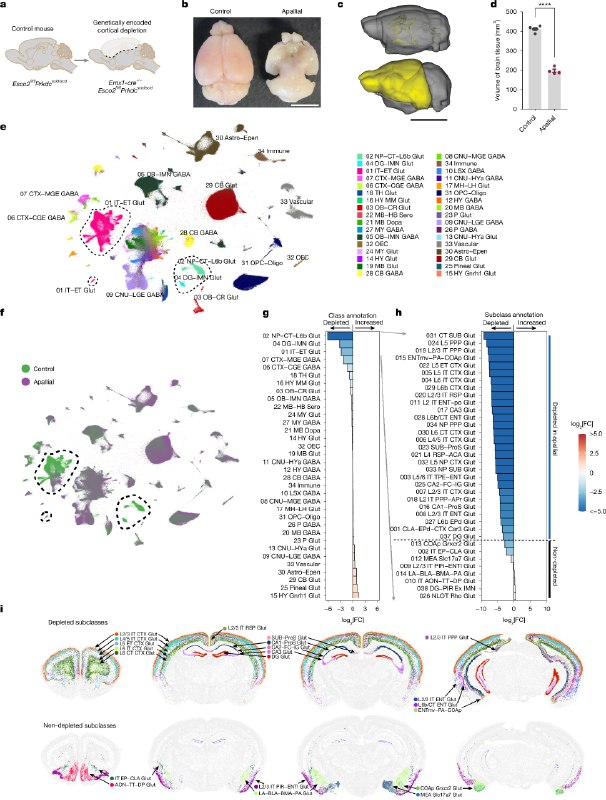
Developmental xenocortication using human-derived organoids in mice

Abstract
The inaccessibility of human brain tissue limits the study of human development and function, a challenge that human stem-cell-derived neural models are beginning to address1,2. Transplantation of neural organoids into rodent hosts enables the in vivo study of aspects of human neurodevelopment and circuit function, alongside behavioural phenotyping of the host animals. However, spatial limitations and competition with host circuits constrain the integration of neural organoids, which is critical for studying disease. Here we establish a transplantation platform using a genetic strategy to effectively deplete glutamatergic neurons from mouse neocortex and hippocampus (apallial) and neonatally engraft the cortical cavity with human stem-cell-derived cortical organoids (hCO) to generate xenocortical mice. This leads to robust graft growth with hCOs occupying most of the cortical volume and generating a diversity of human cortical cell types, including layer 5 extratelencephalic projection neurons. Human cortical neurons integrate with the mouse nervous system, and in vivo cortical graft-wide calcium imaging and electrophysiological analyses revealed patterns of organized activity resembling developing circuits. Behavioural analyses of apallial and xenocortical mice revealed broadly preserved locomotion alongside selective differences in limb coordination and altered organization of spontaneous behaviour. Lastly, this platform enabled behavioural readouts in a model of injury to developing human cortical cells. We envision that xenocortication will be useful for obtaining circuit- and behaviour-level readouts using human neurons to study neurodevelopment, model disease and develop therapeutics.

#Karl_Deisseroth
#Sergiu_Pasca
#Felicity_Gore
Nature Developmental xenocortication using human-derived organoids in mice Nature - Xenocortication with human neurons enables circuit- and behaviour-level analysis of neurodevelopment in mice.
Post #364 123
چرا وقتی بخشی از SC راست را غیرفعال می‌کنیم، چشم به سمت راست جا به ‌جا می‌شود اما همچنان می ‌تواند Fixation را حفظ کند؟
پاسخ این سوال ما را به نگاه متفاوتی از فیکسیشن می ‌رساند:

فیکسیشن شاید بیشتر از آنکه سکون باشد، یک تعادل است.

#Eye_Movements
#Richard_Krauzlis

📱نورواینک (NeuroInk Lab)
تلگرام | اینستاگرام | توییتر(ایکس) | لینکدین‌

https://telegra.ph/Visual-Fixation-as-EquilibriumA-09-24
Telegraph Visual Fixation as Equilibrium در مطالب گذشته بررسی کردیم که چشم در حالت فیکسیشن کاملا ثابت نیست و حرکات مختلفی دارد، گرچه ما متوجه آن‌ها نمی‌شویم. اما نقش SC در عمل فیکسیشن چیست؟ مغز چگونه با وجود این حرکات ریز چشم، نگاه را همچنان روی یک نقطه نگه می‌دارد؟ برای مدت زیادی، بخش جلویی یا…
Post #362 121
Competition between saccade goals in the superior colliculus produces saccade curvature

Abstract
When saccadic eye movements are made in a search task that requires selecting a target from distractors, the movements show greater curvature in their trajectories than similar saccades made to single stimuli. To test the hypothesis that this increase in curvature arises from competitive interactions between saccade goals occurring near the time of movement onset, we performed single-unit recording and microstimulation experiments in the superior colliculus (SC). We found that saccades that ended near the target but curved toward a distractor were accompanied by increased presaccadic activity of SC neurons coding the distractor site. This increased activity occurred approximately 30 ms before saccade onset and was abruptly quenched on saccade initiation. The magnitude of increased activity at the distractor site was correlated with the amount of curvature toward the distractor. In contrast, neurons coding the target location did not show any significant difference in discharge for curved versus straight saccades. To determine whether this pattern of SC discharge is causally related to saccade curvature, we performed a second series of experiments using electrical microstimulation. Monkeys made saccades to single visual stimuli presented without distractors, and we stimulated sites in the SC that would have corresponded to distractor sites in the search task. The stimulation was subthreshold for evoking saccades, but when its temporal structure mimicked the activity recorded for curved saccades in search, the subsequent saccades to the visual target showed curvature toward the location coded by the stimulation site. The effect was larger for higher stimulation frequencies and when the stimulation site was in the same colliculus as the representation of the visual target. These results support the hypothesis that the increased saccade curvature observed in search arises from rivalry between target and distractor goals and are consistent with the idea that the SC is involved in the competitive neural interactions underlying saccade target selection.

#Eye_Movements
#Edward_Keller
#Robert_McPeek
  • ❤ 1
Post #361 128
Feature interference underlies a neuronal basis for the behavioral cost of task uncertainty

Abstract
Humans and animals have an impressive ability to juggle multiple tasks in a constantly changing environment. This flexibility, however, worsens performance under uncertain task conditions. Here we combined monkey electrophysiology, human psychophysics and artificial neural network modeling to investigate the neuronal mechanisms underlying this performance cost. We developed a behavioral paradigm to measure and influence participants’ decision-making and perception in two distinct perceptual tasks. Our data reveal that both humans and monkeys, unlike an artificial neural network trained for the same tasks, make less accurate perceptual decisions when the task is uncertain. By comparing this neural network trained to produce correct choices with another network trained to replicate the participants’ choices, we hypothesize that the cost of task uncertainty comes from feature interference. Through behavioral, physiological and causal experiments, we show that, under uncertain conditions, feature interference causes errors by inducing stronger representations of irrelevant features and entangled neuronal representations of different features. Our results suggest that cognitive capacity limitations may stem from interference between neural representations of different stimuli, tasks or memories.

#Marlene_Cohen
Nature Feature interference underlies a neuronal basis for the behavioral cost of task uncertainty Nature Neuroscience - Using a combined approach of monkey electrophysiology, artificial neural networks and human psychophysics, Xue et al. show that neuronal interference from irrelevant...
  • ❤ 1
Post #360 127
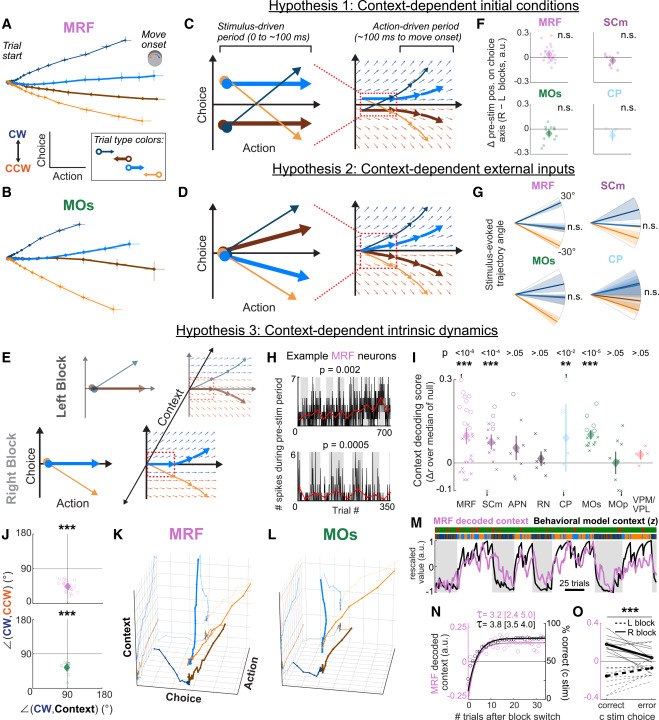
The midbrain reticular formation in contextual control of perceptual decisions

Summary
Flexibly responding to sensory cues is fundamental to animal behavior. However, growing evidence suggests that the relevant neural circuits have been incompletely resolved. We trained mice to apply an abstract rule that maps identical visual stimuli to opposing actions across contexts and investigated the role of the midbrain reticular formation (MRF) in this process. Large-scale recordings revealed that neurons in the MRF, along with several canonical decision-making areas, maintained persistent representations of task context in pre-stimulus activity. These representations predicted divergent population dynamics, putatively routing stimuli toward context-appropriate actions. The MRF was the only recorded region containing neuronal populations that both predicted lapses in contextual control pre-stimulus and exhibited contextually modulated premotor responses. The MRF also showed task-specific sensory plasticity. Context-coding neurons were aligned with cortical inputs, suggesting a spatial organization. These findings support the hypothesis that the MRF is a key node for setting and implementing abstract contextual states within the distributed circuitry for flexible perceptual decisions.

#Nicholas_Steinmetz
Neuron The midbrain reticular formation in contextual control of perceptual decisions Shaker et al. show that the midbrain reticular formation, a region traditionally associated with motor functions, contains abstract contextual signals that predict choices in a flexible decision-making task. The findings support distributed models of cognitive…
Post #359 98

Forwarded from کنفرانس علوم اعصاب شناختی (CNC)

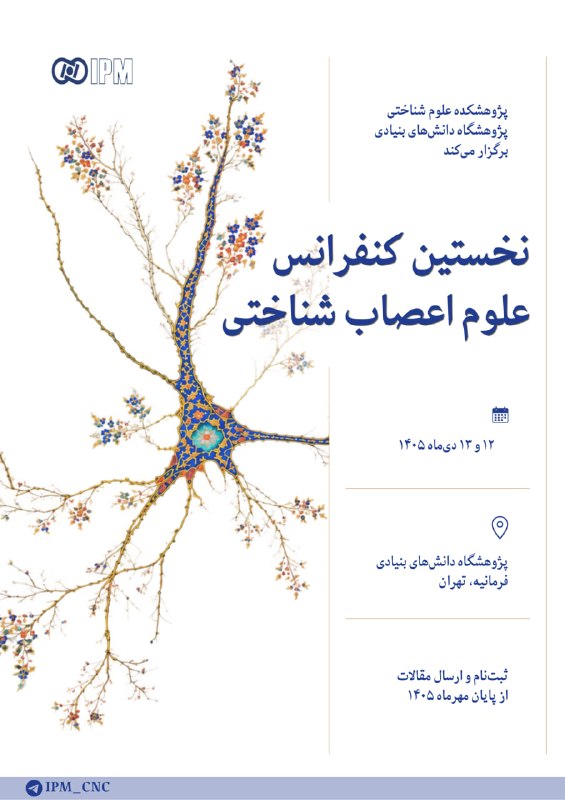
نخستین کنفرانس علوم اعصاب شناختی

پژوهشکده علوم شناختی پژوهشگاه دانش‌های بنیادی (IPM) برگزار می‌کند:

📍 نخستین کنفرانس علوم اعصاب شناختی
📅 ۱۲ و ۱۳ دی‌ماه ۱۴۰۵

📍 پژوهشگاه دانش‌های بنیادی، فرمانیه، تهران

ثبت‌نام و ارسال مقالات از پایان مهرماه ۱۴۰۵ آغاز خواهد شد.

به زودی اطلاعات تکمیلی، فراخوان مقالات و جزئیات ثبت‌نام اعلام می‌شود.

به تداوم راه علم 🧠

@CNC_IPM
Post #358 145
Neural geometry in the human hippocampus enables generalization across spatial position and gaze

Summary
Hippocampal neurons track the positions of self, others, and gaze direction. However, it is unclear how their respective neural codes differ enough to avoid confusion while allowing for abstraction across spatial frames. We recorded from populations of hippocampal neurons while human participants performed a joystick-controlled virtual prey-pursuit task. We found that neurons have mixed selective responses that map the positions of self, prey, and predator, as well as gaze direction. Their codes occupied mostly orthogonal subspaces, but the geometric structures of these subspaces allowed them to be aligned by simple linear transformations. Moreover, their geometries supported some degree of generalization, such that a linear rule learned on one agent could be transferred to another. This scheme enables reliable individuation and abstraction across both agent identity and viewpoint. Together, these findings suggest that hippocampal spatial knowledge is structured as a family of geometrically related manifolds that can be related through simple linear transformations.

#Benjamin_Hayden
Neuron Neural geometry in the human hippocampus enables generalization across spatial position and gaze Chericoni et al. show that neurons in the human hippocampus track the positions of multiple agents in a simple pursuit-based video game. They identified place codes for each agent and for gaze. The codes were systematically related in a way that allowed generalization…
  • ❤ 1
Post #357 154
Post #356 434
فرآیند شکل‌گیری یک تصمیم ❔🧠

در این بخش از دوره‌ زیست‌شناسی رفتار انسان، رابرت ساپولسکی توضیح می‌دهد که در لحظه‌ تصمیم‌گیری، مجموعه ‌ای از عوامل مختلف به ‌طور هم ‌زمان در شکل‌گیری رفتار ما نقش دارند.

فعالیت ‌های عصبی، هورمون‌ها، تجربه‌های گذشته، زمینه‌های ژنتیکی و شرایط محیطی، هرکدام بخشی از فرایندی هستند که در نهایت به یک تصمیم و رفتار مشخص منتهی می ‌شود.

این ویدیو نگاهی کوتاه به تعامل این عوامل در لحظه‌ی شکل ‌گیری رفتار انسان دارد.

📌 این مجموعه را در اینستاگرام هم دنبال کنید:
https://www.instagram.com/p/DdWhNBysVm8/

#نورواینک
#علوم_اعصاب
#neuroscience
#neuroinklab
#Stanford
#Robert_Sapolsky
  • ❤ 2
Post #355 223
Gamma-band synchronization between neurons in the visual cortex is causal for effective information processing and behavior

Abstract
Successful behavior relies on the brain’s ability to process selectively attended information while suppressing irrelevant information. Visual neurons show such functional flexibility by selectively responding to subsets of inputs representing attended objects while ignoring those conveying information about irrelevant objects. Several neuronal mechanisms have been proposed to explain this attention-dependent processing, yet none has been proven as a causal mechanism. One requires precise synchronization between spikes carrying relevant information and the gamma-oscillatory activity in receiving neurons. To investigate its causal relevance, we electrically evoked single volleys of spikes in area V2 of two male macaque monkeys performing a selective-attention task and recorded neuronal activity in downstream area V4. Strongly depending on the γ-phase, when these additional spikes arrived in V4, they impaired monkeys’ performance and evoked a spiking response. This establishes the causal relevance of subtle changes in spike timing, specifically by phase synchronization, for neuronal mechanisms serving cognitive processes.

#Andreas_Kreiter

https://www.nature.com/articles/s41467-025-62732-8
Nature Gamma-band synchronization between neurons in the visual cortex is causal for effective information processing and behavior Nature Communications - The brain’s ability to route information selectively is vital for perception and behavior. Here, the authors demonstrate that routing causally depends on the precise...
Post #354 174
Value Representations in the Primate Striatum during Matching Behavior

Abstract
Choosing the most valuable course of action requires knowing the outcomes associated with the available alternatives. The striatum may be important for representing the values of actions. We examined this in monkeys performing an oculomotor choice task. The activity of phasically active neurons (PANs) in the striatum covaried with two classes of information: action-values and chosen-values. Action-value PANs were correlated with value estimates for one of the available actions, and these signals were frequently observed before movement execution. Chosen-value PANs were correlated with the value of the action that had been chosen, and these signals were primarily observed later in the task, immediately before or persistently after movement execution. These populations may serve distinct functions mediated by the striatum: some PANs may participate in choice by encoding the values of the available actions, while other PANs may participate in evaluative updating by encoding the reward value of chosen actions.

#Paul_Glimcher

https://www.cell.com/neuron/fulltext/S0896-6273(08)00175-X
Neuron Value Representations in the Primate Striatum during Matching Behavior Choosing the most valuable course of action requires knowing the outcomes associated with the available alternatives. The striatum may be important for representing the values of actions. We examined this in monkeys performing an oculomotor choice task. The…
Post #352 175
Neural traveling waves in cortex: Network mechanisms and potential roles in neural computation

Summary
First discovered in anesthetized animals, neural traveling waves (nTWs) have now been observed throughout the brains of awake animals, where they influence neural excitability and behavior. nTWs can arise intrinsically in ongoing network activity or be triggered by sensory input and behavioral events. By structuring neural activity within individual cortical regions, nTWs introduce spatiotemporal dependencies across sensory maps that are not naturally captured by purely feedforward or feedback processing. Here, we synthesize physiological and computational evidence around two themes, focusing on the visual system while drawing connections to other cortical areas. First, we define nTWs and outline the circuit mechanisms that can generate them. Second, we highlight how nTWs can implement spatiotemporal computations, such as predicting upcoming sensory inputs, by embedding sensory history in the evolving activity pattern of an individual cortical region. We conclude by introducing a conceptual framework for spatiotemporal, generative processing by nTWs traveling over sensory maps.

#John_H_Reynolds

https://www.cell.com/trends/cognitive-sciences/abstract/S1364-6613(26)00130-0?dgcid=raven_jbs_etoc_email
Trends in Cognitive Sciences Clarifications about there being two necessary conditions for consciousness We recently proposed a modification to an influential conceptual framework in consciousness science: Ned Block’s distinction between phenomenal (P) consciousness and access (A) consciousness [1]. Instead, we proposed that there is only one type of consciousness…
Post #351 174
Optotagging in primate cortex uncovers excitatory and inhibitory neuron specializations in form vision

Abstract
The perception of complex visual shapes is a hallmark of primates and a foundation for many of their decisions and actions. The neural mechanisms of this visual function are best studied in macaques, but progress in this animal model has been hampered by the inability to dissect the contributions of distinct neuronal cell types. Here, we developed and applied an optogenetic approach for identifying the responses of individual excitatory and inhibitory neurons in the macaque visual cortex with light. Using this optotagging approach in male macaques, we uncovered clear functional differences between the two neuronal cell types. Excitatory and inhibitory neurons showed moderate differences in their extracellular spike waveforms and considerable differences in their visual response properties. Inhibitory neurons signaled simple visual forms almost exclusively, whereas excitatory neurons signaled both simple and complex forms and were more visually responsive than inhibitory neurons. Excitatory neurons had protracted response dynamics and developed their selectivity for complex forms gradually over time. These findings reveal a dominant role for excitatory neurons in visual shape processing, advancing a deeper mechanistic understanding of high-level vision. Beyond these insights, this work establishes a blueprint for elucidating the cell type-specific circuit logic underlying higher brain functions in primates.

#Yasmine_El_Shamayleh

https://www.nature.com/articles/s41467-026-76521-4
Nature Optotagging in primate cortex uncovers excitatory and inhibitory neuron specializations in form vision Nature Communications - This study leverages cell type-specific optogenetics in the monkey cerebral cortex to elucidate the unique functional contributions of excitatory and inhibitory neurons in...
Post #350 434
رفتار انسان چگونه شکل می‌گیرد؟ 🧠

این پرسش، نقطه‌ی آغاز دوره‌ی «زیست‌شناسی رفتار انسان» در دانشگاه استنفورد است؛ دوره‌ای که توسط رابرت ساپولسکی (Robert Sapolsky)، عصب‌شناس و زیست‌شناس، تدریس شده است.

ساپولسکی در این دوره، رفتار انسان را از زاویه‌ی علوم اعصاب، زیست‌شناسی، ژنتیک، هورمون‌ها و تکامل بررسی می‌کند و نشان می‌دهد که رفتارهای ما چگونه از تعامل پیچیده‌ی این عوامل شکل می‌گیرند.

این ویدیو، مقدمه‌ای کوتاه بر این مجموعه است.
در ادامه، بخش‌های منتخب این دوره را با ترجمه‌ی فارسی در کانال تلگرام و اینستاگرام قرار خواهیم داد.

📌 این مجموعه را در اینستاگرام هم دنبال کنید:
https://www.instagram.com/reel/DdEE1ulOTWK/?stkn=cXlzc2J1N2lsY2tu

#نورواینک
#علوم_اعصاب
#neuroscience
#neuroinklab
#Stanford
#Robert_Sapolsky
  • 🔥 2
  • 👌 2
Post #348 169
The Neural Correlates of Parallel and Serial Search

Abstract
For decades, target–distractor similarity has been known to induce distinct visual search modes. A highly salient target can pop out, suggesting parallel processing of all items irrespective of set size. In contrast, high similarity among items requires item-by-item assessment, a characteristic of serial search. Despite this long-standing distinction, search modes remain poorly defined due to confounding of behavioral measures by differences in local contrasts and display density just as neural correlates are confounded by distinct displays used to prompt different search modes. Here, we biased search mode by manipulating target–distractor similarity in inducer trials, while embedded test trials afforded both modes, allowing us to isolate neural signatures of serial and parallel search under visually identical displays. Behavioral results from 24 participants (21 female, 3 male) confirmed successful induction of distinct search modes. EEG decoding reliably discriminated search modes and generalized across inducer and test trials. Attentional deployment toward the target differed across search modes, revealing topographical differences in target location representations. The representation of target location was associated with response times, indicating when subjects swapped search mode from parallel to serial if target was not detected quickly. Moreover, the representation of search target diverged between search modes: A temporally stable pattern emerged during serial search, suggesting the maintenance of conjunction item in working memory, whereas the representations were dynamic in parallel search, likely reflecting the relevant feature. These findings demonstrate that search history shapes search mode, giving rise to clearly distinct neural dynamics even under visually identical stimulation.

#Jan_Theeuwes

https://www.jneurosci.org/content/46/34/e0209262026
Journal of Neuroscience The Neural Correlates of Parallel and Serial Search For decades, target–distractor similarity has been known to induce distinct visual search modes. A highly salient target can pop out, suggesting parallel processing of all items irrespective of set size. In contrast, high similarity among items requires item…
Older posts →

About this channel

How can I read @neuroinklab without a Telegram account?
TGViewer shows the public web preview Telegram publishes for NeuroInk Lab: recent posts, photos, videos and the subscriber count, with no app, login or account.
How many subscribers does NeuroInk Lab have?
NeuroInk Lab (@neuroinklab) has 498 subscribers on Telegram, refreshed roughly every 30 minutes.
Does NeuroInk Lab know I viewed it here?
No. Public channel previews carry no viewer identity, and TGViewer has no accounts or tracking of what you look up.
Threads Profile ViewerView any public Threads profile without an account.Open ThreadLook →Writing with AI? Make it sound human.Metric37 rewrites AI drafts so they read naturally. Free AI detector, 1,500 words free.Try Metric37 →