The midbrain reticular formation in contextual control of perceptual decisions
Summary
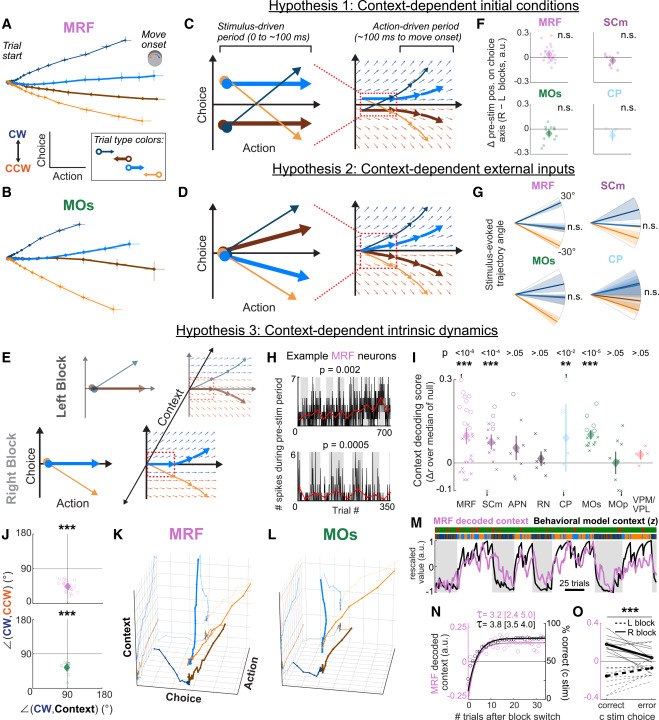
Flexibly responding to sensory cues is fundamental to animal behavior. However, growing evidence suggests that the relevant neural circuits have been incompletely resolved. We trained mice to apply an abstract rule that maps identical visual stimuli to opposing actions across contexts and investigated the role of the midbrain reticular formation (MRF) in this process. Large-scale recordings revealed that neurons in the MRF, along with several canonical decision-making areas, maintained persistent representations of task context in pre-stimulus activity. These representations predicted divergent population dynamics, putatively routing stimuli toward context-appropriate actions. The MRF was the only recorded region containing neuronal populations that both predicted lapses in contextual control pre-stimulus and exhibited contextually modulated premotor responses. The MRF also showed task-specific sensory plasticity. Context-coding neurons were aligned with cortical inputs, suggesting a spatial organization. These findings support the hypothesis that the MRF is a key node for setting and implementing abstract contextual states within the distributed circuitry for flexible perceptual decisions.
#Nicholas_Steinmetz
Post #360
127