TGViewer
Channel Public Channel
Air crash. Investigations ✈️

Air crash. Investigations ✈️

@enmayday

About air crashes and air accidents, their causes and significance for flight safety.

Russian version @rumayday

Contact @Safetyofficerr
Subscribers
344
Photos
22
Videos
4
Links
59

Showing posts older than #89 · Back to latest

Older Posts 20 shown
Post #88 330
​​Foggy Runway

On October 8, 2001, a thick fog settled over Milan's Linate Airport. Visibility dropped at times to as little as 50 meters.

A brand-new Cessna 525A CitationJet CJ2, with only 28 hours of flight time, was preparing for a flight to Paris. On board were two pilots and two passengers.

The crew was instructed to taxi to the runway via northern taxiway R5. However, in the dense fog, the pilots failed to see the faded and unclear markings and mistakenly turned onto taxiway R6, which led directly to the middle of the active runway. The airport had no ground radar, and the runway incursion warning system was disabled. As a result, in such low visibility conditions, the controllers had no way of knowing where the aircraft had actually gone.

Meanwhile, at the start of the same runway, a McDonnell Douglas MD-87 operated by Scandinavian Airlines System was preparing for departure to Copenhagen. There were 110 people on board: 6 crew members and 104 passengers. Shortly after, the MD-87 crew was cleared for takeoff and began accelerating down the runway. The aircraft reached 270 km/h and had just started to lift off when the Cessna suddenly appeared in its path.

The collision was devastating. The business jet was completely destroyed. The MD-87 lost its right landing gear and right engine. The aircraft briefly became airborne, but quickly lost speed and crashed back onto the runway. It veered sharply to the left, skidded across the tarmac, and overran the runway. At around 200 km/h, it slammed into a baggage hangar, was completely destroyed, and caught fire.

For some time, air traffic controllers were unaware that a collision had occurred and failed to sound the alarm. As a result, firefighters arrived at the scene only 20 minutes later. Had they responded sooner, they might have saved the Cessna’s pilots, who eventually died from carbon monoxide poisoning after being trapped in the cockpit.

In total, 118 people lost their lives in the disaster: all 110 on board the MD-87, all 4 occupants of the Cessna 525A, and 4 people inside the baggage hangar.

The investigation found that the accident was caused by a combination of factors: dense fog, errors by both the controller and the business jet pilots, the lack of ground radar, poor runway markings that were not visible from the cockpit, the disabled runway incursion warning system, and other safety deficiencies.

The ground controller and several regulatory officials were sentenced to prison terms by the court.
  • 👍 1
Post #87 323
The NTSB has released a preliminary report on the crash of a McDonnell Douglas MD-11 in Louisville

According to the report, taxiing and the takeoff roll were normal. The problems began at liftoff. Airport surveillance footage showed that shortly after the aircraft’s nose lifted off the runway, the left engine, along with its pylon - the structure attaching the engine to the wing - separated from the left wing. While still airborne, a fire ignited in the area of the detached engine, which flew over the fuselage and fell to the ground near the runway. A fire also broke out at the pylon-to-wing attachment point and continued burning until the aircraft impacted the ground.

After liftoff, the aircraft managed to climb only about 30 feet. It cleared the fence at the end of the runway, but then struck the roof of a UPS warehouse near the airport’s southern boundary with its left landing gear. It then crashed through an open-air storage area and two additional buildings, including a petroleum processing facility. Spilled fuel triggered a large fire. All three pilots on board were killed. On the ground, 11 people died and more than 20 others were injured.

The tower controller noted that the aircraft’s takeoff roll speed appeared normal for this type of plane, but the rate of climb was unusually low - the plane never climbed higher than the control tower, roughly 200 feet tall. Another witness reported that the aircraft first stopped climbing, then began to descend, banking to the left before crashing.

The crew was highly experienced. Both the captain and first officer had thousands of hours on the MD-11. A relief pilot with significant total flight time was also on board.

Both the cockpit voice recorder and flight data recorder were recovered and successfully downloaded. They contained data not only from the accident flight but also from previous flights.

Investigators are focusing on the engine-to-wing attachment point. On the MD-11, engines are mounted beneath the wings using pylons that connect at multiple points - a forward mount that bears thrust loads, and an aft mount with a spherical bearing assembly. It was this aft attachment on the left pylon that failed. Wreckage analysis revealed parts of the pylon, fittings from the rear mount, and a section of the wing with a bolt and fractured spherical bearing still in place.

At the NTSB lab, after cleaning the fracture surfaces, investigators found not only signs of overload failure but also evidence of fatigue cracking in the rear mount’s fittings - cracks that grow slowly over time under repeated stress. On some surfaces, the cracks originated from the bolt holes; others showed signs of sudden failure. The bearing itself was also destroyed.

The aircraft was 34 years old, with nearly 93,000 flight hours and about 21,000 takeoff and landing cycles. UPS maintained it under a continuous airworthiness program. According to company procedures, the rear pylon attachment was subject to visual inspection every six years - the last one occurred in 2021. A separate lubrication of the struts and spherical joints was performed about two weeks before the crash. A more detailed inspection of this attachment point had been scheduled for a later date.

Following the crash, UPS temporarily grounded its MD-11 fleet. Shortly after, the FAA issued an emergency airworthiness directive effectively grounding all MD-11 and MD-11F aircraft until inspections and potential defects were addressed. Within days, the directive was expanded to include DC-10 aircraft, which have a similar engine mounting design. A global inspection effort of these aircraft was launched.

In its preliminary report, the NTSB references the 1979 crash of an American Airlines DC-10 near Chicago. In that case, the left engine and pylon also separated during takeoff, causing the aircraft to lose control and crash, killing 273 people. That accident was attributed to a combination of design issues and improper maintenance procedures. Investigators are now examining whether a similar combination of factors played a role in the
  • 👍 2
Post #86 302
Flight engineer mixed everything up

On 30 June 1990, an Il-62M operated by Aeroflot took off from Moscow bound for Yakutsk. There were 99 passengers and 10 crew members on board.

It was a night landing. After touchdown, the captain called for reverse thrust. However, the flight engineer mixed everything up and advanced two of the four engines to takeoff thrust instead. The automatic system then locked the spoilers at 15°. As a result, instead of slowing down, the aircraft began to accelerate. At first, no one in the cockpit noticed the increase in engine thrust. Seeing that the speed was not decreasing but actually growing, the pilots applied emergency braking and held the wheels locked, which was contrary to the aircraft operating manual. The flight engineer then reduced thrust on the engines in takeoff mode and eventually shut all the engines down.

By that time, the aircraft had reached a speed of about 270 km/h and was only 655 meters from the end of the runway. With the wheels locked, the tires began to burst. Because of this, and also because all the engines were now shut down, the speed dropped to about 200 km/h. But the runway had already ended and the airliner overran onto the unpaved area.

It then crossed the runway end safety area, hit obstacles and broke apart. There was no fire. All three landing gear legs collapsed, and the fuselage broke in three places. Nevertheless, nobody was killed. Two people received serious injuries and four others sustained minor injuries.

The investigation commission concluded that the crew was fully responsible for the accident. The flight engineer, due to insufficient professional skills, made an error in handling the engines and spoilers during landing. This led to the unintentional and unexpected selection of forward takeoff thrust on engines No. 1 and 4 instead of reverse thrust.

The crew as a whole was poorly organized and failed to eliminate the consequences of their colleague’s mistake. The reasons for this included:

- the high verbal workload imposed on the crew during landing by the applicable procedures;

- the operator’s failure to implement the Ministry of Civil Aviation’s recommendations on forming crews with regard to psychophysiological and socio-psychological compatibility;

- failure to comply with the ministry’s requirement to train crews in handling abnormal situations in realistic aerodrome conditions.
  • 👍 2
Post #85 329
Strong winds blew a passenger jet off the runway

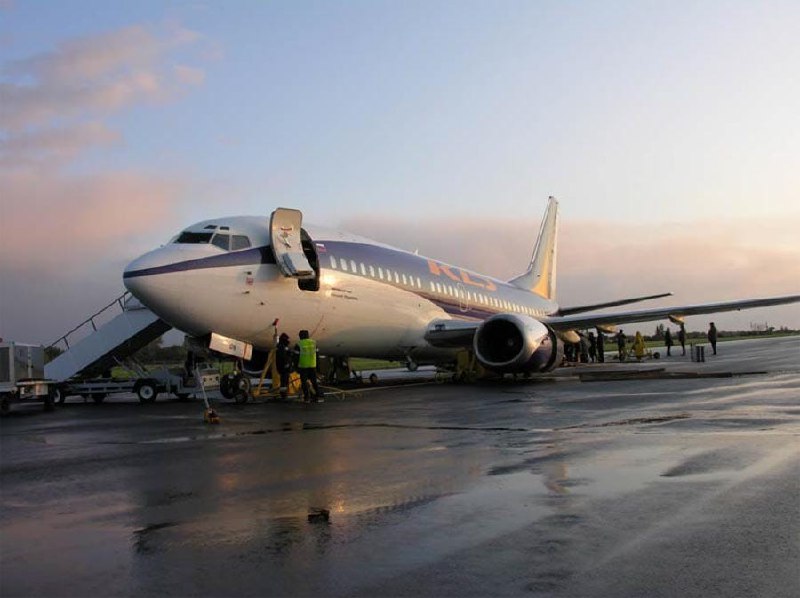
On the evening of December 20, 2008, a Continental Airlines Boeing 737-500 was operating a domestic flight from Denver to Houston. There were 115 people on board: 110 passengers and 5 crew members.

The captain, an experienced 50-year-old pilot with over 13,000 flight hours, including more than 6,300 on the Boeing 737, completed the standard pre-departure procedures with the first officer and received takeoff clearance at 18:17. ATC passed along the weather. It was cold in Denver but snow-free. A crosswind was reported on the runway, with a speed of up to 50 km/h.

The aircraft began its takeoff roll under the captain’s control. During the roll he gradually advanced the throttles to takeoff power. Nothing seemed out of the ordinary - until 18:18, when the aircraft suddenly veered sharply left. The trigger was a strong crosswind gust reaching 92 km/h.

The captain pressed the right pedal to realign the aircraft, then changed his mind and released it. The pedals primarily control the rudder and the nose landing gear steering: pressing the left pedal turns the nose left, pressing the right turns it right. As a result, the aircraft failed to re-align with the runway and, four seconds later, departed its edge.

The captain initiated a rejected takeoff. Shortly afterward the aircraft crossed a ravine, bounced up and slammed back onto the ground. The left engine separated and fell away, and the right engine caught fire. After sliding several hundred meters, the aircraft came to a stop 1,655 meters from the terminal building. During the ground slide the airframe broke into two sections.

Both pilots, injured, were incapacitated for about two minutes and did not run the emergency checklist. The flight attendants in the cabin began the evacuation on their own. The first officer soon recovered from shock and noticed the engine fire. The captain also came to and, with help from the first officer and a flight attendant, exited the aircraft. They were the last to evacuate through the forward door.

Fortunately, no one was killed. However, 38 people sustained injuries of varying severity. Two passengers and the captain were hospitalized with serious injuries. Because of the right-engine fire, the fuselage on the starboard side was completely burned out.

A landing gear malfunction was initially suspected, but it was not confirmed - the gear was normal. In July 2010 the final investigation report was released. It concluded the accident resulted from captain error: during the wind shift he stopped applying right pedal to keep the aircraft aligned with the runway centerline, allowing it to drift left and run off the runway. A contributing factor was the lack of precise wind information for the runway.
  • 👍 4
Post #84 346
"Level out, hold the yoke!" - A Wild Cadet Landing

This is a story of an accident that was captured on an amateur video which, at the time, spread widely across the internet. The footage shows a Let L-410 training and transport aircraft making a failed landing at the Rtishchevo airfield.

The Let L-410 Turbolet is a Czech twin-engine turboprop aircraft designed to carry up to 19 passengers or an equivalent cargo load. Reliable and capable of operating from short runways, it was widely used in the USSR and Russia both for regional flights and for pilot training.

Rtishchevo Airfield, located in the Saratov region, served as a training base where aviation cadets learned to fly the L-410. Students practiced takeoffs and landings there, including in challenging weather and runway conditions.

There is no official accident report available in open sources. However, based on information gathered from online discussions and aviation forums, the following details emerged.

The accident occurred on August 24, 2006. At the controls were cadets performing their second solo flight of the day. Upon touchdown, the aircraft began to “bounce”- repeatedly skipping off the runway and hitting it again with increasing force. The crew did not initiate a go-around, and the aircraft continued to attempt landing until it came to a stop.

“Bouncing” is a series of runway impacts after the initial touchdown. It usually results from excessive approach speed, incorrect flare technique, or poor crew coordination. Each subsequent impact typically occurs with greater vertical speed, increasing structural loads and potentially causing landing gear failure, fuselage damage, and loss of control. In such cases, a go-around after the first hard bounce is the standard and safest response.

The video is accompanied by the voice of an instructor or flight supervisor giving commands:

- Reduce power.
- Level out. Level out.
- Hold the yoke.
- Ease it in gently.
- Hold the yoke. Hold the yoke. Hold the yoke, 65!
- Shut down engine 65!


The consequences were serious: the fuselage and landing gear sustained significant damage. The runway itself was also damaged - visible marks remained on the surface at the points of impact.

According to posts on aviation forums, unauthorized video recording was taking place in the cockpit. Some participants claimed that the recording tape was destroyed after the flight.

A quote allegedly taken from an internal investigation report, published on one of the forums, stated that the cause of the accident was the commander’s lack of discipline. He failed to manage the second pilot’s actions and did not prohibit in-cockpit filming. As of 2009, the damaged aircraft had not returned to service.

A go-around is not a “mistake” but a standard and safest action when a landing becomes unstable. After the first major bounce, the landing parameters already exceed acceptable limits: speed and energy are too high, pitch is unstable, and the next contact with the runway is almost always harder than the last.

Trying to “force the plane down” only increases vertical speed and the load on the landing gear and fuselage. Failure to initiate a go-around is a human factor - a desire to complete what was started, to land no matter what. But physics doesn’t care about human intentions.
  • 👍 2
Post #83 327
​​Explosion Over the Sea

On December 11, 1994, a man identifying himself as Armando Forlani, an Italian citizen, boarded a Philippine Airlines Boeing 747 flying from Manila, the capital of the Philippines, to the city of Cebu - also in the Philippines. The flight was nearly empty, with just 26 passengers and 20 crew members on board. This was only the first leg of the journey; from Cebu the aircraft was scheduled to continue on to Tokyo.

The passport in the name of Armando Forlani was fake. The man behind it was Ramzi Yousef, a Palestinian terrorist. A year earlier, he had carried out the bombing of the World Trade Center in New York, which killed six people and injured 1,042.

Shortly after takeoff, Forlani went to the lavatory, taking his toiletry kit with him. There, he assembled an improvised explosive device using liquid explosives. The explosive mixture was stored in a contact lens liquid bottle, which had passed through airport security without raising suspicion. A wristwatch was used as a timer, and the detonator was hidden in the heel of his left shoe.

Upon returning to his seat, the terrorist placed the bomb in the pocket of a life vest under seat 26K, located on the right side of the aircraft. This seat was originally near the center fuel tank. However, due to a modified cabin layout, it had been moved two rows forward from the tank’s center.

Yousef set the timer so the bomb would explode four hours later. By that time, according to his plan, the plane would be on the second leg of its journey, en route to Tokyo and flying over the ocean.

In Cebu, the terrorist and the other passengers disembarked. After that, 256 new passengers boarded the aircraft for the flight to Tokyo. Seat 26K was taken by a 24-year-old Japanese businessman named Haruki Ikegami. The aircraft departed for Tokyo with a 40-minute delay.

Exactly four hours after the timer had been set, as the plane was flying over the Japanese island of Minamidaito, the bomb under the seat exploded. The blast tore a 0.2 m² hole in the cabin floor, destroyed the seat, and severed several control cables running through the ceiling. Haruki Ikegami took the full force of the explosion and, unknowingly, saved the aircraft from decompression and structural failure. The lower half of his body fell through the hole. He was pulled out, but died two minutes later. Ten nearby passengers were injured.

After the explosion, the aircraft rolled sharply to the right, but the autopilot quickly leveled it out - only to then fail completely. The first officer took manual control. Due to the damage, the ailerons were no longer functioning. Using engine throttles, reducing speed (to help control turns and descend), and dumping fuel (to lessen landing stress on the gear), the crew managed to safely land the aircraft at Naha Airport on Okinawa Island. In the end, only one person died in the attack.

Ramzi Yousef was arrested on February 7, 1995, in Pakistan while preparing a series of bombings targeting 11 American aircraft. He was later sentenced to 240 years in prison. The damaged Boeing was repaired and returned to service with Philippine Airlines. Two years later, it was converted into a freighter and continued flying for various carriers until 2008. In 2018, it was scrapped for metal.
  • 👍 4
Post #82 330
The XB‑70 Valkyrie: America’s Supersonic Dream

In the mid-1950s the U.S. Air Force started a program codenamed Weapon System 110A. The goal was audacious - to build a strategic bomber that could outrun Soviet interceptors by flying higher and faster than any aircraft before it. The specification called for a range of roughly 11,000 km, an operational altitude of 21 km, and a cruising speed around Mach 3 (about 3,700 km/h).

https://medium.com/@eskalion1/the-xb-70-valkyrie-americas-supersonic-dream-57b331ef19e2
Medium The XB‑70 Valkyrie: America’s Supersonic Dream In the mid-1950s the U.S. Air Force started a program codenamed Weapon System 110A. The goal was audacious — to build a strategic bomber…
  • 👍 2
Post #81 366
The First Boeing 747 Accident

The Boeing 747 performed its maiden flight in 1969. At the time, it was a true marvel of engineering - the largest, heaviest, and most capacious passenger aircraft ever built. Even today, it is surpassed in size only by the Airbus A380.

On November 20, 1974, a Lufthansa Boeing 747 was operating a scheduled service from Frankfurt am Main to Johannesburg, with a stopover in Nairobi. The flight to Nairobi (Kenya) proceeded without incident. There, a fresh crew took over. The aircraft departed Nairobi for Johannesburg with a light load - only 157 people on board.

The pilots and flight engineer completed the preflight procedures, taxied to the runway, deployed the flaps, and started the engines. Takeoff was initiated, and the aircraft lifted off at approximately 230 km/h.

Immediately after rotation, the aircraft experienced heavy vibrations. The climb rate was abnormally low, prompting the pilots to suspect an engine failure. However, the flight engineer reported that all four engines were operating normally. At the same time, the pilots began to feel shaking through their control columns - a classic sign of an impending stall.

The first officer was the pilot flying during takeoff. To prevent a loss of airspeed, he pushed the control column forward and leveled the aircraft at an altitude of about 30 meters (100 feet). To reduce drag, he also elected to retract the landing gear. However, when the large gear bay doors opened, drag increased dramatically instead. As a result, the aircraft began to lose altitude rapidly.

At a distance of 1,120 meters beyond the runway threshold, the aircraft made ground contact, bounced, and briefly became airborne again. After traveling another 114 meters, the 747 struck an embankment. The aircraft broke apart; the main fuselage and wings skidded along the ground for another 454 meters. The entire flight lasted just 16 seconds.

Once the fuselage came to a stop, the cabin crew began evacuation of passengers. However, a few minutes later, the fuel tanks exploded. In total, 59 people were killed - 4 flight attendants and 55 passengers. Another 54 sustained injuries. This was the first fatal accident involving a Boeing 747.

The investigation identified three main contributing factors:

- The crew failed to open the bleed valves. As a result, the pneumatic system did not activate the leading-edge slats, which are supposed to deploy in coordination with the trailing-edge flaps. Without the slats, the wings did not generate sufficient lift during takeoff.

- Nairobi airport is situated at an elevation of 1,600 meters (5,200 feet) above sea level. The air is thinner at that altitude, and on the day of the accident, it was also very hot. Under such "hot and high" conditions, more engine thrust is typically required for takeoff.

- The aircraft's takeoff weight was significantly below the maximum permissible weight, so the pilots elected to take off using reduced thrust settings in order to preserve engine life.

These factors collectively led to insufficient lift and an abrupt loss of altitude. The crew did not have enough time or altitude to identify the issue and recover. Compounding the situation was the lack of a slat configuration warning system. Following the accident, Boeing introduced such a system on the 747.

The investigation ultimately attributed the accident to the flight engineer, who failed to verify the position of the bleed valves. However, he was later acquitted in court. Nonetheless, both he and the captain were dismissed from Lufthansa “on medical grounds,” while the first officer was reassigned to less prestigious routes.
  • 👍 4
Post #80 308
A Hasty Decision

On May 10, 1979, at Sochi Airport, a passenger aircraft was preparing for departure to Chelyabinsk. It was an Il-18D operated by Aeroflot. On board were 72 passengers and 7 crew members.

The flight was scheduled for the daytime. Weather conditions were generally favorable: hot, with a temperature of +24°C, and a light wind of 5 m/s that posed no hindrance to takeoff. The crew completed all standard pre-flight procedures, lined up the aircraft on the runway, and began the takeoff roll.

Before every takeoff, a decision speed (V1) is calculated. This is the speed at which the crew must decide to either continuing or aborting the takeoff. It is determined such that if a failure occurs below V1, the aircraft can be safely stopped within the remaining runway. If the failure occurs above V1, the only safe option is to continue the takeoff and deal with the issue in the air.

During the takeoff roll, the Il-18 accelerated to 220 km/h - slightly above V1. At that moment, the navigator noticed that the airspeed had stopped increasing and reported it to the captain. The captain decided to abort the takeoff. There were still 1,100 meters of runway remaining. The flight engineer reduced engine power, but the aircraft continued accelerating, reaching 250 km/h. Despite maximum braking, the aircraft overran the runway and collided with trees. Five crew members and ten passengers were injured.

It was later determined that the brief stagnation in indicated airspeed was caused by a sudden gust of wind. The effect lasted only three seconds. All other takeoff parameters were within normal limits, and there was nothing preventing a safe departure. The investigation commission noted that the Il-18’s flight manual contained no guidance for situations where indicated airspeed stops increasing after V1. Additionally, a long break from flying, combined with high ambient temperatures and the specific environment of Sochi Airport, contributed to the crew’s psychological unpreparedness in that moment.

The accident was caused by the captain’s hasty decision to abort the takeoff due to a brief pause in airspeed increase, despite the aircraft's performance matching calculated takeoff parameters.
  • 👍 1
Post #79 342
Belly Landing

On August 26, 1969, an Aeroflot Ilyushin Il‑18V was operating a flight from Sochi to Moscow. On board were 94 passengers and 7 crew members. The aircraft was scheduled to land at Vnukovo Airport and continue onward to Norilsk.

The approach to Moscow took place at night under good weather conditions. As instructed by the captain, the radio operator began reading out the landing checklist. Upon reaching the item “landing gear - down,” he did not read it aloud, nor the items that followed, since it was still too early to act on them. The captain was in a hurry to descend quickly and join a convenient approach pattern, and increased the descent rate to 28 meters per second - nearly three times the maximum permitted rate of 10 m/s.

At an altitude of 1,200 meters, ATC instructed the crew to turn in order to maintain separation from another aircraft in the vicinity. The crew began visually searching for the other aircraft. Due to the haste, they were tense and completely forgot to lower the landing gear. The situation was exacerbated by the deactivation of the landing gear warning horn, which was very loud and often interfered with crew communications. The Civil Aviation Administration allowed this horn to be turned off; however, deactivating it also disabled the gear position indicator light. Under these circumstances, the landing gear status could only be monitored via the position indicators on the instrument panel.

Once established on final approach, the flight engineer was supposed to complete the remaining checklist items, but he forgot. So did the captain. During landing preparations, the flight engineer failed to notice on the panel that the landing gear was still retracted. As a result, the Il‑18 landed on its belly with the landing gear up.

Upon impact with the concrete runway, the spinning propeller blades shattered and scattered in all directions. Some fragments penetrated the fuselage, damaging electrical wiring and hydraulic lines. The leaked hydraulic fluid ignited due to a short circuit, and a fire broke out, eventually spreading into the passenger cabin. The aircraft skidded down the runway for 1,180 meters before coming to a stop.

The flight crew were genuinely confused and unaware of what had occurred. Believing they had landed normally on the gear, they assumed the engines had caught fire. The navigator entered the cabin and found it filled with smoke. With the help of the flight attendants and passengers, he opened the forward and aft entry doors, as well as two of the four emergency exits. However, the crew initially prevented passengers from evacuating, assuming the aircraft was standing on its gear and that there was a significant drop from the exits to the ground, posing a risk of injury. Nonetheless, the panicked passengers began evacuating. The evacuation took place in darkness and chaos and lasted more than three minutes.

Airport emergency services arrived only 15 to 20 minutes later and quickly extinguished the fire. Sixteen passengers died from smoke inhalation.

The primary cause of the accident was found to be gross negligence by the captain and flight engineer in performing the landing procedures. The investigation also noted the poor crew discipline and inadequate training. In addition, the Il‑18’s landing gear warning system was criticized for its design flaw: disabling the auditory warning also disabled the visual alert.
  • 👍 4
Post #78 360
​​Explosive Passenger, February 2, 2016

A strong contender for the title of “most incompetent terrorist” is Abdullahi Abdisalam Borleh. On February 2, 2016, he boarded a Daallo Airlines Airbus A321. The aircraft was scheduled to fly from Mogadishu, the capital of his native Somalia, to the neighboring country of Djibouti. The 55-year-old terrorist was in a wheelchair, which raised no particular suspicions among passengers or crew. In total, there were 81 people on board.

Twenty minutes after departure, as the aircraft reached an altitude of 14,000 feet (approximately 4,300 meters), an explosion occurred. A large hole was torn in the fuselage, almost directly above the wing. The blast damaged the wing root, the fuel tank, and seats 15F and 16F in the cabin. The crew reacted swiftly and professionally. Flight attendants moved passengers toward the rear of the aircraft. Reporting pressurization issues, the pilots turned around and executed an emergency landing in Mogadishu.

Amazingly, the only fatality was the terrorist himself. The explosion ejected him through the hole in the fuselage. His charred body was later found on the ground by local residents. Two other passengers sustained injuries, but no one else was harmed.

A local terrorist group claimed responsibility for the attack. The investigation revealed that the bomb was most likely concealed inside the terrorist’s laptop. Authorities also confirmed that several airport employees were complicit in the plot.

On May 30, 2016, a Somali court sentenced a former airport security officer to life imprisonment for planning the attack and being a member of a terrorist organization. Another accomplice fled and was sentenced to life in absentia. Eight other airport workers - including security staff, police officers, porters, and immigration officials - were convicted of aiding the terrorists and received prison sentences ranging from six months to four years.
  • 👍 3
  • 😱 1
Post #77 344
When an airliner touches down only to plow into a truck because the controller literally fell asleep, the chain of events reads like a tragic thriller. Here’s the story of a lethal combination of negligence at Omsk Airport in 1984.

https://medium.com/@eskalion1/fell-asleep-on-duty-omsk-accident-october-11-1984-1b331c94d4f6
Medium Fell Asleep on Duty, Omsk accident, October 11, 1984 When an airliner touches down only to plow into a truck because the controller literally fell asleep, the chain of events reads like a…
  • 👍 4
Post #76 393
Runway drift and muscle memory

On April 7, 2022, a DHL Boeing 757-27A freighter departed Juan Santamaría Airport (Costa Rica) bound for La Aurora Airport (Guatemala) carrying cargo. Only the captain and first officer were on board. Earlier that year, the aircraft had already experienced two incidents - an emergency landing in Mexico City on February 11, 2022, without flaps, and another in San José on March 26, 2022, due to a loss of cockpit pressurization.

The takeoff was uneventful at 09:34 local time. However, at 5,800 meters (19,000 ft) and 56 km from the airport, the crew reported hydraulic problems. The display showed an L HYDRAULIC PRESSURE LOW warning. Shortly afterward, flight controls began to degrade.
At 10:00, the captain declared an emergency:

"Juliet-Oscar-Sierra seven two one six, Mayday, Mayday, Mayday. We have problems with the left hydraulic system. Two persons on board. Fuel endurance two hours thirty minutes. Holding at 13,000 feet. We are carrying a cargo containing a corrosive liquid. Preparing the aircraft for an emergency landing due to left hydraulic system failure."

The aircraft entered a holding pattern over the Pacific coast, about 40 km from the airport. Meanwhile, ATC cleared the approach path and positioned emergency services along the runway - a precaution that would prove necessary. Due to the hydraulic failure, the landing had to be performed without autobrakes and without reverse thrust on the left engine. Nosewheel steering and spoiler deployment were also limited.

During landing, the aircraft began veering uncontrollably to the right, then suddenly spun 180 degrees, veered off the runway, and plunged into a ditch in front of the airport fire station, breaking into two sections near the tail. The touchdown and "drift" were captured on video.
There was no explosion or fire, as the fuel tanks remained intact. The cargo did not contain hazardous materials. Both pilots escaped serious injury but were taken to the hospital for observation due to stress.

Following the emergency, Juan Santamaría Airport was closed for five hours. Several inbound flights were diverted to alternate airports. International flights to Costa Rica were rerouted to Guanacaste Airport in Liberia, forcing passengers to travel five hours by ground to reach the capital.

The investigation determined that the hydraulic fluid loss was caused by multiple fatigue cracks in the flexible hose of the actuator cylinder for the left main landing gear strut.

The sudden runway excursion after an initially normal rollout was traced to unexpected thrust from the left engine. Flight data showed that, during braking, the right engine correctly exited reverse thrust, but the left thrust lever unexpectedly and abruptly advanced forward to 92% power.

During interviews, neither pilot could explain the thrust lever movement. No technical faults were found that could have caused it. Investigators concluded that the most likely cause was an unintentional action by the captain - an experienced 58-year-old pilot with 16,000 flight hours. Over the years, he had developed strong procedural habits, a phenomenon known as muscle memory, which may have led him to instinctively push the left thrust lever forward without conscious awareness.
  • 👍 2
Post #75 347
Post #74 403
Pulled the Wrong Lever – and Crashed into a Helicopter

Mount Everest brings Nepal around $300 million annually. Tourists from around the world travel to the country hoping to conquer the summit, paying $11,000 just for the climbing permit. That’s not including flights, hotels, guides, gear, and other expenses.

Let’s take a closer look at the flights. The journey to Everest runs through the small town of Lukla - often called “The Gateway to Everest.” Located at 2,860 meters above sea level, it is where most trekkers and climbers arrive from Kathmandu, Nepal’s capital, before continuing on foot toward the base camp - the starting point for the ascent.

Lukla Airport is one of the most challenging in the world. Its single runway is only 520 meters long. Due to the terrain, all landings are made on Runway 06, and all takeoffs on Runway 24. The runway has a steep gradient - the two thresholds differ in elevation by 60 meters. Runway 06 ends at a 700-meter cliff, while 24 faces a 4,000-meter ridge. The apron also has a helipad. All operations at the airport are visual only, as the only navigational aid is a basic radio station.

On April 14, 2019, a Summit Air L-410 Turbolet was preparing to depart from Lukla. The Let L-410 is well-suited for airports like this - it can take off from a 510-meter runway and land on a 500-meter one. However, the aircraft type has a poor safety record: 116 hull-loss accidents and 474 fatalities, largely due to its use in extreme and remote environments where other aircraft simply can’t operate.

There were only three crew members on board. This was the aircraft’s third flight of the day, transporting tourists and climbers from Ramechhap to Lukla.

The takeoff was being performed by the first officer. Just three seconds into the takeoff roll, the aircraft began veering to the right.

At that moment, an H125 helicopter operated by Manang Air was landing on the helipad. Its rotors were still spinning when the L-410 veered off the runway and slammed directly into it. The airplane hit the helicopter with enough force to flip it over. It then struck another helicopter parked on the apron before finally coming to a stop. The entire incident was caught on video.

The first officer, who was flying the aircraft, was killed upon impact with the spinning rotor blades of the helicopter. Two police officers responsible for the security of the helicopter’s passengers also lost their lives. The captain of the L-410 and the helicopter pilot sustained injuries. As previously mentioned, there were no passengers aboard the airplane. The passengers of the helicopter - including government officials - had already disembarked before the collision occurred.

In its final report, Nepal’s Aircraft Accident Investigation Commission determined that the accident was caused by the aircraft veering to the right during takeoff, which occurred due to the abrupt and unintended aft movement of the right power lever. This led to a thrust asymmetry. The captain’s attempt to correct the situation by increasing engine power did not yield the desired result. Additionally, asymmetric braking - caused by incorrect foot placement on the rudder pedals - further aggravated the rightward deviation.

Investigators were unable to determine the exact reason behind the sudden movement of the right power lever. One theory suggests that the first officer was not qualified to operate flights in and out of Lukla. According to Civil Aviation Authority of Nepal (CAAN) regulations, pilots must complete at least 100 short takeoffs and landings, have one year of flying experience in Nepal, and perform a minimum of 10 landings at Lukla under the supervision of a certified instructor. However, reports indicate that the first officer had at least 18 months of flight experience before the crash. Regardless, the commission specifically noted the first officer’s inability to quickly recognize and manage the situation, attributing it to a lack of sufficient experience.
  • 👍 3
Post #73 337
On August 24, 1981, a young woman on her honeymoon woke up to find her plane tearing apart in mid-air. Moments later, she was plummeting toward the ground, strapped only by sheer will to live.

https://medium.com/@eskalion1/the-soviet-woman-who-survived-a-16-000-foot-fall-4e1c77e53e5a
Medium The Soviet Woman Who Survived a 16,000-Foot Fall On August 24, 1981, a young woman on her honeymoon woke up to find her plane tearing apart in mid-air. Moments later, she was plummeting…
  • 👍 4
Post #72 374
​​Crash at the Airport and Gate Fire

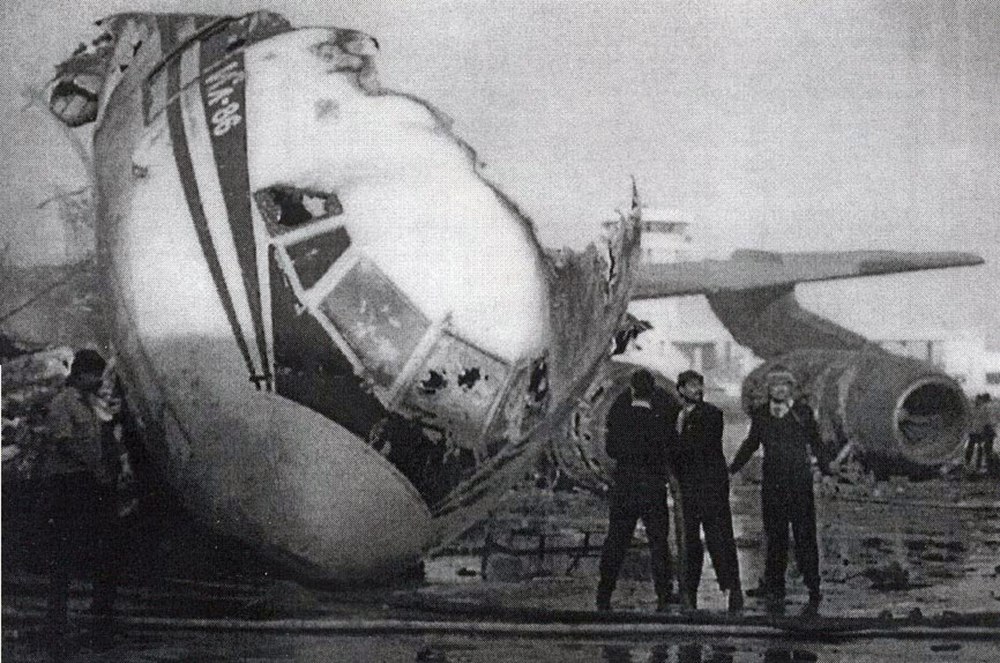
On the evening of March 7, 1994, an Aeroflot Ilyushin Il-86 arrived in Delhi from Singapore. The aircraft was scheduled to continue to Tashkent and then Moscow. However, during pre-flight preparations, a malfunction was detected in the oil system of one of the engines. As a result, the flight was delayed to carry out repairs.

The crew and passengers were accommodated in a hotel, and the aircraft was towed to a remote stand. Maintenance work was performed there, including a test engine run, which lasted throughout the night. Only the following day was the aircraft towed to the gate for boarding of crew and passengers before continuing on its Delhi–Tashkent–Moscow route.

At the same time, a Boeing 737-2R4C operated by Sahara India Airlines was performing a training flight in the vicinity of Delhi Airport. On board were four people: a training captain and three trainee pilots. They were practicing go-arounds and simulating various system failures.

During a simulated engine failure, one of the trainee pilots incorrectly applied rudder input in the opposite direction of what was required. The aircraft entered a left turn at an altitude of approximately 100 meters, with increasing bank toward the airport. At about 30 meters, the bank angle and descent trajectory steepened to 60-70°, and the flight crew were no longer able to recover. The aircraft impacted the concrete apron of Delhi Airport in close proximity to the Il-86 and was completely destroyed.

The incident occurred approximately one hour before the scheduled departure of the Russian airliner, so no passengers or flight crew were on board at the time. Only ground personnel were present, processing technical documentation: two Aeroflot engineers, an airline representative’s assistant, and three Indian ground technicians.

The burning debris from the crash partially destroyed the Il-86 and ignited a fire, which nearly consumed the entire aircraft and passengers’ luggage. All four crew members aboard the Boeing 737 were killed, along with three people on board the Il-86: the two Aeroflot engineers and one Indian technician. The airline representative’s assistant later died in the hospital from burn injuries. The remaining two Indian ground personnel sustained burns but survived. In addition, a fuel company employee on the ground was also killed.

The investigation concluded that the accident was caused by the trainee pilot’s incorrect rudder input during the engine failure simulation. The instructor failed to monitor or override rudder control and did not issue clear commands during the simulated failure exercise.
  • 👍 2
Post #71 318
In July 2024 a Gazprom Avia Sukhoi Superjet 100 on a routine ferry flight from Lukhovitsy to Vnukovo crashed into a field near Moscow. Everyone aboard — two pilots and a flight attendant — died when the aircraft plummeted almost vertically into the ground barely six minutes after take‑off.

A final report from the Interstate Aviation Committee (IAC) now explains how a pair of misinstalled angle‑of‑attack sensors and a cascade of misinterpreted warnings doomed the flight. Full story on Medium:

https://medium.com/@eskalion1/look-our-angle-of-attack-is-high-why-the-superjet-100-crashed-near-moscow-20c42ca95f16
Medium “Look, Our Angle of Attack Is High”: Why the Superjet 100 Crashed Near Moscow In July 2024 a Gazprom Avia Sukhoi Superjet 100 on a routine ferry flight from Lukhovitsy to Vnukovo crashed into a field near Moscow…
  • 👍 2
Post #70 264
​​Snowbound Tragedy

On January 13, 1982, Air Florida flight 90, a Boeing 737-222, was preparing for departure from Washington National Airport (now Reagan National). Shortly before the scheduled departure time, heavy snowfall forced the airport to shut down. Passengers had already boarded, and the aircraft had undergone de-icing, but clearance for takeoff was repeatedly delayed.

Eventually, about an hour past the scheduled departure, the aircraft was finally cleared to taxi to the runway. Snow continued to fall heavily. The ramp area was blanketed in 5 to 8 centimeters of snow. The first airport tug failed to push the aircraft back, and even the use of reverse thrust by the flight crew didn’t help. Only a second tug equipped with winter tires managed to move the aircraft away from the gate and onto the taxi route.

During taxi, the pilots debated whether a second de-icing was necessary. A considerable amount of time had passed since the first de-icing, and fresh snow had accumulated. Nevertheless, the crew concluded that the amount of snow and ice on the wings and fuselage was not critical. They also assumed that any remaining contamination would be blown off during the takeoff roll. Additionally, the captain taxied closely behind a preceding McDonnell Douglas DC-9, hoping the warm exhaust from its engines would help melt accumulated ice.

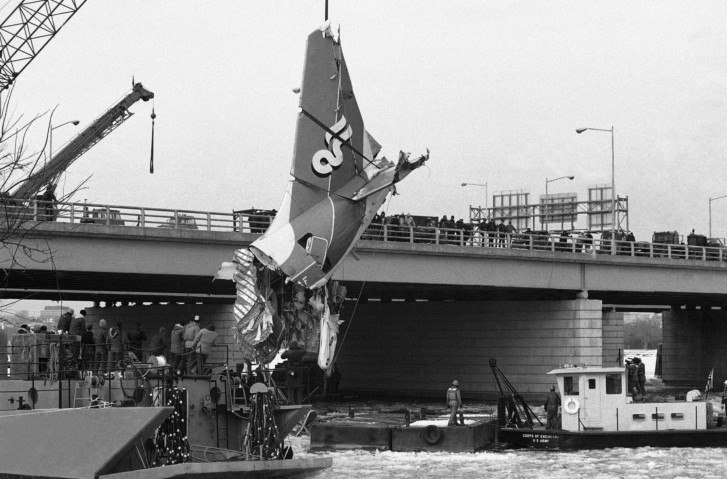
The aircraft eventually lined up on the runway and began its takeoff roll. During acceleration, the first officer noticed anomalies in instrument readings. After rotation, the aircraft’s nose pitched up abruptly. Severe vibrations followed. After traveling only 1,207 meters from the runway threshold and at an altitude of just 11.3 meters, the aircraft struck the 14th Street Bridge (also known as the Rochambeau Bridge) over the Potomac River. Several vehicles on the bridge were crushed - six cars destroyed, one truck overturned, and part of the bridge’s guardrail was torn away. The aircraft then crashed into the frozen Potomac River, breaking through the ice and sinking.

Seventy passengers and four crew members died in the crash. Only four passengers and one flight attendant survived. On the bridge, four motorists were killed and four others injured. In total, 78 people perished in the accident. The crash occurred just three kilometers from the White House, near the Pentagon and the Jefferson Memorial.

The cause of the crash was quickly identified through cockpit voice and flight data recorders: wing icing due to prolonged ground delay and inadequate preflight preparation. The crew failed to request a second de-icing before takeoff. It was also suggested that applying reverse thrust at the gate may have worsened the icing condition by pushing moisture onto the wings. The contaminated wings were unable to generate the necessary lift.

Furthermore, the pitot-static system was iced over, leading to erroneous airspeed and engine pressure ratio (EPR) readings. As a result, the captain set both engines to 25–30% less than the required takeoff thrust. After liftoff, the crew did not increase thrust to regain airspeed and avoid hitting the bridge. Investigators concluded that the captain failed to abort the takeoff early on when the first officer expressed concern over abnormal instrument indications. Additionally, due to inexperience with operations in such weather, the crew neglected to activate the engine anti-ice system.
  • 👍 1
Post #69 224
On a calm Saturday afternoon in May 2002, a routine flight from Taipei to Hong Kong ended in one of the most shocking mid-air breakups in modern aviation history. A Boeing 747 carrying 225 people suddenly vanished from radar over the Taiwan Strait.

What investigators discovered later was not a sudden act of sabotage or engine failure - but a flaw hidden deep within the aircraft’s own structure, dating back more than two decades.

https://medium.com/@eskalion1/the-boeing-747-tail-separation-china-airlines-flight-611-882989bc802b
Medium The Boeing 747 Tail Separation: China Airlines Flight 611 On a calm Saturday afternoon in May 2002, a routine flight from Taipei to Hong Kong ended in one of the most shocking mid-air breakups in…
  • 👍 2
Older posts →
Threads Profile ViewerView any public Threads profile without an account.Open ThreadLook →Writing with AI? Make it sound human.Metric37 rewrites AI drafts so they read naturally. Free AI detector, 1,500 words free.Try Metric37 →