
Strong winds blew a passenger jet off the runway
On the evening of December 20, 2008, a Continental Airlines Boeing 737-500 was operating a domestic flight from Denver to Houston. There were 115 people on board: 110 passengers and 5 crew members.
The captain, an experienced 50-year-old pilot with over 13,000 flight hours, including more than 6,300 on the Boeing 737, completed the standard pre-departure procedures with the first officer and received takeoff clearance at 18:17. ATC passed along the weather. It was cold in Denver but snow-free. A crosswind was reported on the runway, with a speed of up to 50 km/h.
The aircraft began its takeoff roll under the captain’s control. During the roll he gradually advanced the throttles to takeoff power. Nothing seemed out of the ordinary - until 18:18, when the aircraft suddenly veered sharply left. The trigger was a strong crosswind gust reaching 92 km/h.
The captain pressed the right pedal to realign the aircraft, then changed his mind and released it. The pedals primarily control the rudder and the nose landing gear steering: pressing the left pedal turns the nose left, pressing the right turns it right. As a result, the aircraft failed to re-align with the runway and, four seconds later, departed its edge.
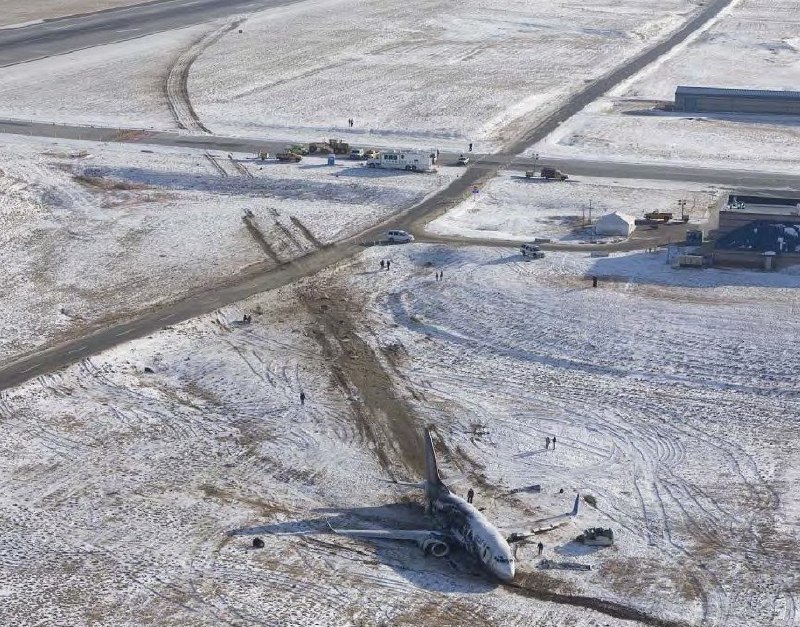
The captain initiated a rejected takeoff. Shortly afterward the aircraft crossed a ravine, bounced up and slammed back onto the ground. The left engine separated and fell away, and the right engine caught fire. After sliding several hundred meters, the aircraft came to a stop 1,655 meters from the terminal building. During the ground slide the airframe broke into two sections.
Both pilots, injured, were incapacitated for about two minutes and did not run the emergency checklist. The flight attendants in the cabin began the evacuation on their own. The first officer soon recovered from shock and noticed the engine fire. The captain also came to and, with help from the first officer and a flight attendant, exited the aircraft. They were the last to evacuate through the forward door.
Fortunately, no one was killed. However, 38 people sustained injuries of varying severity. Two passengers and the captain were hospitalized with serious injuries. Because of the right-engine fire, the fuselage on the starboard side was completely burned out.
A landing gear malfunction was initially suspected, but it was not confirmed - the gear was normal. In July 2010 the final investigation report was released. It concluded the accident resulted from captain error: during the wind shift he stopped applying right pedal to keep the aircraft aligned with the runway centerline, allowing it to drift left and run off the runway. A contributing factor was the lack of precise wind information for the runway.
Post #85
329
- 👍 4