
Snowbound Tragedy
On January 13, 1982, Air Florida flight 90, a Boeing 737-222, was preparing for departure from Washington National Airport (now Reagan National). Shortly before the scheduled departure time, heavy snowfall forced the airport to shut down. Passengers had already boarded, and the aircraft had undergone de-icing, but clearance for takeoff was repeatedly delayed.
Eventually, about an hour past the scheduled departure, the aircraft was finally cleared to taxi to the runway. Snow continued to fall heavily. The ramp area was blanketed in 5 to 8 centimeters of snow. The first airport tug failed to push the aircraft back, and even the use of reverse thrust by the flight crew didn’t help. Only a second tug equipped with winter tires managed to move the aircraft away from the gate and onto the taxi route.
During taxi, the pilots debated whether a second de-icing was necessary. A considerable amount of time had passed since the first de-icing, and fresh snow had accumulated. Nevertheless, the crew concluded that the amount of snow and ice on the wings and fuselage was not critical. They also assumed that any remaining contamination would be blown off during the takeoff roll. Additionally, the captain taxied closely behind a preceding McDonnell Douglas DC-9, hoping the warm exhaust from its engines would help melt accumulated ice.
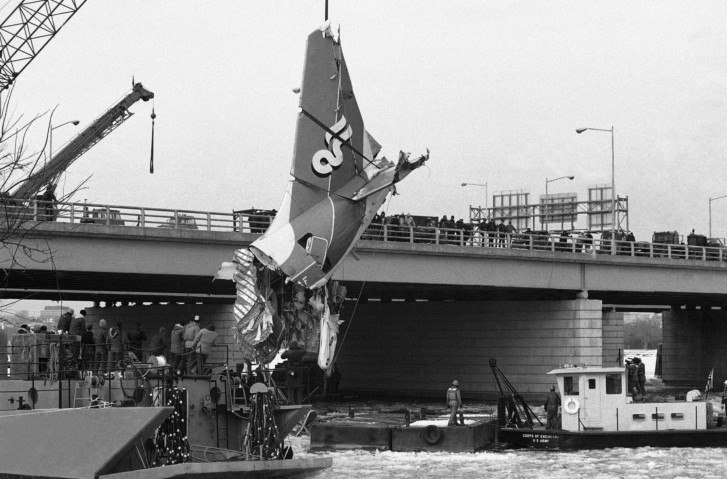
The aircraft eventually lined up on the runway and began its takeoff roll. During acceleration, the first officer noticed anomalies in instrument readings. After rotation, the aircraft’s nose pitched up abruptly. Severe vibrations followed. After traveling only 1,207 meters from the runway threshold and at an altitude of just 11.3 meters, the aircraft struck the 14th Street Bridge (also known as the Rochambeau Bridge) over the Potomac River. Several vehicles on the bridge were crushed - six cars destroyed, one truck overturned, and part of the bridge’s guardrail was torn away. The aircraft then crashed into the frozen Potomac River, breaking through the ice and sinking.
Seventy passengers and four crew members died in the crash. Only four passengers and one flight attendant survived. On the bridge, four motorists were killed and four others injured. In total, 78 people perished in the accident. The crash occurred just three kilometers from the White House, near the Pentagon and the Jefferson Memorial.
The cause of the crash was quickly identified through cockpit voice and flight data recorders: wing icing due to prolonged ground delay and inadequate preflight preparation. The crew failed to request a second de-icing before takeoff. It was also suggested that applying reverse thrust at the gate may have worsened the icing condition by pushing moisture onto the wings. The contaminated wings were unable to generate the necessary lift.
Furthermore, the pitot-static system was iced over, leading to erroneous airspeed and engine pressure ratio (EPR) readings. As a result, the captain set both engines to 25–30% less than the required takeoff thrust. After liftoff, the crew did not increase thrust to regain airspeed and avoid hitting the bridge. Investigators concluded that the captain failed to abort the takeoff early on when the first officer expressed concern over abnormal instrument indications. Additionally, due to inexperience with operations in such weather, the crew neglected to activate the engine anti-ice system.
Post #70
264
- 👍 1