
😎Layering - how a fake buyer wall gets painted in the Bitcoin order book 😎
Guys, today we're breaking down one of the most cynical manipulation tactics in the exchange order book. It doesn't require huge capital, doesn't leave obvious traces, and works even against experienced algorithms.
It's called Layering.
What it is
You open the BTC order book and see a ladder of buy orders.
Not one, but an entire layer.
Say, 800 contracts at 80,000, 1000 at 79,900,
1200 at 79,800, 1500 at 79,700.
• Buy-side depth is three times greater than sell-side depth.
The brain automatically concludes:
there's a big player sitting below, the market is protected, there's nowhere to fall.
The problem is that this wall of liquidity can be a phantom.
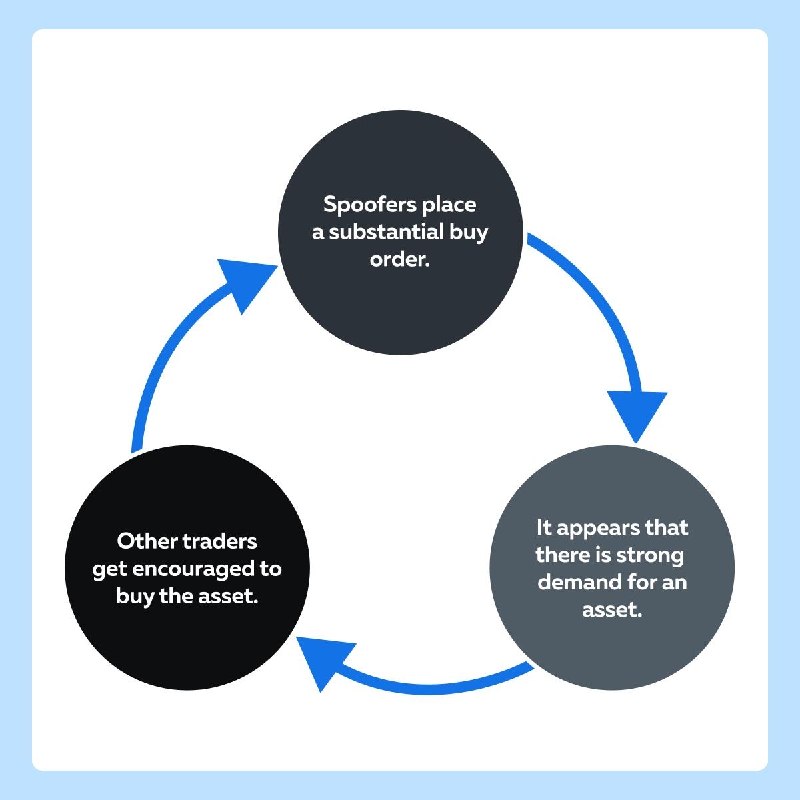
Layering is when one participant places multiple orders at different levels to create an illusion of strength. It's not just one large order that vanishes on touch. It's an entire system designed to make you believe there's real demand below the price. In reality, there isn't.
Why it works
The market sees an imbalance. Sellers pull their orders back, unwilling to fight the "buyer." Buyers get more aggressive, thinking they're running out of time. Algorithms register the growing depth and recalibrate their models. Everyone starts acting as if there's a mega-fund sitting under the market. And then the orders disappear one by one. First the 800, then the 1000, then the 1200. Price plunges, stop-losses trigger, and you hand your money over to those very orders that no longer exist.
This isn't price manipulation - it's manipulation of your perception of the market.
Nobody tells you "buy."
You're shown a picture in which buying seems like the only reasonable decision.
How to spot it
There are several signs worth watching so you don't walk into the trap.
1) the lifespan of orders.
A real large order usually sits for quite a while, because there's genuine intent to execute behind it. Phantom orders live for seconds or milliseconds, especially as price approaches.
2) behavior on touch.
If an order gets partially filled and immediately refills, that's a sign of real demand. But if it vanishes before price even reaches it, or gets pulled at the first serious touch, that's a reason to be suspicious.
4) synchronicity.
Phantom levels often appear and disappear simultaneously, as if controlled by a single bot. If you see several orders at different levels get pulled at the same moment, that's not a coincidence.
4) repetition.
The same structure can appear in the same section of the order book several times a day. A real buyer isn't that predictable. A slick bot - absolutely.
But there's a nuance almost nobody talks about. Even if you've learned to recognize phantom liquidity, that doesn't mean you know what to do next. Because Layering is often used not on its own, but as part of a more complex construction. The same wall can be a trap for longs, or it can be cover for a short position.
What exactly does the MM do after pulling the orders?
How do you tell simple manipulation from preparation for a real move?
And why is it sometimes better not to trade at all when you see Layering in the book?
That's for the next post.
In the meantime, think about it: how many times have you seen a perfect buyer wall
that then vanished without a trace?
And what happened to the price a minute later?
😎😎😎😎
Post #33
18
- 👍 6
- ❤ 4
- 🔥 4