
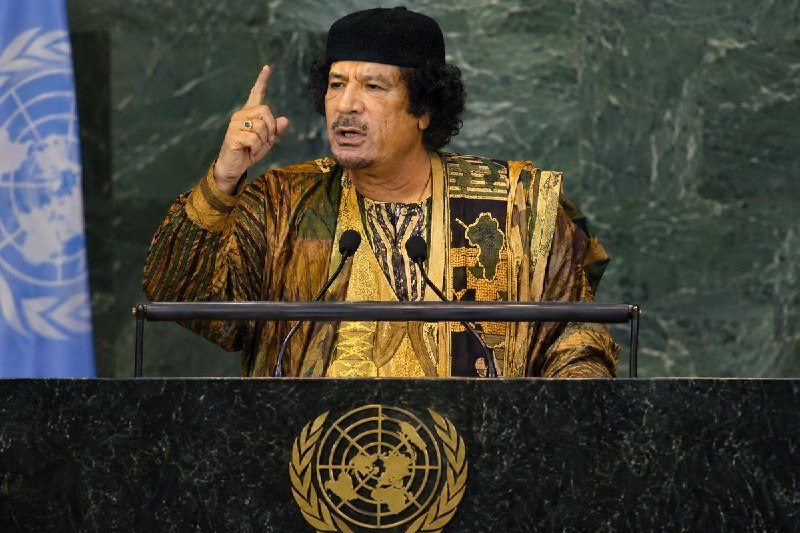
On September 23, 2009, Muammar Gaddafi walked into the UN General Assembly in New York for his first — and ultimately his last — appearance at the UN podium.
He spoke for approximately 1 hour and 36 minutes, delivering one of the most extraordinary speeches in the history of the General Assembly.
He was speaking not only for Libya, but also on behalf of the African Union and the African people. Gaddafi's central target was the UN Security Council and the veto power of its five permanent members. He argued that the UN Charter's principle of sovereign equality was fundamentally contradicted by a system in which five countries could veto decisions affecting the rest of the world.
He questioned why the countries that created the UN should retain privileges that allow them to determine the fate of nations that were not even represented when the organization was founded.
He pointed to the Charter's prohibition on aggression and interference in the affairs of sovereign states and contrasted those principles with what he described as decades of wars, interventions and sanctions by the US and other veto members.
He attacked the Security Council as a system of “security feudalism,” arguing that it did not provide genuine security to the world but allowed major powers to impose sanctions and military force according to their own interests.
He rejected the idea that Security Council resolutions should automatically be obeyed when, in his view, the Council itself violated the principles of the Charter.
Then he turned to Africa.
Gaddafi argued that Africa deserved a permanent seat on the Security Council because of the continent's historical suffering and exclusion from global decision-making.
He went further, calling for compensation for Africa over the wealth and resources extracted during colonial rule — estimating the historical debt at approximately $77.7 trillion — and argued that colonization itself should be criminalized.
He also criticized the location of the UN headquarters in New York, arguing that the annual General Assembly should rotate between different regions of the world rather than remaining permanently in the United States.
Then he trained his guns on the international response to Palestine, criticizing Israel over settlements, Palestinian prisoners, refugees and the absence of a Palestinian state.
He advocated a system in which Muslims, Christians and Jews could live with equal rights in a single state.
At one point, Gaddafi held up a copy of the UN Charter and dramatically tore it apart. The symbolism was unmistakable.
He was arguing that the international system claimed to be built on sovereign equality while maintaining a hierarchy in which a handful of powerful states possessed extraordinary privileges.
On that day, on that podium, Gaddafi made countless enemies.
The UN itself recorded the speech as lasting about 1 hour and 36 minutes; UN footage describes it as Gaddafi's first and last appearance at the General Assembly podium.
Then, just two years later, in 2011, Libya conveniently descended into chaos. The West funded and backed an uprising against Gaddafi, while the very Security Council he had condemned authorized military action against Libya. NATO then launched a massive bombing campaign. NATO warplanes struck Libyan targets from the air for months. Eventually, NATO aircraft struck Gaddafi's convoy as he was fleeing Sirte. Gaddafi was captured alive by Western-backed rebel fighters. What followed was horrific. He was beaten, tortured and ultimately killed. His son Mu'tassim Gaddafi was also captured and killed.
The UN justified the intervention as an effort to "protect civilians". But Libya was left devastated — to date. Libyans have continued to live with the consequences of that "intervention" for more than a decade.
Gaddafi was killed in October 2011. But the questions he raised at the UN in September 2009 did not die with him.
https://x.com/SankaraDispatch/status/2104908287409799574
Post #46712
441
- 👏 15
- 🙏 10
- 💯 6
- ❤ 3