TGViewer
Channel Public Channel
The Macro Butler

The Macro Butler

@themacrobutlersubstack

The Macro Butler aims to deliver concise yet comprehensive macroeconomic insights that impact global and regional markets. We analyze key indicators, trends to provide actionable & timely investment recommendations to all kind of investors.
Subscribers
447
Photos
1.7K
Videos
137
Links
1.2K
Recent Posts 20 shown
Post #3181 31
The labour market didn't weaken — it was always this weak, and the statisticians have just caught up.
Post #3180 31
Last month everyone with a modicum of common sense suggested the four-sigma August miracle would not survive its revision. It took one cycle. September payrolls printed 29,000 — below every estimate on the Street — while August was cut from 162,000 to 133,000 and July revised from +21,000 all the way to minus 10,000. The month Wall Street EYIs celebrated as proof of resilience has quietly become a contraction. Unemployment rose to 4.2%, with 78,000 more people out of work, and average hourly earnings managed just 0.1%, trimming annual wage growth to 3.0% — comfortably below the 4.6% inflation consumers expect.
Post #3179 52
Every refiner is now hoarding for home — which is precisely how a shortage becomes a scramble.
Post #3178 51
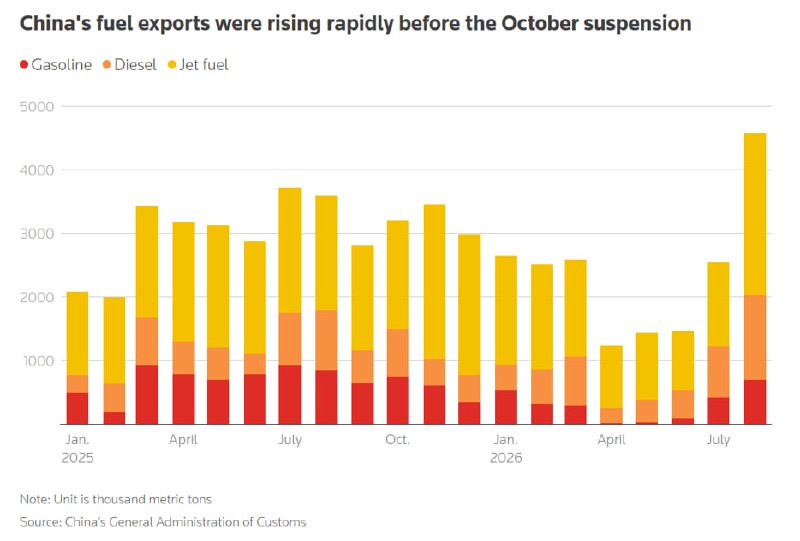
China has suspended refined fuel exports for October. PetroChina cancelled several gasoline and jet cargoes, Zhejiang Petrochemical scheduled none over the National Day holiday, and Beijing has authorised no October shipments beyond Hong Kong and Macau. The stated reason is domestic security of supply, and the numbers support it: Kpler puts Chinese commercial diesel and gasoil inventories around 20 million barrels below pre-war levels, with gasoline some 9 million short of the threshold Beijing wants restored before exports resume. Exports may restart after 7 October, inventory permitting. Consider the timing. Saudi output is at 1990 lows with the East-West pipeline shut, Russian refineries are under attack, US Midwest gasoline stocks are at a record low with national inventories the weakest since 2014, and Washington is debating a diesel export ban.
Post #3177 54
Export controls govern where a chip is shipped — not who is logged into it.
Post #3176 53
Tencent has signed a five-year, roughly $7 billion deal to rent about 100,000 advanced AI chips from Oracle — 30% paid upfront, approximately $2.1 billion — with the hardware sitting in Southeast Asian data centres rather than in China. The implied rate works out near $1.60 per chip-hour, which is a fraction of the going market price. Ask why a seller accepts a fraction. Oracle's flagship US data centre is under force majeure, its credit default swaps are at record levels, and Larry Ellison is pledging stock elsewhere. A company that needs cash sells cheaply to whoever has it, and Tencent has it. Note the geography, which does all the work: the chips Beijing cannot buy are perfectly rentable one border away, billed by the hour, in facilities a Chinese firm neither owns nor imports. Washington built a wall around the hardware and left the electricity socket outside.
Post #3175 50
Every developed sovereign is discovering the same thing at once — the debt was always affordable, but only at rates that no longer exist.
Post #3174 51
The European sovereign debt crisis has returned from its long holiday. The OAT-Bund 10-year spread hit the widest since 2012, while the French 2-year spread to Germany just recorded the biggest move since 2012. French CDS have doubled in a month. Contagion arrived on schedule: the Italy-Germany 2-year spread nearly doubled, the largest daily jump since 2020. The arithmetic behind the panic is unglamorous. France's average interest cost is migrating from 2% toward 3%, and Paris needs a primary surplus of +1% to stabilise its debt — a figure the Fifth Republic has achieved roughly as often as it has formed a lasting government.
  • 👍 1
Post #3173 50
The factories are busy because one industry is buying everything — and everybody else is paying the clearing price.
Post #3172 54
American manufacturing is having its best run since May 2022. ISM came in at 54.5 against 54.0 expected, with new orders and employment both bouncing, while S&P Global's final September reading held near four-year highs. September has seen the pace of US manufacturing growth pick up, with surging orders prompting factories to expand output and hiring. Splendid — until the next sentence: demand outstripping supply means inflationary pressures remain a concern, and the prices paid component duly spiked. The source of the demand is worth naming. Growth was driven by machinery and equipment investment "linked in many cases to rising AI-related spend." So, the boom is one sector buying hardware for data centres, bidding against everyone else for the same chips, copper, transformers and freight — which is why the price gauges are lighting up.
Post #3171 64
Before Washington demands another dollar in tax to service $40 trillion in debt, perhaps it should first explain where the last half-trillion went — because a government that cannot say whether it was robbed of $233 billion or $521 billion has not earned the right to audit your wallet.
Post #3170 68
The Ministry of Fiscal Responsibility has an accounting note it would rather you not read alongside its demands for higher taxes: the government's own watchdog, the GAO, estimates that Washington loses between $233 billion and $521 billion every single year to outright fraud — not waste, not bloat, not interest on the debt, but theft — which at the upper end is $1.4 billion a day, or roughly 10% of an entire year's federal revenue simply vanishing into criminal pockets. The range is a quarter-trillion dollars wide because the government cannot even determine how much it is being robbed, a confession that in any private company would see the board defenestrated before lunch; in Washington, they simply raise the debt ceiling.

https://www.gao.gov/blog/nine-ways-congress-can-combat-fraud-federal-government
Post #3169 63
Minutes after the Fed's own inspector general cleared the Eccles renovation of criminality - and of administrative misconduct – Donald Copperfield made clear he is not treating the Horowitz report as the last word. The FED cannot forecast inflation, and now we know it cannot budget for it either — in its own lobby.
Post #3168 64
The Fed's Inspector General has examined the renovation of the Eccles Building and found no criminal violation and no administrative misconduct — merely everything else. The budget rose from $1.3 billion in 2020 to $2.4 billion, an 80% overrun. The Board ignored earlier recommendations to set a cost ceiling, never requested construction cost estimates, and four years in — after contracts were awarded — had still not established a guaranteed maximum price. Some work went out with insufficient bidding. Governance was, in the IG's assessment, inadequate for a project of this scale. Savour the irony: the institution charged with managing the price level of the world's reserve currency could not manage the price of its own building, and the explanation offered includes "inflationary pressures." Powell's June 2025 testimony denied the VIP dining room, the new marble, the beehives and the roof terrace gardens; the IG says those items didn't materially drive costs, which is a narrower vindication than it sounds.
  • ❤ 1
Post #3164 59
US inflation did not slow— the government propaganda changed the deflator, and the savings rate quietly paid the difference.
Post #3163 60
Core PCE came in at 3.0% year-on-year against 3.3% expected, and 0.2% on the month — a splendid miss, achieved largely by spreadsheet. The BEA has retroactively revised its methodology back to Q1 2021, shaving roughly 18 basis points off the annual pace via three changes: portfolio management services switched to a quantity-based series, computer software to a new composite deflator, and legal services to a revised measure after the old CPI approach proved unreliable. Inflation did not fall; the ruler shortened. Headline PCE printed 0.3% monthly and 3.4% annually against 3.7% expected. Now the part nobody revised: personal spending surged 0.9% while income rose just 0.2%, the slowest since April 2022, and the savings rate collapsed to 4.1% from 4.6% — the lowest since November 2022. Americans are funding record spending out of a shrinking cushion.
Older posts →

About this channel

How can I read @themacrobutlersubstack without a Telegram account?
TGViewer shows the public web preview Telegram publishes for The Macro Butler: recent posts, photos, videos and the subscriber count, with no app, login or account.
How many subscribers does The Macro Butler have?
The Macro Butler (@themacrobutlersubstack) has 447 subscribers on Telegram, refreshed roughly every 30 minutes.
Does The Macro Butler know I viewed it here?
No. Public channel previews carry no viewer identity, and TGViewer has no accounts or tracking of what you look up.
Threads Profile ViewerView any public Threads profile without an account.Open ThreadLook →Writing with AI? Make it sound human.Metric37 rewrites AI drafts so they read naturally. Free AI detector, 1,500 words free.Try Metric37 →