5/17 Regulation of cytokinesis by Rho GTPase flux Rho activation by guanine nucleotide exchange factors (GEFs) - initiation Rho inactivation by GTPase activating proteins (GAPs) - termination MgcRacGAP: a conserved cytokinesis regulator thought to be required only at the end of cytokinesis This paper: GAP activity of MgcRacGAP is necessary early during cytokinesis for the formation and maintenance of the Rho activity zone the GAP domain of MgcRacGAP has two unexpected roles throughout cytokinesis: 1. it transiently anchors active Rho 2. it promotes local Rho inactivation, resulting in the constant flux of Rho through the GTPase cycle
centralspindlin complex: kinesin MKLP-1 and the Rho GAP MgcRacGAP - activate Rho through Ect2, a Rho GEF that binds MgcRacGAP
4/12 Midblastula transition (MBT) of the cell cycles in the yolk and pigment granule-free translucent blastomeres obtained from centrifuged Xenopus embryos (Development, differentiation, and growth 2005 Japan)
4/11 A Model for Cleavage Plane Determination in Early Amphibian and Fish Embryos (Current Biology 2010 Tim Mitchison) metaphase spindles are positioned and oriented by interactions of their astral microtubules with the cellular cortex, followed by cleavage in the plane of the metaphase plate a model to explain cleavage plane geometry in which the length of astral microtubules is limited by interaction with these boundaries, causing length asymmetries - Dynein anchored in the cytoplasm then generates length-dependent pulling forces, which move and orient centrosomes
4/11 Nuclear Size Scaling during Xenopus Early Development Contributes to Midblastula Transition Timing (2015 Current biology University of Wyoming) The N/C volume ratio increases prior to the MBT during Xenopus development Nuclear size and the N/C volume ratio can be manipulated in Xenopus embryos Altering the N/C volume ratio changes the timing of zygotic gene transcription Altering the N/C volume ratio changes the timing of cellular hallmarks of the MBT
4/11 Exploring generic principles of compartmentalization in a developmental in vitro model (2023 developments German) protocell patterns emerge by simultaneous formation of randomly assembling protocells that grow at a uniform rate towards a frustrated arrangement before fusion of adjacent protocells eventually drives coarsening
4/11 Dynactin functions as both a dynamic tether and brake during dynein-driven motility (nature communication 2014 Upenn) dynactin enhances the initial recruitment of dynein onto microtubules and promotes the sustained engagement of dynein with its cytoskeletal track
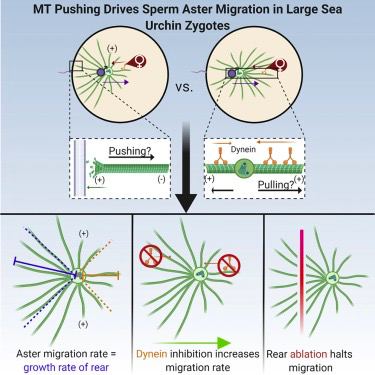
4/11 A Pushing Mechanism for Microtubule Aster Positioning in a Large Cell Type (Cell report 2020 Boston College David R. Burgess) Chemical ablation of rear astral MTs halts aster migration Inhibition of dynein-mediated transport increases aster migration rate After sperm aster centration, the female pronucleus pulls by dynein on the aster Sperm aster geometry and growth dynamics are consistent with pushing
4/11 Dynein/dynactin regulate metaphase spindle length by targeting depolymerizing activities to spindle poles (JCB 2004 Tarun M. Kapoor Rockefeller) dynein/dynactin: a multi-subunit microtubule minus-end–directed motor complex NuMA:a microtubule cross-linker Dynein/dynactin + NuMA - regulate the MT length dynactin or NuMA inhibition suppresses microtubule disassembly at spindle poles without affecting polewards microtubule sliding Inhibition of Kif2a, a KinI kinesin known to depolymerize microtubules in vitro, results in increased spindle microtubule length. dynein/dynactin contribute to the targeting of Kif2a to spindle poles, suggesting a model in which dynein/dynactin regulate spindle length and coordinate flux by maintaining microtubule depolymerizing activities at spindle poles.
3/15 Katanin Contributes to Interspecies Spindle Length Scaling in Xenopus (Cell 2011 Rebecca Heald) Phosphation of AuroraB -> decrease the serving of katanin -> decrease MT depolymerization rate -> increase the spindle size The balance of k-fiber number and MT depolymerization rate -> maintain the spindle morphology
1/12 Importin α partitioning to the plasma membrane regulates intracellular scaling These experiments identify importin α as a conserved surface area-to-volume sensor that scales intracellular structures to cell size.
1/22 Importin Importin is a type of karyopherin that transports protein molecules from the cell's cytoplasm to the nucleus. It does so by binding to specific recognition sequences, called nuclear localization sequences (NLS). Importin has two subunits, importin α and importin β. Members of the importin-β family can bind and transport cargo by themselves, or can form heterodimers with importin-α. As part of a heterodimer, importin-β mediates interactions with the pore complex, while importin-α acts as an adaptor protein to bind the nuclear localization signal (NLS) on the cargo. The NLS-Importin α-Importin β trimer dissociates after binding to Ran GTP inside the nucleus, with the two importin proteins being recycled to the cytoplasm for further use. Importin-β - 90-95 kDa Importin-α - an adaptor to cargo proteins (via interactions with the NLS)
1/22 A tug of war between filament treadmilling and myosin induced contractility generates actin rings (2022 elife) Actin filaments are highly dynamic, undergoing rapid polymerization and depolymerization, and are subject to contractile forces generated by myosin motors Actin polymerization is polarized: monomeric actin (G-actin) binds to the barbed ends of filaments and polymeric actin (F-actin) dissociates from the pointed ends in a process called treadmilling
1/15 In Vitro Reconstitution of Self-Organizing Protein Patterns on Supported Lipid Bilayers (2018 Jove) Escherichia coli MinCDE system (a reaction-diffusion system) - This system is based on the ATPase MinD, the ATPase activating protein MinE, and the membrane as a spatial reaction matrix; MinC is not part of the pattern formation mechanism, but is the actual functional agent: an inhibitor of the main divisome protein FtsZ
1/14 Prc1E and Kif4A control microtubule organization within and between large Xenopus egg asters (2018 MBoC Tim Mitchison) conserved cytokinesis midzone proteins: Prc1 and Kif4A. Prc1E Prc1E was required for Kif4A recruitment but not vice versa plus-end growth slowed and terminated preferentially within interaction zones, resulting in a block to interpenetration that depended on both Prc1E and Kif4A We propose that Prc1E and Kif4, together with catastrophe factors, promote “anti-parallel pruning” that enforces radial organization within asters and generates boundaries to microtubule growth between asters. The plus-end–directed kinesin-family motor Kif23 (a.k.a. MKLP1) transports the furrow-stimulating factor RacGap1 (together they constitute the centralspindlin complex) to the center of the midzone, while the plus-end–directed motor Kif20A (a.k.a. MKLP2) transports the chromosome passenger complex (CPC) - Centralspindlin and the CPC then signal locally to the equatorial cortex to initiate the furrow
1/14 A mitotic chromatin phase transition prevents perforation by microtubules (Nature 2022 Australia) a substantial global reduction in chromatin solubility caused by deacetylation during mitotic entry converts chromosomes into phase-separated bodies rather than loose bottlebrush structures with chromatin fibre loops extending into the cytoplasm The immiscible mitotic chromatin forms a surface that provides resistance to microtubule perforation while allowing local chromatin fibre sliding internally, as required for continuous dynamic loop formation by condensin By contrast, hyperacetylated mitotic chromosomes lack a defined surface boundary, are frequently perforated by microtubules and are prone to missegregation.
1/14 Action at a distance during cytokinesis (JCB 2009 UW & UWM) cells depleted of astral microtubules conduct accurate, complete cytokinesis asters alone can support furrow induction without a spindle, but only when sufficiently separated Ablation of a single centrosome displaces furrows away from the remaining centrosome; ablation of both centrosomes causes broad, inefficient furrowing the asters confer accuracy and precision to a primary furrow-inducing signal that can reach the cell surface from the spindle without transport on microtubules astral microtubules are not needed to transmit the cytokinetic signal, even in large round cells where the nearest spindle microtubule is far from the cell surface
1/14 ATP as a biological hydrotrope (Science 2017 MPI) Hydrotropes are small molecules that solubilize hydrophobic molecules in aqueous solutions. ATP at concentrations found in cells could act as a hydrotrope to help solubilize hydrophobic proteins. ATP inhibits the phase separation of unstructured proteins.
12/28 Glassfrogs conceal blood in their liver to maintain transparency (Science 2022 Duke) glass frogs are able to maintain a high level of transparency because a large proportion of their red blood cells are “hidden” in the liver This strategy allows the frogs to attain transparency when they are the most vulnerable
How can I read @paperreading without a Telegram account?
TGViewer shows the public web preview Telegram publishes for Paper/Seminar Record: recent posts, photos, videos and the subscriber count, with no app, login or account.
How many subscribers does Paper/Seminar Record have?
Paper/Seminar Record (@paperreading) has 74 subscribers on Telegram, refreshed roughly every 30 minutes.
Does Paper/Seminar Record know I viewed it here?
No. Public channel previews carry no viewer identity, and TGViewer has no accounts or tracking of what you look up.