Post #17912
161
Channel ✦ Verified Channel
 OB
OB Observer Research Foundation
@orftg
Non-partisan, independent analysis on security, strategy, economy, development, energy & global governance.
- Subscribers
- 17.4K
- Photos
- 2.6K
- Videos
- 443
- Links
- 14.8K
Recent Posts 16 shown
Post #17911
243
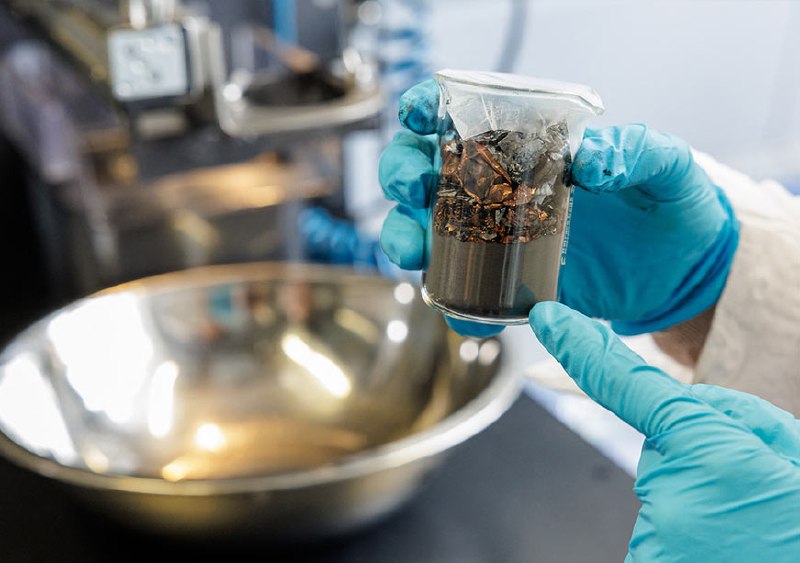
What if India’s growing e-waste mountain isn't just an environmental liability but a US$3.5 billion opportunity?
As EV sales scale rapidly India faces a dual imperative: securing critical raw materials currently 100% imported, and managing 14 million tonnes of expected e-waste.
Black mass recycling offers a path to reduce import dependence.
However, this brief argues that turning recycling capacity into true circularity requires recovered minerals to re-enter domestic cell manufacturing. A targeted policy push is essential to connect recyclers with material producers and build a closed-loop supply chain: https://www.orfonline.org/expert-speak/from-black-mass-to-batteries-building-a-circular-battery-value-chain
As EV sales scale rapidly India faces a dual imperative: securing critical raw materials currently 100% imported, and managing 14 million tonnes of expected e-waste.
Black mass recycling offers a path to reduce import dependence.
However, this brief argues that turning recycling capacity into true circularity requires recovered minerals to re-enter domestic cell manufacturing. A targeted policy push is essential to connect recyclers with material producers and build a closed-loop supply chain: https://www.orfonline.org/expert-speak/from-black-mass-to-batteries-building-a-circular-battery-value-chain
Post #17910
227
Creating domestic capacity is one thing—keeping it viable against cheap imports is another. How does India build true strategic redundancy in pharma?
This brief argues that market forces won't reward spare capacity or secondary sourcing on their own. To protect public health from future supply shocks, policy must view strategic redundancy like an insurance premium: maintaining key domestic capabilities even when they can't consistently compete on price: https://www.orfonline.org/expert-speak/tolerating-inefficiency-building-strategic-redundancy-in-indian-pharma
This brief argues that market forces won't reward spare capacity or secondary sourcing on their own. To protect public health from future supply shocks, policy must view strategic redundancy like an insurance premium: maintaining key domestic capabilities even when they can't consistently compete on price: https://www.orfonline.org/expert-speak/tolerating-inefficiency-building-strategic-redundancy-in-indian-pharma

Post #17909
273
Japan is spending trillions on modern defense hardware—but who will operate it?
While the Defence of Japan 2026 white paper highlights ambitious spending and technological pivots, Japan’s defense expansion faces a critical bottleneck: a severe military personnel shortage.
With a rapidly shrinking youth population, a competitive private job market, and persistent recruitment shortfalls,this brief argues that Japan’s strategic pivot will remain incomplete without deep institutional reform: https://www.orfonline.org/expert-speak/japan-s-defence-reorientation-hinges-on-personnel-reform
While the Defence of Japan 2026 white paper highlights ambitious spending and technological pivots, Japan’s defense expansion faces a critical bottleneck: a severe military personnel shortage.
With a rapidly shrinking youth population, a competitive private job market, and persistent recruitment shortfalls,this brief argues that Japan’s strategic pivot will remain incomplete without deep institutional reform: https://www.orfonline.org/expert-speak/japan-s-defence-reorientation-hinges-on-personnel-reform

Post #17908
307
A civil nuclear pact grants Saudi Arabia uranium enrichment rights the US once denied Iran and the UAE. Is Washington setting off a Middle East arms race?
The landmark 123 agreement between Washington and Riyadh lays the legal foundation for domestic uranium enrichment up to 20%. While meant to power civilian reactors and anchor Saudi Arabia to the US rather than China or Russia, the deal drops the long-held ""Gold Standard"" requirement to forgo enrichment and reprocessing.
This brief argues that amidst ongoing regional conflict and Iran's expanding stockpile, granting enrichment rights to Riyadh could prompt rival powers to seek similar capabilities, opening a dangerous new chapter in Middle Eastern nuclear proliferation: https://www.orfonline.org/expert-speak/how-the-us-saudi-nuclear-deal-could-ignite-a-middle-east-arms-race
The landmark 123 agreement between Washington and Riyadh lays the legal foundation for domestic uranium enrichment up to 20%. While meant to power civilian reactors and anchor Saudi Arabia to the US rather than China or Russia, the deal drops the long-held ""Gold Standard"" requirement to forgo enrichment and reprocessing.
This brief argues that amidst ongoing regional conflict and Iran's expanding stockpile, granting enrichment rights to Riyadh could prompt rival powers to seek similar capabilities, opening a dangerous new chapter in Middle Eastern nuclear proliferation: https://www.orfonline.org/expert-speak/how-the-us-saudi-nuclear-deal-could-ignite-a-middle-east-arms-race

Post #17907
424
Squeezed between India and China, how does a nation expand its diplomatic footprint? For Bhutan, the answer lies in Buddhist diplomacy.
Confronted with domestic demographic shifts, Thimphu is actively deploying its spiritual heritage to secure its strategic interests and preserve its national identity.
The brief traces how initiatives like new temple developments in Lumbini and Rajgir, high-level royal diplomacy, and the flagship Gelephu Mindfulness City project are transforming cultural capital into normative influence and economic opportunity: https://www.orfonline.org/expert-speak/between-survival-and-strategy-reading-bhutan-s-recent-buddhist-outreach
Confronted with domestic demographic shifts, Thimphu is actively deploying its spiritual heritage to secure its strategic interests and preserve its national identity.
The brief traces how initiatives like new temple developments in Lumbini and Rajgir, high-level royal diplomacy, and the flagship Gelephu Mindfulness City project are transforming cultural capital into normative influence and economic opportunity: https://www.orfonline.org/expert-speak/between-survival-and-strategy-reading-bhutan-s-recent-buddhist-outreach

Post #17906
386
For Asia’s aquatic food systems which generate 76% of the world’s aquatic animals and algae resilience begins before the port, at the hatchery, where the quality of larvae, live feed, and seedstock shapes survival rates and downstream reliability.
Disruptions in the Suez and Panama Canals have proven that relying on single, hyper-efficient trade routes is no longer viable.
This brief highlights why securing maritime food supply chains requires moving from vulnerable, single routes to a network of distributed production nodes and digital cold chains: https://www.orfonline.org/expert-speak/from-hatchery-to-hinterland-securing-asia-s-blue-food-corridors
Disruptions in the Suez and Panama Canals have proven that relying on single, hyper-efficient trade routes is no longer viable.
This brief highlights why securing maritime food supply chains requires moving from vulnerable, single routes to a network of distributed production nodes and digital cold chains: https://www.orfonline.org/expert-speak/from-hatchery-to-hinterland-securing-asia-s-blue-food-corridors

- ❤ 1
Post #17905
375
Tokenmaxxing.' is reshaping the AI economy but the real return on that spending tells a different story.
For every dollar an enterprise spends on AI coding tools, 18 cents becomes shipped product, while the remaining 82 cents goes towards fixing, reworking, and reviewing the code generated by those tools.
This brief argues that government programmes and enterprises must shift from tracking raw token consumption to evaluating tangible outcomes—measuring cost per completed task, error rates, and acceptance rates to determine true operational value: https://www.orfonline.org/expert-speak/from-tokens-to-weights-the-changing-value-of-ai
For every dollar an enterprise spends on AI coding tools, 18 cents becomes shipped product, while the remaining 82 cents goes towards fixing, reworking, and reviewing the code generated by those tools.
This brief argues that government programmes and enterprises must shift from tracking raw token consumption to evaluating tangible outcomes—measuring cost per completed task, error rates, and acceptance rates to determine true operational value: https://www.orfonline.org/expert-speak/from-tokens-to-weights-the-changing-value-of-ai

Post #17904
372
In the last decade, Chinese research vessels in the Indian Ocean have been known to disable their tracking systems to avoid detection.
The problem isn't spotting them, it's knowing what they're doing there.
Existing maritime security mechanisms rely on maritime domain awareness and joint patrols, but these fall short in addressing grey-zone activities, which operate below the threshold of armed conflict and exploit the ambiguities between war and peace.
This brief argues that despite constraints, Indian Ocean Rim Association (IORA) remains a pragmatic choice for building attribution capabilities within the existing maritime security architecture: https://www.orfonline.org/expert-speak/attribution-as-the-next-step-in-indian-ocean-maritime-security
The problem isn't spotting them, it's knowing what they're doing there.
Existing maritime security mechanisms rely on maritime domain awareness and joint patrols, but these fall short in addressing grey-zone activities, which operate below the threshold of armed conflict and exploit the ambiguities between war and peace.
This brief argues that despite constraints, Indian Ocean Rim Association (IORA) remains a pragmatic choice for building attribution capabilities within the existing maritime security architecture: https://www.orfonline.org/expert-speak/attribution-as-the-next-step-in-indian-ocean-maritime-security

Post #17903
488
Can Germany's political firewall survive the AfD's record-breaking momentum?
A small state in central-eastern Germany, Saxony-Anhalt, held a state-level election that shook Germany to its core.
The Alternative für Deutschland (AfD) won 43.8 percent of the vote, more than double the vote share of Chancellor Friedrich Merz's centre-right Christian Democratic Union (CDU)..
This brief argues that if the AfD's national trajectory holds through 2029, refusing cooperation may no longer be politically or numerically sustainable, especially for the CDU: https://www.orfonline.org/expert-speak/fraying-firewall-what-the-afd-s-saxony-anhalt-win-means-for-germany-and-europe
A small state in central-eastern Germany, Saxony-Anhalt, held a state-level election that shook Germany to its core.
The Alternative für Deutschland (AfD) won 43.8 percent of the vote, more than double the vote share of Chancellor Friedrich Merz's centre-right Christian Democratic Union (CDU)..
This brief argues that if the AfD's national trajectory holds through 2029, refusing cooperation may no longer be politically or numerically sustainable, especially for the CDU: https://www.orfonline.org/expert-speak/fraying-firewall-what-the-afd-s-saxony-anhalt-win-means-for-germany-and-europe

Post #17902
432
#ORFevents
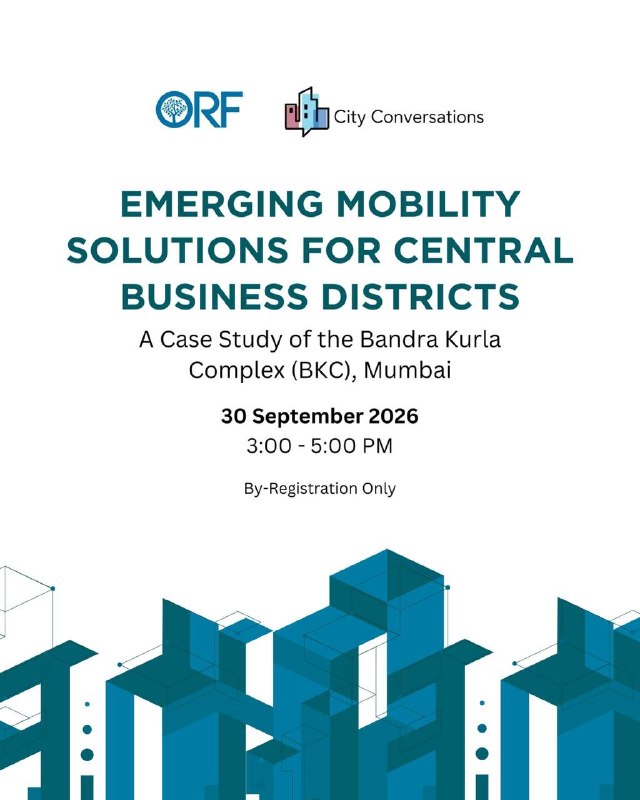
ORF is hosting a session titled ‘Emerging Mobility Solutions for Central Business Districts: A Case Study of the Bandra Kurla Complex (BKC), Mumbai’ as part of the ‘City Conversations’ series.
This edition will map emerging mobility ecosystems and identify key operational, regulatory, and governance gaps. The discussion seeks to accelerate multimodal integration and leverage corporate demand through shared mobility, open data, unified fares, and interoperable infrastructure; while ensuring that new mobility deployments are safe, accessible, gender-responsive, equitable, and environmentally sustainable.
🗓️ 30 September | 📍ORF Mumbai | By Registration Only
Register Now! 🔗 https://or-f.org/40416
ORF is hosting a session titled ‘Emerging Mobility Solutions for Central Business Districts: A Case Study of the Bandra Kurla Complex (BKC), Mumbai’ as part of the ‘City Conversations’ series.
This edition will map emerging mobility ecosystems and identify key operational, regulatory, and governance gaps. The discussion seeks to accelerate multimodal integration and leverage corporate demand through shared mobility, open data, unified fares, and interoperable infrastructure; while ensuring that new mobility deployments are safe, accessible, gender-responsive, equitable, and environmentally sustainable.
🗓️ 30 September | 📍ORF Mumbai | By Registration Only
Register Now! 🔗 https://or-f.org/40416
- ❤ 1
Post #17901
403
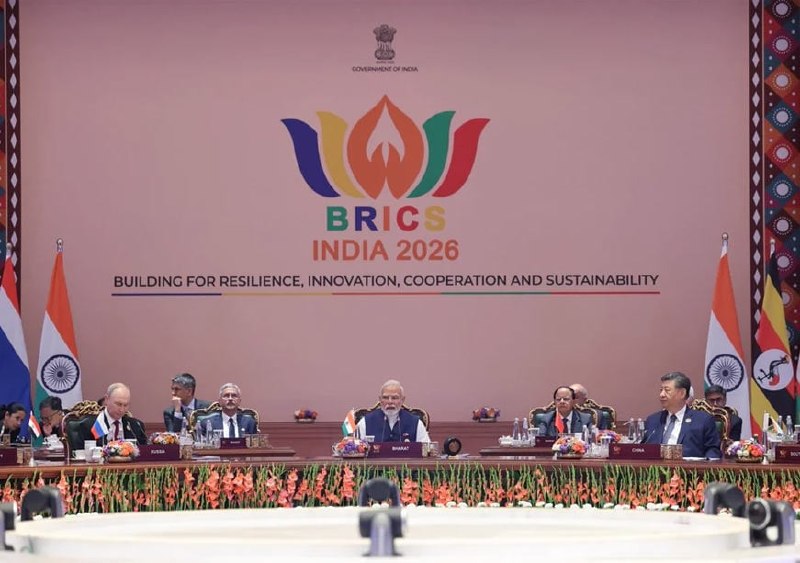
BRICS' relevance is increasing just as its internal consensus is becoming more difficult to sustain.
BRICS was born as a geoeconomic idea. It was never intended to be an anti-Western alliance. With Egypt, Ethiopia, Iran, the UAE, Saudi Arabia and Indonesia joining the original five, BRICS now brings together eleven countries with very different strategic interests; its growing membership gives it greater global weight, but also makes consensus considerably harder.
This brief argues that its credibility will ultimately rest not on grand declarations about multipolarity, but on whether its members can translate their shared dissatisfaction with the existing order into institutions that actually deliver: https://www.orfonline.org/research/the-geopolitical-transformation-of-brics
BRICS was born as a geoeconomic idea. It was never intended to be an anti-Western alliance. With Egypt, Ethiopia, Iran, the UAE, Saudi Arabia and Indonesia joining the original five, BRICS now brings together eleven countries with very different strategic interests; its growing membership gives it greater global weight, but also makes consensus considerably harder.
This brief argues that its credibility will ultimately rest not on grand declarations about multipolarity, but on whether its members can translate their shared dissatisfaction with the existing order into institutions that actually deliver: https://www.orfonline.org/research/the-geopolitical-transformation-of-brics
Post #17900
474
A civil nuclear pact grants Saudi Arabia uranium enrichment rights the US once denied Iran and the UAE. Is Washington setting off a Middle East arms race?
The landmark 123 agreement between Washington and Riyadh lays the legal foundation for domestic uranium enrichment up to 20%. While meant to power civilian reactors and anchor Saudi Arabia to the US rather than China or Russia, the deal drops the long-held ""Gold Standard"" requirement to forgo enrichment and reprocessing.
This brief argues that amidst ongoing regional conflict and Iran's expanding stockpile, granting enrichment rights to Riyadh could prompt rival powers to seek similar capabilities, opening a dangerous new chapter in Middle Eastern nuclear proliferation: https://www.orfonline.org/expert-speak/how-the-us-saudi-nuclear-deal-could-ignite-a-middle-east-arms-race
The landmark 123 agreement between Washington and Riyadh lays the legal foundation for domestic uranium enrichment up to 20%. While meant to power civilian reactors and anchor Saudi Arabia to the US rather than China or Russia, the deal drops the long-held ""Gold Standard"" requirement to forgo enrichment and reprocessing.
This brief argues that amidst ongoing regional conflict and Iran's expanding stockpile, granting enrichment rights to Riyadh could prompt rival powers to seek similar capabilities, opening a dangerous new chapter in Middle Eastern nuclear proliferation: https://www.orfonline.org/expert-speak/how-the-us-saudi-nuclear-deal-could-ignite-a-middle-east-arms-race

- ❤ 1
Post #17895
507


India's economic data tells us what happened. The next step is understanding what it means for YOU.
ORF’s ‘So What?’ report responds to precisely that.
Is the economy strengthening, or simply holding steady? And who feels the difference: consumers, businesses, government, or external stakeholders?
‘So What?’ brings India's latest macroeconomic data together into a single, comparable read on where the economy stands and what it means for you.
Find out in the latest issue 🔗 https://www.orfonline.org/research/so-what-issue-1
Authors: Dr. Nilanjan Ghosh, Arya Roy Bardhan, Diya Shah, Kumkum Mohata, Manish V., Shruti Jain
Datalab Team: Khush Advani, Rakesh Kumar, Rakesh Sinha
#ORFNewsletter #Economy #EconomicData #India
ORF’s ‘So What?’ report responds to precisely that.
Is the economy strengthening, or simply holding steady? And who feels the difference: consumers, businesses, government, or external stakeholders?
‘So What?’ brings India's latest macroeconomic data together into a single, comparable read on where the economy stands and what it means for you.
Find out in the latest issue 🔗 https://www.orfonline.org/research/so-what-issue-1
Authors: Dr. Nilanjan Ghosh, Arya Roy Bardhan, Diya Shah, Kumkum Mohata, Manish V., Shruti Jain
Datalab Team: Khush Advani, Rakesh Kumar, Rakesh Sinha
#ORFNewsletter #Economy #EconomicData #India
Post #17894
472
India’s child online safety framework must move beyond age-gating and takedowns to address how platforms shape what children see.
This brief argues that stronger child safety requires regulating platform design and measuring how often children encounter harmful material: https://www.orfonline.org/expert-speak/beyond-age-gating-regulating-platform-design-for-child-safety
This brief argues that stronger child safety requires regulating platform design and measuring how often children encounter harmful material: https://www.orfonline.org/expert-speak/beyond-age-gating-regulating-platform-design-for-child-safety

Post #17893
502
Squeezed between India and China, how does a nation expand its diplomatic footprint? For Bhutan, the answer lies in Buddhist diplomacy.
Confronted with domestic demographic shifts, Thimphu is actively deploying its spiritual heritage to secure its strategic interests and preserve its national identity.
The brief traces how initiatives like new temple developments in Lumbini and Rajgir, high-level royal diplomacy, and the flagship Gelephu Mindfulness City project are transforming cultural capital into normative influence and economic opportunity: https://www.orfonline.org/expert-speak/between-survival-and-strategy-reading-bhutan-s-recent-buddhist-outreach
Confronted with domestic demographic shifts, Thimphu is actively deploying its spiritual heritage to secure its strategic interests and preserve its national identity.
The brief traces how initiatives like new temple developments in Lumbini and Rajgir, high-level royal diplomacy, and the flagship Gelephu Mindfulness City project are transforming cultural capital into normative influence and economic opportunity: https://www.orfonline.org/expert-speak/between-survival-and-strategy-reading-bhutan-s-recent-buddhist-outreach

- ❤ 1
About this channel
- How can I read @orftg without a Telegram account?
- TGViewer shows the public web preview Telegram publishes for Observer Research Foundation: recent posts, photos, videos and the subscriber count, with no app, login or account.
- How many subscribers does Observer Research Foundation have?
- Observer Research Foundation (@orftg) has 17.4K subscribers on Telegram, refreshed roughly every 30 minutes.
- Does Observer Research Foundation know I viewed it here?
- No. Public channel previews carry no viewer identity, and TGViewer has no accounts or tracking of what you look up.