TGViewer
Channel Public Channel
Lithuanian Weltanschauung

Lithuanian Weltanschauung

@newltu

The foundations of the first Lithuanian republic.
Subscribers
255
Photos
84
Videos
0
Links
2
Recent Posts 19 shown
Post #88 28
STRUGGLE OR COOPERATION?

"According to the principles of socialism, in order to achieve prosperity for the broad masses, it is necessary to destroy the capitalists, thereby establishing the dictatorship of the working people. Socialism declares a fierce struggle against capital. Socialism sees salvation in the class struggle, from which the workers are supposed to emerge victorious.

We hold a different conviction on this matter and therefore believe that prosperity for the working people can be achieved not through class struggle, but through class cooperation.
Only through close cooperation among the classes can the nation create high value and increase the country’s productivity. Industrial output is exported to foreign markets, thereby attracting foreign capital into the country, which enriches the state and, in turn, its citizens.

A nation that wishes to achieve prosperity and be politically and economically independent must maximize the country’s production, and this can be achieved only through cooperation between labor and capital. The basis for this cooperation must be the fair regulation of relations between workers and employers. This difficult task can be accomplished only with the assistance of the government. Disputes arising between employers and workers must be resolved by a special body of corporate representatives, and if that body fails to resolve the dispute, the government, as the supreme guardian of justice, shall have the final and unappealable say.

The government’s primary concern is to ensure that the state’s interests are not harmed by any disputes that arise, because this would automatically harm the citizens as well. For the common good of the state, each side must sacrifice a portion of its own interests, because only by following this path can common prosperity be achieved.
Lockouts and strikes, as instruments of class struggle that undermine national solidarity, are harmful to the state; therefore, these actions are not only impermissible but, on the contrary, should be severely punished.

Only wealthy countries like the United States and England can afford such a “luxury,” for whom losses of several tens of millions due to a strike or lockout do not pose any significant financial difficulties. For us, however, for whom every cent is precious, such a luxury would be an unjustifiable crime, especially since this approach cannot, in any case, resolve the issue of improving workers’ conditions (as the history of strikes confirms). The damage that strikes inflict on the state is well illustrated by last year’s strike by English coal miners. The workers, having produced nothing for a long time, supported themselves and caused the state several hundred million pounds in losses, while gaining almost nothing for themselves. All of this happened because the labor issue was attempted to be resolved in a completely different way than was necessary. In the name of justice and the common good, an employer cannot exploit workers, just as workers have no right to destroy the country’s industry with their demands. Government leadership is necessary to regulate this matter.
Every sensible and patriotic worker or employer understands that their well-being lies in the well-being of the state, and that this can be achieved not through class struggle, but through the united efforts of the nation. We are convinced that our reborn nation, with its honorable traditions of the past, will show the world examples of a new way of governing and coexistence.”


— Juozas Mantautas | Tautos kelias 1928-Birž.1

@NEWLTU
Post #87 559
The agencies of national education must therefore concern themselves with the preservation of racial purity. The family must so influence its members that men do not marry women of a foreign racial type, and girls do not marry men of a foreign race. The school must explain the grounds for the harmfulness of mixed marriages. The state, through its laws, must regulate the influx of foreign blood. The state has the right and duty, by means of certain principles, to protect the purity of the blood of its nation when this is threatened with being destroyed by the uncontrolled and excessive influx of foreign blood. Mixed marriages may be tolerated only when the ethnic type of the spouses is not too different (e.g., Lithuanians and Latvians, Germans and Dutch), when such marriages constitute only a small percentage, and when the national culture is strong. The union of closely related ethnic types can sometimes even produce a fortunate combination, because from the other type the body may acquire characteristics that it lacked in its own type.


— Antanas Maceina; National Education (1934)

@NEWLTU | @lithuaniasot
Post #86 101
"The Lithuanian revival is not merely about preserving the language of our ancestors. Language is the highest expression of the soul, through which we express what lies within us; language is the form without which a distinctive national consciousness cannot emerge. To be reborn is to rise from the depths of contempt, to take our rightful place among other nations, to strive for favorable living conditions, and to renew within ourselves all that is noble, without straying from the foundations of our healthy traditions."


Lietuvių atgimimas nėra vien tik tėvų kalbos išlaikymas. Kalba yra viršuja sielos žymė, kuria pareiškiama tai, kas yra mūsų viduje, kalba yra forma, be kurios negali pasirodyti savotiška tautinė mintis. Atgimti yra pakilti iš žemos paniekos, šiek tiek sverti ir kitų tautų eilėje, tiektis patogių sąlygų gyventi, atnaujinti savyje visa, kas prakilnu, tačiau nenueinant nuo sveikųjų tradicijų pagrindų.


— Antanas Smetona

@NEWLTU
Post #85 119
Cinema "Romuva" facade project. Arch. N. Mačiulskis.

@NEWLTU
Post #84 151
“Folklore is the fortress of our nation’s spirit, but we, blinded by modernity and foreign ideas, often consider it obsolete. When a nation abandons its songs, its legends, its ancient customs, it loses not only its past but also its ability to create a future. Foreign influences, which infiltrate our lives, not only detach us from our roots but also make us strangers in our own land. The preservation of folklore is not only respect for our ancestors but also our duty if we want our nation to remain alive and strong.”


— Vincas Krėvė-Mickevičius | Tauta ir žodis

@NEWLTU
Post #83 154
"The slogans of freedom from the liberal era are slogans of the past. Only for those who fear discipline, who lack confidence in their own strength, and who, paradoxically, fear competition - freedom is a refuge for their insignificance. A liberal state can be likened to stagnant water, while a nationalist state is like an eternally raging sea. For a person full of strength and confidence, those waves and that current are not a restriction of freedom, nor a restraint, but a constant vigilance, purposeful and energetic action."


"Liberalistinės gadynės laisvės šūkiai - praeities šūkiai. Tik tam, kurs bijo disciplinos, kurs nepasitiki savo jėgomis, kuris, paradoksališkai sakant, bijo konkurencijos - laisvė yra jo menkybės prieglobstis. Liberalinę valstybę galima prilyginti stovinčiam vandeniui, o tautinė valstybė yra lyg amžinai banguojanti jūra. Pilnam jėgos ir pasitikėjimo žmogui tos bangos ir ta srovė nėra tai laisvės suvaržymas, nėra pažabojimas, bet nuolatinis budėjimas, tikslingas ir energingas veikimas."


— V. Trumpa | Akademikas 1934-Nr.9

@NEWLTU
Post #82 170
"Lithuania’s body has already been revived, and its consciousness awakened. All that remains for us, the younger generation, is to build our own culture upon the clear cultural foundations laid by our Aesti ancestors. Having found the core of our nation, we must nurture it within contemporary culture into a new, modern Lithuania - one that will be independent not only physically but also in spirit. So, let us embrace a more conscious sense of national identity. Let us not be satisfied merely with the title of “nationalist” or with documentary proof of it. Let us cultivate our innate national characteristics! Let us be sincerely Lithuanian; let us honor our word. Just more content! Our outward characteristics will refine themselves naturally."


Jau prikeltas Lietuvos kūnas. pažadinta jos sąmonė. Mums, jaunajai kartai, belieka kurti savą kultūra mūsų protėviu aisčiu kultūros pagrindais. Mes turime, suradę savo tautos branduolį, išugdyti jį nudienėje kultūroje į naują modernišką Lietuva. kuri bus ne vien fiziškai, bet ir savo dvasia nepriklausoma. Tad daugiau sąmoningo tautiškumo. Nesitenkinkime vien tautininko vardu nei dokumentaliu jo įrodymu. Ugdykime savo prigimtas tautines ypatybes! Būkim lietuviškai nuoširdūs, gerbkime savo žodi. Tik daugiau turinio! Išorinės mūsų ypatybės savaime apsišlifuos."


— Albinas Liaugminas | Akademikas 1934-Nr.6-7

@NEWLTU
Post #80 431
🇱🇹 In the symbols of Lithuanian nationalist organizations, one can see an unusual triskele symbol, whose wings point clockwise and stylistically depict flames.
During the interwar period, this emblem became the official symbol of “Jaunoji Lietuva,” a youth organization founded by the Lithuanian Nationalist Union.

What is the meaning of this symbol? The Three Flames is an ancient, Lithuanian historical symbol of the sun. It symbolized eternity. As the symbol of the nationalist movement, the meaning of the Three Flames is as follows:

During the interwar the three flames symbolized the three main parts of the Lithuanian nation: Free Lithuania, the Klaipėda Region, and the Occupied Vilnius Region. The symbol as a whole represents the burning love of a "Young Lithuanian" for his homeland and the rebirth of national consciousness.
Modern nationalists interpret it as the three parts of Lithuania: Mainland Lithuania, Lithuania Minor, and Samogitia. The historically and culturally interconnected and indivisible land of our nation. Three flames - three regions - come together to form an eternally rotating and perfect circle of flames.

Although the triskelion itself is intrinsically linked to the sun and the element of fire, on a symbolic level, fire is seen as an expression of tireless struggle, renewal through purification, an uplifted spirit, determination, courage, and idealism.

All of this confirms the archaic nature, significance, and multifaceted meanings of the symbolism chosen by deeply committed Lithuanian nationalists.


@NEWLTU
Post #79 147

Forwarded from Lithuania’s School of Thought

The Jew cheats and wrongs people wherever he can. If, looking at things in general, in the majority of life’s misfortunes one ought to remember chercher la femme [look for the woman], then in the majority of the misfortunes in the life of our little people one must remember: cherchez le juif [look for the Jew]. Well, enough of that; the Jews the Semites wrong us Aryans. We have grown used to it and it is no wonder. The Semites have been leading a struggle against the Aryans from the ages; they cannot stand one another. Today’s anti-Semitism is only a stage in the continuation of that eternal struggle, showing that the Aryans have more clearly felt on their necks the more painful squeeze of the Semitic hydra and are striving to free themselves. We would be very much surprised, however, if the Jews began to fight among themselves and to wrong one another. In recent times everywhere in the world people are already reproaching the Jews that by their behaviour they have become very hateful to everyone. Only a part could no longer more severely punish our towns than by sending upon them a swarm of Jews with their dirt and uncleanliness that infect the air, with all the secrets of the Talmud, with all the filth and harmfulness of their morals, directed toward harming Christians.


- Vincas Kudirka. 🇱🇹
The Bell, No. 7, (1890)
Post #78 177
"A lesson from the past: the Lithuanian people’s assimilation into Polish, Russian, and German cultures robbed us of many of our finest talents, stifled our own creativity, and brought the life of our nation to the very brink of extinction. The insufficient vigilance of our ancestors’ national consciousness was perhaps one of the most important reasons for the many historical calamities that befell us. Therefore, the concern of a reborn Lithuania to strengthen national consciousness and strive to avoid repeating historical calamities is entirely understandable. The efforts to strengthen expressions of national identity across all aspects of life - especially in artistic creation, that is, in literature - are entirely understandable. Our instinct for self-preservation compels us to do so. Perhaps we have no other choice if we, as a nation, wish to survive."


"Praeities pamoka: lietuvių lenkėjimas, rusėjimas, vokietėjimas atėmė iš mūsų daugybę geriausiųjų jėgų, nualino mūsų pačių kūrybą, tautos gyvybę beveik prie kapo krašto privarė. Mūsų prabočių tautinės sąmonės nepakankamas budrumas gal ir buvo viena svarbiausiųjų priežasčių, šitiek is-torinių nelaimių mums atnešusių. Todel tat visiškai suprantamas atgimusios Lietuvos susirūpinimas stiprinti tautinę sąmonę, stengtis nebekartoti istorinių nelaimių. Visiškai suprantamos pastangos stiprinti tautiškumo pasireiškimus visoje gyvenimo įvaireny-bėje, ypač meno kūryboje, atseit, ir literatūroje. Taip daryti verčia mus savisaugos instinktas. Gal mums ir kito kelio nėra, jei mes, kaip tauta, norime būti gyvi."


— Balys Sruoga | Akademikas 1933-Nr.3

@NEWLTU
Post #77 170

Forwarded from Lithuania’s School of Thought

A nation is the past, present, and future, living not for hundreds, but for thousands of years. Nationality is not an abstraction, but a concept of real national affairs.


- Antanas Smetona. 🇱🇹
The Nation and Its Government, (1931)
Post #76 210
"A revolution that wishes to endure within its own institutions must remain eternally young and keep pace with life. Anyone who does not feel the weight of our years and whose heart does not burn with envy for maturing youth - that person is young. The revolution must be replenished with new forces, which must ensure its continuity and prevent spirits from becoming weighed down by the hardships of struggle or tarnished solely by the rust of doctrine. May those new forces grow, properly educated, guided, and strengthened."


"Revoliucija, norinti išsilaikyti savo institucijose, privalo būti amžinai jauna ir eiti su gyvenimu. Kiekvienas, nejaučiąs mūsų metų slogučio ir širdy nedegąs pavydu bręstančiai jaunystei - jaunas. Revoliucija turi pasipildyti naujom jėgom, kurios privalo užtikrinti jos nenutrūkstamumą ir neleisti dvasioms apsivilti kovų sunkumu bei pa-juoduoti vien doktrinos rūdimi. Tos naujos jėgos teauga tinkamai auklėjamos, prižiūrimos ir stiprinamos."


— Zenonas Blynas | Akademikas 1933-Nr.4

@NEWLTU
Post #75 236
"The nationalist student movement does not shy away from ideological struggle; it is not afraid of open confrontation. It does not hide behind pamphlets and slander - such methods of struggle are foreign to it. These are the tactics of the “catacombists”! They do not resort to provocation, slander, or demagoguery. “Democratic” fanaticism and taboos are foreign to them. If the "Varpininkai", having forgotten those times when, during their 1926 “democratic” year of 1926, the police, set upon them by Communist commissars, trampled the nation’s sanctuary, beat nationalist students and respected members of society with rifle butts - if today’s students are already becoming apostles and martyrs of the nation, the nationalist students say to them: Enough!"


"Tautiškoji studentija nevengia idejinės kovos, Nesibijo atviro grumtynių lauko. Nesislapsto po pamfletais ir degutu pamfletais ir degutu jai šie kovos būdai svetimi. Tai „katakombistų" taktika! Ji nesigriebia provo-kacijos, šmeižto ar demagogijos. Jai svetimas,, demokratiškasis" fanatizmas ir Tabu. Jei varpininkai, užmiršę tuos laikus, kai jų 1926 „demokratiško" gyvenimo metais komunistų komisarų užsiundyta policija trypė tautos šventovę, mušė tautiškąją studentiją ir visuomenei nusipelnusius žmones su šautuvų buožėmis, šiandie studentijoj jau darosi tautos apaštalais ir kankiniais, tautiškoji studentija jiems taria - gana!"


— V. Audrūnas | Akademikas 1933-Nr.5

@NEWLTU
Post #74 287
"The young march forward with a hymn of victory on their lips; perhaps their path is difficult and perhaps misguided, but they are not content with yesterday’s darkness and the grayness of their surroundings; instead, they press forward and, driven by self-sacrifice and faith, seek new paths and a new life. They must find it, they must achieve it, for tomorrow belongs to those who march on!"


"Jaunieji eina su pergalės himnu lūpose; gal būt ji kelias sunkus ir gal klaidingas, bet jie nesitenkina vakardienos tamsuma ir aplinkos pilkuma, o veržiasi į priekį ir, pasiaukojimo ir tikėjimo skatinami, ieško naujų kelių, naujo gyvenimo. Turės rasti, turės atsiekti, nes rytojus einančių!"


— Zenonas Blynas | Akademikas 1933-Nr.5

@NEWLTU
Post #73 294
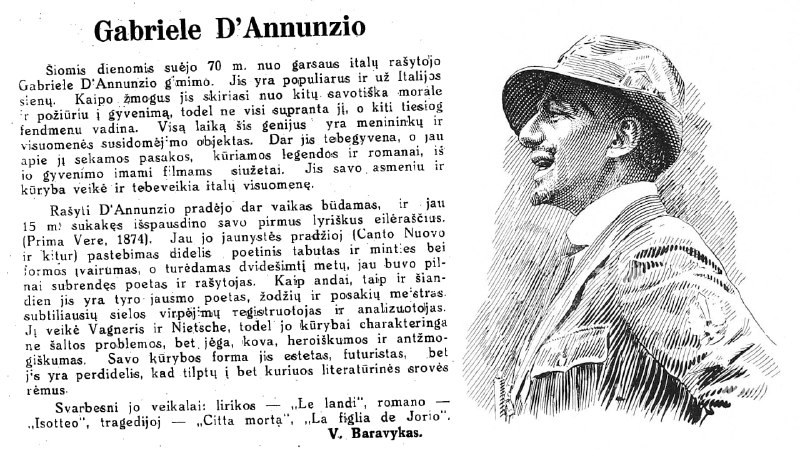
MAGAZINE "AKADEMIKAS" ON D'ANNUZIO

"These days mark the 70th anniversary of the birth of the famous Italian writer Gabriele D'Annunzio. He is popular even beyond Italy's borders. As a person, he stands out from others due to his unique moral code and outlook on life; for this reason, not everyone understands him, while others simply call him a fanatic. This genius has always been the subject of interest among artists and the public. Even while he is still alive, stories are being told about him, legends and novels are being created, and his life and personality serve as the basis for movie plots. His work has influenced and continues to influence Italian society.
D’Annunzio began writing as a child, and by the age of 15 he had already published his first lyrical poems. (Prima Vera, 1874). Even in his early youth (in *Canto Nuovo* and elsewhere), a great poetic talent and a diversity of thought and form were evident, and by the age of twenty, he was already a fully mature poet and writer. Then as now, he is a poet of pure feeling, a master of words and phrases, and a chronicler and analyst of the subtlest stirrings of the soul. He was influenced by Wagner and Nietzsche; therefore, his work is characterized not by cold rationality but by power, struggle, heroism, and superhuman qualities. In terms of form, he is an aesthete and a futurist, yet he is too grand to be confined within the boundaries of any single literary movement."

His major works include the poetry collection "Le landi", the novel "Isotteo", and the tragedies "Citta morta" and "La figlia de Jorio".


Šiomis dienomis suėjo 70 m. nuo garsaus italų rašytojo Gabriele D'Annunzio gimimo. Jis yra populiarus ir už Italijos sienų. Kaipo žmogus jis skiriasi nuo kitų savotiška morale ir požiūriu į gyvenimą, todel ne visi supranta jį, o kiti tiesiog fendmenu vadina. Visą laiką šis genijus yra menininkų ir visuomenės susidomėjimo objektas. Dar jis tebegyvena, o jau apie ją sekamos pasakos, kūriamos legendos ir romanai, iš Jis savo asmeniu ir io gyvenimo imami filmams siužetai. kūryba veikė ir tebeveikia italų visuomenę.
Rašyti D'Annunzio pradėjo dar vaikas būdamas, ir jau 15 m. sukakęs išspausdino savo pirmus lyriškus eilėraščius. (Prima Vere, 1874). Jau jo jaunystės pradžioj (Canto Nuovo ir kitur) pastebimas didelis poetinis tabutas ir minties bei formos įvairumas, o turėdamas dvidešimtį metų, jau buvo pilnai subrendęs poetas ir rašytojas. Kaip andai, taip ir šiandien jis yra tyro jausmo poetas, žodžių ir posakių meistras, subtiliausių sielos virpėjimų registruotojas ir analizuotojas. Jį veikė Vagneris ir Nietsche, todel jo kūrybai charakteringa ne šaltos problemos, bet jėga, kova, heroiškumos ir antžmogiškumas. Savo kūrybos forma jis estetas, futuristas, bet - jis yra perdidelis, kad tilptų į bet kuriuos literatūrinės srovės rėmus.

Svarbesni jo veikalai: lirikos „Le landi", romano - Isotteo", tragedijoj „Citta morta", „La figlia de Jorio".


— V. Baravykas | Akademikas 1933-Nr.6

@NEWLTU
Post #72 315
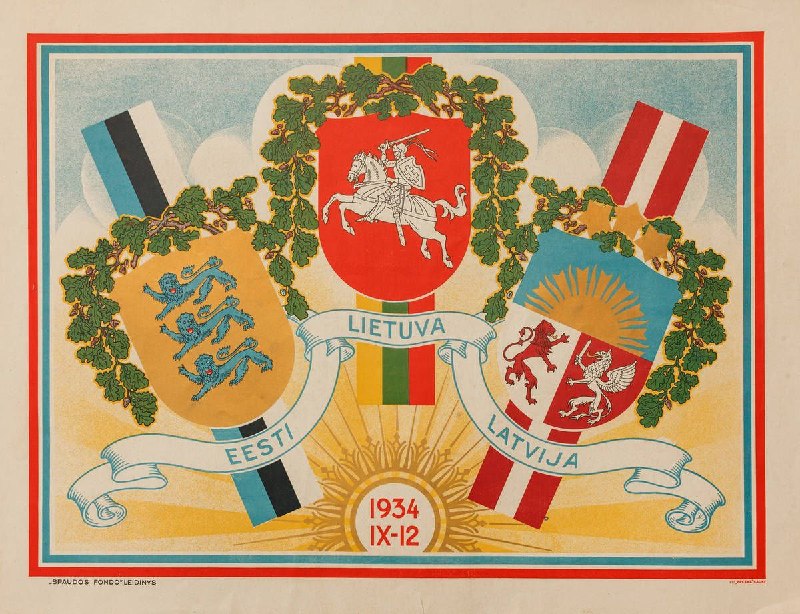
On September 12, 1934, at the initiative of Lithuania, the political union of Estonia, Latvia, and Lithuania, otherwise known as the Baltic Entente, was created in Geneva.

@NEWLTU
Post #71 289
"The Young Lithuanians (Jaunalietuviai) are a youth organization dedicated to fostering the nationalist ideology. Its primary goal is the cultural education of youth and cultural activities, however, all of the organization’s endeavors are colored by the Nationalist ideology, and this organization is closely linked to the current Lithuanian regime, which is led by Nationalist ideologues, since the fundamental views of both the regime and this organization coincide. Jaunalietuviai, of course, works toward ensuring that life in Lithuania continues to be organized on its current foundations, that the current regime is strengthened, and that its agenda is carried out. The regime also needs this organization in the cultural and political spheres, as it brings new collaborators from the younger generation into the regime’s efforts."


"Jaunalietuviai yra tautininkų ideologijos jaunimo auklėjimo organizacija. Jos tikslas yra pirmiausia kultūrinis jaunimo auklėjimas ir kultūrinė veikla, tačiau visi tos organizacijos užsimojímai yra nudažyti tautininkų ideologine spalva ir šioji organizacija yra glaudžiai susijusi su dabartiniu, tautininkų ideologų vadovaujamu Lietuvos režimu, kadangi lygiai režimo, lygiai šios organizacijos pagrindinės pažiūros sutampa. Jaunalietuviai, žinoma, veikia ta linkme, kad Lietuvos gyvenimas ir toliau da-bartiniais pagrindais būtų tvarkomas, kad dabartinis režimas tvirtėtų, kad jo programa būtų vykdoma. Režimui toji organizacija taip pat reikalinga kultūros ir politikos srityje, nes per ją į režimo vadovaujamą darbą įsijungia nauji talkininkai iš jaunosios kartos."


— V. Rasteinis | Organizacijas Beorganizuojant; Vairas 1939-Nr.4

@NEWLTU
Post #70 1.68K
"Nationalism, in essence, is a dynamic process, and only in this case is the dynamic spirit of religion always in harmony with the dynamic, ideal national movement. Fascism, understood as that dynamic, ideal national movement, is characterized by the fact that it has no static forms. In other words, fascism is dynamic even in its forms. From this dynamic aspect of it arises ideal tolerance, which, as we have mentioned, is dynamic in nature; moreover, one might say that this ideal tolerance is the dynamic spirit of all forms of religion and idealism. And fascism, while dynamic in nature even in its forms, has as its specific distinguishing feature an ideal tolerance of a dynamic nature. Through this ideal tolerance, it coincides both with the general idealism of humanity and with the religious spirit inherent in the Christian religion and ethics. <...>

<...> It is now sufficiently clear that, in order to achieve a perfect relationship between religion and nationalism, it is important that every religious form correspond to the character of the individual or the nation. In other words, the statism of religion or idealism, corresponding to the static side of the human being - to human statism - creates one another.
Christianity is a form of religion that corresponds to the Lithuanian character. Therefore, the ideology of the Nationalists is grounded in Christian ethics."


"Tautiškumas, iš esmės, dinamiška tėkmė, ir tik šiuo atvėju dinamiškoji religijos dvasia visada suderinama su dinamiškuoju tautiškai idealiniu judėjimu. Fašizmas, suprantamas tuo dinamiškuoju tautiškai idealiniu judėjimu, turi tą esmingą pobūdį, kad jis neturi ir statiškų formų. Vadinas, fašizmas ir savo formose yra dinamiškas. Iš tos dinamiškosios jo pusės išplaukia idealinė tolerancija, kuri, kaip minėjom, yra dinamiško pobūdžio; dar daugiau, galima sakyti, toji idealinė tolerancija yra visų religijos ir idealizmo formų dinamiškoji dvasia. O fašizmas, net savo formose būdamas dinamiško pobūdžio, savo differentia specifica turi dinamiško pobūdžio idealinę toleranciją. Tąja savo idealine tolerancija jis sutampa ir su bendruoju žmonijos idealizmu ir su religine dvasia, glūdinčia krikščioniškojoj religijoj ir etikoj. <...>

<...> Dabar jau yra pakankamai aišku, kad, siekiant tobulo religijos ir tautiškumo santykiavimo, yra svarbu tai, kad kiekviena religinė forma turi atitikti žmogaus arba tautos charakterį. Vadinas, religijos arba idealizmo statizmas, atitikdamas žmogaus statiškąjai pusei, žmogaus statizmui, vienas antrą kuria.
Krikščionybė yra tokia religijos forma, kuri atitinka lietuvių charakteriui. Todėl krikščioniškąja etika yra pagrįsta tautininkų ideologija."


— Mykolas Jasėnas | Akademikas 1933-Nr.10

@NEWLTU
Post #69 700
"It is widely known that every nation is characterized by a certain uniqueness of blood. A nation, just like a family, draws a person into unbroken blood ties. But this represents only the outward aspect of national solidarity. In reality, this interaction deeply affects our psyche, our emotional and instinctual life, and our thoughts. Every nation constitutes a distinct psychological world: it exists on a wholly unique plane of psychological vitality, which acts almost of its own accord and often reaches members of the same nation even without external mediation, but which can never be fully experienced by foreigners. Our psychological interaction with our compatriots is much closer, more vivid, and more conscious than with people of other nations. But even deeper than psychological interaction lies the communion of the nation’s spirit and soul. Every nation is characterized by a unique light of spirit and soul, a unique vitality of consciousness, and a unique humanity. This manifests itself in the fact that, from time to time, a special movement of devotion and self-sacrifice arises within the nation."


"Plačiai yra žinoma, kad kiekviena tauta pasižymi tam tikru kraujo ypatumu. Tauta, lygiai kaip šeima, įveda žmogų į nenutraukiamus kraujo ryšius. Bet tuo pasireiškia tik išorinė tautinio bendradarbiavimo pusė. Iš tikrųjų tas bendravimas giliai paliečia ir mūsų psichiką, mūsų jausmų-geismų ir mūsų minčių gyvenimą. Kiekviena tauta sudaro atskirą psichinį pasaulį: ji gyvena visai ypatinga psichinio gyvumo plasta, kuri veik savaime ir dažnai net be išorinio tarpininkavimo tenka tos pačios tautos nariui, bet kuri niekuomet negali būti pilnai atjausta svetimtaučių. Psichinis mūsų bendravimas su mūsų tautiečiais yra daug ankštesnis, gyvesnis ir sąmoningesnis, negu su kitų tautų žmonėmis. Bet dar giliau negu psichinis bendravimas siekia tautos dvasios-sielos bendrumas. Kiekviena tauta pasižymi ypatinga dvasios-sielos šviesa, ypatingu sąmonės gyvumu, ypatingu žmoniškumu. Pasireiškia tai tuo, kad tautoje laiks nuo laiko sukyla ypatingas pasišventimo ir pasiaukojimo judesys."


— V. Dovilas | Akademikas 1933-Nr.13

@NEWLTU
Older posts →

About this channel

How can I read @newltu without a Telegram account?
TGViewer shows the public web preview Telegram publishes for Lithuanian Weltanschauung: recent posts, photos, videos and the subscriber count, with no app, login or account.
How many subscribers does Lithuanian Weltanschauung have?
Lithuanian Weltanschauung (@newltu) has 255 subscribers on Telegram, refreshed roughly every 30 minutes.
Does Lithuanian Weltanschauung know I viewed it here?
No. Public channel previews carry no viewer identity, and TGViewer has no accounts or tracking of what you look up.
Threads Profile ViewerView any public Threads profile without an account.Open ThreadLook →Writing with AI? Make it sound human.Metric37 rewrites AI drafts so they read naturally. Free AI detector, 1,500 words free.Try Metric37 →