
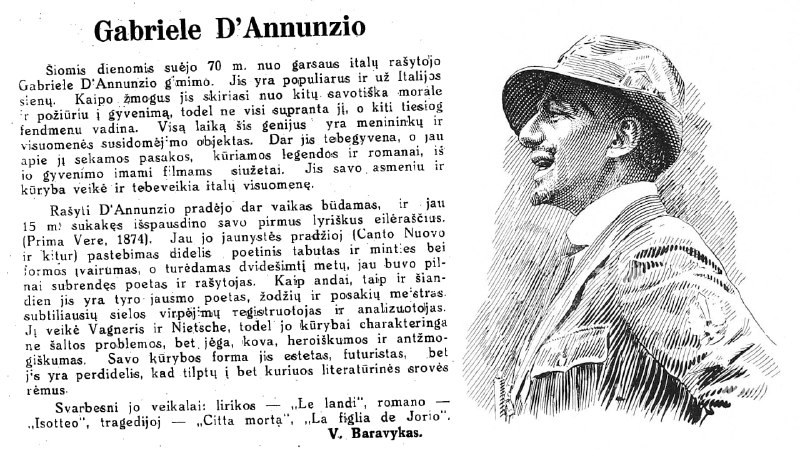
"These days mark the 70th anniversary of the birth of the famous Italian writer Gabriele D'Annunzio. He is popular even beyond Italy's borders. As a person, he stands out from others due to his unique moral code and outlook on life; for this reason, not everyone understands him, while others simply call him a fanatic. This genius has always been the subject of interest among artists and the public. Even while he is still alive, stories are being told about him, legends and novels are being created, and his life and personality serve as the basis for movie plots. His work has influenced and continues to influence Italian society.
D’Annunzio began writing as a child, and by the age of 15 he had already published his first lyrical poems. (Prima Vera, 1874). Even in his early youth (in *Canto Nuovo* and elsewhere), a great poetic talent and a diversity of thought and form were evident, and by the age of twenty, he was already a fully mature poet and writer. Then as now, he is a poet of pure feeling, a master of words and phrases, and a chronicler and analyst of the subtlest stirrings of the soul. He was influenced by Wagner and Nietzsche; therefore, his work is characterized not by cold rationality but by power, struggle, heroism, and superhuman qualities. In terms of form, he is an aesthete and a futurist, yet he is too grand to be confined within the boundaries of any single literary movement."
His major works include the poetry collection "Le landi", the novel "Isotteo", and the tragedies "Citta morta" and "La figlia de Jorio".
Šiomis dienomis suėjo 70 m. nuo garsaus italų rašytojo Gabriele D'Annunzio gimimo. Jis yra populiarus ir už Italijos sienų. Kaipo žmogus jis skiriasi nuo kitų savotiška morale ir požiūriu į gyvenimą, todel ne visi supranta jį, o kiti tiesiog fendmenu vadina. Visą laiką šis genijus yra menininkų ir visuomenės susidomėjimo objektas. Dar jis tebegyvena, o jau apie ją sekamos pasakos, kūriamos legendos ir romanai, iš Jis savo asmeniu ir io gyvenimo imami filmams siužetai. kūryba veikė ir tebeveikia italų visuomenę.
Rašyti D'Annunzio pradėjo dar vaikas būdamas, ir jau 15 m. sukakęs išspausdino savo pirmus lyriškus eilėraščius. (Prima Vere, 1874). Jau jo jaunystės pradžioj (Canto Nuovo ir kitur) pastebimas didelis poetinis tabutas ir minties bei formos įvairumas, o turėdamas dvidešimtį metų, jau buvo pilnai subrendęs poetas ir rašytojas. Kaip andai, taip ir šiandien jis yra tyro jausmo poetas, žodžių ir posakių meistras, subtiliausių sielos virpėjimų registruotojas ir analizuotojas. Jį veikė Vagneris ir Nietsche, todel jo kūrybai charakteringa ne šaltos problemos, bet jėga, kova, heroiškumos ir antžmogiškumas. Savo kūrybos forma jis estetas, futuristas, bet - jis yra perdidelis, kad tilptų į bet kuriuos literatūrinės srovės rėmus.
Svarbesni jo veikalai: lirikos „Le landi", romano - Isotteo", tragedijoj „Citta morta", „La figlia de Jorio".
— V. Baravykas | Akademikas 1933-Nr.6
@NEWLTU