TGViewer
Channel Public Channel
Maps and stuff

Maps and stuff

@m0nstas

Twitter:@M0nstas (restored)
War-related maps, directions and news that shape the battlefield.
Subscribers
1.44K
Photos
4.1K
Videos
715
Links
908
Recent Posts 12 shown
Post #6348 641
Infiltration Mechanics - Days of suffering, compressed into seconds
  • 👍 11
  • ❤ 2
Post #6346 311
Reach still has to become control, and here the burden changes sides. Getting a man somewhere is cheap, but keeping him there is where the bill starts. Every claimed kilometre that Russia wants to turn into control has to be supplied, rotated and held under constant drone attack, and for an overextended force, control thins with time. The AFU does not need to attack every penetration immediately, because the paint itself keeps pressing on Russian resources.

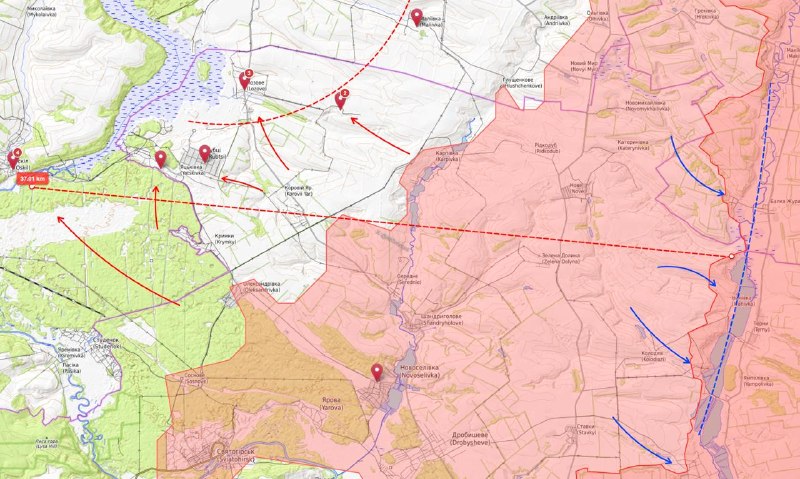
For the attacker, the map becomes a debt, and orders are written against the painted line. Every group sent toward Sviatohirsk now goes to a town Moscow already owns on paper. Velykyi Burluk has not even a flag behind it. Since July, pro-Russian channels have been closing a "cauldron" there that nobody has confirmed. Meanwhile the 16th Army Corps describes individual soldiers slipping a few kilometres in and hiding in the forest without controlling any ground. The attacker keeps infiltrating to catch up with his own map. The further reach runs ahead of control, the more of the force goes into that chase.

The sponge defense is built around exactly that. Let the enemy slip in, then make him disappear. A DRG that gets through shows which route is open. There is no need to chase every group, but the rear has to be warned and the route covered, because the infiltration groups will follow it. From that moment the defender can start shaping the process.

The limit is intensity. Not every infiltrator can be hunted. Where Ukrainian detection and clearing slow down, Russian accumulation can outrun removal, and paint starts turning into control. Any exposure is deadly, and scaling up drone use extends how much infiltration a defender can absorb. Drones are the biggest multiplier but not the only one. Obstacles, bombs, the mix of drone roles and overall unit quality change the speed and the cost for both sides.

Once the Russians wear themselves down, the AFU can attack. Russian units often end up on poorly placed lines they overcommitted to reach, with little left to hold them. Earlier, the AFU had limited capability to exploit that. It learned at Dobropillia in August 2025 and applied the lesson at Kupiansk that winter: cut the routes behind a penetration first, then clear it.

Russia can reach further while controlling less, and the 6,000 km² is the size of that difference: the reach surplus. Actual Russian control lies somewhere behind its outer edge, sometimes even behind DeepState's line, since confirmation lags on both maps. Two things show where control sits: whether supply keeps reaching isolated positions, and whether the same ground appears in fresh footage weeks later. Where neither happens, the paint outlives the men who put it there.
  • 👍 7
  • ❤ 1
Post #6343 299
Paint rush

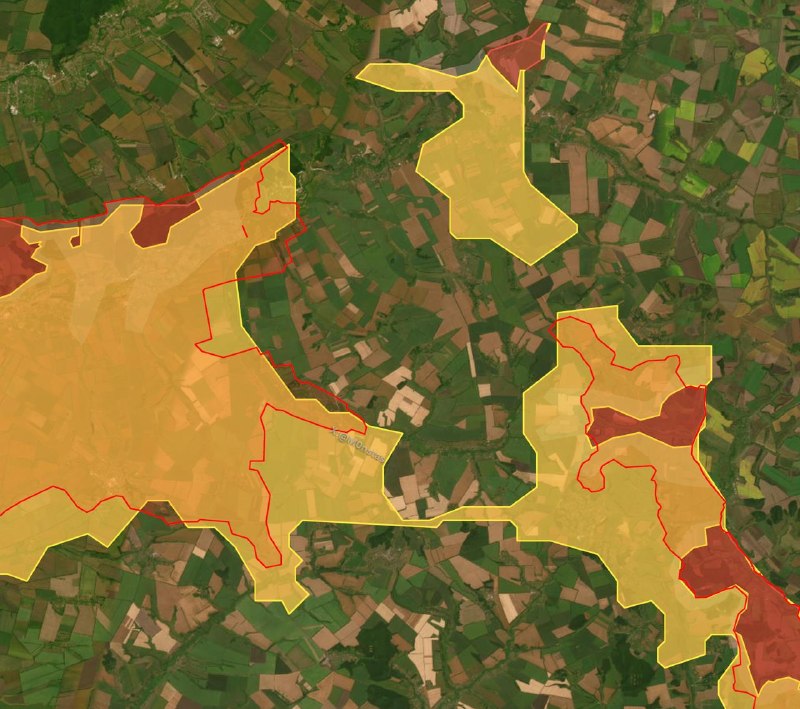
By late September, RIA's map claimed roughly 6,000 km² more territory than DeepState's. A gap that size can't be explained by reporting lag or a few disputed villages, so everyone now brings their own theory. Mine will follow the framework defined in sponge defense, fracking assault, control decay and expandable russian nature.

Russia has generally spent people to buy ground. Ukraine tries to save people but doesn't give ground away for free. Where it has to yield, it makes Russia pay for every kilometre in losses. Russian infiltration tactics follow from that trade and look blind only from the outside. They run on two layers of people with one reporting act on top.

The first layer is the DRG. These are small, relatively capable groups that go first and keep moving. Their tasks are recon, hunting in the vulnerable rear (drone crews, logistics, anything soft behind the line) and finding the weak spot. They avoid unnecessary attention, don't try to hold ground, and always push. Where they get through, they lay the route.

The second layer is the infiltration group. It is larger and far less trained, made of the shell soldiers from my earlier piece. These groups follow the routes the DRGs opened, gather in basements and tree lines, and wait. Their task is to scrape off the blue paint. They carry most of the risk in the scheme. They unmask defenders by drawing fire and break the defense by being where nobody expected them, with little chance of evacuation when things go wrong. They are send-and-forget units with a hide-and-pray escape plan, and their survival is mostly luck.

The reporting act sits on top of both layers. Any soldier who reaches a point can plant a flag, and we often don't see it until the video appears. Most of RIA's paint comes from this: someone gets there and films it, and the map turns red.

DeepState also works on confirmation, but it doesn't treat a lone flag deep behind the line as control. It is also a victim of its own success. With both armies reading it, DeepState has to self-censor and follow extra OPSEC, delaying or leaving out what could expose Ukrainian positions, so its line is deliberately incomplete too. The gap therefore holds ground where infiltrators are present but control is unresolved, flags DeepState didn't accept, and claims with no footage at all. The flags are the largest part, because RIA's paint only piles up. Old flags stay and new ones keep arriving. In the fracking model, infiltration was the probe that prepares a heavier strike. Over 2026 that strike came less often, and infiltration itself became the main way ground gets claimed.

The result is a multi-reality. Russian command knows where the enemy is and paints 40 km past him. On September 1 Putin announced the capture of Sviatohirsk, and six days later the commander of Ukraine's 3rd Corps walked through its centre on camera and called it his rear. Russian command doesn't count its people, yet reports them successfully withdrawn. Both versions of Sviatohirsk exist at once, and each audience picks the one it prefers. The Russian Newspeak has room for all of it, including a pile of losses that still counts as a success.
  • 🤔 5
  • 👍 1
Post #6341 279
Another mass missile and drone attack on Kyiv and Odesa regions.

Air Force report:
• 220/282 drones + Banderol
 • 219 drones
 • 1 Banderol
• 4/? Zircon
• 3/? ballistic missiles

13 locations hit, with 10 more affected by debris.

The Air Force reports Zircon launches from Kursk, Rostov and Oryol regions, and ballistic launches from Kursk and Bryansk regions, but does not provide the total number launched in either category.

Meanwhile, @war_monitor_ua provides this distribution:

• Kyiv: 6 Zircon / Oniks-M + 8 ballistic missiles
• Mayaky: 12 Banderol
• 400+ strike drones

War Monitor total:
• 400+ strike drones
• 6 Zircon / Oniks-M
• 8 ballistic missiles
• 12 Banderol

Approximate scale according to StrategicaviationT:

• up to 500 Geran/Gerbera drones
• up to 10 Iskander-M / S-400 ballistic missiles
• up to 10 Zircon
• ~10 Banderol

Main targets according to their assessment: Kyiv, Odesa and western regions of Ukraine.
  • 🤬 6
  • 🤔 1
  • 😭 1
Post #6340 286
TG messages based attack illustration with 50km repeater range
  • ❤ 3
Post #6339 378
150km Mesh shadow.

Recent drone routes show some signs that Transnistria may host repeaters as well.
  • 🤬 11
  • 🤔 3
  • 👏 2
Post #6338 363
Have no idea why they are doing that, but RIA kinda painted Dobropillia.
  • 🤡 9
  • 🤣 5
  • 👏 1
Post #6337 355
RT encircled Dobropillia.

The rest is the same as RIA
  • 🤡 2
Post #6334 357
What the defence gets in exchange

Making the grey zone deeper helps and hurts at the same time. It stretches the defence, but it also spreads the attacker across more ground than he can keep suppressed continuously. Russia compensates with more men; Ukraine compensates with more eyes and small clearing groups. The result is a lot of grey paint produced by relatively little durable control. The lower orbit hands the defence the same tools at shorter range, and the answer is clearing rather than containment: assault units kept for taking infiltrators out of the brigades' defensive areas, living inside the zone instead of waiting in reserve. That is how the overstretch is handled, and so far it keeps up.

Which is what the bombs are really for. The answer to Ukrainian counterattacks is the aircraft: a position cleared at dawn can be flattened by a KAB in the afternoon, and the defence has to decide whether the rubble is worth holding. That argues for clearing fast and holding thin: take the foothold out, leave nothing in it worth a bomb.

The logistics run the other way too. The city belt is a hub: interior roads, cover, repair, staging, short rotations, all of which the attacker has to improvise. Pushing them back in the north helped: the M03 is safer than it was. What is left is lateral movement along the wall, north to south inside the belt and watched the whole way — the problem that was survived at Toretsk and Kostiantynivka.

What the command change means

The boundary has been redrawn rather than the line. One command now holds Kramatorsk together with Lyman, the arc the Russian 3rd Army works from the Donets valley down to the eastern approaches; another holds Dobropillia and Druzhkivka. The Lyman end still faces the 25th, so the match is rough. It is a small-looking change aimed at what kept going wrong all year: seams. A defence split along map lines gives the attacker a boundary to work; one connected frontage under one commander makes a whole Russian army somebody's problem.

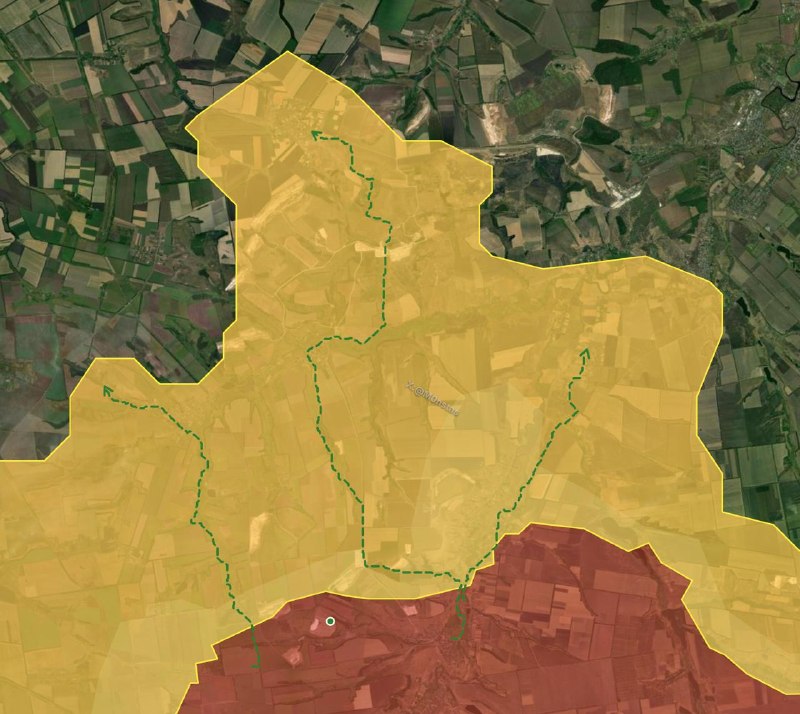
It moves the seam rather than removing it, and the new one matters because the southern push is aimed almost directly at it. The retraction loop on the Dobropillia side is Russia's way around the wall: work Druzhkivka from the rear, shorten the belt from the south and make the frontal problem smaller before anyone has to solve it. That is the cheap outcome for Russia, and the one the new arrangement has to deny.

The useful end state for Ukraine is almost the opposite. Deny the northern route, deny the southern retraction, clear the infiltration in between, and leave Russia with the strongest shape on the map — the city belt itself, supplied from inside and approached across open ground. Nothing has to be held for its own sake. The point is to keep removing the cheaper answers until the remaining one is the river-valley grind Russia has already spent two years paying for.

That pushes the requirement back onto Russian mass. The method eats infantry because most of the manpower available on paper never arrives together at the point of contact, and adding more only matters if there is enough drone coverage to move it through transparent ground. More men, more drone crews, more suppression, all to keep the same small groups moving forward. That can be bought, but it takes time, and time is the resource disappearing fastest here.

So watch the bomb tempo against the belt, the depth of the infiltration and whether any gathering area survives a week. Last week the grey shrank by twenty-two square kilometres against twelve taken; those are the two numbers worth running weekly.

For now clearing keeps pace, the same ground keeps changing hands, and Russia is still being made to fight the shape Ukraine would rather give it. The sign that has changed will be windows staying open longer and footholds surviving them.
  • 🤔 5
Post #6331 312
Punishing The Orbit

Bombs break fixed positions, drones suppress what survives and open routes through the obstacles, and infantry follows on foot to take the ground. The problem is timing: a bomb can remove a building in seconds, but the infantry meant to exploit it may still be days away. The position and its approaches have to stay suppressed until they arrive, and by then there may be little left worth occupying.

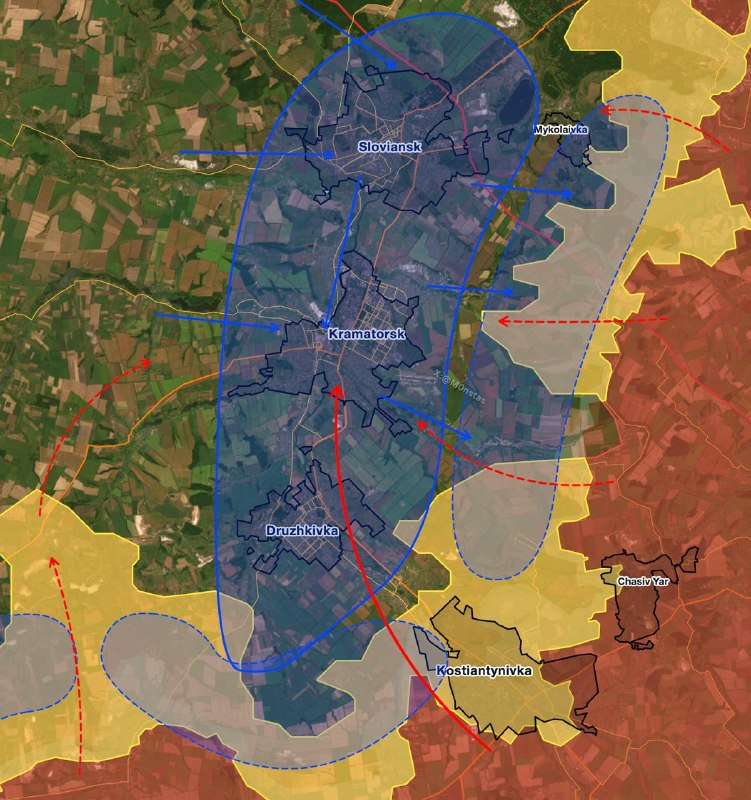
That matters because the wide orbit failed. Its purpose was to keep the hardest fighting away from the urban core: work the flanks, cut the roads, narrow the logistics, and squeeze the defenders out before the city itself has to be taken. With the northern arm gone, that radius has collapsed inward. Russia is left pressing Sloviansk and Kramatorsk from the east while the southern edge is shaved back village by village.

At that distance the arithmetic reverses. Ukraine flies from inside the belt, with crews, workshops and roads behind it; Russia has to push the same system forward over exposed ground. Every kilometre closer shortens Ukrainian logistics and lengthens Russian ones. East of Sloviansk the 3rd Army is still feeling for a usable approach through the hills around Rai-Oleksandrivka and Mykolaivka, shifting its own weight along the frontage rather than opening a new axis.

What the ground offers

The ground is simple. East of the Kazennyi Torets it rises onto a broad crest, with the canal running along it, then falls west toward the Kramatorsk–Sloviansk basin. Kramatorsk sits roughly sixteen kilometres from that line, Sloviansk about nine from its northern stretch.

The canal matters less as a wall than as another crossing problem. Russia is already west of it farther south, which means the same obstacle that once sat in front of the advance now cuts across the routes feeding it; farther north it is still something that has to be crossed. Either way, the deeper the advance goes, the more infrastructure and crossings accumulate behind it.

Beyond the crest there is nowhere clever to go. The ground opens and falls toward the cities, with the opposite side of the valley still in Ukrainian hands and continuous built-up ground stretching toward Druzhkivka and Sloviansk. That is the urban wall here: not a single defensive line, but a long exposed descent into a belt that can watch the approach.

What the gathering problem is

Infiltration only matters once enough people can gather somewhere forward of the line. That is the hard part. The woods and ravines carry small groups in, but they are the same ground the defence uses and they favour whoever is already established there. Men can leak through one or two at a time; turning that presence into a force means finding ground where they can wait, collect and survive long enough for the next groups to arrive.

The grey zone is what makes that possible and what limits it. On the eastern approaches it is only three to six kilometres deep, widening to roughly a dozen farther south toward Kostiantynivka. It is not empty because nobody wants it. It is empty because anything that stays visible for long gets hit. Russian groups move through gaps rather than through positions, Ukrainian groups clear the same gaps rather than line them continuously, and the yellow on the map is mostly the space neither side can afford to occupy densely.

That is enough for infiltration, but not for accumulation. To build a usable force inside the zone, Russia has to suppress the defence long enough for several small groups to arrive in the same place without being cleared in between. Bombs and drones buy those windows. The problem is that the window closes: whoever is meant to exploit it has to be close enough already, and every gathering area cleared afterwards costs Russia both the ground and the men collected inside it.
  • ❤ 7
  • 🤔 1
Post #6330 363
Maps and stuff The Invisible Wall Modern battlefields are becoming transparent. Cheap drones now hover over front lines for hours, feeding live video to operators who can call in artillery, direct strike teams, or simply watch and wait. The result is something military analysts…
The Active-Passive Zone

The grey zone didn't erase the boundary between offense and defense. It relocated it. The line no longer separates attacker from defender — it separates the side that's moving from the side that's staying put.

Active defense, including clearing operations, is barely distinguishable from offense in practice. Both reduce to the same two requirements: infiltration past a contested position, then retention of what was reached. Strip away the doctrinal language and what's left is: move forward, survive where you are. That's the operational content, regardless of which side's map you're on.

Most of the value of defense doesn't come from the people manning it. It comes from the obstacle network — minefields, wire, prepared fighting positions — and that network offers the same resistance to whoever crosses it, attacker or defender alike. So the moment your task requires leaving a fixed position to reach one, you've stepped into offensive behavior, even with zero intention of making contact. You're infiltrating. The mission was reinforcement, not an assault, but the geometry you're executing is identical either way.

This is also why the war reads as static from outside and isn't. A resupply run, a rotation, the reinforcement of a "defensive" line — each is functionally an offensive act, even when nothing about its purpose or authorization looks like one.

Drones didn't change this logic. They just made movement more expensive and more visible. The basic calculation — move forward, survive where you are — is much older than drones. The battlefield changed. The logic didn't.
  • 🤔 5
  • ❤ 3
  • 👍 2
  • 👏 1
Post #6329 427
Election day
  • ❤ 17
  • 🔥 8
Older posts →

About this channel

How can I read @m0nstas without a Telegram account?
TGViewer shows the public web preview Telegram publishes for Maps and stuff: recent posts, photos, videos and the subscriber count, with no app, login or account.
How many subscribers does Maps and stuff have?
Maps and stuff (@m0nstas) has 1.44K subscribers on Telegram, refreshed roughly every 30 minutes.
Does Maps and stuff know I viewed it here?
No. Public channel previews carry no viewer identity, and TGViewer has no accounts or tracking of what you look up.
Threads Profile ViewerView any public Threads profile without an account.Open ThreadLook →Writing with AI? Make it sound human.Metric37 rewrites AI drafts so they read naturally. Free AI detector, 1,500 words free.Try Metric37 →