
What the defence gets in exchange
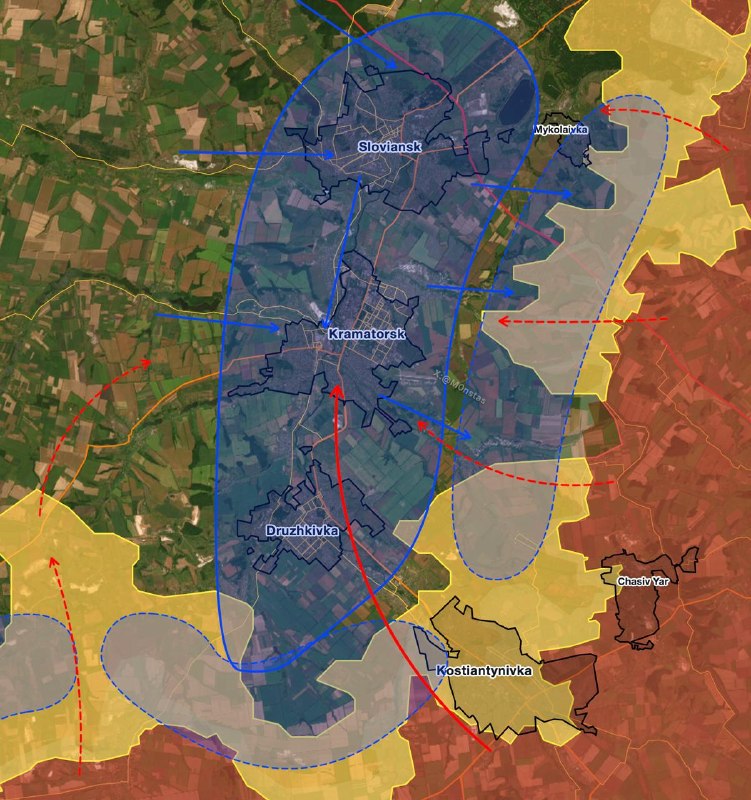
Making the grey zone deeper helps and hurts at the same time. It stretches the defence, but it also spreads the attacker across more ground than he can keep suppressed continuously. Russia compensates with more men; Ukraine compensates with more eyes and small clearing groups. The result is a lot of grey paint produced by relatively little durable control. The lower orbit hands the defence the same tools at shorter range, and the answer is clearing rather than containment: assault units kept for taking infiltrators out of the brigades' defensive areas, living inside the zone instead of waiting in reserve. That is how the overstretch is handled, and so far it keeps up.
Which is what the bombs are really for. The answer to Ukrainian counterattacks is the aircraft: a position cleared at dawn can be flattened by a KAB in the afternoon, and the defence has to decide whether the rubble is worth holding. That argues for clearing fast and holding thin: take the foothold out, leave nothing in it worth a bomb.
The logistics run the other way too. The city belt is a hub: interior roads, cover, repair, staging, short rotations, all of which the attacker has to improvise. Pushing them back in the north helped: the M03 is safer than it was. What is left is lateral movement along the wall, north to south inside the belt and watched the whole way — the problem that was survived at Toretsk and Kostiantynivka.
What the command change means
The boundary has been redrawn rather than the line. One command now holds Kramatorsk together with Lyman, the arc the Russian 3rd Army works from the Donets valley down to the eastern approaches; another holds Dobropillia and Druzhkivka. The Lyman end still faces the 25th, so the match is rough. It is a small-looking change aimed at what kept going wrong all year: seams. A defence split along map lines gives the attacker a boundary to work; one connected frontage under one commander makes a whole Russian army somebody's problem.
It moves the seam rather than removing it, and the new one matters because the southern push is aimed almost directly at it. The retraction loop on the Dobropillia side is Russia's way around the wall: work Druzhkivka from the rear, shorten the belt from the south and make the frontal problem smaller before anyone has to solve it. That is the cheap outcome for Russia, and the one the new arrangement has to deny.
The useful end state for Ukraine is almost the opposite. Deny the northern route, deny the southern retraction, clear the infiltration in between, and leave Russia with the strongest shape on the map — the city belt itself, supplied from inside and approached across open ground. Nothing has to be held for its own sake. The point is to keep removing the cheaper answers until the remaining one is the river-valley grind Russia has already spent two years paying for.
That pushes the requirement back onto Russian mass. The method eats infantry because most of the manpower available on paper never arrives together at the point of contact, and adding more only matters if there is enough drone coverage to move it through transparent ground. More men, more drone crews, more suppression, all to keep the same small groups moving forward. That can be bought, but it takes time, and time is the resource disappearing fastest here.
So watch the bomb tempo against the belt, the depth of the infiltration and whether any gathering area survives a week. Last week the grey shrank by twenty-two square kilometres against twelve taken; those are the two numbers worth running weekly.
For now clearing keeps pace, the same ground keeps changing hands, and Russia is still being made to fight the shape Ukraine would rather give it. The sign that has changed will be windows staying open longer and footholds surviving them.
Post #6334
363


- 🤔 5