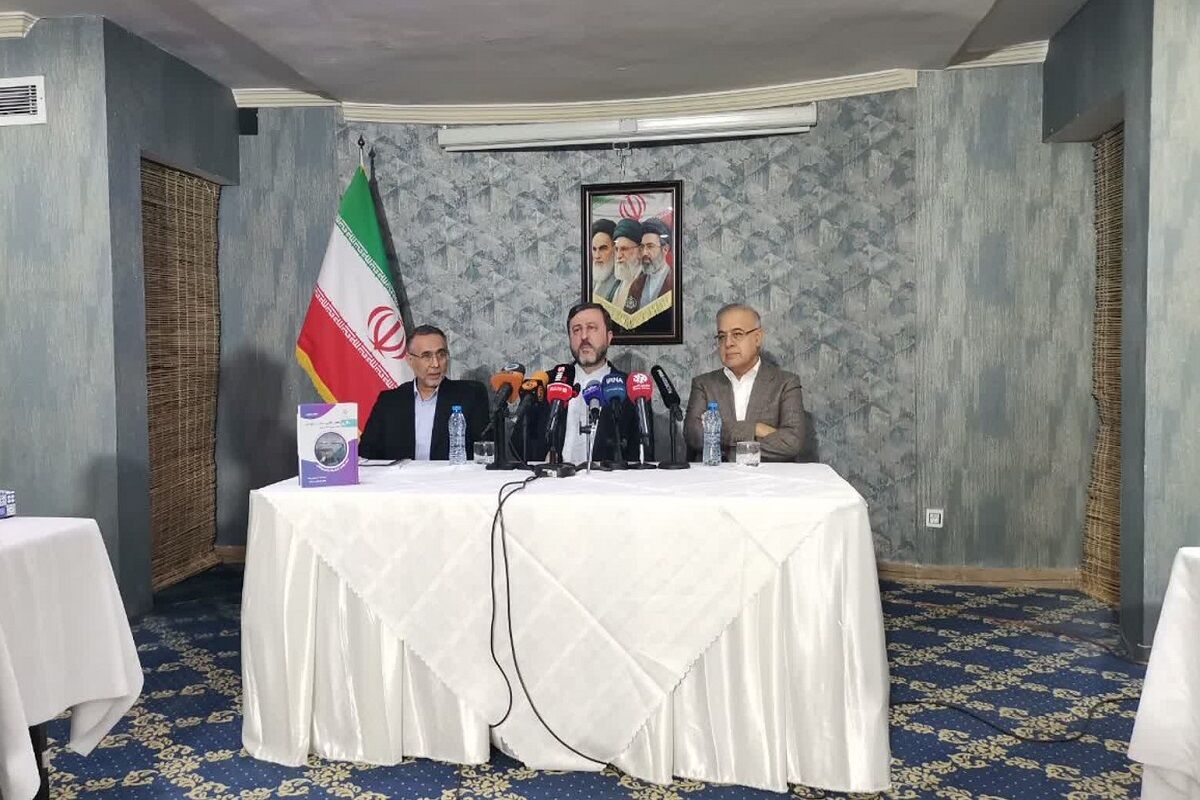
📌 Bandar Abbas, IRNA – Deputy Foreign Minister for Legal and International Affairs, Kazem Gharibabadi, says the Strait of Hormuz is part of Iran’s national security, and that the country will continue to control the strategic waterway until the United States returns to its commitments.
Gharibabadi made the remarks at a press conference in Bandar Abbas, the capital of Hormuzgan Province in southern Iran, on Sunday evening.
He arrived in the province earlier that day to assess areas targeted in the recent US-Israeli war of aggression, including Shajareh Tayyebeh Elementary School in Minab, which was struck on the first day of the war, February 28.
“The Strait of Hormuz is part of the Islamic Republic of Iran’s national security, and Iran reserves the right to take the necessary measures to protect its national security,” he said, rejecting criticism of Iran’s control of the strategic waterway, which has been in place since the early days of the war.
“These control measures will remain in place until the United States, as the main aggressor, concludes that military action is not the solution and returns to its commitments,” Gharibabadi said, adding that Iran’s declared arrangements were being strictly enforced in the strait. Under these arrangements, warships are barred from passing through, while commercial vessels may transit after completing the required coordination, he added.
“At present, no vessel can pass through the strait without coordination with the Islamic Republic of Iran. Vessels that attempt to do so without Iran’s coordination will violate the arrangements announced by Iran and face punitive measures by our Armed Forces,” he stressed.
The deputy foreign minister also referred to an understanding reached between Iran and Oman on the passage of vessels through the Strait of Hormuz.
He described the understanding as highly important and fair from both legal and technical perspectives. However, he said, final approval of the arrangement would not mean the immediate reopening of the strait. Instead, he noted, vessels would be allowed to pass along routes agreed upon by Iran and Oman, with the reopening contingent on the United States fulfilling its commitments to Iran.
“The United States’ return to its commitments is an essential and integral part of the process, and any subsequent action by the Islamic Republic of Iran will be contingent on it,” he stressed.
Gharibabadi also said Iran had always sought good and constructive relations with all its neighbors, including the Arab countries along the southern coast of the Persian Gulf.
He reiterated Iran’s position that security in the Persian Gulf region can only be ensured by the countries of the region, not by foreign forces. He pointed to the recent 40-day war, during which attacks against Iran were launched from regional countries hosting US military bases.
“During the 40-day war, everyone saw that the presence of foreign forces, particularly the United States, was the main source of insecurity not only for the region but also for countries hosting US military bases and equipment. This is a lesson that must be learned from these recent developments and acts of military aggression,” he said.
Gharibabadi stressed that Iran did not expect any country to allow its territory to be used for aggression against Iran’s national security, warning that Iran reserved the right to defend itself if such actions occurred.
The official also stressed that US hostility was directed not only at the Islamic Republic of Iran but at Iran itself.
“Iran, with its several-th . . .
📲 @Irna_en