🔭 NASA’s New Eye on the Universe Has Begun Its Journey
NASA’s Nancy Grace Roman Space Telescope launched on August 30 aboard a SpaceX Falcon Heavy.
With a field of view at least 100 times larger than Hubble’s, Roman will survey billions of galaxies, investigate dark matter and dark energy, and search for worlds beyond our Solar System.
🔵Blue Sunset in Mars' Gale Crater NASA’s Curiosity rover captured a remarkable sunset from Gale Crater on Mars. Unlike sunsets on Earth, the sky around the setting Sun appears blue. The reason is Martian dust. Fine particles in Mars’ thin atmosphere scatter sunlight differently, allowing blue light to remain concentrated around the Sun while warmer colors spread more widely across the sky. A sunset on the Red Planet — glowing blue. 🔵🌅
Webb Uncovers the Violent Past of a Mysterious Galaxy
The James Webb Space Telescope has captured a stunning new infrared view of Arp 263, an irregular galaxy about 25 million light-years away. Astronomers believe Arp 263 was shaped by a past galactic merger. Webb’s NIRCam can peer through its thick gas and dust, revealing brilliant clusters where new stars are actively forming. Its former companion may even have been completely absorbed into the galaxy. Credit: ESA/Webb,
This remarkable view of the galaxy cluster Abell 370 reveals the “Dragon” — a distant background galaxy whose light has been magnified and stretched by the cluster’s immense gravity. This phenomenon, known as gravitational lensing, allows astronomers to study galaxies that would otherwise be too faint and distant to see clearly. 📸 Credit: NASA / ESA / Hubble
Mars Express Takes Us Inside a Giant 460-Km Crater on Mars ESA’s Mars Express has taken us on a spectacular flight over Schiaparelli Crater, one of the largest craters on Mars. The crater stretches about 460 km across and may have been partly filled over billions of years by wind-blown sediment, water deposits and lava.
The 3D flyover was created using high-resolution data from Mars Express, revealing the enormous landscape in remarkable detail.
🌌 Hubble Uncovers an Ancient Chapter of the Milky Way
Hubble has uncovered evidence that the Milky Way merged with an ancient dwarf galaxy called LKH about 11.8 billion years ago. The discovery shows that the Milky Way grew not only by forming its own stars, but also by absorbing other galaxies throughout its history.
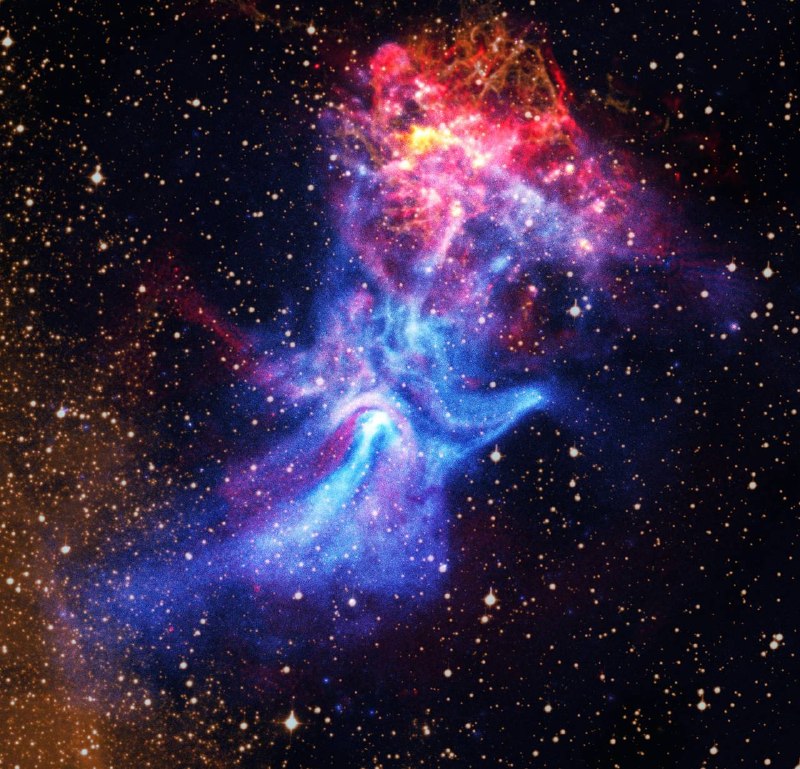
🖐️ A Giant “Cosmic Hand” Revealed in New NASA Image
NASA’s Chandra X-ray Observatory has revealed a striking hand-shaped nebula called MSH 15-52. At its heart is a rapidly spinning neutron star only about 12 miles (19 km) wide, yet the enormous nebula it powers stretches more than 150 light-years across. New radio and X-ray data are helping astronomers better understand this unusual remnant of an exploded star. 📸 Credit: NASA/
NASA/ESA/CSA’s James Webb Space Telescope has captured a stunning new view of the “Treasure Chest” inside the Carina Nebula, about 7,500 light-years from Earth. Instead of gold, this cosmic chest contains a young cluster of around 70 stars. The most massive is a rare O-type star about 19 times the mass of our Sun. Webb’s infrared vision reveals how these young stars and powerful stellar winds are sculpting the surrounding clouds of gas and dust. 📸 Credit: NASA, ESA, CSA, STScI
🌌 James Webb Zooms In on the Heart of the Milky Way
James Webb has captured an extraordinary new view of IRS 3, a dying star located just 0.55 light-years from Sagittarius A*, the supermassive black hole at the heart of our galaxy. Webb’s observations show that even in this extreme environment, dust and water can form and survive — material that could eventually contribute to future generations of stars and planets. 📸 Credit: ESA/Webb, NASA
🦁 James Webb Reveals the Lion Nebula NASA’s James Webb Space Telescope has captured new infrared images of NGC 2392, the Lion Nebula. At its center is a dying star’s white dwarf, whose radiation shapes the surrounding gas and dust into a structure resembling a lion’s face and mane. Astronomers estimate the nebula will gradually disperse over the next 10,000 years.
🕷️ Three NASA Telescopes Unveil the Tarantula Nebula Like Never Before NASA has combined observations from Chandra, James Webb, and Hubble to create a striking new view of the Tarantula Nebula — one of the most active star-forming regions near our galaxy. Located about 160,000 light-years from Earth, the nebula contains thousands of young stars surrounded by vast clouds of gas and dust. The combined data also revealed that the region contains less X-ray-emitting hot gas than scientists expected, offering new clues about how energy escapes from massive stellar nurseries. Image Credit: X-ray: NASA/CXC/Ohio
☄️ The Perseids Meteor Showeris About to Light Up the August Sky
The Perseid meteor shower is approaching its annual peak around August 12–13. Created by debris from Comet Swift–Tuttle, the Perseids are famous for their fast, bright meteors and occasional fireballs. For the best view, find a dark location away from city lights. Credit:Nasa
🌌 Webb Finds Water Near the Milky Way’s Black Hole
James Webb has detected water and oxygen-rich dust around the evolved star IRS 3, just 0.55 light-years from Sagittarius A*, the supermassive black hole at the center of the Milky Way. The discovery shows that these materials can survive even in this extreme environment. Credit : Nasa
🌑The Moon’s Shadow Returns — Total Solar Eclipse on August 12 The total eclipse will be visible from parts of northern Russia, Greenland, Iceland, Spain, and northwestern Portugal. Totality will last less than 2½ minutes, while a partial eclipse will be visible across a much wider region. ⚠️ Eclipse glasses are required during all partial phases. Credit: NASA
The Falcon 9 upper stage previously tracked on its way toward the Moon struck the lunar surface on August 5, 2026. Now, observations from ESO’s Very Large Telescope have detected sodium and lithium gas in the impact plume, which remained detectable for several minutes. Scientists can use the event to study how material behaves during impacts on the Moon. Lunar orbiters are also examining the impact site and the new crater left behind. Credit: Nasa / SpaceX