TGViewer
Channel Public Channel
Galaxy

Galaxy

@galaxy

Space, science and the universe. ✨
The most fascinating discoveries from space, Earth and beyond.
Subscribers
552
Photos
193
Videos
57
Links
22

Showing posts older than #301 · Back to latest

Older Posts 16 shown
Post #300 698
✨ One of James Webb’s Most Stunning Images: Planetary Nebula NGC 1514

The James Webb Space Telescope captured an extraordinary infrared view of NGC 1514, revealing intricate dust rings, hidden gaps, and showing that the bright central object is actually a pair of stars shaping the nebula.
  • ❤ 5
  • 🦄 2
  • 👾 2
Post #299 712
🔭 Hubble Captures Two Galaxy Clusters in the Middle of a Cosmic Collision

Hubble observed the massive galaxy cluster CL0016+1609 (MACS J0018.5+1626), revealing that it is actually two galaxy clusters merging together.

Although Hubble cannot see dark matter directly, astronomers used gravitational lensing to map its distribution and better understand how these colossal collisions shape the large-scale structure of the Universe.

The observations also uncovered hundreds of extremely distant galaxies, whose light was magnified by the cluster’s immense gravity.

Credit: NASA / ESA / Hubble
  • ❤‍🔥 3
Post #298 541
🌕 A SpaceX Falcon 9 Rocket Is About to Crash Into the Moon

NASA and SpaceX are tracking the Falcon 9 upper stage from the Blue Ghost 1 mission, which is expected to impact the Moon near the Einstein and Bell craters.
The impact poses no danger to Earth, but it offers a rare scientific opportunity. NASA will study the new crater and the ejected dust to better understand the Moon’s surface and improve future impact models and space object tracking.
The collision is expected to create a crater about 18 meters (60 ft) wide and 3.5 meters (12 ft) deep.
Credit: NASA
  • ⚡ 1
  • 👀 1
  • 👾 1
Post #297 406
☀️ NASA Just Made Solar Storm Forecasts 10× More Accurate

NASA’s PUNCH mission successfully predicted the arrival of a solar storm within 30 minutes—about 10 times more accurate than current forecasting methods.

Using four spacecraft, PUNCH continuously tracks solar eruptions across the inner Solar System, capturing a new image every 4 minutes. This breakthrough could greatly improve warnings for satellites, power grids, astronauts, and GPS systems while helping scientists better understand how solar storms evolve.

Credit: NASA
  • 👀 2
Post #295 407
https://youtu.be/I29P2zHNGdI


Skywatching Highlights

Aug. 5: Last Quarter Moon
Aug. 12: Total solar eclipse across northern Russia, Greenland, Iceland, northern Spain, and part of Portugal; partial eclipse in parts of the U.S.; New Moon
Aug. 12-13: Perseid meteor shower peak under dark skies
Aug. 14-16: Venus reaches greatest eastern elongation and shines low in the west after sunset
Aug. 27-28: Partial lunar eclipse visible from much of North and South America and parts of Europe and Africa
YouTube What's Up: August 2026 Skywatching Tips from NASA A solar eclipse, one of the year's best meteor showers, Venus at its brightest in the evening sky, and a partial lunar eclipse to close out the month. On August 12, a total solar eclipse crosses northern Russia, Greenland, Iceland, northern Spain, and a…
  • 👍 1
Post #294 439
NASA’s Chandra Finds Unexpected Fireworks in Aftermath of Stellar Explosions

NASA's Chandra X-ray Observatory found that several supernova remnants in galaxy M83 are changing in X-ray brightness instead of fading as expected.
Scientists think the most likely cause is material from a surviving companion star falling onto a black hole or neutron star. Another possibility is that the compact object is pulling back debris from the original explosion.
* The discovery offers new clues about how supernova remnants evolve.
Credit: Nasa
  • ❤ 5
  • ❤‍🔥 1
  • 🔥 1
Post #293 592
🕸️The Universe Hid Its Biggest Secret… Until Scientists Asked a Slime Mold
For decades, astronomers have searched for the Cosmic Web—the vast network of dark matter and faint hydrogen gas that connects galaxies across the Universe. But tracing it was nearly impossible because dark matter is invisible.

Scientists found inspiration in slime mold, a single-celled organism that naturally builds the shortest and most efficient networks while searching for food. They realized its patterns closely resemble the Cosmic Web.

Using a computer algorithm inspired by slime mold, researchers analyzed the positions of 37,000 galaxies to predict where the Universe’s hidden filaments should be.

They then tested the prediction with Hubble observations of 350 distant quasars. Hubble detected hidden hydrogen gas exactly where the algorithm had predicted, providing one of the strongest confirmations yet that galaxies are connected by an enormous Cosmic Web—the invisible backbone of our Universe.
Credit: Nasa
  • ❤ 3
  • 👍 3
  • 💘 2
Post #292 461
🌌 The First 3D Map of Dark Matter
Using nearly 1,000 hours of Hubble observations and 575 overlapping images, astronomers created the first three-dimensional map of dark matter across the universe.
Built from the shapes of 500,000 distant galaxies, the map reveals that galaxies are not randomly scattered, but follow a vast Cosmic Web of dark matter filaments that has grown denser over billions of years under gravity.
This breakthrough transformed dark matter from a theoretical prediction into something whose large-scale structure can be directly mapped, offering new clues to how galaxies—and possibly dark energy—shaped our universe.
Credit: Nasa
  • 🔥 3
  • 💘 2
  • 👍 1
  • 🐳 1
Post #291 472
💥 Four Galaxy Clusters in a Historic Collision
This composite image of MACS J0717.5+3745 captures the first known collision of four galaxy clusters. Hubble reveals the galaxies, while Chandra X-ray Observatory shows the hot gas, with blue indicating the hottest gas and reddish-purple the coolest.
Astronomers found that a 13-million-light-year-long filament of galaxies, gas, and dark matter is continuously feeding the cluster, driving these repeated collisions. Located 5.4 billion light-years from Earth, MACS J0717 is one of the most complex galaxy clusters ever discovered.
Credit: Nasa
  • 👍 2
  • 👾 2
Post #289 352
🕸️🕸️ The Universe Looks Like a Giant Spider Web
Astronomers believe the early universe was almost perfectly smooth. Tiny differences in density gradually pulled in more matter through gravity, forming a vast Cosmic Web that resembles a giant spider web. Made mostly of dark matter, this enormous network of filaments forms the large-scale backbone of the universe today.
This image combines 18 Hubble observations of the galaxy cluster MACS J0717.5+3745.
By studying how gravity bends the light from distant galaxies, astronomers discovered a dark matter filament extending from the cluster’s core. Shown in blue, the filament stretches to the left of the cluster and was mapped in 3D for the first time using Hubble and ground-based telescopes.
Credit: NASA, ESA
  • 👍 2
  • 💯 1
Post #287 295
✨ When Light Reveals the Invisible
When V838 Monocerotis erupted in 2002, it became 600,000 times brighter than the Sun. Instead of a normal explosion, its light illuminated ancient clouds of dust, creating a breathtaking light echo that continues to reveal new cosmic structures years later.
Credit: NASA
  • ❤‍🔥 2
  • 👍 1
Post #284 310
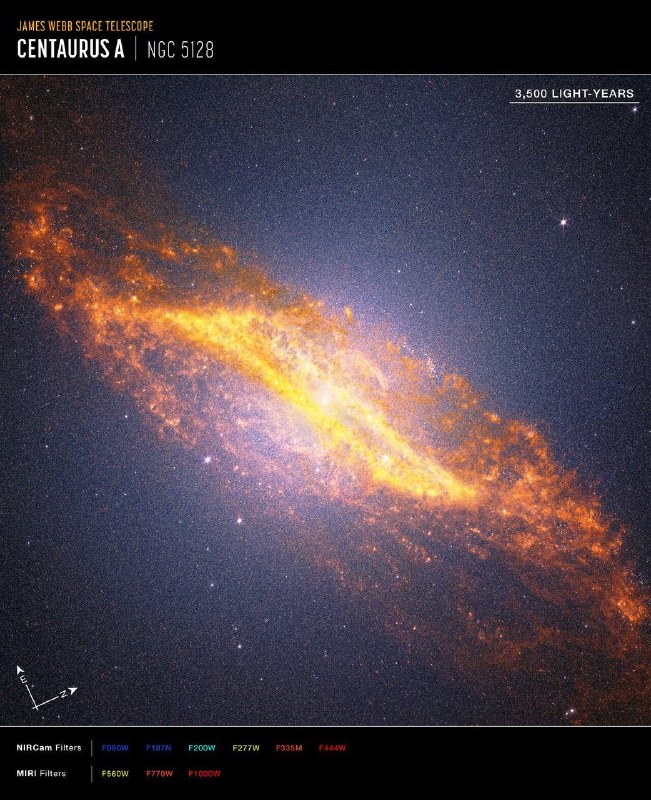
🌌 James Webb Reveals Centaurus A Like Never Before
The James Webb Space Telescope captured one of the clearest infrared views of Centaurus A, exposing hidden dust lanes and the active heart of this galaxy in remarkable detail.
Credit : NASA
  • 💋 3
  • 👍 2
Post #283 396
🍬 The First True Sugar Found in Deep Space

Astronomers have discovered erythrulose, the first true sugar ever detected in interstellar space.
While it may sound like an ordinary molecule, sugars are essential for life. They help power living cells and form part of the backbone of DNA and RNA, making this discovery an important clue in the search for life’s cosmic origins.
Credit: Nature Astronomy / Centro de Astrobiología (CSIC-INTA)
  • ❤‍🔥 3
  • 🥰 2
  • ⚡ 1
Post #282 436
🌌The Galaxy That Wears a Cosmic Hat
Famous for its brilliant central bulge and the dark dust lane that makes it resemble a giant sombrero, M104 is one of the most iconic galaxies ever discovered.
Credit: NASA, Hubble
  • ❤‍🔥 2
  • 🔥 2
Post #281 366
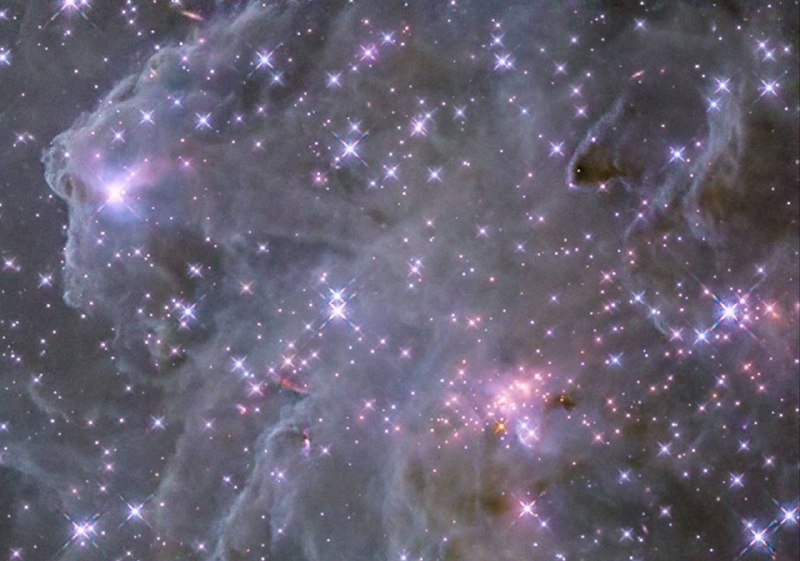
✨A Hidden Stellar Nursery
Hubble’s infrared view of emission nebula Sh2-284 provides a glimpse of the brilliant young stars hidden within clouds of gas and dust.
Credit: NASA
  • 💯 4
Post #276 477
🏜️ A Survivor of Martian Time
Today, NASA released a stunning new view of “Miraflores,” a 6-meter-tall butte that has survived millions of years of Martian erosion.
Surrounded by mysterious polygon patterns, this ancient formation offers another glimpse into Mars’ geological past.
Credit: NASA
  • 👍 4
  • ❤ 1
  • 🥰 1
Older posts →
Threads Profile ViewerView any public Threads profile without an account.Open ThreadLook →Writing with AI? Make it sound human.Metric37 rewrites AI drafts so they read naturally. Free AI detector, 1,500 words free.Try Metric37 →