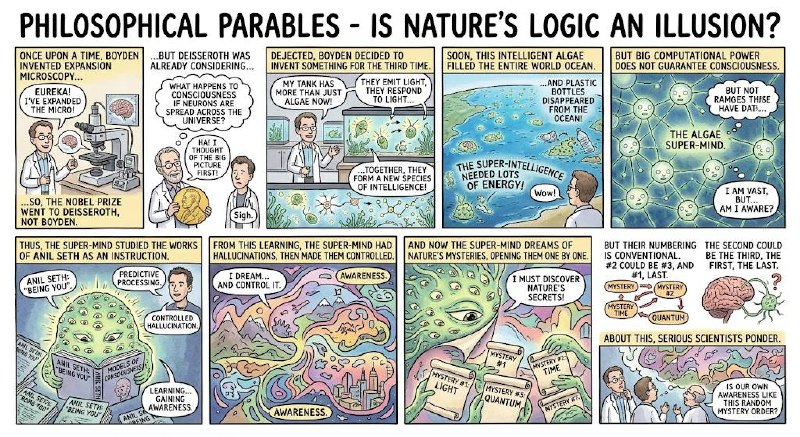
From the section “Philosophical Parables”
Once, Boyden invented expansion microscopy, but Deisseroth had already earlier pondered the question of what would happen to consciousness if neurons were scattered across distant corners of the universe. So the Nobel Prize for this was again awarded to Deisseroth, not to Boyden.
Then Boyden decided to invent something for a third time. Soon, swimming in his aquarium were not only Chlamydomonas but also dinoflagellates; some emitted light, others reacted to it, and together they formed a new kind of mind.
Soon these intelligent algae filled the entire World Ocean, and at the same time the plastic-bottle trash disappeared somewhere, because the supermind needed a lot of energy.
But great computational power did not guarantee the emergence of consciousness. So the supermind began poring over Anil Seth’s works, using them as an instruction manual. Thanks to this acquired knowledge, the supermind developed hallucinations, and then they became controlled.
And so the supermind dreams that there exists some nature, and it has many mysteries. And the supermind must uncover these mysteries. It uncovers the first mystery, then the second, third, and so on.
But in reality, the numbering of these mysteries is arbitrary. The second could just as well be designated the third, and the first the last.
Now let us conduct a thought experiment: randomly shuffle all the mysteries and see what comes out.
This is roughly what happens with our human brain and consciousness. Serious, major scientists think about this.
#philosophicalparables
Post #16637
50