TGViewer
Channel Public Channel
Astrobin Image of the day

Astrobin Image of the day

@astrobinimageoftheday

🔭 Every day, the image of the day from www.astrobin.com

👤 Developed by Marco Aceti (@MarcoBuster)
Subscribers
211
Photos
0
Videos
0
Links
3.1K
Recent Posts 20 shown
Post #3101 24
🔭 NGC 281 - The Pacman Nebula by Peter_Butler
NGC 281, also known as The Pacman Nebula, is a bright emission nebula and part of an H II region in the northern constellation of Cassiopeia and is part of the Milky Way's Perseus Spiral Arm. This 20×30 arcmin sized nebulosity is also associated with open cluster IC 1590, several Bok globules and the multiple star, B 1. It collectively forms Sh2-184, spanning over a larger area of 40 arcmin. A recent distance from radio parallaxes of water masers at 22 GHz made during 2014 is estimated it lies around 9200 light year from us.This is a collaboration with Chuck's Astrophotography, with Chuck capturing the data with his 8" RASA and ASI533MC Pro, and then processed by me using Pixinsight.
Post #3100 33
🔭 A total solar eclipse mosaic. by cmk
Here is a complete, chronological story of the eclipse's most critical moments, assembled into a single, symmetrical mosaic. The image captures key optical phenomena accompanying the Moon's transit across the face of our star, recorded during an expedition to Spain.How to read this composition? Center: Totality and the solar corona. The moment the Moon’s disk completely obscures the Sun’s photosphere. For these few dozen seconds, twilight falls, revealing the outer, highly diffuse part of the solar atmosphere—the corona. It consists of ionized plasma reaching temperatures of millions of degrees Celsius.Middle (moving outward): Baily’s beads. A phenomenon visible for just a few seconds immediately before and after totality. As the Moon’s disk almost entirely covers the Sun, its edge is not a perfectly smooth line. Sunlight begins to break through the deep valleys, craters, and topographical irregularities of the lunar surface (the lunar limb profile). To an observer on Earth, this resembles a string of shining pearls or points of light that blink out or flare up in sequence due to orbital motion.Edges (outer frames): Diamond ring. A spectacular and highly dynamic effect that heralds the onset (C2) and the end (C3) of totality. It forms the moment the last, solitary, and incredibly bright fragment of the photosphere emerges from behind—or slips behind—the dark lunar disk. Combined with the inner solar corona already faintly visible around it, this phenomenon creates an optical illusion in the sky resembling a giant, blazing engagement ring set with a single, glittering diamond.If you look closely at the edge of the solar disk, you can also spot intensely red structures. These are massive prominences—giant loops of matter ejected into space, shaped by the Sun's powerful magnetic field lines.Combining such dynamic stages into a single, aesthetically cohesive mosaic required precise exposure planning for each phase—ranging from fractions of a second for Baily's beads to longer exposures needed to capture the outer reaches of the corona.
Post #3099 36
🔭 M6_The Butterfly Cluster by MariusD69
“The Butterfly Cluster (cataloged as Messier 6 or M6, and as NGC 6405) is an open cluster of stars in the southern constellation of Scorpius. Its name derives from the resemblance of its shape to a butterfly.The first astronomer to record the Butterfly Cluster's existence was Giovanni Battista Hodierna in 1654. However, Robert Burnham Jr. has proposed that the 2nd century astronomer Ptolemy may have seen it with the naked eye while observing its neighbor the Ptolemy Cluster (M7). Credit for the discovery is usually given to Jean-Philippe Loys de Chéseaux in 1746. Charles Messier observed the cluster on May 23, 1764, and added it to his Messier Catalog.Estimates of the Butterfly Cluster's distance have varied over the years. Wu et al. (2009) found a distance estimate of 1,590 light-years, giving it a spatial dimension of some 12 light years. Modern measurements show its total visual brightness to be magnitude 4.2. The cluster is estimated to be 94.2 million years old. Cluster members show a slightly higher abundance of elements heavier than helium compared to the Sun; what astronomers refer to as the metallicity.120 stars, ranging down to visual magnitude 15.1, have been identified as most likely cluster members. Most of the bright stars in this cluster are hot, blue B-type stars but the brightest member is a K-type orange giant star, BM Scorpii, which contrasts sharply with its blue neighbours in photographs. BM Scorpii, is classed as a semiregular variable star, its brightness varying from magnitude +5.5 to magnitude +7.0. There are also eight candidate chemically peculiar stars.” (Wikipedia)
Post #3098 39
🔭 The Methuselah Nebula by GB-Astronomy
The Methuselah Nebula (MWP 1) is a bipolar planetary nebula that is over 100,000 years old, making it one of the oldest known planetary nebula. Nearby to it is Alves 1, another faint planetary nebula that was discovered accidentally by an amateur astronomer Filipe Alves while he was observing MWP 1.This project was over 1 year in the making. It began in late August of 2025, and after a hiatus while Cygnus was out of season, we added tons more data to create this result. This is one of the most underrated regions of the sky, with incredible Ha and Oiii structure at both close up and widefield views, so we are glad to do it justice.
Post #3097 69
🔭 C2025 K1 ATLAS visits the Leo Triplet by jdh_astro
Post #3096 62
🔭 Neptune's Cloud features near North Pole (Timelapse animation) by aikenji
1. Bright Clouds Features Near Neptune’s North PoleNeptune has a dynamic atmosphere composed mainly of hydrogen, helium, and methane, with bright cloud features often visible at infrared wavelengths. Because Neptune is more than four billion kilometers from Earth, subtle atmospheric structures are extremely difficult to observe from the ground.On August 26 in East part of China, I was fortunate to have a night of exceptionally good seeing and transparency ahead of an approaching typhoon. So I decided to make an observation of Neptune using IR filter. To my surprise, I detected a prominent bright cloud feature near Neptune’s north polar region, and it appears around C.M. 250°.To verify the reality of the feature, I continued imaging for approximately three hours to create a rotation animation. The animation finally reveals two bright cloud features near Neptune’s north pole. They can be seen rotating with Neptune, while Triton’s orbital motion is also visible. It was exciting to reveal Neptune’s atmospheric features with an amateur telescope from the ground.2. Imaging and Processing DetailsThe observation was made with a Celestron C9.25, a QHY678M monochrome camera, and a 720IR filter.I captured 25 sequences of 8,000 frames each, with 50 ms exposure per frame, covering approximately three hours. The sequences were stacked with AutoStakkert! 4 and sharpened using wavelet processing, revealing the bright spots near Neptune’s north pole. A continuous GIF generated directly from the raw data is also provided to demonstrate the reality of the features.The infrared data were then used as the luminance channel and combined with color data captured on the same night, producing the final three-hour rotation animation.raw footage
Post #3095 49
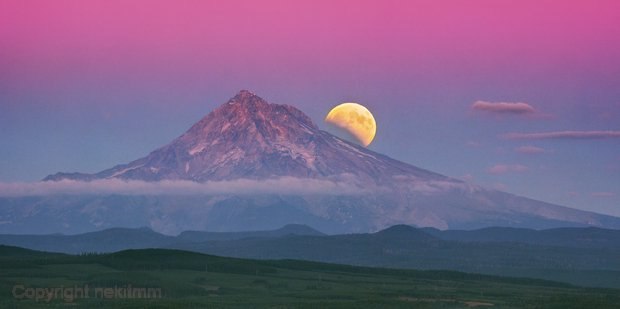
🔭 Moon eclipse Aug 27th from Portland, OR by nekitmm
Haven’t had a chance to do much astro lately, but here’s a shot of last week’s lunar eclipse!Hope you enjoy — cheers!
Post #3094 54
🔭 ​The Milky Way and Red Sprites over Geroldsee (Wagenbrüchsee), Germany 🇩🇪⚡ by LukaszRemkowicz
Together with friends, we originally planned to photograph the Milky Way in the Dolomites 🇮🇹. However, the forecast predicted widespread thunderstorms, so we changed our destination and headed to Geroldsee (Wagenbrüchsee) in Bavaria 🇩🇪, which offers a spectacular view of the Karwendel mountain range. 🏔️🌅 After sunset, the clouds gradually cleared, revealing the summer arc of the Milky Way. The foreground is dominated by traditional alpine cabins and meadows, while the illuminated upper station of the Karwendelbahn 🚠 can be seen on the horizon, just below Westliche Karwendelspitze (2,385 m).⚡ The most remarkable feature of this image, however, is the Red Sprites visible above the mountain ridge. These transient luminous events were recorded above a large thunderstorm system located approximately 170–180 km away, over northern Italy. 🇮🇹⛈️✨ Red Sprites are rare atmospheric electrical discharges that occur high above thunderstorm clouds, at altitudes of around 50–90 km. Lasting only a few to a few dozen milliseconds, they are extremely difficult to observe with the naked eye and are most often captured only in photographs.🌈 The image also reveals prominent bands of airglow in shades of green and red, stretching across the southern horizon.
Post #3093 58
🔭 The Dark Tower: An LRGB Rendition by ashastry
Some objects earn their names the moment you see them. The Dark Tower rises out of a crowded Scorpius star field like a ruin from another age, a column of dust roughly forty light years tall, leaning as if caught mid-collapse, its silhouette swallowing the stars behind it. It lies about 5,000 light years away, and the catalogs know it only by the anonymous designation GN 16.43.07.01, which feels like a crime against an object this theatrical.The Dark Tower is a cometary globule, and its shape tells you exactly where its tormentors stand. Off the top of the frame burn the O stars of the Sco OB1 association and the young cluster NGC 6231, and their ultraviolet flood has been sandblasting this cloud for eons. The side facing them has been eroded into a dense, bright-rimmed head, glowing red where the gas is ionized right off the dust, while everything behind streams away into the long, tattered tail that gives these globules their name. The whole structure is a windsock for starlight, pointing straight at its persecutors.But the Dark Tower is not simply being destroyed. The same radiation crushing it from outside is squeezing its head like a fist, and inside that compressed knot new stars are already forming. Look closely at the crown: tucked beneath the red rim shine soft blue pools of reflection nebulosity, infant starlight scattering off the very dust that shrouds it, and further down the column smaller embers glow through the soot. A thing built of darkness, lit from within.Ten hours of LRGB went into this rendering, with the luminance carrying the delicate rim structure and the faint red veils that drift through the whole field. I kept the processing restrained. The star field does the work here, thousands of gold and blue suns behind a shape that needs no exaggeration to unsettle you. The Dark Tower stands, the light lays siege, and somewhere inside it the next stars are quietly being born.Captured from my remote setup at Obstech in Chile:🔭 PlaneWave CDK500 Observatory System📸 Moravian C5A-100M Camera🎨 Chroma L, R, G, and B Filters📀 L: 48×300s, R: 44×180s, G: 38×180s, B: 37×180s (9.95 hours)🖥️ Processed in PixInsight and Adobe Photoshop
Post #3092 63
🔭 The 'Devil's Horns' during the partial Solar Eclipse of 12 August 2026 by sabre414
The 'Devil's Horns' phenomenon is a rare optical effect that occurs during solar eclipses, particularly when the moon partially covers the sun, leaving two glowing points that resemble demonic horns piercing the sky. It is best observed at sunrise or sunset, and is the result of atmospheric refraction over water. The phenomenon is scientifically known as the 'Etruscan vase' effect. The Sun's altitude was too high above the horizon to capture the 'Etruscan vase' effect in my image.This is my interpretation of the 'Devil's Horns' during the partial Solar Eclipse of 12 August 2026, and was imaged from Swansea, Wales, where we witnessed a 93.4% partial eclipse.
Post #3091 51
🔭 A Deep Dive Into Andromeda Galaxy's (M31) Core - LRGB+Ha by NE-FL-Astro
For a while now, I’ve wanted to do a deep image on Andromeda’s core with an emphasis on the hydrogen alpha. For the last month or so, I’ve been pointing my telescope at Andromeda to do just that.The stacking was done in Pixinsight along with some of the basic editing and continuum subtraction. To blend it all together, I moved over to Photoshop. I could not simply screen the Ha over the LRGB image as the core is too bright to show any detail. Instead, I screened the Ha for the outer bands and large bright nebulae. For the core, I had to use additional layers with a mask to exclude the outer regions. For layer types, I used luminosity with reduced fill/opacity and additional screen layers. It took a fair amount of blending with masks to get the level of control I needed. As far as noise reduction, I found it best to do the continuum subtraction on images with zero noise reduction and then run NoiseXterminator after. I also created a super luminance frame for the luminance layer, maximizing detail and SNR.
Post #3090 57
🔭 220P/McNaught Comet by 175892800@qq.com
The McNaught Comet has a period of 5.5 years for its orbit. It erupted on August 5th, with its brightness increasing sharply to a magnitude of 6.4. It then gradually declined, reaching around 10.7 magnitudes on August 25th. It managed to capture the tail of the comet during its observation window. At 3 o'clock in the morning, I called my friends at the observatory one by one, urging them to take pictures. However, not a single one of them woke up.ORZ
Post #3089 58
🔭 Saturn from 2018 to 2026 by macnenia
I have had the pleasure of imaging Saturn since 2017. My technique didn’t really cut it that first year, but by 2018, I had mastered imaging the ringed planet and this montage shows the progress of the planet each year since then. 2018 was the year when the rings were fully open and Saturn was at its most Southerly Declination, so highest in the sky for me with an altitude of up to 79 degrees. Those early years I had some nights of phenomenal seeing and was able to capture the planet at its most photogenic. With Saturn now moving northwards, the planet is less favourably positioned but still with an altitude of some 55 degrees. Nevertheless, the seeing today doesn’t reach the heights of the early years. However, when I do have a night with good seeing, it does allow me to continue adding to this montage of the planet over the years and I am now up to 9 years.When the rings were wide open in 2018 and the years fter that, we were able to see the north pole of the planet and particularly the hexagonal polar vortex. This was really well resolved due to the colour contrast in 2019. It is interesting to see how the subtle colours of the banding changes from year to year. By 2025 the rings went edge-on and we were able to see the planet much as we would see it if it had no rings and getting an equal view of each Hemisphere. Since then of course we are now seeing the other side of the rings as the Southern Hemisphere of the planet begins to dominate. That will of course continue until the rings are fully open again, whence we will no longer be able to see the Northern Hemisphere of the planet.It is a jewel of the solar system and I still get a thrill seeing it in the eyepiece. I hope this gives you a good appreciation of its changing aspect over this time frame, which represents the planet’s motion through ~ 30% of its orbit.
Post #3088 63
🔭 TSE 2026 - Coronal streamers in HDR by Lrx.photo
🌞🇪🇸 Éclipse solaire totale du 12 août 2026 - Couronne solaire - Espagne🥹 Irréel… C'est le premier mot qui me vient en vivant ce phénomène pour la première fois ici en Espagne… Il faut le vivre pour comprendre la puissance du truc, aucune photo ne peut rendre justice à ce qu'on voit à l'œil nu (simulation de ce qu'on voit à l'œil nu dessous). Cette sphère d'un noir profond entourée par cet anneau de feu sur fond d'un ciel digne d'une fin de blue hour donne l'impression d'être dans un film de science fiction. Voir ça de ses propres yeux est une expérience inoubliable que je recommande à quiconque…Si il y a bien 2 événements célestes qui marquent à vie selon moi et que vous devriez absolument faire si vous le pouvez : les tempêtes géomagnétiques (aurores) et les éclipses solaires totales ! Ce n'est pas des phénomènes aussi rares qu’on le pense. Et ayez en tête que les meilleurs souvenirs que l'on se procure, sont avant tout ceux fait avec nos propres yeux et ne doivent pas être au détriment d’obtenir un cliché numérique à tout prix (même si c'est largement possible de le faire les deux à la fois).Après une année et demie à planifier techniquement/logistiquement ce voyage et à chercher l'endroit idéal, je me suis retrouvé dans la province de Burgos sur un spot repéré en amont qui était assez loin dans mon classement de préférence. J’ai préféré jouer la carte de la sûreté météo ! Voici une première image d'une série à venir, un HDR de 7 blocs d'images pour tirer le maximum de chaque partie : l'anneau de diamant, les grains de Baily, les protubérances, la couronne interne, externe, très externe et la Lune ! Le tout en séquence quasi full automatique et n'ayant jamais pratiqué le solaire, encore moins une éclipse, avant ce 12 août 2026…EXIF :@canonfrance EOS R6@ttartisan RF 500mm F/6.3@skywatcher Star Adventurer HDR de 7 séries d'images, 434 photos pour 1mn44 de totalité à 8,5° de hauteurA très vite pour la suite des images et du récit ! ✨NB : La résolution finale ici a été divisée par 2 pour éviter tout vol et manipulation d’image.
Post #3087 63
🔭 NGC 3621: A Pure Disk Spiral in Hydra by ashastry
NGC 3621 is a galaxy that should not work. Some 22 million light years away in Hydra, it is a spiral with no bulge at all. Where most galaxies carry a glowing central swarm of old stars, this one is pure disk, a sheet of stars and gas spun flat, with only a modest golden core marking its heart. Galaxies are supposed to grow through mergers, and mergers build bulges, so a disk this clean suggests a quiet life, eons spent spinning alone at the edge of the Leo Spur while the rest of the universe collided around it.Yet the quiet is deceptive. The disk is flocculent, its arms broken into hundreds of woolly tufts of star formation rather than grand sweeping spirals, and the deep hydrogen data lights them up: dozens of rose-pink HII regions scattered along the blue star clouds like embers in ash. Deeper still, the nucleus hides a surprise. Despite the missing bulge, its spectrum betrays an active center, evidence that a black hole grew here anyway, without the merger history that supposedly feeds one. NGC 3621 also carries scientific weight out of proportion to its fame: it was one of the galaxies whose Cepheid variables the Hubble Space Telescope used to calibrate the cosmic distance scale.This field rewards wandering. A perfect little face-on spiral hangs above the galaxy, and the black around it is salted with dozens of background galaxies, ellipticals, edge-on slivers, and faint smudges hundreds of times farther away, all framed by the golden and blue foreground stars of our own Milky Way.Just over 39 hours of integration went into this one, among the longest I have spent on a single galaxy. The luminance carries the faint outer disk, which fades so gradually that it takes real depth to hold its full extent, and the hydrogen subs give the star-forming regions their color. A galaxy with no name and no bulge, and one of the finest disks in the southern sky.Captured from my remote setup at Obstech in Chile:🔭 PlaneWave CDK600 Observatory System📸 Moravian C5A-100M Camera🎨 Chroma L, R, G, B, and 3nm Ha Filters📀 L: 95×600s, R: 61×300s, G: 62×300s, B: 64×300s, Ha: 23×1200s (39.08 hours)🖥️ Processed in PixInsight and Adobe Photoshop
Post #3086 58
🔭 IC4592 Blue Horsehead Nebula in HaLRGB by count.neverest
Blue Horshead is an object worth spending more time integrating, even though the main reflection nebula is bright.While collecting data under a Bortle class 1 sky, we captured the dust surrounding IC 4592. It’s clear that the diffuse dust surrounding the “eye” also glows blue. We added the to most commonly imaged (L)RGB combination an Ha data.The Blue Horshead is located about 400 light-years away and spans 40 light-years. The reflection nebula reflects light from the star Nu Scorpii.____________________________On the right side of the “revision D” photograph, long filaments of the Ha emission are visible. What is particularly interesting is a small jet resembling a Herbig-Haro object:
Post #3085 61
🔭 Saturn's animation of ring spokes and storms 2026-08-17 by aikenji
I reprocessed the raw footage from the 17th and made a 1-hour rotation animation of Saturn, which allows us to clearly see the drift of storms in the southern hemisphere as well as the motion of the ring spokes.
Post #3084 58
🔭 The Raging Forest of Fire, 20.08.2026 by MaxWarrior
Homemade achromatic refractor 204/1800 derf dual antlia, double lunt40.20.08.2026, 08:00:16 - 09:13:54 local time.Equipment: Antlia 200mm derf, achromat 204/1800, quark combo BF, lunt40 and imx428 camera.Shooting parameters: 2.5ms shutter speed, 70 gain, 60% histogram fill. AS!4.
Post #3083 71
🔭 Barnard's Galaxy (Ngc 6822) in HOO - a maelstrom of rings and bubbles by stefanopesci
This H-alpha and O-III rendition of NGC 6822, with 25h of narrowband integration plus RGB stars, highlights the complex structure of Barnard’s galaxy emission nebulae. These nebulae were thouroughly catalogued in a 1982 science paper available here: https://articles.adsabs.harvard.edu/pdf/1982PASP...94..444K and are shown in the image overlay, with their apparent dimentions (largest ones). In the overlay the nebulae are identified as DN (diffuse nebula).Here is Edwin Hubble 1925 historic paper on Ngc 6822, referred to as a “faint cluster of stars and nebulae”, which provided the first identification for the galaxy emission nebulae labelled as “Hubble” plus a Roman number (from I to X): https://articles.adsabs.harvard.edu/pdf/1925ApJ....62..409HWorth mentioning is that Edwin Hubble correctly identified Ngc 6822 as extra galactic and farther away (correctly) than the Magellanic Clouds, through the analysis of period-luminosity relation of Cepheid variables.In the image, RGB stars were added without overwhelming the nebulae in the galaxy core.
Post #3082 71
🔭 Total Solar Eclipse 2026: Baily’s Beads by astro.midnight
Totality, before and after. These are the famous Baily’s Beads, the last breath of sunlight through the lunar mountains just before and after totality, and to be honest, it was the most beautiful thing I have ever seen in my life.One of the nicest details in these eclipse images is the warm yellow color. With the Sun very low in the sky, the atmosphere naturally shifted its light toward yellow, a look I made sure to preserve as naturally as possible.This sequence was captured with my Canon RF and Canon RF 200-800mm telephoto lens at 600mm f/8, ISO 100, mounted on a Sky-Watcher Star Adventurer tracking the Sun. To capture this level of detail and extreme dynamic range, I used two types of 7-step bracketing: one for the Baily’s Beads and another for totality. These were saved in the camera memory so that at the exact moment I could just switch modes and fire again.
Older posts →

About this channel

How can I read @astrobinimageoftheday without a Telegram account?
TGViewer shows the public web preview Telegram publishes for Astrobin Image of the day: recent posts, photos, videos and the subscriber count, with no app, login or account.
How many subscribers does Astrobin Image of the day have?
Astrobin Image of the day (@astrobinimageoftheday) has 211 subscribers on Telegram, refreshed roughly every 30 minutes.
Does Astrobin Image of the day know I viewed it here?
No. Public channel previews carry no viewer identity, and TGViewer has no accounts or tracking of what you look up.
Threads Profile ViewerView any public Threads profile without an account.Open ThreadLook →Writing with AI? Make it sound human.Metric37 rewrites AI drafts so they read naturally. Free AI detector, 1,500 words free.Try Metric37 →