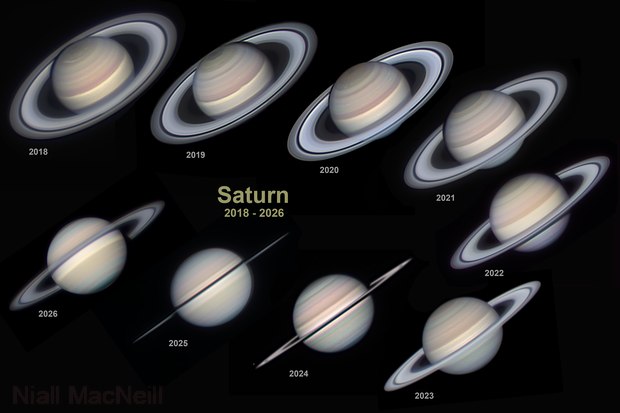
macneniaI have had the pleasure of imaging Saturn since 2017. My technique didn’t really cut it that first year, but by 2018, I had mastered imaging the ringed planet and this montage shows the progress of the planet each year since then. 2018 was the year when the rings were fully open and Saturn was at its most Southerly Declination, so highest in the sky for me with an altitude of up to 79 degrees. Those early years I had some nights of phenomenal seeing and was able to capture the planet at its most photogenic. With Saturn now moving northwards, the planet is less favourably positioned but still with an altitude of some 55 degrees. Nevertheless, the seeing today doesn’t reach the heights of the early years. However, when I do have a night with good seeing, it does allow me to continue adding to this montage of the planet over the years and I am now up to 9 years.When the rings were wide open in 2018 and the years fter that, we were able to see the north pole of the planet and particularly the hexagonal polar vortex. This was really well resolved due to the colour contrast in 2019. It is interesting to see how the subtle colours of the banding changes from year to year. By 2025 the rings went edge-on and we were able to see the planet much as we would see it if it had no rings and getting an equal view of each Hemisphere. Since then of course we are now seeing the other side of the rings as the Southern Hemisphere of the planet begins to dominate. That will of course continue until the rings are fully open again, whence we will no longer be able to see the Northern Hemisphere of the planet.It is a jewel of the solar system and I still get a thrill seeing it in the eyepiece. I hope this gives you a good appreciation of its changing aspect over this time frame, which represents the planet’s motion through ~ 30% of its orbit.