TGViewer
Channel Public Channel
World Genetics

World Genetics

@worldgenetics

Learn more about your ancestry
Subscribers
593
Photos
100
Videos
5
Links
55

Showing posts older than #94 · Back to latest

Older Posts 20 shown
Post #93 271
Modern Greenlanders have a distinctive ancestry profile shaped by both Inuit ancestry and more recent European gene flow.

A 2024 Genome Medicine study analyzed 5,996 Greenlanders. Across the cohort, individuals averaged about 71% Inuit and 29% European ancestry, although ancestry proportions varied substantially from person to person.

The European contribution is relatively recent. The authors link much of this gene flow to Danish colonization and subsequent contact with Europeans, while Inuit ancestry remains the dominant component of the population.

Greenlandic Inuit ancestry also reflects a distinctive demographic history. Inuit ancestors experienced a long population bottleneck, which increased genetic variation in the effects of some traits and helped make Greenlanders especially informative for ancestry-based genetic research.

The researchers then identified 1,474 admixed full-sibling pairs from 697 families. Because siblings share much of their environment but inherit slightly different proportions of Inuit and European ancestry, the study could compare ancestry effects while reducing environmental confounding.

Using this design, Inuit ancestry was associated with lower estimated genetic values for several body-composition traits, including BMI, body weight, fat percentage and hip circumference. These were the most robust differences across the study's models.

But ancestry did not explain every population difference. Although height differed substantially in the observed data, researchers found no significant difference in the genetic contribution to height between Inuit and European ancestry.

The study shows how Greenland's recent admixture and deeper Inuit population history can help separate genetic ancestry from environmental effects.

📚 Source: Lin et al. (2024), Genome Medicine
Analysis of admixed Greenlandic siblings shows that the mean genotypic values for metabolic phenotypes differ between Inuit and Europeans

🧬 Curious about your own ancestry?
🌍 Explore your DNA at https://www.worldgenetics.app/
  • ❤ 1
  • 👍 1
Post #92 268
Ancient DNA reveals just how dramatically Rome's population changed during the rise and fall of the Empire.

A Science study sequenced 127 ancient genomes from 29 sites around Rome and central Italy, spanning roughly 12,000 years.

Before the Empire, 8 of 11 Iron Age and Republican samples belonged to a genetic cluster relatively shifted toward European populations. But during Imperial Rome, only 2 of 48 fell in that same cluster.

Instead, Imperial Rome shifted dramatically eastward. About 40% of the sampled individuals belonged to an Eastern Mediterranean genetic cluster and 28% to a Near Eastern cluster, with another 24% in a broader Mediterranean cluster.

This does not mean those percentages were literal ancestry components. They represent the share of individuals assigned to each genetic cluster.

The shift likely reflected the extraordinary movement of people through an empire connecting Rome with Greece, Anatolia, Cyprus, the Levant, Egypt and beyond.

At Isola Sacra, the cemetery serving Rome's main port, eight of nine people belonged to Eastern Mediterranean or Near Eastern clusters. Yet all nine had isotope values compatible with having grown up locally, suggesting these diverse communities had become established around Rome over generations.

After 300 CE, the pattern reversed. Near Eastern affinity declined while ancestry shifted back toward central and northern Europe. By the Medieval period, Rome's sampled population clustered close to modern central Italians.

Rome really was a genetic crossroads whose population changed with the political geography of the city itself.

📚 Source: Antonio et al. (2019), Science
Ancient Rome: A genetic crossroads of Europe and the Mediterranean

🧬 Curious about your own ancestry?
🌍 Explore your DNA at https://www.worldgenetics.app/
  • ❤ 3
  • 👍 1
Post #91 303
Ancient DNA is rewriting the migration history of the western Pacific.

A new Cell study analyzed genome-wide data from 72 ancient individuals spanning Fiji, Vanuatu, Tonga and the eastern Solomon Islands across the last 3,000 years.

The first Lapita-associated settlers carried predominantly Southeast Asian-related ancestry and reached Fiji around 2,900 years ago. But only a few centuries later, a second ancestry was already spreading east.

The earliest direct evidence of Papuan-related ancestry appears in Vanuatu around 2,700 years ago. Across Vanuatu, Fiji and Tonga, this ancestry is best proxied by populations related to the Bismarck Archipelago, and its spread appears to have been male-biased.

Fiji experienced at least two distinct Papuan-related influxes, around 2,000–1,700 and 1,300–900 years ago. The later movement may have come from Vanuatu or another nearby population, although missing ancient genomes prevent an exact identification.

Migration later reversed direction. Around 1,200–800 years ago, Polynesian-related ancestry moved westward into Vanuatu. A woman from Aniwa dated to about 900 years ago was genetically best modeled as recently Polynesian-related, with no detectable local Vanuatu admixture.

DNA also revealed social structure in early Fiji. At Sigatoka, one biological kin group carried more Southeast Asian-related ancestry and included higher-status individuals, suggesting wealth or status may have been preserved within the lineage.

The Pacific was not peopled by one migration, but repeatedly reshaped by movements traveling in both directions across the ocean.

📚 Source: Feldman et al. (2026), Cell
Ancient genomes reveal distinct human dispersals and social stratification in the settlement history of western Remote Oceania

🧬 Curious about your own ancestry?
🌍 Explore your DNA at https://www.worldgenetics.app/
  • 👍 2
  • 🤩 1
Post #90 290
Cabo Verde has one of the most distinctive genetic profiles in the Atlantic.

A genome-wide study of people from all nine inhabited islands found that Cabo Verdeans average roughly 59% African and 41% European ancestry in a broad two-way ancestry model. But the proportions vary substantially from island to island. Santiago averages about 71% African ancestry, while Fogo averages around 48%.

The origins of those two components are remarkably specific.

Nearly all of the European haplotypic ancestry detected across the archipelago is most closely shared with Iberian populations, consistent with the Portuguese settlement of Cabo Verde beginning in the 1460s.

The African ancestry is overwhelmingly Senegambian. The strongest genetic links are with Mandinka and Wolof populations, while groups from other parts of West and Central Africa that historically passed through Cabo Verde during the slave trade appear to have contributed much less to the present-day gene pool.

The islands also developed noticeably different genetic profiles. Fogo and Brava cluster together, Santiago forms another pattern, while Boa Vista, Sal, São Nicolau, São Vicente and Santo Antão show further distinctions.

Genetic modelling suggests African-European admixture began very early in the settlement history of the islands, often around the time each island was first permanently populated.

Surprisingly, comparatively limited new admixture is inferred during the peak centuries of the trans-Atlantic slave trade, with additional African and European gene flow appearing again around or after abolition.

The study also found that genetic differences between islands partly parallel differences in Kriolu speech, suggesting that the archipelago’s genetic and linguistic histories developed together at a remarkably local scale.

📚 Source: Laurent et al. (2023), eLife
A genetic and linguistic analysis of the admixture histories of the islands of Cabo Verde

🧬 Curious about your own ancestry?
🌍 Explore your DNA at https://www.worldgenetics.app/
  • ❤ 1
  • 👍 1
Post #89 274
What does the genetic profile of Cuba actually look like?

A genome-wide study of 860 Cubans from all 15 provinces found that the population is primarily a three-way mixture of European, African and Native American ancestry, with a small East Asian contribution. Across the full sample, European ancestry averaged about 71%.

But Cuba is far from genetically uniform.

Western Cuba was generally the most European. Mayabeque averaged 87.7% European ancestry, while eastern provinces carried much higher African and Native American ancestry. Guantánamo averaged 40.1% African ancestry and Santiago de Cuba 38.8%. Meanwhile, Native American ancestry reached 13.9% in Las Tunas and 12.4% in Granma.

When researchers isolated each ancestry component, the European DNA matched southern Europeans, with the strongest affinity to Iberian populations.

The African component was most closely associated with populations around the Bights of Benin and Biafra and West-Central Africa, including present-day Benin, Nigeria, Cameroon, Gabon and Angola. These regions were also major sources of enslaved Africans forcibly transported to Cuba.

The precise source of Cuba’s Native American ancestry was harder to identify, but genetic sharing pointed especially toward South American populations, alongside broader Mesoamerican links.

The study also uncovered a powerful colonial signature: European ancestry was disproportionately male-derived, while African and Native American ancestry showed stronger female contributions, particularly in eastern Cuba.

📚 Source: Fortes-Lima et al. (2018), Scientific Reports
Exploring Cuba's population structure and demographic history using genome-wide data

🧬 Curious about your own ancestry?
🌍 Explore your DNA at https://www.worldgenetics.app/
  • ✍ 3
  • 👍 1
Post #88 302
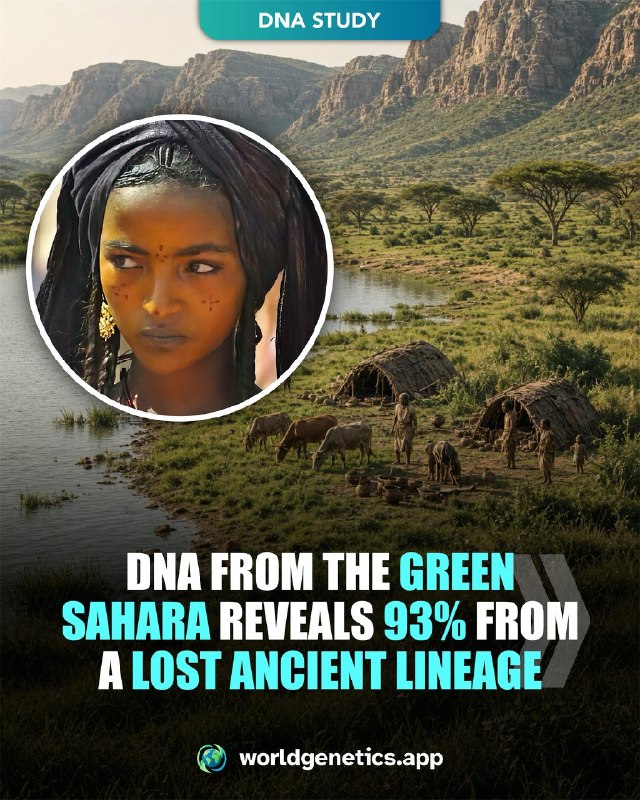
Around 7,000 years ago, the Sahara was not a desert. Lakes, rivers and savannas covered large parts of North Africa, supporting communities of hunters and cattle herders.

A 2025 Nature study recovered genome-wide DNA from two naturally mummified women buried at Takarkori in southwestern Libya. Their ancestry was unlike anything previously described: a genetic model estimated that about 93% came from a deeply divergent, previously unknown North African lineage, with only ~7% from an ancient Levantine-related source.

The Takarkori women were most closely related to ancient North Africans from Morocco, including 15,000-year-old hunter-gatherers from Taforalt. Using Takarkori as a better reference, the study revised Taforalt’s ancestry to about 60.8% Natufian-related and 39.2% Takarkori-like deep North African ancestry.

Despite the Sahara being green and crossed by lakes and waterways, the researchers found no evidence for substantial south-to-north genetic exchange from sampled sub-Saharan African populations during the African Humid Period.

Takarkori’s people were cattle herders, yet they carried only marginal Levantine-related admixture. This suggests pastoralism spread through the Central Sahara mainly by cultural adoption rather than large-scale population replacement.

They also carried only about 0.15% detectable Neanderthal ancestry, roughly ten times less than most non-African populations, consistent with a deeply rooted African lineage that received only limited Eurasian-related gene flow.

📚 Source: Salem et al. (2025), Nature
Ancient DNA from the Green Sahara reveals ancestral North African lineage

🧬 Curious about your own ancestry?
🌍 Explore your DNA at https://www.worldgenetics.app/
  • 👍 3
  • 😍 1
Post #87 318
How did Native American DNA reach Polynesia centuries before Europeans crossed the Pacific?

A 2020 study published in Nature analyzed 807 individuals from 17 Polynesian island populations and 15 Native American groups from the Pacific coast of the Americas.

The researchers found conclusive genetic evidence that Polynesians and Native Americans came into contact around AD 1200, during the period when remote eastern Polynesia was being explored and settled.

Importantly, the evidence suggests that this contact happened before the settlement of Rapa Nui. Rather than originating on Easter Island itself, the Native American ancestry found there was probably inherited from an earlier contact somewhere else in eastern Polynesia.

The American ancestry was most closely related to Indigenous populations from present-day Colombia and Ecuador, particularly the Zenu population from Colombia.

Genetic dating produced remarkably similar estimates across several islands: around AD 1150 in the South Marquesas, AD 1200 in the North Marquesas, and AD 1230 in both Mangareva and Palliser. A separate method estimated the shared admixture event at AD 1234 ± 90 years.

The earliest signal comes from Fatu Hiva in the South Marquesas. Because this date is close to the estimated initial Polynesian settlement of the Marquesas, the authors raise an intriguing possibility: Polynesian settlers may have encountered a small Native American population already living there.

However, the DNA cannot determine the direction of the original voyage. Native Americans may have crossed the Pacific to Polynesia, but Polynesian voyagers could instead have reached northern South America and returned with Native American people or ancestry.

The study ultimately favors a single prehistoric contact event somewhere in eastern Polynesia. Descendants carrying both Polynesian and Native American ancestry may then have spread across other islands, leaving a genetic signal in the Marquesas, Palliser, Mangareva and eventually Rapa Nui.

📚 Source: Ioannidis et al. (2020), Native American gene flow into Polynesia predating Easter Island settlement, Nature 583, 572–577.

🧬 Curious about your own ancestry?
🌍 Explore your DNA at https://www.worldgenetics.app/
  • 👍 5
  • ❤ 2
  • 🐳 1
Post #86 309
A major ancient DNA study published in Nature traces a distinctive ancestry associated with Uralic-speaking peoples back to prehistoric Siberia.

Researchers generated genome-wide data from 180 ancient individuals across northern Eurasia, spanning roughly 11,000 to 4,000 years ago. They found that early hunter-gatherers once formed a genetic gradient stretching about 7,000 km from the Baltic to Transbaikal.

One especially ancient individual from the Middle Lena region, dating to around 16,700 years ago, belonged to a population closely related to the ancestry that later contributed to Native Americans. This represents a much older layer of Siberian history and should not be confused with the later ancestry linked to Uralic expansion.

Around 4,500 years ago, a new population emerged in the Lena River Valley. The study calls this ancestry Yakutia_LNBA, associated mainly with the Ymyyakhtakh culture. It can be modeled as roughly a 50:50 mixture of an earlier Lena Valley population and a population related to Neolithic groups east of Lake Baikal.

This ancestry is strongly associated with ancient and modern Uralic-speaking populations. In the study’s models, it usually accounts for nearly all of their East Asian-related ancestry, although its total contribution varies greatly across populations.

By around 4,200 years ago, people carrying this ancestry had already moved far southwest toward the Krasnoyarsk region. Soon after, it appeared among communities connected to the Seima-Turbino Bronze Age network, helping trace one of the earliest westward expansions associated with Uralic-speaking groups.

The same movement also carried branches of Y-chromosome haplogroup N, whose descendants remain common today among Uralic-speaking populations.

The study also identifies a separate ancient Siberian ancestry associated with Yeniseian peoples, with tentative genetic evidence that may support a deeper connection to ancient Athabaskan populations in North America.

📚 Source: Zeng et al. (2025), Nature
Ancient DNA reveals the prehistory of the Uralic and Yeniseian peoples

🧬 Curious about your own ancestry?
🌍 Explore your DNA at https://www.worldgenetics.app/
  • ❤ 3
  • 👍 3
  • 🔥 1
Post #85 333
Some of the deepest human genetic diversity ever studied survived in southern Africa until just 1,400 years ago.

A 2026 DNA study published in Nature sequenced 28 ancient southern African genomes dating from about 10,200 to 150 years ago.

Remarkably, every individual older than roughly 1,400 years fell outside the range of genetic variation observed among modern-day humans in the study, including present-day Khoe-San populations. They were fully Homo sapiens, but represented an extremely distinctive ancient branch of human genetic diversity.

For nearly 9,000 years, these populations showed no detectable outside admixture, suggesting remarkable long-term genetic continuity and isolation in southern Africa.

The researchers estimated that this ancient southern African population diverged from other human populations roughly 240,000–310,000 years ago, representing one of the deepest population splits within Homo sapiens.

Their genetic legacy has not disappeared. Among modern Khoe-San individuals selected for relatively low recent admixture, the study estimated an average of about 79% ancient southern African ancestry, with the Juǀ’hoansi and Karretjie People showing some of the closest genetic affinities to the ancient samples.

Detectable incoming ancestry from eastern and western African populations appears in southern Africa only around 1,300 years ago, followed later by additional African and European admixture.

The study highlights just how much ancient human genetic diversity has been lost or reshaped by more recent population movements, and how important southern Africa is for understanding the deep history of Homo sapiens.

📚 Source: Jakobsson et al. (2026), Homo sapiens-specific evolution unveiled by ancient southern African genomes, Nature.

🧬 Curious about your own ancestry?
🌍 Explore your DNA at worldgenetics.app
  • 👍 6
  • 💔 1
Post #84 377
A 1,400-year-old migration reshaped the DNA of millions of Europeans.

A 2025 DNA study published in Nature analyzed genome-wide data from 555 ancient individuals and compared them with more than 11,500 present-day Europeans.

The results point to large-scale migration from Eastern Europe during the 6th–8th centuries AD, with the source population best approximated by an area spanning southern Belarus and northern Ukraine.

In some regions, the demographic impact was enormous. The study estimated that migrants associated with Slavic-period ancestry replaced approximately 93% of the local gene pool in Poland–northwestern Ukraine, 83% in Eastern Germany and 82% in the northwestern Balkans.

A simplified model of early Slavic-period ancestry found roughly 71% Baltic Bronze Age-related ancestry and 29% Early European Farmer-enriched ancestry, although the authors emphasize that the real population history was likely more complex.

The genetic legacy remains clearly visible today. Slavic-period ancestry is highest in Ukraine, Belarus and Poland, and also reaches very high levels in several populations from western Russia. In the Balkans, many South Slavic populations retain roughly 50–70% of this ancestry, while non-Slavic populations such as Greeks and Albanians also show a smaller but measurable contribution.

Overall, the study supports a major migration-driven component to the spread of Slavic populations and languages across Europe, while also revealing substantial regional mixing with the populations already living there.

📚 Source: Gretzinger et al. (2025), Ancient DNA connects large-scale migration with the spread of Slavs, Nature.

🧬 Curious about your own ancestry?
🌍 Explore your DNA at worldgenetics.app
  • 👍 5
  • ❤ 3
  • 🐳 2
Post #83 418
Why is the oldest whole genome ever sequenced from ancient Egypt so important?

A 2025 DNA study published in Nature analyzed a man from Nuwayrat in Middle Egypt who lived around 2855–2570 BC, spanning the transition from the Early Dynastic period to the Old Kingdom.

His ancestry was modeled as approximately 78% related to Middle Neolithic North Africans and 22% related to Neolithic populations from Mesopotamia and the eastern Fertile Crescent.

Importantly, these populations are genetic proxies rather than direct ancestors from Morocco or Mesopotamia. The results suggest that most of his ancestry came from a deeply rooted North African population, while around one-fifth reflected gene flow from populations related to the eastern Fertile Crescent.

This provides direct genetic evidence that contacts between early Egypt and the Near East involved not only trade and cultural exchange, but also human migration.

Researchers also predicted that he had brown eyes, brown hair and dark to black skin, although they caution that phenotype prediction is less certain for ancient populations with limited reference data.

Because this genome comes from a single individual, more ancient Egyptian genomes will be needed to determine how representative his ancestry was of Egypt as a whole.

📚 Source: Morez Jacobs et al. (2025), Whole-genome ancestry of an Old Kingdom Egyptian, Nature 644, 714–721.

🧬 Curious about your own ancestry?
🌍 Explore your DNA at worldgenetics.app
  • 👍 3
  • 🔥 1
Post #82 482
Why did 4,000-year-old mummies from western China have such a striking “Western” appearance?

A 2021 DNA study published in Nature analyzed 13 ancient individuals from the Tarim Basin. Rather than being recent migrants from Europe or the western steppe, they formed a remarkably genetically isolated local population.

Their ancestry was modeled as approximately 72% Ancient North Eurasian and 28% ancient Northeast Asian, with no detectable Afanasievo steppe ancestry. The Ancient North Eurasian component represents a very old Siberian-related lineage that contributed ancestry to later populations across Eurasia and the Americas.

This means the unusual appearance of the Tarim mummies did not require them to be recent European settlers, as some earlier theories had proposed. Instead, they appear to have preserved ancestry from a deeply ancient population while remaining genetically isolated for a long period.

The famous mummy pictured here was not herself one of the 13 individuals sequenced; the study reveals the genetic origins of the early Tarim population to which these famous mummies belonged.

📚 Source: Zhang et al. (2021), The genomic origins of the Bronze Age Tarim Basin mummies, Nature 599, 256–261.

🧬 Curious about your own ancestry?
🌍 Explore your DNA at worldgenetics.app
  • 👍 2
  • ❤ 1
  • 🔥 1
Post #75 867
World Genetics You can now get your instant World Genetics DNA analysis 🌍 https://www.worldgenetics.app/
Let me know what you would like me to improve/add to the website 🫵
Post #72 1.19K
Post #71 1.14K
🇪🇸 Medieval Iberia was already mixed across the Mediterranean

Ancient DNA from an early medieval individual buried at the Menga dolmen in southern Spain shows that people living in Al-Andalus (8th–11th centuries CE) were not genetically isolated or “purely Iberian”. This individual carried a mixed ancestry profile, combining local Iberian roots with clear North African and Levantine-related ancestry.

When modeled genetically, his ancestry can be approximated as ~45% Iron Age Iberian–like, ~20% deep North African–related, and ~35% Levantine–related ancestry. This kind of profile closely matches other Roman and early medieval individuals from southern Iberia and Italy, showing that Mediterranean gene flow was already well established before and during Islamic rule.

Importantly, this North African and Levantine ancestry was not unique or exotic. Similar proportions appear across southern Iberia from Late Roman times onward, reflecting centuries of movement across the Mediterranean through trade, empire, and later intensified contacts with North Africa after 711 CE. Genetics here does not map cleanly onto religion or culture: individuals with similar DNA could have been Christian, Muslim, Jewish, or pagan.

Takeaway: By the early Middle Ages, southern Iberians were already genetically Mediterranean, shaped by long-term admixture with North Africa and the eastern Mediterranean, rather than sudden population replacement.

Source: Silva et al., 2026. Genetic and historical perspectives on the early medieval inhumations from the Menga dolmen, Antequera (Spain).
  • 👍 9
  • ❤ 1
  • 🔥 1
Post #70 809
🇷🇺 Who were the medieval Rus’, genetically?

This large ancient DNA study shows that the people who formed medieval Rus’ (10th–13th centuries) were not Vikings, but mainly Slavic-related populations with a strong Baltic-rooted ancestry, plus regional admixture in the north.

Most Rus’ individuals fall into a Slavic-related genetic core, ancestral to modern Russians, Ukrainians, and Belarusians. Their ancestry can be traced largely to Bronze Age Baltic populations, which make up roughly 60–80% of their deep ancestry, combined with European farmer-related ancestry (around 20–35%) and only minor Siberian-related input (usually <10%).

In Northern Rus’, the picture changes. These populations still share the same Baltic-based foundation, but they also carry a much stronger Uralic-related component, with ~10–25% Siberian ancestry, similar to what we see today in Veps, Karelians, and northern Russians. This reflects admixture between incoming Slavic groups and local Finno-Ugric populations, rather than replacement.

Crucially, Scandinavian (Viking) ancestry is rare and minor. Only a handful of individuals show small Viking-related signals, and these never dominate the genetic makeup. Even elite warrior burials traditionally linked to Vikings are genetically Slavic/Baltic, not Scandinavian.

Takeaway: The Rus’ state was built on a Baltic–Slavic genetic foundation, with regional Finno-Ugric admixture in the north, and only minimal Viking input. Modern East Slavs largely descend from this medieval population.

Source: Andreeva et al., 2025. Genetic history of Rus’.
  • 👍 11
  • ❤ 3
  • 🔥 2
Post #69 662
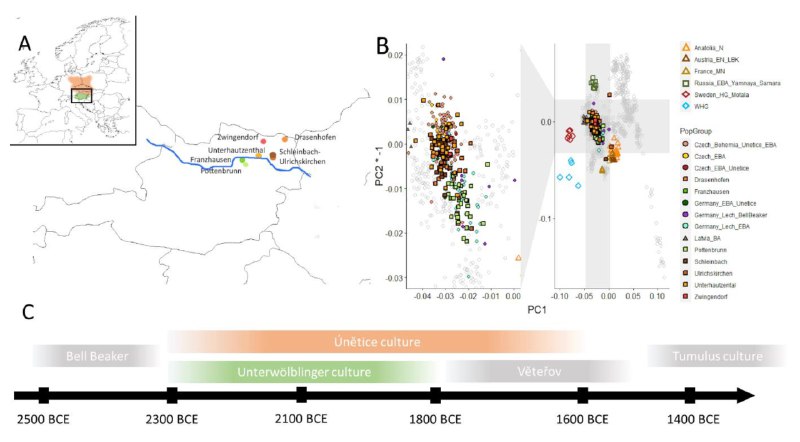
🇦🇹 Early Bronze Age Austria was genetically unified

Ancient DNA from Early Bronze Age communities in Lower Austria shows a remarkably homogeneous ancestry across sites and cemeteries. Individuals largely share the same steppe-derived Bronze Age profile, typical of Central Europe after ~2500 BCE, formed by a mix of Pontic–Caspian steppe ancestry and earlier European farmer ancestry. In simple terms, most people cluster around ~55–65% steppe-related ancestry and ~35–45% Neolithic farmer ancestry, with very little local hunter-gatherer input remaining.

What’s striking is not big migrations between villages, but genetic similarity over wide areas. Men and women buried in different farmsteads belong to the same ancestry pool, showing that long-distance connections and marriage exchange happened within an already shared genetic framework, not between clearly distinct populations.

Takeaway: By the Early Bronze Age, Lower Austria was part of a genetically leveled Central European world, dominated by steppe-derived ancestry and only moderate farmer ancestry, with social structure changing without major new genetic inflows.

Source: Furtwängler et al., 2025. Tracing social mechanisms and interregional connections in Early Bronze Age societies in Lower Austria.
  • ❤ 5
  • 👍 1
  • 🔥 1
Older posts →
Threads Profile ViewerView any public Threads profile without an account.Open ThreadLook →Writing with AI? Make it sound human.Metric37 rewrites AI drafts so they read naturally. Free AI detector, 1,500 words free.Try Metric37 →