
What does the genetic profile of Cuba actually look like?
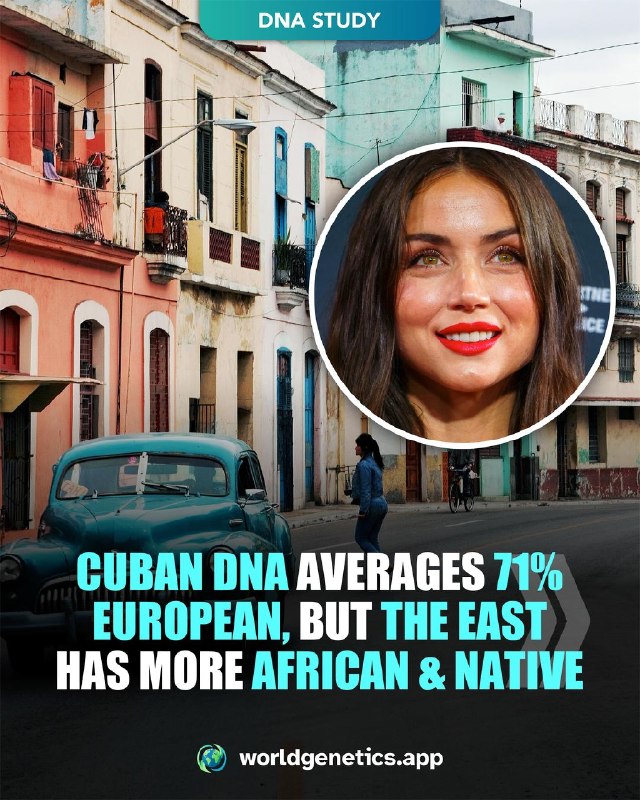
A genome-wide study of 860 Cubans from all 15 provinces found that the population is primarily a three-way mixture of European, African and Native American ancestry, with a small East Asian contribution. Across the full sample, European ancestry averaged about 71%.
But Cuba is far from genetically uniform.
Western Cuba was generally the most European. Mayabeque averaged 87.7% European ancestry, while eastern provinces carried much higher African and Native American ancestry. Guantánamo averaged 40.1% African ancestry and Santiago de Cuba 38.8%. Meanwhile, Native American ancestry reached 13.9% in Las Tunas and 12.4% in Granma.
When researchers isolated each ancestry component, the European DNA matched southern Europeans, with the strongest affinity to Iberian populations.
The African component was most closely associated with populations around the Bights of Benin and Biafra and West-Central Africa, including present-day Benin, Nigeria, Cameroon, Gabon and Angola. These regions were also major sources of enslaved Africans forcibly transported to Cuba.
The precise source of Cuba’s Native American ancestry was harder to identify, but genetic sharing pointed especially toward South American populations, alongside broader Mesoamerican links.
The study also uncovered a powerful colonial signature: European ancestry was disproportionately male-derived, while African and Native American ancestry showed stronger female contributions, particularly in eastern Cuba.
📚 Source: Fortes-Lima et al. (2018), Scientific Reports
Exploring Cuba's population structure and demographic history using genome-wide data
🧬 Curious about your own ancestry?
🌍 Explore your DNA at https://www.worldgenetics.app/
Post #89
274
- ✍ 3
- 👍 1