TGViewer
Channel Public Channel
Words of the Buddha

Words of the Buddha

@wordsofbuddha

Daily teachings of Buddha Dharma
Subscribers
1.42K
Photos
3.4K
Videos
0
Links
2.8K
Recent Posts 20 shown
Post #6231 12
Mingyur Rinpoche elaborated on this, emphasizing that the teaching in both is not to reify the awareness as self nor to perceive objects as having independent, substantial existence. Khyentse Rinpoche makes the same point: “Those who cling to the lucid or to the void aspect of the mind are caught in dualistic attachment to subject and object.”

In any instruction to rest in awareness, we need to understand that awareness implies recognizing its empty nature as well as its lucid aspect—and not getting attached to emptiness is equally important. Nagarjuna, one of the greatest of the Indian adepts, warns that even the view of emptiness can become a trap when grasped as a view. He writes, “It is sad to see those who mistakenly believe in material, concrete reality, but far more pitiful are those who are attached to emptiness.”

The question then arises: How do we cut through this subtle identification with the knowing capacity of mind, with awareness itself? At one point in my practice, a simple linguistic shift became a pathway for cutting through this identification. By changing how we language our experience (even silently to ourselves) from the active voice to the passive voice, we can settle effortlessly into a receptive, selfless mode.

For example, we usually think of what we’re doing in the active voice: “I’m moving, I’m thinking, I’m hearing.” In the passive voice, this might become: “Movement being known, thought being known, sounds being known.” This shift is striking because the “I” is no longer the subject of the action. Instead, things simply arise and are known effortlessly without a sense of self. As the Austrian philosopher Ludwig Wittgenstein noted, much philosophy is “a shadow cast by grammar”; our language habits easily conjure a “self” behind experience.

The Buddha gave a succinct and powerful teaching on this in his discourse, The All. In this sutta, he described the totality of our experience in just six concise phrases: “the eye and visible objects, the ear and sounds, the nose and odors, the tongue and tastes, the body and tactile objects, the mind and mental phenomena.” By being mindful of these six categories as being known, we gain glimpses—and sometimes sustained experiences—of selflessness, of empty phenomena rolling on.

To deepen this experience of selflessness, we can then ask the simple yet profound question: Known by what? In meditation, as different sounds arise, I may ask myself, Can I find what’s knowing this sound? The sound is being known—but by what? There’s nothing to find. And yet, as the Tibetan Dzogchen master Tulku Urgyen remarked, in searching for awareness, “the not finding is the finding.” This inquiry helps dissolve the subtle identification with the knowing itself, which, when unnoticed, perpetuates the felt sense of a knower.

Even after these transformative insights arise, the path continues. The 12th-century Korean Zen Master Chinul expressed this in his teachings on sudden awakening and gradual cultivation:

Although we have awakened to original nature, beginningless habit energies are extremely difficult to remove suddenly. Hindrances are formidable and habits are deeply ingrained. So how could you neglect gradual cultivation simply because of one moment of awakening? After awakening, you must constantly be on your guard. If deluded thoughts suddenly appear, do not follow after them. Then and only then will your practice reach completion.

Chinul’s follow-up reminder is equally vital:

Although you must cultivate further, you have already awakened suddenly to the fact that deluded thoughts are originally void and the mind’s nature is originally pure.
===
Words of the Buddha channel:

https://t.me/wordsofbuddha
===
Telegram Words of the Buddha Daily teachings of Buddha Dharma
  • 👍 1
Post #6230 11
Liberation Through Non-Clinging Across Buddhist Traditions

How approaches from different Buddhist traditions can complement and support each other on the path to awakening
By Joseph Goldstein

Part 1 of 3

Other Paths of Practice that Cultivate Nonduality

Many paths of practice may not explicitly emphasize nonduality, yet may lead to that understanding, even if it is described as “selflessness” or “emptiness of self.” Although the explicit term nonduality gained prominence in early Mahayana Prajnaparamita texts (1st century BCE–1st century CE), several hundred years after the Buddha lived, the experience it points to is already present in the well-known Bahiya Sutta from the Pali canon:

Then, Bahiya, you should train yourself thus:
In the seen there will be merely the seen;
in the heard, merely the heard;
in the sensed, merely the sensed;
in the cognized, merely the cognized.
That is how you should train yourself.
When, Bahiya, for you in the seen there is merely the seen . . .
then, Bahiya, you will not be with that.
When you are not with that, you will not be in that,
When you are not in that,
then you will be neither here nor beyond nor in between the two.
Just this is the end of suffering.

Perhaps the term selflessness, then, more clearly reflects what the state of liberative nonduality reveals.

Right Effort

This raises interesting questions about different modes of practice. H.H. the Dalai Lama has recounted how even Milarepa, one of the greatest Tibetan yogis, faced tremendous difficulties and needed arduous effort over many years to attain complete enlightenment. In vipassana practice, significant emphasis is placed on mindfulness of the body, as it is the first of the four foundations of mindfulness the Buddha declared to be the direct path to awakening. Some teachers in this tradition emphasize the importance of strong effort to penetrate the object of meditation as a means of going beyond our conceptual understanding of it. However, this strong effort can sometimes reinforce the sense of someone actively exerting that effort.

Effortless Awareness

But even within methods that emphasize strong effort, proper practice naturally leads to a state of effortless awareness. From this state, the mind can open to what is called “gaining the vision of the dharma,” or the “opening of the dharma eye.” That marks the point at which the belief in self has been completely uprooted.

A salient point emerges here in both vipassana and explicitly nondual practices: how to rest in effortless awareness (however we arrive there) without identifying with that awareness, without making awareness the home of self, the last hold-out of “I.” Sometimes awareness feels boundless and centerless, yet this too can mask a subtle identification with self. Even in this wonderfully expansive state, there can be a subtle identification with awareness or a faint sense of someone experiencing it.

Mahasi Sayadaw, a renowned vipassana meditation master of the 20th century, highlighted one aspect of this in his talk “The Purification and Progress of Insight”:

At times there is nothing to note, with the body disappearing and the sense of touch lost. However, at this moment, knowing consciousness is still apparent. In the very clear, open space of the sky there remains only one very clear, blissful consciousness, which is very clear beyond comparison and very blissful. The yogi tends to delight in such clear, blissful consciousness. But this consciousness is not going to stay permanent. . . . It has to be noticed as “knowing, knowing.”

We see the same caution about identification with awareness in Dzogchen and other nondual traditions as well. In Dzogchen and Mahamudra, although using different terminology, the fundamental nature of mind is expressed as the union of clarity and emptiness. Thrangu Rinpoche observed that the nature of mind is sometimes obscured because the clarity aspect (knowing) obscures the emptiness aspect.
Telegram Words of the Buddha Daily teachings of Buddha Dharma
  • 👏 1
Post #6229 11
The Experience of Insight, A Natural Unfolding by Joseph Goldstein
  • 💯 1
Post #6228 26
The Earth has been there for along time. She is Mother to all of us. She knows everything. The Buddha asked the Earth to be his witness by touching her with his hand when he had some doubt and fear before his awakening. The Earth appeared to him as a beautiful mother. In her arms she carried flowers and fruit, birds and butterflies, and many different animals, and offered them to the Buddha. The Buddha’s doubts and fears instantly disappeared. Whenever you feel unhappy, come to the Earth and ask for her help. Touch her deeply, the way the Buddha did. Suddenly, you too will see the Earth with all her flowers and fruit trees and birds, animals, and all the living beings that she has produced. All these things she offers to you.

– Thich Nhat Hanh

Image : Leshan giant Buddha, the tallest pre-modern statue in the world built during Tang dynasty era, Sichuan, China.
  • 🔥 1
  • 👏 1
  • 🤩 1
  • 🕊 1
Post #6226 50
October 12

SN 16.3 Candūpamāsutta: Like the Moon

At Savatthī. “Bhikkhus, you should approach families like the moon— drawing back the body and mind, always acting like newcomers, without impudence towards families. Just as a man looking down an old well, a precipice, or a steep riverbank would draw back the body and mind, so too, bhikkhus, should you approach families.

“Bhikkhus, Kassapa approaches families like the moon—drawing back the body and mind, always acting like a newcomer, without impudence towards families. What do you think, bhikkhus, what kind of bhikkhu is worthy to approach families?”

“Venerable sir, our teachings are rooted in the Blessed One, guided by the Blessed One, take recourse in the Blessed One. It would be good if the Blessed One would clear up the meaning of this statement. Having heard it from him, the bhikkhus will remember it.”

Then the Blessed One waved his hand in space and said: “Bhikkhus, just as this hand does not get caught in space, is not held fast by it, is not bound by it, so when a bhikkhu approaches families his mind does not get caught, held fast, and bound amidst families, thinking: ‘May those desiring gains acquire gains, may those desiring merits make merits!’ He is as elated and happy over the gains of others as he is over his own gains. Such a bhikkhu is worthy to approach families.

“Bhikkhus, when Kassapa approaches families his mind does not get caught, held fast, or bound amidst families, thinking: ‘May those desiring gains acquire gains, may those desiring merits make merits!’ He is as elated and happy over the gains of others as he is over his own gains.

“What do you think, bhikkhus, how is a bhikkhu’s teaching of the Dhamma impure, and how is his teaching of the Dhamma pure?”

“Venerable sir, our teachings are rooted in the Blessed One….”

“Then listen and attend closely, bhikkhus, I will speak.”

“Yes, venerable sir,” those bhikkhus replied. The Blessed One said this:

“A bhikkhu teaches the Dhamma to others with the thought: ‘Oh, may they listen to the Dhamma from me! Having listened, may they gain confidence in the Dhamma! Being confident, may they show their confidence to me!’ Such a bhikkhu’s teaching of the Dhamma is impure.

“But a bhikkhu teaches the Dhamma to others with the thought: ‘The Dhamma is well expounded by the Blessed One, directly visible, immediate, inviting one to come and see, applicable, to be personally experienced by the wise. Oh, may they listen to the Dhamma from me! Having listened, may they understand the Dhamma! Having understood, may they practise accordingly!’ Thus he teaches the Dhamma to others because of the intrinsic excellence of the Dhamma; he teaches the Dhamma to others from compassion and sympathy, out of tender concern. Such a bhikkhu’s teaching of the Dhamma is pure.

“Bhikkhus, Kassapa teaches the Dhamma to others with the thought: ‘The Dhamma is well expounded by the Blessed One…. Oh, may they listen to the Dhamma from me! Having listened, may they understand the Dhamma! Having understood, may they practise accordingly!’ He teaches the Dhamma to others because of the intrinsic excellence of the Dhamma; he teaches the Dhamma to others from compassion and sympathy, out of tender concern.

“Bhikkhus, I will exhort you by the example of Kassapa or one who is similar to Kassapa. Being exhorted, you should practise accordingly.”
===
Free Buddhism books, teachings, podcasts and videos from Theravada, Mahayana and Vajrayana traditions:

https://t.me/buddha_ebooks
===
Telegram Buddha Dharma books Free Buddhism books, teachings, podcasts and videos from Theravada, Mahayana and Vajrayana traditions
  • 🙏 1
  • 👌 1
  • 🤝 1
Post #6225 58
It would be more fruitful to feed one once-returner than a hundred of those accomplished in view.

It would be more fruitful to feed one non-returner than a hundred once-returners.

It would be more fruitful to feed one perfected one than a hundred non-returners.

It would be more fruitful to feed one Independent Buddha than a hundred perfected ones.

It would be more fruitful to feed one Realized One, a perfected one, a fully awakened Buddha than a hundred Independent Buddhas.

It would be more fruitful to feed the mendicant Saṅgha headed by the Buddha than to feed one Realized One, a perfected one, a fully awakened Buddha.

It would be more fruitful to build a dwelling especially for the Saṅgha of the four quarters than to feed the mendicant Saṅgha headed by the Buddha.

Partial excerpts from AN 9.20 : Velama Sutta
  • 🙏 2
  • 🥰 1
  • 😍 1
Post #6224 61
October 11

AN 7.36 Mitta Sutta: A Friend

“Monks, a friend endowed with seven qualities is worth associating with. Which seven? He gives what is hard to give. He does what is hard to do. He endures what is hard to endure. He reveals his secrets to you. He keeps your secrets. When misfortunes strike, he doesn’t abandon you. When you’re down & out, he doesn’t look down on you. A friend endowed with these seven qualities is worth associating with.

“He gives what is beautiful,
hard to give;
does what is hard to do;
endures painful, ill-spoken words.

His secrets he tells you;
your secrets he keeps.

When misfortunes strike,
he doesn’t abandon you;
when you’re down & out,
doesn’t look down on you.

A person in whom these traits are found,
is a friend to be cultivated
by anyone wanting a friend.”
===
Ajahn Chah, Buddhist teacher of Thai forest meditation of Theravada Buddhism channel:


https://t.me/ajahnchah_buddhism
===
Telegram Ajahn Chah - Theravada Thailand Buddhism Collection of teachings of Venerable Ajahn Chah, a foremost meditation and Buddhist teacher from Thailand
  • 🥰 1
  • 🙏 1
  • 🤗 1
Post #6223 35

Forwarded from Dhammapada - Buddha Dharma Teachings

Free Buddha Dharma ebook

Tapussa and Bhallika the Buddha’s First Disciple

By Bhante Shravasti Dhammika

In the Mahavacchagotta Sutta of the Majjhima Nikaya the Buddha mentioned that he had many thousands of disciples, a good number of whom had attained one or another of the stages leading to enlightenment. However, the Buddha’s first disciples were the merchants Tapussa and Bhallika. During the Buddha’s fourth week at Uruvela, now called Bodh Gaya, these two men happened to be passing the outskirts of the village and saw him quietly meditating there. Impressed his serene looks and the aura of peace around him they approached him with an offering of barley gruel and honey balls. When the Buddha had finished eating the merchants asked if they could take refuge in him, i.e. become his disciples, and his Dhamma.

Free download available:

https://budblooms.org/tapussa-and-bhallika-the-buddhas-first-disciple/
===
  • 🙏 1
  • 💯 1
  • 🤝 1
Post #6221 55
At Sāvatthī.

“Mendicants, dragons grow and wax strong supported by the Himalayas, the king of mountains. When they’re strong they dive into the pools. Then they dive into the lakes, the streams, the rivers, and finally the ocean. There they acquire a great and abundant body.

In the same way, a mendicant develops and cultivates the seven awakening factors depending on and grounded on ethics, acquiring great and abundant good qualities. And how does a mendicant develop the seven awakening factors depending on and grounded on ethics, acquiring great and abundant good qualities?

It’s when a mendicant develops the awakening factor of mindfulness, which relies on seclusion, fading away, and cessation, and ripens as letting go.

They develop the awakening factor of investigation of principles, energy, rapture, tranquility, immersion, and equanimity, which relies on seclusion, fading away, and cessation, and ripens as letting go.


SN 46.1 : Himavantasutta
  • 👏 2
  • 🙏 1
  • 🫡 1
Post #6219 65
October 10

AN 3.52 Dutiyadvebrāhmaṇasutta: Two Brahmins (2)

Then two brahmins who were old, aged, burdened with years, advanced in life, come to the last stage, a hundred and twenty years of age, approached the Blessed One … and said to him:

“We are brahmins, Master Gotama, old, aged … a hundred and twenty years of age. But we have not done anything good and wholesome, nor have we made a shelter for ourselves. Let Master Gotama exhort us and instruct us in a way that will lead to our welfare and happiness for a long time!”

“Truly, brahmins, you are old, aged, burdened with years, advanced in life, come to the last stage, a hundred and twenty years of age, but you have not done anything good and wholesome, nor have you made a shelter for yourselves. Indeed, this world is burning with old age, illness, and death. But though the world is burning with old age, illness, and death, when one has departed, bodily, verbal, and mental self-control will provide a shelter, a harbor, an island, a refuge, and a support.”

When one’s house is ablaze
the vessel taken out
is the one that will be useful to you,
not the one that is burnt inside.

So since the world is ablaze
with old age and death,
one should take out by giving:
what is given is well taken out.
When one departs this life,
self-control over body, speech, and mind,
and the deeds of merit one did while alive,
lead to one’s happiness.
===
Dhammapada, beloved and favorite teachings of the Buddha channel:

https://invite.viber.com/?g2=AQBLD6phsgvP%2F061YjEM3K%2BNeH1Yb372b9mtfQX2EmuBpgoLUoc99BDMfzHghrme
===
Viber Dhammapada - Buddha Dharma Teachings Daily teachings of the Dhammapada, beloved and favorite teachings of the Buddha
  • ❤ 1
  • 👏 1
  • 🙏 1
  • 💯 1
Post #6218 63
Dagoba is a specific Sinhalese word derived from the Sanskrit dhatu-garbha (meaning "relic chamber"). It is the term exclusively used in Sri Lanka to describe their distinct, massive white or brick-domed stupas.


In China and Japan, the design evolved into tall, multi-story wooden towers with prominent, projecting overlapping roofs.

Hidden Anatomy: The Stupa Inside the Pagoda

Even though a pagoda looks entirely different from a dome, it still retains the structural anatomy of the original Indian stupa—it is just stretched vertically.

The Spire (Tee or Finial): at the very top of a pagoda, a metallic, ringed spire called a tiancha or sorin is actually a miniature, stylized model of the original Indian stupa's multi-layered umbrella crown.

The Heart Pillar (Shinbashira): Many wooden pagodas (especially in Japan) feature a massive central log suspended down the middle of the tower. This piritually represents the axis mundi—the cosmic axis line that ran straight through the center of the earliest stupas.
  • 🙏 2
  • 👏 1
  • 🆒 1
Post #6217 67

Forwarded from Buddha

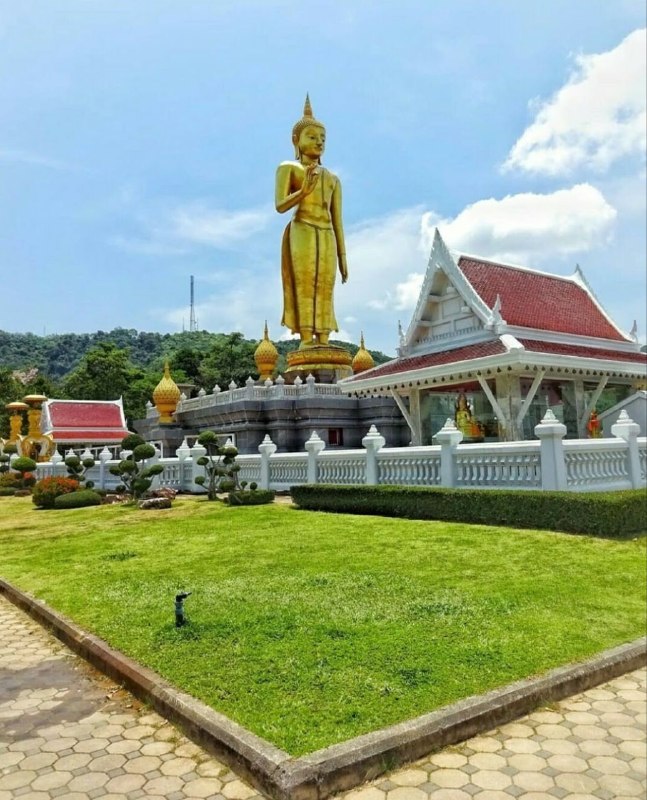
Cheng'en Buddhist temple, Fanjingshan sacred mountain, China, the place where world's largest gold statue of Metteya Buddha is kept.
  • 🙏 2
  • 😍 1
Post #6216 75
October 9

AN 3.57 Vacchagottasutta: Vaccha

Then the wanderer Vacchagotta approached the Blessed One … and said to him:

“Master Gotama, I have heard: ‘The ascetic Gotama says: “Alms should be given only to me, not to others; alms should be given only to my disciples, not to the disciples of others. Only what is given to me is very fruitful, not what is given to others; only what is given to my disciples is very fruitful, not what is given to the disciples of others.”’ Do those who speak thus state what has been said by Master Gotama and not misrepresent him with what is contrary to fact? Do they explain in accordance with the Dhamma so that they would not incur any reasonable criticism or ground for censure? For we do not want to misrepresent Master Gotama.”

“Those, Vaccha, who say: ‘The ascetic Gotama says: “Alms should be given only to me … only what is given to my disciples is very fruitful, not what is given to the disciples of others,”’ do not state what has been said by me but misrepresent me with what is untrue and contrary to fact. One who prevents another from giving alms creates an obstruction and stumbling block for three people. What three? He creates an obstruction to the donor’s acquiring merit, to the recipients’ gaining a gift, and already he has maimed and injured himself. One who prevents another from giving alms creates an obstruction and stumbling block for these three people.

“But, Vaccha, I say that one acquires merit even if one throws away dishwashing water in a refuse dump or cesspit with the thought: ‘May the living beings here sustain themselves with this!’ How much more, then, does one acquire merit when one gives to human beings! However, I say that what is given to one of virtuous behavior is more fruitful than what is given to an immoral person. And the most worthy recipient is one who has abandoned five factors and possesses five factors.

“What five factors has he abandoned? Sensual desire, ill will, dullness and drowsiness, restlessness and remorse, and doubt. These are the five factors that he has abandoned.

“And what five factors does he possess? The virtuous behavior, concentration, wisdom, liberation, and knowledge and vision of liberation of one beyond training. These are the five factors that he possesses.

“It is in such a way, I say, that what is given to one who has abandoned five factors and possesses five factors is very fruitful.”

Among cattle of any sort,
whether black, white, red, or golden,
mottled, uniform, or pigeon-colored,
the tamed bull is born,
the one that can bear the load,
possessing strength, advancing with good speed.
They yoke the burden just to him;
they are not concerned about his color.

So too, among human beings
it is in any kind of birth—
among khattiyas, brahmins, vessas,
suddas, caṇḍālas, or scavengers—
among people of any sort
that the tamed person of good manners is born:
one firm in Dhamma, virtuous in conduct,
truthful in speech, endowed with moral shame;
one who has abandoned birth and death,
consummate in the spiritual life,
with the burden dropped, detached,
who has done his task, free of taints;
who has gone beyond all things of the world
and by non-clinging has reached nibbāna:
an offering is truly vast
when planted in that spotless field.

Fools devoid of understanding,
dull-witted, unlearned,
do not attend on the holy ones
but give their gifts to those outside.
Those, however, who attend on the holy ones,
on the wise ones esteemed as sagely,
and those whose faith in the Fortunate One
is deeply rooted and well established,
go to the world of the devas
or are born here in a good family.
Advancing in successive steps,
those wise ones attain nibbāna.
===
Words of the Buddha channel:

https://invite.viber.com/?g2=AQAFqzqlj7FmI061PX17rxWMAtZ%2BRuso%2FH2KmHKZSgnv7v9DD8X0bDkKnZDr9JDq
===
Viber Words Of The Buddha Daily teachings from Buddha Dharma
  • 👍 1
  • 🙏 1
Post #6213 65
…So Ānanda, live as your own island, your own refuge, with no other refuge. Let the teaching be your island and your refuge, with no other refuge. And how does a mendicant do this? It’s when a mendicant meditates by observing an aspect of the body—keen, aware, and mindful, rid of covetousness and displeasure for the world. They meditate observing an aspect of feelings … mind … principles—keen, aware, and mindful, rid of covetousness and displeasure for the world. That’s how a mendicant is their own island, their own refuge, with no other refuge. That’s how the teaching is their island and their refuge, with no other refuge.…

Partial excerpts from DN 16 From… Mahaparinibbanasutta: The Great Discourse on the Buddha’s Extinguishment—Live as an Island
  • 👏 2
  • 🙏 1
  • 👌 1
Older posts →

About this channel

How can I read @wordsofbuddha without a Telegram account?
TGViewer shows the public web preview Telegram publishes for Words of the Buddha: recent posts, photos, videos and the subscriber count, with no app, login or account.
How many subscribers does Words of the Buddha have?
Words of the Buddha (@wordsofbuddha) has 1.42K subscribers on Telegram, refreshed roughly every 30 minutes.
Does Words of the Buddha know I viewed it here?
No. Public channel previews carry no viewer identity, and TGViewer has no accounts or tracking of what you look up.
Threads Profile ViewerView any public Threads profile without an account.Open ThreadLook →Writing with AI? Make it sound human.Metric37 rewrites AI drafts so they read naturally. Free AI detector, 1,500 words free.Try Metric37 →