
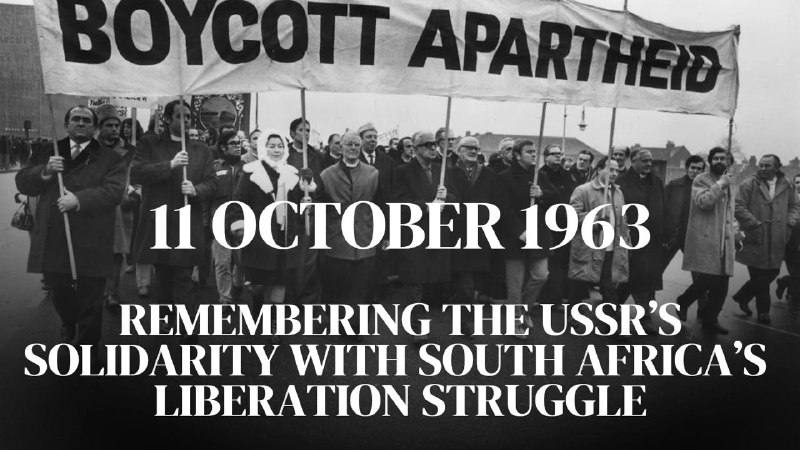
✍️Address by Russian Ambassador to South Africa and Lesotho Roman Ambarov on the Occasion of 11 October 1963: Remembering the USSR’s Solidarity with South Africa’s Liberation Struggle
Today, 11 October, marks an important date in the history of South Africa's struggle against apartheid.
On this day in 1963, the United Nations General Assembly adopted Resolution 1881, calling on the South African authorities to abandon the Rivonia Trial and release political prisoners.
☝️The resolution was adopted by an overwhelming 106 votes to 1, with the Soviet Union voting in favour.
This was not an isolated act.
⭐️At a time when many Western capitals viewed the apartheid regime through the prism of Cold War geopolitics, the Soviet Union stood proud among the few on the international stage to be vocal about theSouth Africa's liberation.
The USSR also provided political, financial, military and humanitarian assistance to the African National Congress and the South African Communist Party, while thousands of South Africans received education, training and medical assistance in the Soviet Union.
The USSR along with its alies was also active in building the international framework for decolonisation and the struggle against racial discrimination.
👉In 1960, the Soviet leadership submitted a draft Declaration on the Granting of Independence to Colonial Countries and Peoples to the UN General Assembly, contributing to the process that led to the adoption of Resolution 1514.
👉In 1963, the Soviet Union actively participated in the drafting and adoption of the Declaration on the Elimination of All Forms of Racial Discrimination.
❗️To this very day, these landmark UN documentsremain foundational pillars of the international struggle against colonialism, racism and racial discrimination.
The Soviet position was clear. In a communication to the United Nations on 8 October 1963, just three days before Resolution 1881 was adopted, the Soviet Government reaffirmed its support for African states' efforts against apartheid and called for international action to bring an end to racial discrimination.
The solidarity of the Soviet people with the South African liberation struggle was remembered and appreciated by those who fought for freedom.
During his state visit to Moscow in 1999, President Nelson Mandela expressed his profound gratitude for the “solidarity of the Russian people in the South African fight against apartheid and for freedom.”
💬President Vladimir Putin has likewise emphasised the importance of preserving the memory of Africa's outstanding freedom fighters:
“Russia cherishes the memory of Africa’s outstanding sons. We must remember them, and we must never forget them. <...> While relying on the principles of justice and equality, they staunchly promoted independent development for their nations, often sacrificing their lives.”
The history of our relations is therefore not simply a history of diplomacy between two states. It is also a history of people-to-people solidarity.
Africa’s historic struggle for decolonization has evolved into a modern effort to ensure sovereignty across all spheres of national life. Russia fully supports this aspiration and consistently advocates, at the United Nations and other international fora, for the eradication of all forms of neo-colonialism.
The international movement “For the Freedom of Nations!”, established on the initiative of the United Russia Party and bringing together political parties from more than 50 countries, provides a valuable platform for coordinating such multilateral efforts, with many African states already participating.
🇷🇺🇿🇦Today, Russia and South Africa remain close partners.
The bonds forged during the difficult years of the liberation struggle remain an important part of our shared history.
We remember them. We honour them. And we carry their legacy forward.
#RussiaSouthAfrica #AmbassadorAmbarov