TGViewer
Channel Public Channel
Linux - Reddit

Linux - Reddit

@r_linux

Stay up-to-date with everything Linux!
Content directly fetched from the subreddit just for you.

Powered by : @r_channels
Subscribers
1.07K
Photos
4.6K
Videos
207
Links
42K

Showing posts older than #42104 · Back to latest

Older Posts 20 shown
Post #42102 62
Is there an alternative linux mini-OS for this ALDI beamer? Has anybody tried modding one with a Noctua fan?

Hey, I just bought this ALDI LED beamer for 39,99 €:

https://www.aldi-sued.de/produkt/bauhn-hd-led-projektor-000000000000708495

I thought I would just do it for shit and giggles to have a projector to watch shit on the ceiling above my bed, but this thing is shockingly good... for the most part.

It has keystone integrated so it automatically adjusts the angle and cut if you change the angle up to a certain degree, the picture quality is good...

BUT...

I don't trust the software. It immediately asked me to connect it to the internet.

I don't want to connect some sketchy 40 € China beamer to my WLAN. Plus, I don't want the installed official YouTube apps etc. - I want it to basically run Firefox or Waterfox with uBlock Origin, DeArrow, Sponsorblock, No Shorts ("Shorts für YouTube ausblenden"), return YouTube Dislike and so on...

Has anybody successfully modded that thing to run with any kind of a linux OS?

Plus, that thing is LOUD.

Unfortunately, if I point that thing directly upwards towards my ceiling, the cooling performance is bad, because the base has no air vents and not a good airflow to the sides. The exhaust feels hot.

So to make this things feasible, it would definitely need a Noctua fan. Has anyone already attempted that hardware modification?

I screwed off the 1 screw at the back, but the backplate still wouldn't open. So I have no idea how to get it open.

https://redd.it/1tu7ljm
@r_linux
ALDI SÜD HD LED-Projektor So viel Spaß macht Qualität zu kleinen Preisen. HD LED-Projektor zum günstigen ALDI Preis ➔ Jetzt bei ALDI SÜD kaufen!
Post #42101 55
Post #42097 63
Post #42093 46
Why don't Linux distros ship the "trio" (XKB, IBus, and Fcitx) out of the box and let users choose?

Hi everyone, there's something that has been baffling me and probably many other non-English users: Why don't Linux distributions pre-install and integrate the "trio" of input frameworks—XKB, IBus, and Fcitx - directly into the system, and simply let the user choose their preferred option during or after installation? Why do they still only default to XKB?

Currently, I see a lot of people giving up on Linux simply because of this input method barrier.

# For context

I am a Vietnamese user who transitioned from Windows. On Windows, we just need to download a lightweight tool like UniKey (or in the past, VietKey, WinVNKey, or ABC). Once downloaded, we just run it and basically forget about it. It requires minimal to no configuration, and it just works across the entire OS because it acts as a proper hook/IME layer.

# The inherent flaw of XKB for complex scripts

Let's be honest, XKB's design is fundamentally flawed and outdated when it comes to input methods like Vietnamese Telex. XKB treats Telex as if it were just another static keyboard layout using dead keys. It lacks any concept of an active text buffer or smart processing.

For example, tools like UniKey on Windows handle Telex dynamically (allowing users to type the tone mark at the end of the word, e.g., c-h-u-o-n-g \+ w = chương, t-r-i-n-h \+ f = trình). XKB completely fails at this because it can't look back at the characters you just typed. Trying to force Telex into XKB's 1:1 or simple dead-key mapping matrix is just painful and unusable for daily communication.

# The current state of Linux (and why average users hate it)

To get basic Vietnamese typing working on a fresh install, a casual user is forced to follow a manual "tutorial" that looks like this:

1. Install the engine via Terminal: Since these IMEs are rarely in the default Software Center GUI, they must copy-paste commands to add external repositories and install packages: sudo apt update && sudo apt install ibus-bamboo (Or deal with the AUR/Pacman if they are on Arch-based distros: sudo add-apt-repository ppa:bamboo-im/ibus-bamboo).
2. Manually configure System Environment Variables: They must open a text editor (often as root) and append these lines to /etc/environment, ~/.xprofile, or ~/.pam_environment: GTK_IM_MODULE=ibus; QT_IM_MODULE=ibus; XMODIFIERS=@im=ibus
3. Register the Input Source: Log out, log back in, open GNOME/KDE Keyboard Settings, search for "Vietnamese", and manually add the newly installed engine to the list.
4. Fix Flatpak / Snap Sandbox Issues: Realize that modern apps like Discord, Steam, or Spotify (installed via Flatpak/Snap) cannot type Vietnamese out of the box. They now have to install another app like Flatseal or run complex terminal overrides just to let the IME pass through. (This is especially a nightmare for IBus users and Electron-based apps on Wayland).

It is already 2026. Why can't we simplify this process out of the box the way Microsoft does with its built-in IMEs? I understand that forcing a single monolithic solution might go against modern Linux design philosophies.

But why can't we design a unified system settings GUI that pre-configures and integrates all three frameworks behind the scenes? The setup process for a user should be as simple as choosing:

1. Language (e.g., Vietnamese)
2. Framework/Engine (e.g., XKB vs. iBus vs. Fcitx - where the OS automatically handles the environment variables and sandbox permissions in the background)
3. Layout/Input Method (e.g., Telex, VNI, or US Layout)

What are the architectural, historical, or philosophical reasons keeping distros from making IME a first-class, pre-configured citizen alongside XKB, instead of forcing us to deal with an outdated framework that doesn't understand modern input methods?

https://redd.it/1ttdq5h
@r_linux
Reddit From the linux community on Reddit Explore this post and more from the linux community
Post #42092 51
How's Paint.NET support through Wine going? (Hey! You! Stop typing! I know there are alternatives! I know! But I just really like Paint.NET a lot!)

Hey, all!

Been on Linux (Nobara) for about a year now, and it's been great, but there's nothing that matches the absolute perfection that was Paint.NET. I've tried so many alternatives (Photopea, Gimp, Krita, Affinity, etc.) but none hit that sweet spot for just plain simplicity-to-efficiency

(I know there are other options, but I'm begging you to just let me pine over Paint.NET for a bit, and if I can get it working, that sure would be swell!)

So yeah, how's that Wine support going? Can I track progress anywhere?

Thanks!

https://redd.it/1ttaj8k
@r_linux
Reddit From the linux community on Reddit Explore this post and more from the linux community
Post #42090 50
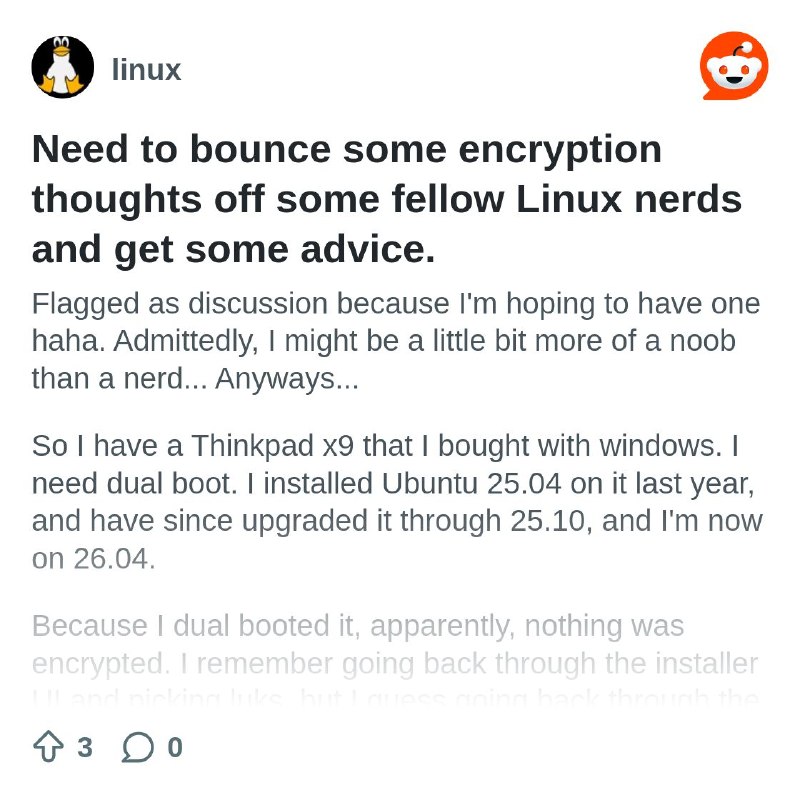
Need to bounce some encryption thoughts off some fellow Linux nerds and get some advice.

Flagged as discussion because I'm hoping to have one haha. Admittedly, I might be a little bit more of a noob than a nerd... Anyways...

So I have a Thinkpad x9 that I bought with windows. I need dual boot. I installed Ubuntu 25.04 on it last year, and have since upgraded it through 25.10, and I'm now on 26.04.

Because I dual booted it, apparently, nothing was encrypted. I remember going back through the installer UI and picking luks, but I guess going back through the manual partitioning method on the version I used meant that nothing actually got encrypted.

So now I have a dual booted machine with no encryption whatsoever. Seems like newer Ubuntu versions do support using luks and dual boot.

So, what to do? It sounds like you cannot encrypt a partition while it is mounted, meaning that if I want to encrypt my Ubuntu partition, I would have to do a full clean install. That's a huge pain in the ass, but I do have a time shift back up that I could use to restore most stuff. And I guess it would be an exercise in making sure that that works like I think it does in case of future unplanned disaster.

However...

Full disc encryption (fde) really only protects you against threat models where your device is powered off. If it gets swiped from a coffee shop or confiscated by the cops (idk, maybe I have some spicy memes I'm taking through TSA that this admin doesn't like... kidding, but still) or something then the keys are still in ram, and a thief can just brute force your password to get past the UI.

I basically never turn off my laptop. I pretty much only reboot it when I have to for updates. I think this is very common behavior among people generally.

Android and iOS have changed their encryption methodology to use file-based encryption, where the device can boot the OS without the user putting in their password, and the user's data is protected with the screen lock. Clearly, since it can boot, the whole drive isn't uniquely encrypted, but if your phone gets stolen or something, your lock screen can still protect your data.

I was asking Gemini about Linux's approach to this, and it said the Linux approach has pretty much settled on full disk encryption instead of only encrypting your home directory, but that Ubuntu does still support encrypting just your home folder, and that it would be protected by the OS's lock screen.

So, here's my dilemma: why has Linux settled on fde instead of encrypting the home folder? It doesn't matter that much if certain OS files are recovered by an attacker, but it'd be pretty bad if your personal files were compromised. I'd really like to avoid having to reinstall my system if possible, and it seems like encrypting my home folder better matches my threat model of having my device swiped in public while powered on, but locked. On the other hand, this doesn't seem to be the recommended way to go, and I would also be worried about support for just encrypting /home being removed in the future.

What does r/Linux think?

https://redd.it/1ttaphy
@r_linux
Reddit From the linux community on Reddit Explore this post and more from the linux community
Post #42084 63
Most Active Projects NixOS 15773 commits; French government Digital Sovereignty and Linux Migration;To support this transition, DINUM's Interministerial Products Operator department is developing Sécurix, a highly secure, reproducible operating system base built on NixOS
https://openhub.net/

https://redd.it/1tssmr0
@r_linux
Older posts →
Threads Profile ViewerView any public Threads profile without an account.Open ThreadLook →Writing with AI? Make it sound human.Metric37 rewrites AI drafts so they read naturally. Free AI detector, 1,500 words free.Try Metric37 →