
Good morning, dear friends! ☕️🙂
🌊 Solovki: How Monks Built a Road Right Through the Sea
Friends, today we are traveling to the Solovetsky Islands in the White Sea. The archipelago is known above all for its monastery. But today we are focusing on something else: an astonishing engineering system that developed here over the course of centuries.
The monks did not just pray—they built roads through the sea, connected lakes with canals, and harnessed the power of water for their work.
Welcome to the Solovetsky Islands—a vast historic water-engineering project.
🧱 A Causeway Across the Strait
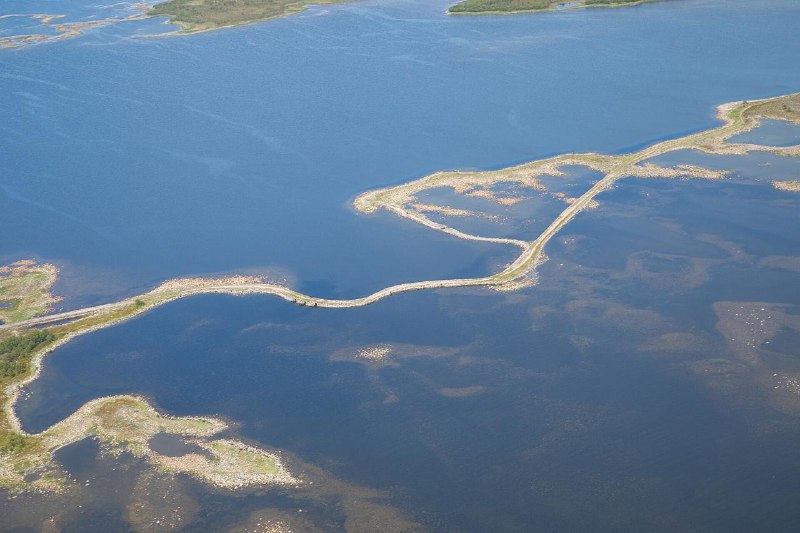
A roughly 1.2-kilometer-long stone causeway runs between Bolshoy Solovetsky Island and Bolshaya Muksalma. At first glance, it could be mistaken for a natural rocky ridge. In fact, however, it was built by people from countless boulders.
The reason was entirely practical. The main island lacked suitable grazing land, so part of the livestock operation was moved to Bolshaya Muksalma. But a strait lay between the two islands. Constantly transporting animals, hay, and other goods by boat was inconvenient and dependent on the weather.
The decisive construction phase took place between 1859 and 1865. The project was led by Fyodor Sosnin, who later entered the monastery as Feoktist. It took several years to complete the stone connection across the strait.
The causeway consists of boulders piled up without cement. Its curved route follows the shallower sections of the strait. The structure had to bear not only the weight of people, animals, and carts, but also withstand waves, currents, and the ice of the White Sea.
💧 A System of Lakes and Canals
But the causeway is only one part of a much larger story. A complex system of lakes, canals, and waterways developed on Solovki. Water was channeled to the monastery, where it was used both for the water supply and to power various mechanisms.
As early as the 16th century, under Abbot Filipp, numerous lakes were connected by canals. The water flowed into Lake Svyatoye and from there onward to the monastery’s economic facilities.
This system made it possible to operate watermills and mechanize various tasks—long before steam engines or electricity were available for this purpose.
The cultural historian Dmitry Likhachov later described how skillfully the monks regulated the water level of Lake Svyatoye and used its water for pipelines, technical installations, and various areas of the monastery’s economy.
⚙️ Harbors, Mills, and Docks
In addition to dams and canals, harbors, roads, and drainage systems were built on Solovki. The so-called Bay of Prosperity became the main harbor directly beside the monastery.
As early as the late 15th and early 16th centuries, the islands’ inhabitants were using the power of water. In the 16th century, several watermills and other mechanical installations operated here.
Later, facilities for maintaining and repairing ships were also established. In the 20th century, the long history of hydropower was ultimately continued with a small hydroelectric plant.
Thus, step by step, the inhabitants of the Solovetsky Islands transformed their challenging environment into a functioning technical system: lakes became reservoirs, canals became energy suppliers, and even a strait eventually became a road.
Give it a ❤️ if you liked it, and save the post!
📍 The coordinates of the location: available here
💥 Our channel: Node of Time EN
Post #33428
133



- ❤ 3