Post #5517
2.34K
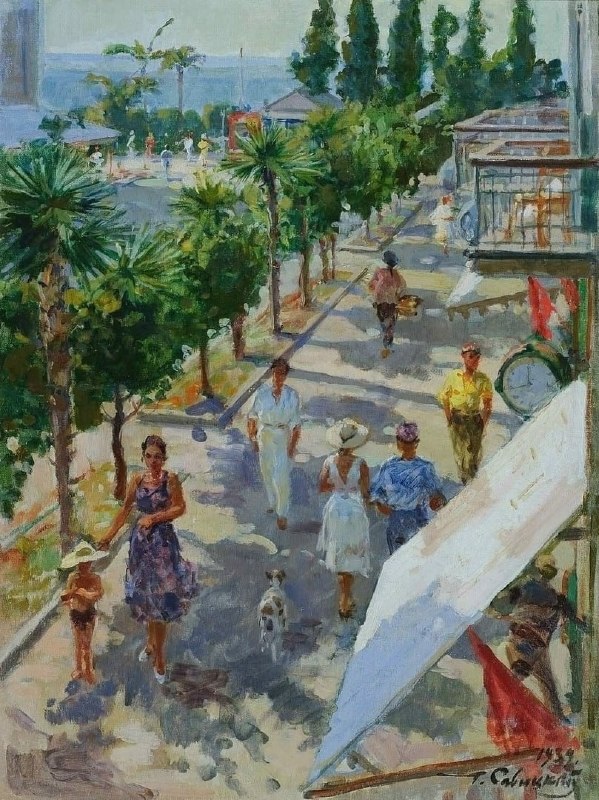
Georgy Savitsky’s painting “Street in Sukhumi” (1939) hides a surprising creative contrast. The artist was renowned in the USSR as a monumental battle painter, a co-founder of the Association of Artists of Revolutionary Russia (AARR), and the driving force behind the panoramic work “Storming of Perekop.” Yet in this intimate piece he emerges as a refined lyricist.
That year proved fortunate for him: he married painter Maria Polishchuk, who inspired him with soft, sunlit motifs. Rather than the rigid tenets of Socialist Realism, he turned to an impressionist idiom. He deftly conveyed the scorching southern air, the play of shadows on palm fronds, and the unhurried rhythm of a resort town. The canvas demonstrates that Soviet art was not confined to strict boundaries, but welcomed freer painterly experiments.
Bright Bits
That year proved fortunate for him: he married painter Maria Polishchuk, who inspired him with soft, sunlit motifs. Rather than the rigid tenets of Socialist Realism, he turned to an impressionist idiom. He deftly conveyed the scorching southern air, the play of shadows on palm fronds, and the unhurried rhythm of a resort town. The canvas demonstrates that Soviet art was not confined to strict boundaries, but welcomed freer painterly experiments.
Bright Bits
- 🔥 4