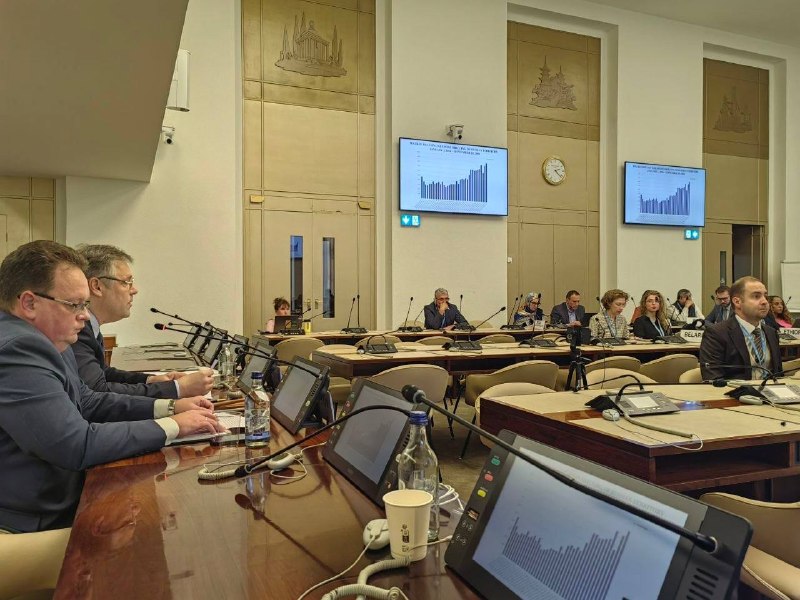
🎙 Ambassador-at-Large of the Russian Ministry of Foreign Affairs Rodion Miroshnik’s remarks at the side event “Systematic Violations of International Human Rights Law and International Humanitarian Law in the Context of the Evolving Conflict in Europe in 2026” (Geneva, September 28, 2026)
💬 Even before Ukraine gained statehood in 1991, its 1990 Declaration of State Sovereignty stipulated that “The people of Ukraine shall be the single source of the state authority in the Republic”.
The same document stated that “the Ukrainian nation has exercised its inalienable right to self-determination” to leave the USSR. Thirty-five years ago, the Western world applauded this move and swiftly and widely recognised the new state that had appeared on the map.
12 years ago, in response to the illegal coup in Kiev and the unconstitutional so-called “anti-terrorist operation” launched against them, the residents of Ukraine’s Lugansk and Donetsk regions likewise exercised their “inalienable right to self-determination” and voted in referendums to leave Ukraine. Yet this expression of the will of more than four million people in Donbass received no such approval in the West.
👉 This exercise of direct democracy by a population outraged by the coup was branded “separatism”, “occupation” and an attack on “Ukraine’s territorial integrity”.
Exactly four years ago, the residents of the Lugansk and Donetsk People’s Republics and the Zaporozhye and Kherson regions also exercised their “inalienable right to self-determination” and voted in referendums to join the Russian Federation. Since then, these regions have been new constituent entities of Russia and part of its territory under the Constitution.
👉 Yet both Kiev and the West chose to describe this exercise of direct democracy as “Russian occupation” as well.
A few days ago, UN Secretary-General Antonio Guterres displayed similar double standards.
In his view, the question of self-determination for Crimea, Donbass and Novorossiya must be approached exclusively through Ukraine’s “territorial integrity”, whereas the issue of Greenland must be resolved on the basis of both Denmark’s territorial integrity and the right of Greenland’s population to self-determination.
In other words, the rights of the people of Greenland are one thing, while those of the people of Crimea and Donbass are something else entirely. The key here is not to get the two mixed up…
Read in full (in Russian)
Post #32455
877