TGViewer
Channel Public Channel
International Center for Armenian Genocide Studies

International Center for Armenian Genocide Studies

@icags

Research, educational, informational, expert, and publishing activities in the field of the history of the Armenian Geno
Subscribers
24
Photos
4
Videos
0
Links
0
Recent Posts 6 shown
Post #13 23
IAGS Resolution on Nagorno-Karabakh
- Recognising the killing and other violence, including torture, against Armenian civilians;
- Recognising the detention of political leaders of Nagorno-Karabakh;
- Acknowledging the expulsion under threat of mass violence of the remaining 100,000 ethnic Armenians from Nagorno-Karabakh in September 2023;
- Acknowledging the history of anti-Armenian hate speech and expressions of genocidal intent from Azerbaijani media, political and military leadership, religious leaders and other sources;
- Recognising that Azerbaijan has taken ethnic Armenian soldiers and civilians prisoner, some of whose whereabouts remain unknown;
- Recognising the destruction of Armenian cultural heritage in Nagorno-Karabakh by Azerbaijan;
- Acknowledging the multiple representative and referendum votes from 1988 to 1992 to join Armenian Republic or become an independent state, which have never been respected internationally;
- Recognising that the closure by Azerbaijan of the Lachin Corridor from December 2022 to September 2023 prevented essential goods including food, fuel, and medicine from reaching the residents of Nagorno-Karabakh, and prevented residents from accessing external medical treatment and separated families including children from parents, creating a humanitarian crisis resulting in malnutrition, death from starvation, illness, and psychological harm;
- Acknowledging the International Court of Justice’s preliminary measures order of February 2023 that declared Azerbaijan’s blockade of Nagorno-Karabakh including the closure of the Lachin Corridor ‘may have a serious deterrent impact on the health and lives of individuals’ and ordered Azerbaijan to ‘take all measures at its disposal to ensure unimpeded movement of persons, vehicles and cargo along the Lachin Corridor in both directions’;
- Acknowledging the International Court of Justice’s preliminary measures order of February 2023 that ordered Azerbaijan to cease incitement and promotion of racial hatred and discrimination targeted at national or ethnic Armenians; and to prevent and punish destruction of Armenian cultural heritage;
- Acknowledging the International Court of Justice’s preliminary measures order of November 2023 that ordered Azerbaijan, inter alia, to ensure the safe, unimpeded and expeditious return of those who wish to return to Nagorno-Karabakh; and the protection of persons in Nagorno-Karabakh;
- Acknowledging Azerbaijan’s lack of compliance with the International Court of Justice’s preliminary measures orders of February (supported by a follow-up statement of 6 July 2023) and November 2023;
- Recognising that Azerbaijan bombed Nagorno-Karabakh including civilians areas on 19-20 September 2023, resulting in the deaths of over 200 people and over 400 injured including civilians, and the above-referenced forced displacement of over 100,000 people from Nagorno-Karabakh into Armenia;
- Recognising international concern over a possible Azerbaijan invasion of Armenia and that Azerbaijan’s leadership continues to threaten Armenia with possible future military attacks;
- Recognising the statements of legal experts, current UN officials, former UN officials, non-governmental organisations and scholars of the risk of genocide and the declaration of the blockade of Nagorno-Karabakh as genocide;
- Recognising that Azerbaijan is a state party to the 1948 United Nations Convention on the Prevention and Punishment of the Crime of Genocide;
- Recognising that Azerbaijan is a state party to the four Geneva Conventions of 1949; the 1954 Hague Convention for the Protection of Cultural Property; and the 2006 Convention for the Protection of all Persons from Enforced Disappearance;
- Recognising that Azerbaijan is a state party to the 1984 Convention Against Torture; the 1965 Convention on the Elimination of all forms of Racial Discrimination, and a number of other international human rights law treaties;
- Recognising that, in November 2023 Armenia deposited its ratification of the 2002 Rome Statute of the International Criminal Court, which came into effect 1 February 2024, including a declaration on the acceptance of retroactive application of the ICC’s jurisdiction to 10 May 2021;

Therefore, the IAGS:
1. Declares the blockade of Nagorno-Karabakh from December 2022 to September 2023, including the closure of the Lachin Corridor, was characteristic of actions considered imposing conditions of life designed to bring about the physical destruction of the ethnic Armenians in the territory and caused serious mental and bodily harm to the Armenians in the territory, which are recognized as genocidal crimes under the United Nations Convention on the Prevention and Punishment of the Crime of Genocide;
2. Declares the forced removal of ethnic Armenians in September and October 2023 through siege and bombing as ethnic cleansing and the crime against humanity of deportation or forcible transfer of population (forced displacement);
3. Declares the bombing of civilian areas to be a violation of international humanitarian law;
4. Declares the torture and killing of ethnic Armenian prisoners of war and civilians to be a violation of international humanitarian law;
5. Calls upon the government of Azerbaijan to free all ethnic Armenians in Azerbaijani detention in unlawful circumstances;
6. Urges Azerbaijan to comply with orders and judgments of the International Court of Justice, and other obligations of international law including international human rights law and international humanitarian law;
7. Calls upon the government of Azerbaijan to prevent future violations of human rights and international law being perpetrated against the Armenians of the South Caucasus;
8. Calls upon Azerbaijan to prevent further displacement of Armenians from their homeland by respecting the Republic of Armenia’s territorial sovereignty;
9. Call upon Azerbaijan to respect, protect and prevent the destruction of any Armenian cultural property in Nagorno-Karabakh;
10. Calls upon the international community to protect Nagorno-Karabakh’s right to self-determination;
11. Calls upon the international community to take appropriate measures to guarantee the right to return and security of Armenians forcibly displaced from Nagorno-Karabakh, as confirmed by the International Court of Justice in its 17 November 2023 Provisional Measures Order;
12. Calls upon the international community, including national governments and international organisations, to recognise the atrocities perpetrated against the ethnic Armenians of Nagorno-Karabakh as constituting gross violations of human rights, war crimes, genocide and crimes against humanity, as applicable, and to take appropriate measures in response to prevent further violations and crimes.
13. Recommends appropriate transitional justice measures including but not limited to: sanctions against those who are responsible; referral of the situation to the International Criminal Court to ensure justice for victims; commencement of proceedings against Azerbaijan in the International Court of Justice under the Convention on the Prevention and Punishment of the Crime of Genocide and the Convention Against Torture; the creation of an international fact-finding mission to gather evidence of human rights abuses and crimes; the creation of a missing persons search process; and the use by state courts of universal jurisdiction to commence proceedings against individuals involved in the crimes.
14. Calls upon the Prosecutor of the International Criminal Court to use Armenian ratification of the Rome Statute to investigate and prosecute the transboundary crime against humanity of deportation from Nagorno-Karabakh into Armenian territory.
15. Calls upon Azerbaijan to remove its soldiers from the territory of the Armenian Republic and to respect the right of self-determination of the Armenians of Nagorno-Karabakh as guaranteed under the United Nations Charter (Chapter I, Article 2).
Resolution passed September 2, 2024

@ICAGS
  • 👍 2
  • ❤ 1
  • 🔥 1
Post #11 367
Three years ago, on September 19, 2023, Azerbaijani forces launched a massive military attack on Artsakh (Nagorno-Karabakh).
Within days, more than 100,000 ethnic Armenians were forced to flee their ancestral homeland. More than 200 people were killed, including civilians.
This was not simply the end of a war. It was the culmination of a process that resulted in the displacement of the entire Armenian population of Artsakh.
The International Association of Genocide Scholars (IAGS), the leading international organization bringing together scholars of genocide and other atrocity crimes, adopted a resolution addressing the events in Nagorno-Karabakh. The resolution described the forced removal of the Armenian population as crimes against humanity, genocidal acts, ethnic cleansing and forcible transfer, and warned of the broader genocidal dimensions and risks surrounding the destruction of the Armenian community in Artsakh.
Three years later, the people of Artsakh remain displaced from their homes.
Remembering is not enough. We must also study, document, and understand how mass atrocities become possible - and what can be done to punish perpetrators and prevent them from happening again.

See the whole resolution below.

@ICAGS
  • 👍 3
  • ❤ 1
  • 😢 1
Post #8 38
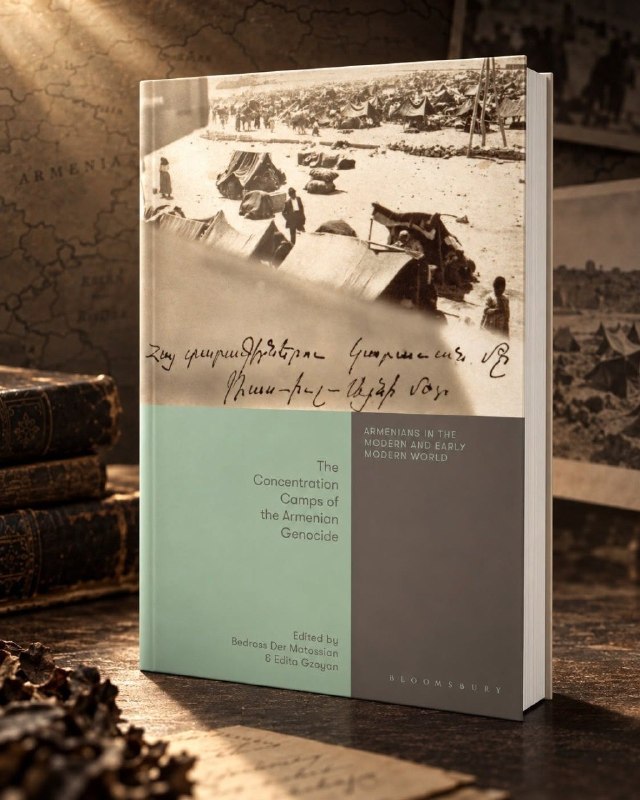
𝐃𝐞𝐫 𝐌𝐚𝐭𝐨𝐬𝐬𝐢𝐚𝐧 𝐚𝐧𝐝 𝐆𝐳𝐨𝐲𝐚𝐧 𝐏𝐮𝐛𝐥𝐢𝐬𝐡 𝐋𝐚𝐧𝐝𝐦𝐚𝐫𝐤 𝐕𝐨𝐥𝐮𝐦𝐞 𝐨𝐧 𝐭𝐡𝐞 𝐂𝐨𝐧𝐜𝐞𝐧𝐭𝐫𝐚𝐭𝐢𝐨𝐧 𝐂𝐚𝐦𝐩𝐬 𝐨𝐟 𝐭𝐡𝐞 𝐀𝐫𝐦𝐞𝐧𝐢𝐚𝐧 𝐆𝐞𝐧𝐨𝐜𝐢𝐝𝐞
LONDON/NEW YORK — Bloomsbury Publishing has announced the publication of The Concentration Camps of the Armenian Genocide, a 520-page edited volume by Prof. Bedross Der Matossian and Dr. Edita Gzoyan. The book is part of the series Armenians in the Modern and Early Modern World, edited by Bedross Der Matossian of the University of Nebraska–Lincoln.
Although scholarship on the Armenian Genocide has expanded significantly in recent decades, the concentration-camp system established by the Ottoman authorities, particularly in present-day Syria, remains insufficiently studied. This is the first volume to offer an in-depth and multifaceted examination of these camps. Its chapters trace the origins and development of the camp system and document the atrocities committed at sites such as Deir ez-Zor, Ras al-Ain, Meskene, and elsewhere.
Featuring twenty-one chapters by historians and social scientists from Armenia, France, Germany, the United States, the United Kingdom, Lebanon, and Australia, the volume brings together diverse disciplinary and geographical perspectives. It also foregrounds survivors’ voices through memoirs and diaries that document their experiences of deportation and life in the camps. Literary reflections and biographical studies of Armenian and foreign individuals connected with the camps and humanitarian missions further enrich the volume’s interdisciplinary approach.
The contributors examine the experiences of deportees along deportation routes and in transit and concentration camps; the geography and spatial organization of the camps; the brutal realities of daily life; the distribution of humanitarian assistance and the development of self-help mechanisms; interactions between deportees and local populations; moral and physical forms of resistance; and the experiences of children. The volume also considers Ottoman laws, decrees, and administrative practices relating to the camps and situates the Armenian case within the broader comparative history of concentration camps and genocide.
This project was generously supported by the Friedman Fund, the Hymen Rosenberg Professorship, and the Department of History at the University of Nebraska–Lincoln.
“This has been one of the most demanding projects we have undertaken,” Der Matossian and Gzoyan commented. “One of the volume’s distinguishing features is that it brings together renowned experts and emerging scholars, including a substantial number of Armenia-based researchers. Over the course of three years, we worked closely with the contributors to ensure the scholarly quality and historical accuracy of each chapter. Repeatedly engaging with accounts of the suffering and violence endured by Armenians in these camps was difficult, but it also reinforced our commitment to documenting this understudied dimension of the genocide.”
“We consider this one of the most important books published in the field of Armenian Genocide in the past few years. We hope that it will make a significant contribution to Armenian Genocide scholarship and encourage further research on the concentration-camp system and what is often described as the second phase of the genocide,” they continued.

@ICAGS
Post #7 31
Comment from Bedross Der-Matossian

Hikmet Hajiyev, the Azerbaijani presidential spokesman, recently brought a group of diplomats to the Armenian museum at Gandzasar Monastery in occupied Artsakh, in what appears to have been a carefully staged attempt to “prove” that its Armenian manuscripts were fake. His evidence was remarkably simplistic: he flipped through several volumes, pointed out that only one page contained writing and an illustration while the remaining leaves appeared blank, and presented this as some kind of smoking gun.
The episode says far less about the manuscripts' authenticity than it does about Hajiyev’s apparent unfamiliarity with museum practice, archival preservation, and manuscript conservation. Blank leaves, incomplete codices, detached folios, conservation bindings, facsimiles, and reconstructed volumes are hardly unusual in manuscript collections. Presenting such features to diplomats as evidence of fabrication is not serious scholarship; it is political theater dressed up as expertise.
In the Gandzasar museum display, visitors encounter what at first appears to be a complete manuscript volume. In fact, the object is a specially produced exhibition facsimile. Only the page intended for display has been carefully reproduced from the original manuscript, preserving its text, illumination, and visual character. The remaining leaves are blank and serve simply to give the object the physical form, thickness, and presence of a bound volume.
This is a perfectly ordinary exhibition technique. It lets a museum present a manuscript in a visually convincing, accessible way while keeping the original safely stored and protected from prolonged light exposure, handling, humidity fluctuations, and other environmental risks. Reproducing only the page needed for interpretation also lets the museum highlight a particularly significant passage or illustration without incurring the expense or conservation concerns of producing a complete facsimile of the entire codex.
Against that background, Hajiyev’s supposed “discovery” is less an exposé than a demonstration of either ignorance or deliberate misrepresentation.
More troubling, however, was the reaction of the European diplomats who accompanied him. Their laughter at the display—rather than any apparent effort to understand what they were actually being shown—raises questions of its own, particularly given the long-running controversies surrounding Azerbaijan’s so-called “caviar diplomacy” and its cultivation of foreign officials and political figures. Whatever one thinks of Hajiyev’s performance, the willingness of visiting diplomats to participate in the spectacle is revealing in itself.
And there is an additional irony: the original manuscripts from Artsakh are preserved at the Matenadaran in Yerevan, one of the world’s major repositories of Armenian manuscripts. The objects displayed at Gandzasar were never required to function as substitutes for the originals. They were exhibition materials intended to convey the appearance and cultural significance of manuscripts whose authentic originals are preserved elsewhere.
Treating a museum facsimile as evidence that the underlying manuscript is “fake” is therefore not a serious historical or scholarly argument. It is propaganda built upon either a basic misunderstanding of museum practice or the expectation that the audience will not know the difference.

@ICAGS
  • 👍 3
Post #6 60
Research, educational, informational, expert, and publishing activities in the field of the history of the Armenian Genocide and Genocide Studies.
  • ❤ 5
  • 👍 5
  • 🔥 2
Post #1
Channel created

About this channel

How can I read @icags without a Telegram account?
TGViewer shows the public web preview Telegram publishes for International Center for Armenian Genocide Studies: recent posts, photos, videos and the subscriber count, with no app, login or account.
How many subscribers does International Center for Armenian Genocide Studies have?
International Center for Armenian Genocide Studies (@icags) has 24 subscribers on Telegram, refreshed roughly every 30 minutes.
Does International Center for Armenian Genocide Studies know I viewed it here?
No. Public channel previews carry no viewer identity, and TGViewer has no accounts or tracking of what you look up.
Threads Profile ViewerView any public Threads profile without an account.Open ThreadLook →Writing with AI? Make it sound human.Metric37 rewrites AI drafts so they read naturally. Free AI detector, 1,500 words free.Try Metric37 →