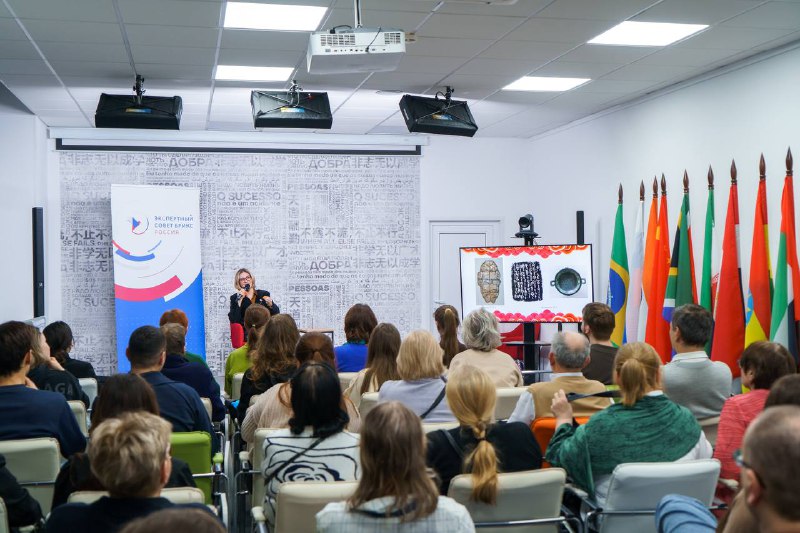
We are glad to share the key points from the lecture "A Journey into China's Past: The Hidden Stories Behind China's History and Script," delivered by
Maria Efimenko, Lecturer of the School of Asian Studies at HSE University, at Inostranka.
⚪This lecture is a journey through time: from the Neolithic period and the first symbols on pottery to the modern system of simplified characters and Standard Mandarin.
⚪The earliest signs were simple crosses, circles, and "flower-with-eye" motifs; these were sacred symbols applied to ritual objects, not used for administrative record-keeping as in Ancient Sumer.
⚪The transition to the Shang (Yin) dynasty provided us with deciphered inscriptions on oracle bones and shells: questions were phrased in affirmative and negative pairs so the gods’ answers—interpreted through cracks—could be read as “yes” or “no.”
⚪The Western Zhou period featured inscriptions on bronze vessels: essentially administrative records with dates, circumstances, appointments, and lists of gifts—a document intended for ancestors, preserved at the bottom of a ritual vessel.
⚪Chinese characters evolved from pictograms (“horse,” “tree,” “woman”) to ideograms and then to phono-semantic compounds, combining a semantic clue with a phonetic indicator within a single character.
⚪A primary challenge for Europeans is the disconnection between writing and sound: a character does not directly represent sound; it cannot be read phonetically “letter by letter,” as in Cyrillic or Latin scripts.
⚪Chinese writing left a lasting legacy in Japan, Korea, and Vietnam: local writing systems based on Chinese characters were adapted to record not the Chinese language, but their own native tongues.
📎 Click
here to watch a video of this lecture
#EXPERT #inostranka
🕊🕊🕊