Formula Data AnalysisFerrari's SF-26 looks 'basic': very simple endplates and bulky bodywork... this might be a 'base-spec' to be significantly developed! 👀 💡Interesting bits: - The minimal centerline cooling makes up for the huge sidepod inlets (the opposite of Racing Bulls!)…
Ferrari's SF-26 looks 'basic': very simple endplates and bulky bodywork... this might be a 'base-spec' to be significantly developed! 👀
💡Interesting bits: - The minimal centerline cooling makes up for the huge sidepod inlets (the opposite of Racing Bulls!) → Lower CoG, cleaner rear wing airflow. - This is the first real car with an inwashing front wing. - Back to front push-rod. Very rearward-rotated upper wishbone. - Stepped shark fin. - From video, the car has almost no rake. - The bargeboard stays have an intriguing shape!
Considering Ferrari's frequent development issues, starting from a simple base might be a pro, not a cons.
The new Mercedes W17 DOES have sidepods - and keeps W16’s front and rear push-rod suspension layout.
The size reduction is striking: Mercedes’ wheelbase is over 30 cm shorter than in 2021, yet the car is 18 kg heavier!
DO NOT read on unless you're a nerd!
If a 2021 F1 car were simply scaled down to a 2026-style wheelbase, its mass would be: 752 × (3400 / 3724)³ = 572.3 kg (since volume - and mass - scale with the cube of length).
Yet the 2026 car is almost 200 kg heavier than that! Why?
- F1 cars have very low “effective density”: much of the mass sits in components (e.g. PU) that don’t shrink when the car gets shorter.
- Some parts got HEAVIER, most notably the jump from 13″ to 18″ wheels.
A more conservative way to estimate the ‘expected’ mass is: Wheelbase 3724mm → 3400mm Track 2000mm → 1900mm Same height
752*(3400/3724)*(1900/2000)=652.2kg, or still ~120kg less than the 2026 mandated minimum
- HUGE central inlet (~3× ERS power → far higher cooling needs); - Radical front suspension rethink: much flatter upper wishbone and switch from PULL-rod to PUSH-rod; - TINY front wingspan (+ active aero actuator); - Far more complex endplate and outboard section.
The Pull→Push-rod switch, mainly aero-driven, is major and potentially critical (Ferrari’s failed push→pull change last year is a warning).
We still need clearer shots of the lower wishbone to assess anti-dive.
Intriguing design: 2026 F1 cars look radically different! 😁
The renders - NOT the physical show cars - released by Red Bull Racing and VCARB do NOT match any F1 FIA renders seen so far. They may be pre-testing prototypes, hinting at the design direction already chosen. 💡
Both will switch the front suspension from PULL to PUSH-rod. 🛠
Formula Data AnalysisScaling the effect: 0.26 / 540 × 840 ≈ 0.4 s/lap That means: - More ICE power; - More ERS power; - Lighter car at race start (Higher thermal efficiency with fixed fuel flow → Better fuel economy → Less fuel load). This mirrors the early ('14) V6 era, when…
Some of the sources I started from come from this article:
Formula Data AnalysisMercedes' (and RBR's?) "compression ratio trick" could be worth 4 tenths in Monza, and even more in the opening laps (~21s over a race: the difference between P2 and P6 this year)! Let’s look at the numbers! 16:1 → mandated ’26 compression ratio (cold engine…
Scaling the effect: 0.26 / 540 × 840 ≈ 0.4 s/lap
That means: - More ICE power; - More ERS power; - Lighter car at race start (Higher thermal efficiency with fixed fuel flow → Better fuel economy → Less fuel load).
This mirrors the early ('14) V6 era, when Mercedes NEVER ran full power, and still dominated with a detuned engine!
Such a fundamental design advantage will be hard to copy before '27. That said, this is Mercedes' best-case scenario: its real impact might be smaller.
Mercedes' (and RBR's?) "compression ratio trick" could be worth 4 tenths in Monza, and even more in the opening laps (~21s over a race: the difference between P2 and P6 this year)!
Reaching 18:1 in ’26 via thermal expansion would yield ~10 kW (~13 hp), requiring only a ~0.5 mm geometric change.
Currently, +13hp ICE power is worth ~0.26s/lap in Monza. But '26 ICEs will be far less powerful (~540hp vs ~840hp), so the same gain matters much more, since the ICE feeds the battery!
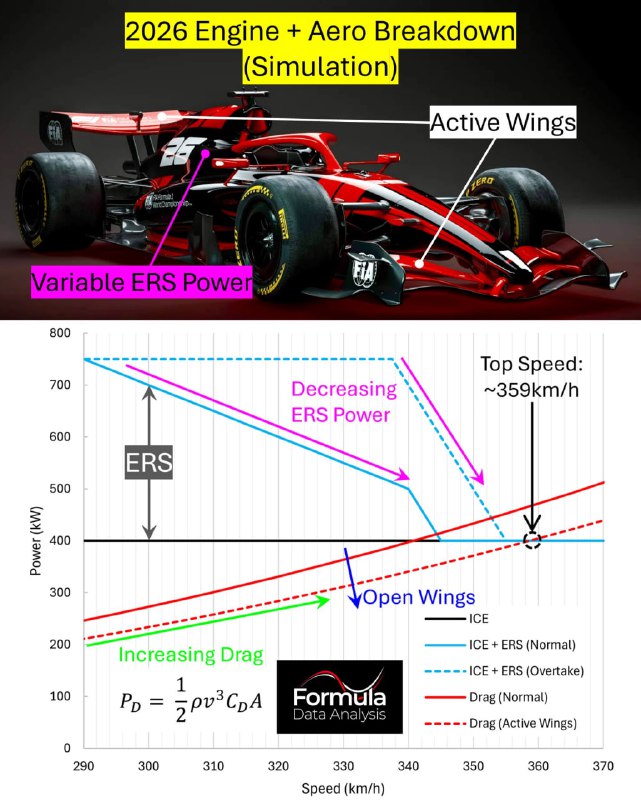
Formula Data AnalysisEver seen a 2026 F1 car accelerate? Now you can, through this simulation!🏎 ⬛️ Normal ERS vs 🟥 Overtake Mode — Normal Aero vs -- Active Aero Key points: - Cars will accelerate QUICKER than in '25 until 290km/h (same power, 30kg less, less drag). - Beyond…
Ever seen a 2026 F1 car accelerate? Now you can, through this simulation!🏎
⬛️ Normal ERS vs 🟥 Overtake Mode — Normal Aero vs -- Active Aero
Key points: - Cars will accelerate QUICKER than in '25 until 290km/h (same power, 30kg less, less drag). - Beyond that, acceleration drops sharply as ERS power fades. When chasing another car, Overtake keeps full ERS power up to 337.5 km/h. - In '25, Active Aero's (DRS) impact grew with speed. Same in '26, AS LONG ASA. full ERS power is available. With overtake mode and open wings, '26 cars will accelerate super-quickly until 337.5km/h, then effectively 'hit a wall' (as ERS power drops sharply).