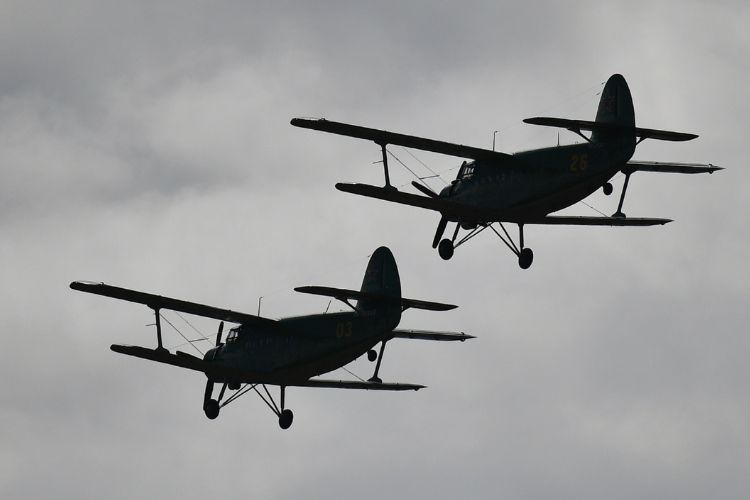
Controller Negligence and Mid-Air Collision Over Irkutsk
On December 4, 1974, an An-12B was performing a training flight in the area of Irkutsk Airport, conducting a series of approaches to the paved runway. There were five crew members on board.
At the same time, local An-2 aircraft were taking off from an unpaved runway located about 2.5 kilometers away. According to the published procedure, after takeoff they were to make a left turn, climb to 300 meters, and then cross the centerline of the paved runway. Because of this, overflights of the paved runway were only allowed at altitudes not exceeding 200 meters.
Soon, weather conditions worsened. The sky became overcast with clouds, the cloud base dropped to 440 meters, snow began to fall, and visibility decreased to 2,000 meters. In response, the deputy airport manager prohibited all visual flights from the unpaved runway.
However, 20 minutes later, a local air traffic controller observed that actual visibility at the departure point was 2,500 meters - above the required minimum - and cleared an An-2 for takeoff despite the standing ban.
Due to the weather, one of the An-2 pilots was replaced before the flight with a more experienced one who had not originally been scheduled to fly that day. Four minutes after receiving clearance, the An-2 took off with 11 passengers and 2 pilots on board and began climbing according to the standard procedure.
Meanwhile, the An-12 had completed another approach and descended to 100 meters, reporting its altitude to the approach controller. The crew then initiated a go-around and began climbing to 200 meters. Afterward, they switched to the circuit frequency, where the controller had just been replaced by the flight operations director. However, the local ATC controller failed to inform the director about the An-2’s departure.
Unaware of the actual traffic situation and believing that no takeoffs were taking place from the unpaved runway, the flight director authorized the An-12 to climb directly to 600 meters.
Four minutes after takeoff, the An-2, flying at an altitude of 270 meters, collided at a right angle with the underside of the An-12’s fuselage, directly over the center of the paved runway. The An-2 broke apart from the impact, and its wreckage fell 200 meters north of the runway and caught fire. All 13 people on board the An-2 were killed.
The An-12 was more fortunate. The pilots felt a strong jolt and then noticed a sharp left bank. The crew shut down all engines, feathered the propellers, and executed a forced landing in a floodplain of the Ushakovka River. Upon landing, the aircraft struck a 10-meter-tall lightning rod tower, which collapsed onto the An-12, destroying its center wing section. Both left engines were torn off, one right propeller separated, and the lower fuselage was heavily damaged. However, no fire broke out, and all five crew members survived.
The investigation identified several contributing factors. First, the local ATC controller showed criminal negligence by authorizing the An-2’s takeoff despite the ban, and by failing to coordinate its flight path over the paved runway with the circuit controller. Second, the flight operations director, acting as circuit controller, did not properly manage the shift and, unaware of the traffic situation, effectively abdicated overall control of flight operations in deteriorating visibility. Third, the deputy airport manager failed to ensure enforcement of his own order prohibiting local flight operations.
Post #93
322