
A Small Detail
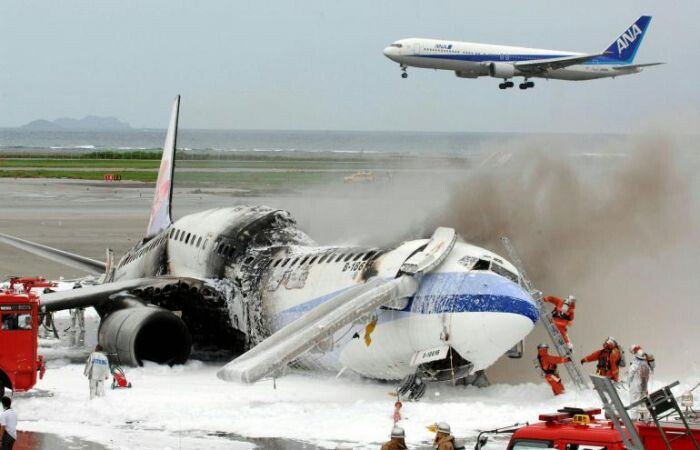
On August 20, 2007, a China Airlines Boeing 737-809 was operating a flight from Taipei, Taiwan, to Naha, Japan. There were 165 people on board (157 passengers and 8 crew members).
The aircraft landed normally and had already taxied to the gate when passengers noticed flames near the right wing and right engine. At the same moment, the pilots received a “Engine No. 2 Fire” warning. The cabin quickly filled with black smoke. The cabin crew began an evacuation through the emergency exits, and passengers left the aircraft via the inflatable slides.
By the time the last passenger was off the airplane, the fire had already engulfed half of the fuselage. The pilots evacuated last. The first officer climbed out through the cockpit window; at that moment an explosion occurred and he fell to the ground, but he was not injured. As the captain began to climb out through the same window, two more explosions followed and the aircraft broke apart, yet the captain was also uninjured. The entire evacuation took six minutes. No one was killed, but four people were injured, including an airport worker.
Investigators quickly determined that the fire was caused by a fuel leak. When they examined the wing fuel tank, they found a dented bolt that had punctured the tank wall and compromised its seal. While the aircraft was taxiing, the airflow from the operating right engine prevented the leaking fuel from reaching hot engine components. However, once the engine was shut down, fuel spilled onto the hot exhaust nozzle and ignited.
The dented bolt was part of a mechanism that served as a limit stop for slat extension. Several weeks before the incident, at the manufacturer’s request, airline maintenance personnel had modified this mechanism. The change involved bonding a nut to the bolt with adhesive to prevent it from repeatedly working loose. Because the attachment point was difficult to access, the mechanics tightened and loosened the bolt by feel, effectively working “blind.” During the procedure, a washer - which prevented the bolt from slipping out of the mechanism - fell out unnoticed.
The bolt, which came loose during landing, remained inside a “cup” into which the slat retracts very tightly. This “cup” is located inside the fuel tank. As a result, when the slats were retracted, powerful hydraulics drove the bolt into the fuel tank wall, causing the leak and the fire.
After the investigation, Boeing urgently inspected 737-800 aircraft worldwide. In the United States alone, more than 20 aircraft were found to have a similar potential hazard. The locking device was later redesigned across the fleet.
Post #90
359
- 👍 2