Engines Separated Mid-Flight
On March 31, 1992, a Boeing 707-321C cargo aircraft was scheduled to operate a flight for Kabo Air Cargo from Luxembourg to Kano, Nigeria. At 09:14 local time, the Boeing, carrying 38 tons of drilling equipment on board, departed Luxembourg and headed for Africa. The initial climb proceeded without any irregularities, and it seemed nothing could go wrong. The aircraft was reliable, and the crew experienced.
Approximately an hour into the flight, while climbing to cruise altitude over France, the aircraft encountered a turbulence zone. Shortly thereafter, the crew felt two powerful jolts, immediately followed by a severe roll to the right. At the same time, a fire warning was triggered, which the flight engineer was unable to silence for the remainder of the flight.
While the captain struggled to control the now unstable aircraft, the first officer looked out at the wings and saw the cause of the jolts and the roll - both engines on the right wing had detached. Realizing the need to descend, the captain initiated a diversion toward Marseille. Meanwhile, the flight engineer began fuel dumping. The crew prepared for an emergency landing.
During the descent, the crew spotted a runway ahead - it was the military airbase in Istres. The pilots decided to land there on Runway 15, banking the aircraft left to line up with the runway. The first officer encouraged the captain, as handling the aircraft in such a damaged state was extremely difficult. Shortly before landing, the air traffic controller observed that the aircraft’s right wing was engulfed in flames.
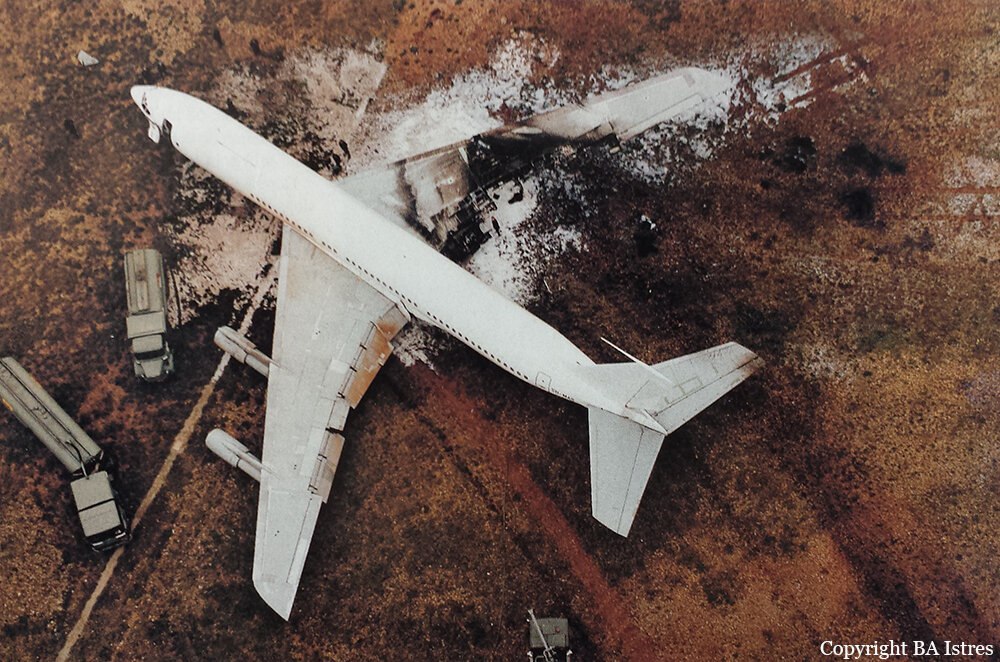
The pilots managed to land the aircraft, but it only came to a full stop after overrunning onto unpaved ground. After the stop, the first officer also noted that the right wing was ablaze. The crew quickly evacuated the burning Boeing 707. Thanks to timely and well-executed decisions, all five crew members survived without serious injuries. Later, the crew would be awarded the Hugh Gordon-Burge Award.
Unfortunately, the aircraft was not as lucky: in addition to losing both engines, the right wing was completely destroyed by fire, and the rear fuselage on the right side was severely burned. The aircraft was subsequently declared beyond repair and written off.
The incident was investigated by France’s Bureau of Enquiry and Analysis for Civil Aviation Safety (BEA). Investigators concluded that the cause of the accident was plain metal fatigue.
It was determined that a crack had formed on the pylon of engine No. 3 (the inboard right engine). Due to turbulence, the crack propagated, and the engine detached, striking engine No. 4 (the outboard right engine). That engine’s pylon also failed, and it separated as well. The investigation also found that the procedures for inspecting engine pylons were ineffective. The BEA recommended revisions to pylon inspection procedures to better detect fatigue cracks.
Post #60
214