Destructive Oxygen
On July 25, 2008, a Qantas Boeing 747-438 was en route from London to Melbourne with a stopover in Hong Kong. There were 365 people on board - 346 passengers and 19 crew members.
About an hour after departing from Hong Kong, when the airliner was at an altitude of around 9,000 meters, there was a loud bang. In front of the passengers, a section of the floor collapsed. Below it was the cargo hold, in the wall of which there was a hole 2 meters wide and 1.5 meters high. The cabin were depressurized, and oxygen masks were released.
Upon seeing the depressurization warning, pilots quickly descended the aircraft to 3,000 meters, which is an altitude where people do not experience oxygen starvation. After that, the crew turned the plane towards the nearest airport. It turned out to be Manila Airport, the capital of the Philippines, located 475 kilometers away. The explosion and depressurization damaged the navigation, landing, and braking systems, but this did not result in a loss of control. In the end, 54 minutes after the explosion, the pilots managed to make a successful emergency landing.
In the incident, no one was seriously injured. Even the cargo was practically undamaged. Unlike the aircraft. On the right side a huge hole in the fuselage was visible. It was located at the level of the cargo hold, at the base of the wing. Investigators had to find out how and why it appeared.
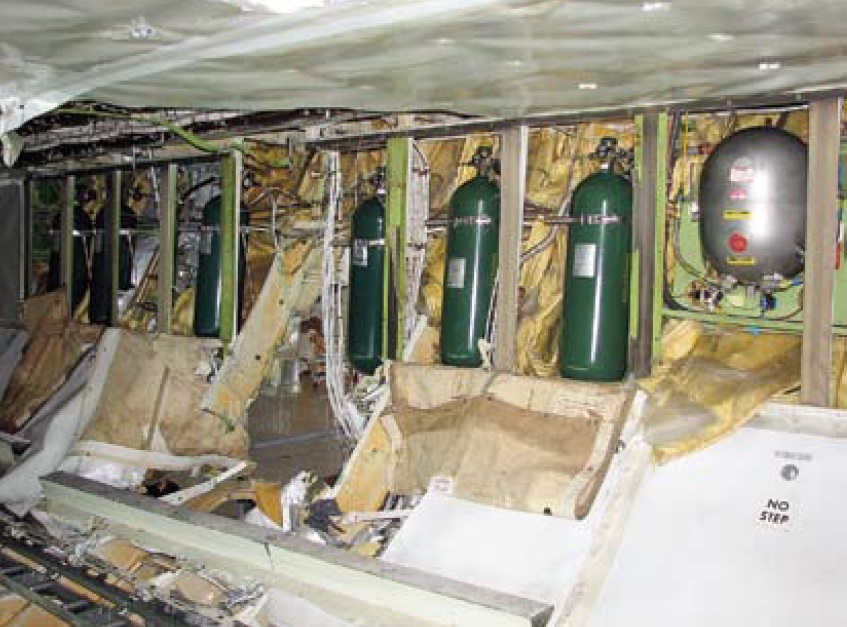
The first thing they did was to carefully examine the cargo hold. There they noticed cylinders, the air from which is supplied to the oxygen masks. Seven of them were supposed to be installed on the right wall of the nose section of the cargo compartment. However, in the crashed Boeing, there were only six - the cylinder located in the middle was missing.
By analyzing the nature of the damage, the investigators managed to reconstruct the picture of what happened. The oxygen in the cylinders is under high pressure. One of the cylinders suddenly exploded, with the explosion occurring at its bottom. As a result, the fuselage was punctured, and the cylinder itself, like a rocket, flew upwards. It broke through the ceiling of the cargo hold, tearing 85 electrical wires and control cables for the ailerons, and ended up in the cabin. There, the cylinder hit the handle for opening the right door, moving it 120 degrees from the "locked" position. Investigators believe that it then fell back through the hole in the cabin floor and flew out of the airplane through the tear in the fuselage.
The cylinder was never found, so the investigation could not determine the exact cause of the explosion. Even after checking and testing all the cylinders on board, as well as cylinders from the same batch, experts could not identify any design or manufacturing defects and shortcomings. As a result, the commission concluded that the oxygen cylinders of this series did not pose a threat to flight safety.
After being repaired, the Boeing 747 flew for about another year under the Qantas livery but was later sold to a Nigerian airline, where it operated for the next six years.
Post #19
808