
#econoscope_books
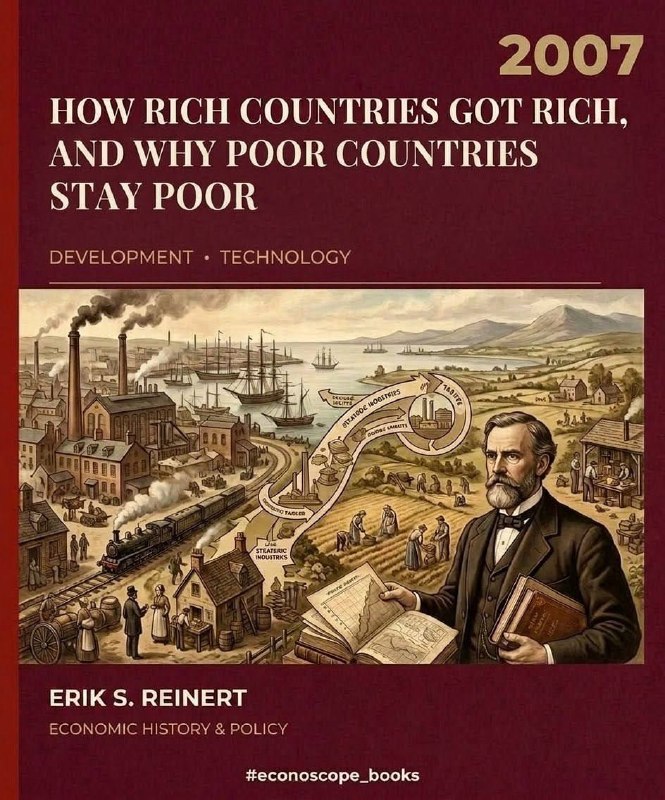
Erik Reinert - How Rich Countries Got Rich, and Why Poor Countries Stay Poor (2007)
📚 Erik Reinert’s “How Rich Countries Got Rich, and Why Poor Countries Stay Poor” is more than a book on economics . It is a narrative history of economic development from the Italian Renaissance to the modern Far East, and it challenges the standard story that today’s wealthy nations got there through free trade. Reinert argues that rich countries first protected and built up their own industries, and only later embraced free trade. The book is one of the best-known works of economics.
💡 Reinert engages critically with the “Washington Consensus,” the free-market policy package promoted by the IMF, the World Bank and the US Treasury. A Norwegian economist and Executive Chairman of the Other Canon Foundation, he draws on a long historical record to argue that the economics profession has long been split between a continental tradition rooted in the Renaissance and the free-market theories of English and later American economics.
💰 The core of his argument is that manufacturing, rather than agriculture or raw-material extraction, drives long-term development, because it offers increasing returns, technological progress and higher wages. In his reading, successful countries, England and the United States among them, used tariffs, subsidies and state support to nurture their industries first. They turned to free trade once they had a lead. From this, Reinert concludes that advising poorer countries to open their markets immediately ignores how today’s rich countries actually developed.
✒️ Reinert traces the same pattern of protection and strategic investment across several centuries and regions, from early modern England to the East Asian economies. This is a historical interpretation, and mainstream economists dispute parts of it, but it is argued with a wealth of detail and examples.
⚡️ The book has been translated into 27 languages. In 2008 it won the Gunnar Myrdal Prize of the European Association for Evolutionary Political Economy, and Reinert’s university profile also lists the Norwegian Selvaag Prize for the same year. For anyone interested in the roots of global inequality and the debate over industrial policy, it is it worth reading.
Post #246
67
- ❤ 5
- 👍 2
- 🔥 1