TGViewer
Channel Public Channel
The EconoScope Journal

The EconoScope Journal

@econoscopejrnl

💸A journal of economic thought — written by learners, for learners.

✍️From global crises to quiet theories, all in English.

✅The Journal works with @oeconomicus – the MGIMO Economics Club
Subscribers
185
Photos
204
Videos
5
Links
14
Recent Posts 20 shown
Post #240 34

Forwarded from Oeconomicus Экономический клуб МГИМО

#oeconomicus_english by the @econoscopejrnl

Can you predict future crises? (Part 1)

First, let’s consider what a crisis is according to the Oxford dictionary.
A crisis is a time of great danger, difficulty or doubt when problems must be solved or important decisions must be made. So, is an economic recession simply a time period when most economic markers decline?

🏦 The World Bank defines a global recession as a reduction in the income of the average person on the planet and a simultaneous downturn in several major economies.

🏢 The International Monetary Fund (IMF) defines a recession as a significant and prolonged decline in business activity, such as a fall in GDP, a rise in unemployment, and a decrease in production and retail sales.

🇺🇸 The US National Bureau of Economic Research (NBER) emphasizes that a recession involves a significant decline in economic activity that is spread across the economy and lasts more than a few months. They use three measures: the expenditure-side and income-side estimates of real gross domestic product (GDP) and gross domestic income (GDI), as well as payroll employment.

🇪🇺 The Euro Area Business Cycle Dating Committee (EABCDC) does not use the technical recession criterion (two consecutive quarters of GDP decline) to determine whether a crisis exists. A recession is understood as a significant decline in economic activity that has spread across the entire economy of the eurozone.

🇷🇺 What about Russia?
There are three key groups of institutions that record and comment on economic downturns in Russia.
• The first is the Federal State Statistics Service (Rosstat), which calculates GDP dynamics.
• The second group includes the government and the Bank of Russia, which analyse the data provided by Rosstat. On the government side, the situation is officially assessed by the Ministry of Economic Development (MED). At the same time, the Central Bank publishes analytical reports and macroeconomic forecasts.
• The third group consists of academic institutions, such as Centre for Macroeconomic Analysis and Short-Term Forecasting (CMASF), universities, and major analytical departments of banks.

To sum up, different countries and institutions define a recession differently because there is no universal definition, which makes predicting crises even harder.

✍️ Written by Barkov Mark (2-IER)
  • 👍 3
  • ❤ 1
  • 🔥 1
Post #239 50
#econoscope_books

Theodore Dreiser – “The Financier” (1912)

📚 Theodore Dreiser’s “The Financier,” published in 1912, is much more than a novel. It is a stark portrait of American capitalism in its rawest form, tracing the rise of a financial tycoon who operates entirely outside conventional morality, told with the unbiased eye of a naturalist. This book is the opening volume of Dreiser’s “Trilogy of Desire” — a three-part epic that traces the life and career of Frank Cowperwood

💡The book emerged during the Gilded Age’s aftermath, when America’s “robber barons” had already transformed the nation’s economy through ruthless consolidation and speculation. Dreiser based his main character Frank Cowperwood on the real-life streetcar magnate Charles Yerkes, using his story to expose how financial power is accumulated through manipulation, political corruption, and an almost biological instinct for survival .

💰 At the heart of Dreiser’s message is the belief that the financier is a force of nature, not a moral agent. Cowperwood’s philosophy is brutally simple.
The novel follows Cowperwood from his first boyhood speculation (buying soap at auction and reselling it at a 70% profit) through his rise as a Philadelphia broker, his manipulation of municipal funds with the city treasurer, and his eventual downfall after the 1871 Chicago Fire triggers a market panic . Imprisoned for his role in the scandal, he emerges unrepentant and rebuilds his fortune during the Panic of 1873. His personal life is equally transactional: he marries a wealthy widow, then embarks on an affair with Aileen Butler, the daughter of a powerful contractor.

✒️As one critic observed, the trilogy presents “the philosophy of life in connection with the philosophy of capitalism” — and Cowperwood embodies every trait of the financial titans who dominated the late 19th century: the pursuit of success for its own sake, wealth preserved through force and chicanery, and a magnetism that drew women as readily as it drew capital .

⚡️ “The Financier” remains an essential read for anyone interested in the amorality of financial power. Dreiser’s views are considered to be a striking counterpart to the moral certainties of his contemporaries and a direct ancestor to the financial antiheroes of modern literature.

✍️ Written by Milena Apitsaryan (4- IER)
  • ❤ 4
  • 👍 2
  • 🔥 2
Post #238 68
#econoscope_watch

The Startup That Needed an Elder: A Review of the Film "The Intern" (2015), directed by Nancy Meyers.

Nancy Meyers is an American filmmaker known for sharp, humane comedies about work and domestic life, and "The Intern" is her most economically minded film. It stars Robert De Niro as Ben Whittaker, a 70-year-old retired widower who joins an e-commerce fashion startup as a "senior intern", and Anne Hathaway as Jules Ostin, the company's young founder and CEO. On its surface a gentle workplace comedy, the film is quietly a study of two economies colliding: the disciplined corporate world of the late twentieth century and the fast, flexible, often precarious world of the tech-driven startup.

🧭One Man Against a New Consensus: Ben spent forty years at the same company, climbing a stable career ladder built on loyalty, seniority, and predictable advancement. Jules built her company from her kitchen table into a 220-person operation in eighteen months, riding the logic of venture capital: growth first, profit later, scale at any cost. When Ben walks into her open-plan office full of ping-pong tables and twenty-something employees, the film stages a quiet confrontation between two very different theories of how work should be organized.

🔮The Core Insights: What the Film Teaches Us About the Modern Workplace

1️⃣The Startup Growth Trap Jules's company is growing so fast that its own investors want to bring in an outside CEO to "professionalize" it, a common feature of the venture-backed growth model: founders are often seen as expendable once a company scales past their operational capacity. The film treats this pressure as a genuine economic threat, not just a personal one.

2️⃣The Undervalued Cost of Experience Ben's value to the company is never measured in output metrics or KPIs; it's measured in judgment, calm, and institutional wisdom. The film argues, gently but consistently, that labour markets built entirely around youth and speed systematically undervalue exactly this kind of capital.

3️⃣Women, Leadership, and the Economics of "Having It All" Jules faces constant pressure to hire a CEO to "help" her, pressure her male peers running similar companies do not face. The film frames this as an economic bias with real costs: the same market that celebrates founder-led growth stories is often unwilling to extend that faith to women.

4️⃣The Gig-Era Erosion of Institutional Memory Ben's "senior intern" program exists because the company, like much of the modern economy, has few employees who have ever worked anywhere for more than a few years. The film suggests that rapid job-hopping and flat organizational structures create efficiency but strip companies of the accumulated judgment older, long-tenured workers once provided.

"The Intern" is, on its surface, a warm comedy about friendship across a generational divide. But its economic subtext is easy to miss and hard to dismiss: the tension between institutional experience and disruptive growth, between stable careers and precarious ones, is one of the defining economic questions of the past two decades. To understand how the modern workplace got here, this film is a surprisingly useful place to start.
  • 👍 7
  • ❤ 3
  • 🔥 3
Post #237 84
#econoscope_markets
🔍 Did you know that the AI boom could trigger the next global recession?

⏩ Everyone’s talking about AI while companies are spending billions. But what if this spending is building a bubble that could pop?

The Bank for International Settlements (BIS) — the “central bank of central banks” — has issued a stark warning: the AI spending frenzy is the number one risk to global financial stability.

The numbers behind the gamble

💰 The five largest tech companies are about to commit over $1 trillion to AI-related data center capex in 2026, up from over $420 billion in 2025 — a 57% year-on-year jump.

But the returns? Not there yet.

1️⃣ Productivity gains are missing.
The St. Louis Fed analyzed 490,000 earnings calls since 2000. The result is that 95% of AI-related productivity talk is about what companies expect to happen in the future — not what's already happened. And that share has held steady since 2023.

2️⃣ Task-level wins, economy-wide nothing.
Goldman Sachs found that companies measuring AI at the task level reported roughly 30% median productivity gains. But for the whole economy? “Basically zero”.

3️⃣ The scary scenario.
Fitch Ratings modeled what happens if AI stocks drop 35% over six months: a US recession, GDP contracting up to 1.5%, private capital spending falling more than 6%, and global stagnation spreading within a year.

📎 This is Solow's Paradox 2.0.
Back in 1987, Robert Solow said: “You can see the computer age everywhere but in the productivity statistics.”
It took several decades of reorganizing factories, retraining workers, and changing workflows before electrification's productivity payoff showed up in the data. AI might be the same. So, the technology works. But companies need to reorganize before it pays off.

➡️ And that’s the risk. If the money keeps flowing but the expected returns don’t come, it won’t be just a tech crash. It will be a global economic story.

The bottom line is that AI isn’t failing. The diffusion is. Economy-wide gains require structural change — and that takes time the market might not have.

✍️ Written by Elmira Miftakhutdinova (3-IER)
  • ❤ 6
  • 👍 3
  • 🔥 2
Post #236 84
#econoscope_terms
How Do People Lose About $150 Billion, or What Is Curtailment?

💡 It is widely known that renewable energy is seen as the future, and countries are investing trillions into solar and wind, however, there is a catch: nowadays, people are producing way more green power than our grids can actually handle. This paradox is know as curtailment (a term for intentionally shutting down power generation because the grid is full).

In 2025, global renewable generation outpaced grid capacity by nearly 1,000 TWh. It can easier to realise what 1,000 TWh is with an illustration.

That is enough electricity to power a mega-city like Moscow for about 8 years. At average market prices, this equals roughly $150 billion in lost revenue every year.

There are different ways to solve this problem. One of them is to build more power lines, but why do people not just do it?

And there is a trap. Building power lines sounds simple, but it is an economic nightmare. A single 2,000 km high-voltage line (based on Chinese prices) costs over $6 billion and may take 5–10 years to plan, approve, and construct. When grids are too slow and expensive to build, countries turn to energy storage. But that creates new financial riddles:

🔋 Lithium batteries are a perfect option for smoothing out daily peaks but are far too expensive for storing energy over weeks or months.

🧪 Hydrogen sounds great, but building hydrogen plants requires about $2 billion, which is much more expensive than lithium batteries. If you only turn them on during excess power hours, the equipment sits idle 70% of the time, making the produced hydrogen ridiculously expensive.

The first one is cheap but can only function for a short period of time while the second is too expensive to use for short periods but the ideal option for the long term.

The main question is how we can stop throwing money away. There is a solution. China, one of the largest countries struggling with this problem, is using hybrid complexes.

Instead of choosing one technology, they pair batteries with hydrogen generators right next to industrial sites. Batteries handle daily power bumps, keeping hydrogen units running continuously. The green hydrogen is then piped straight to chemical plants to replace coal, avoiding the costly process of converting it back into electricity.

To conclude, curtailment is not just wasted energy, it is stranded capital. The true success of the green transition depends not just on building more solar farms, but on smart economic decisions that ensure energy actually reaches consumers.

✍️ Written by Filkova Sofia - 2nd year IR-IIEPD student
  • ❤ 6
  • ❤‍🔥 4
  • 👍 3
Post #235 95

Forwarded from Oeconomicus Экономический клуб МГИМО

#oeconomicus_english by the @econoscopejrnl

Did you know that one Bank’s fall started a Global Crisis? 📉

On September 15, 2008, a famous investment bank went bankrupt. This single event triggered the worst financial crisis since the Great Depression. This is the story of Lehman Brothers: a classic tale of a huge rise and a spectacular fall.

From a small store to a Wall Street giant

⭐️It all started with three German immigrant brothers: Henry, Emanuel, and Mayer Lehman. In the 1840s, they opened a small store in Alabama. They traded cotton, and after the Civil War, they moved to New York where everything changed.

💰The company's activities increasingly shifted towards finance: it began to engage in investment operations and trading securities. Over time, Lehman Brothers grew into one of the most powerful banks in the U.S. They helped companies like Sears and even Hollywood studios raise money and grow. But their main business was securitization —bundling many loans together and selling them as one product to other investors.

⚡️In early noughties Lehman Brothers actively expanded its mortgage lending business by acquiring mortgage brokers. By 2008, the bank's mortgage loan volume had reached $680 billion, with capital of only $22.5 billion. This structure made the company extremely vulnerable: a decline in property values of just 3-5% could result in the bank losing all its capital.

What went wrong?

Three main mistakes caused their collapse:

1️⃣ Too much debt. For every $1 of its own money, Lehman Brothers borrowed over $30. When investments lost value, the company had nothing left.

2️⃣ Bad bets on housing. They invested heavily in "subprime" mortgages: loans given to people with poor credit. When housing prices crashed, those loans became worthless.

3️⃣ Loss of trust. Other banks got scared and demanded their money back. Lehman didn't have enough cash to pay everyone.

➡️And that’s how the crisis started. When housing prices crashed, all those packaged loans became worthless. Banks stopped trusting each other, credit froze, and the whole global economy fell into a deep recession

✍️ Written by Vasilisa Shevchenko (2-IITSD)
  • ❤ 5
  • 👍 3
  • 🆒 1
Post #234 175
#econoscope_news

A review of key Chinese news from the past week

※ China's economy slows, reigniting stimulus talk
In April 2026, China's economy slowed sharply: investment collapsed, and industrial and retail sales posted their worst results in years. Exports were no longer a lifeline. Analysts were calling for urgent stimulus, but the government was hesitant due to the risk of inflation. The next decision wasn't expected until July.

※ Trade turnover between China and Russia increased by 14.7% to $61.2 billion in the first quarter of 2026.
Trade between China and Russia is growing steadily. Last year, trade turnover reached nearly $228 billion—the third consecutive year above $200 billion. China has remained Russia's largest trading partner for 16 years. In the first quarter of this year, growth was over 14.5%, exceeding $60 billion. China is increasing its exports of machinery and electronics, while Russia supplies energy and agricultural products. The countries are successfully leveraging their complementary advantages.

※ China confirmed an order for 200 Boeing aircraft and named aviation a key area of ​​cooperation with the US.
China has officially approved the purchase of 200 Boeing aircraft, as well as engines and spare parts. This is the first major order since 2017. Although the figure was lower than analysts expected, the Chinese Ministry of Commerce called aviation key to deepening cooperation between China and the United States. Additional orders from Chinese airlines are possible in the future.

※ Xi Jinping and Vladimir Putin signed a joint statement on further strengthening the China-Russia partnership.
Russia and China agreed to strengthen their strategic partnership in all key areas—from economics and defense to humanitarian ties—while maintaining their non-aligned status. The two sides jointly opposed Western sanctions and hegemonic policies, reaffirming their commitment to upholding the central role of the UN and creating a new security architecture in Eurasia.

※ China is squeezing Japan over rare earths, repeating the 2010 showdown.
Since December, China has effectively stopped supplying heavy rare earth metals (dysprosium, terbium, and gallium) to Japan. This coincided with the conflict over Taiwan. Japanese magnet manufacturer Shin-Etsu has already stopped accepting orders for such products. Beijing has also imposed export restrictions on major Japanese conglomerates, including Mitsubishi. Japan has responded with restraint; its trade minister is currently in China for talks.

※ The number of enterprises with foreign investment in China has exceeded 530 thousand.
The number of foreign enterprises in China has grown for the third consecutive year, exceeding 530,000. Total accumulated foreign direct investment (FDI) has reached over $3.6 trillion. In the first four months of 2026, 20,113 new foreign-invested enterprises were established (up 6.8% year-on-year). However, the actual volume of investment utilized decreased by 10.3%, reaching RMB 287.7 billion (~$42 billion). Meanwhile, investment in high-tech industries increased by 20.3%. The largest increases came from Luxembourg (+110%), Switzerland (+60.8%), France (+58.3%), and the United States (+24.5%). Chinese authorities are actively engaging with foreign businesses through roundtable discussions, and over 180 complaints have already been resolved.

✍️Written by Vera Zhukova1-IER
  • ❤ 6
  • ❤‍🔥 3
Post #233 107

Forwarded from Oeconomicus Экономический клуб МГИМО

#oeconomicus_english by the @econoscopejrnl

Let’s get to know a student of a MGIMO Master program of the faculty of tourism and hospitality industry — Lukian Silagadze. He created an app «Навылет!» which helps users get all the information about their upcoming desirable trip. It’s time to find out how the app works and what’s under the hood!


1. When and under what circumstances did the idea for your startup come about? What motivated you to create your own startup?


The idea of the app «Навылет!» came to us when my team and I were working on the AI solutions for travel companies. We saw that everything in the travel industry is separated꞉ tours, hotels and cruises are on different platforms. We used a usual format of communication with AI assistants and generative models such as Chat GPT to shorten the “route” from requests to purchases. The user of the app sends their request, the assistant clarifies the details, then the user sees the best suggestions with detailed information about the desirable tour (Canvas). The payment is made via payment gateway. We do not hold the customer’s money, our commission is charged automatically ‐ the client’s path from requesting to purchasing takes few minutes.

2. Why did you choose to create an app specifically? Why did you decide to focus on the sphere of tourism?


I chose the app because people are used to solving problems by their phones and they appreciate a small dialogue instead of long conversations. I chose tourism because the market of this industry is highly fragmented. For example, the elements of the cruise industry is not situated in one place. Since 2023 our team AIMPACT has dealt with digitalization of tourism and implementation of AI. We have cases in different spheres, we often speak at international congresses, major forums and sessions of Chamber of commerce and industry and receive feedback from specialized governmental structures and top companies. Thanks to our experience, market analysis and feedback we understood that tourism needs a new GUI for improving customer experience.

3. How long did the process of launching your app on the market last? What did you have to go through?


At the moment «Навылет!» is a prototype for B2C. At the same time we have launched our multi‐agent AI system as B2B products, including꞉ an embedded AI search for travel agencies’ websites, corporate assistants, sales assistants and consultants for travel companies. Our pilot projects are based on these products and we work with leading market players. Having passed the Fast Track at “Skolkovo” we are now registering our residence there. It helps to test integration and the interface on real clients and then scale up the consumer product.

4. What are the distinctive features of your app «Навылет!»?


Our app stands out among others by having a single window of tours, hotels and cruises, showing 3‐5 best options instead of hundreds of them and dozens of filters, purchasing via a well‐known payment gateway which increases customer trust. The AI assistant is available for the client after the purchase and helps with visa intricacies, luggage, tourist attractions near the hotel which was selected via our app. Having a text mode and a voice mode the AI assistant chats like a real manager. The app has a lot of internal functions such as understanding the request, searching suggestions, ranking, price checking, deep link integration and consultations when choosing a trip or during a trip.

5. In your opinion, what qualities should an aspiring entrepreneur have? What advice or words of wisdom would you give to aspiring entrepreneurs?


I think that an aspiring entrepreneur should be pragmatic, disciplined instead of being prone to momentary motivation, honest with customers, able to say “no” to unnecessary features. It is essential to choose a free niche and be the first. «Навылет!» follows this way. Make products which save customer’s time꞉ in tourism it always pays off!

✍️ Written by Vasilisa Shevchenko (1-IITSD)
  • 👍 7
  • ❤‍🔥 4
  • ❤ 4
Post #232 101
Import Substitution in Algeria: Industrial Policy, Investment and Economic Consequences

🇩🇿 Algeria, the second largest country by GDP in North Africa, is strongly dependent on hydrocarbon exports: between 2020 and 2024 hydrocarbons accounted for 13.3% of GDP and 45.8% of budget revenues. In response, Algeria implemented measures aimed at import substitution and domestic production expansion.

Instruments of import substitution

🚫 Firstly, one of the instruments is import restrictions and licensing. Since 2021, Algeria has applied trade-restrictive measures that the European Commission considers equivalent to an import ban; this prompted the EU to open dispute-settlement proceedings in June 2024 and to launch arbitration in July 2025.

💸 Secondly, the investment framework is used to push firms toward local production. AAPI, the Algerian Investment Promotion Agency, presents Law No. 22-18 as a reform intended to diversify the economy away from oil dependence, enhance the economy’s competitiveness, promote investment in priority sectors and valorize local resources. APS reported that AAPI had registered more than 7,600 import-substitution projects expected to generate more than 270,000 direct and indirect jobs.

Main sectors

🚗 Automobiles are the clearest case of import substitution with a European investor. Stellantis states that its Tafraoui plant in Oran involves more than EUR 200 million in investment with targeted annual assembly capacity of 90,000 cars. The Fiat brand plays a major role in Algeria’s automotive production, which might remind you of something familiar.
🟥Steel is one of the stronger examples because it is also competitive in international markets. AQS, Algerian Qatari Steel, exported nearly 700,000 tonnes of steel products in 2024 to 36 countries, generating more than $360 million.
💉Pharmaceuticals are another important sector. Locally manufactured pharmaceutical products covered around 68% of the national market in the first half of 2023. The U.S. International Trade Administration also notes that Algeria bans around 350 pharmaceutical products and certain medical equipment, partly to promote local manufacture.

Economic effects, risks and conclusion

📈 The potential benefits are clear but conditional. Import substitution can reduce dependence on hydrocarbons, foreign-exchange outflows, create jobs and increase domestic production. The most convincing evidence is sector-specific: Stellantis’ investment and localization targets, AQS steel exports and pharmaceutical localization data.

🏭 The risks are equally important. Import controls may raise prices if local production is expensive or insufficient. They may create shortages if restrictions precede actual production capacity. Local factories may continue to depend on imported components, machinery, raw materials and technical expertise, which means import dependence changes form rather than disappears. CKD assembly (Stellantis) can create employment, but it does not by itself prove deep local industrialization. Administrative licensing can also raise costs, while the EU dispute shows that trade restrictions can lead to diplomatic tensions.

🤔 Overall, Algeria is pursuing a selective import-substitution strategy based on import controls, investment promotion and localization requirements. The policy can support diversification if it leads to competitive firms, domestic suppliers and export-capable sectors. It can fail if it becomes permanent protection for high-cost assembly and weak competition. The decisive test is not the reduction of imports alone, but the creation of productive, technologically capable and internationally competitive domestic industry.
  • ❤ 7
  • 👍 2
Post #231 89
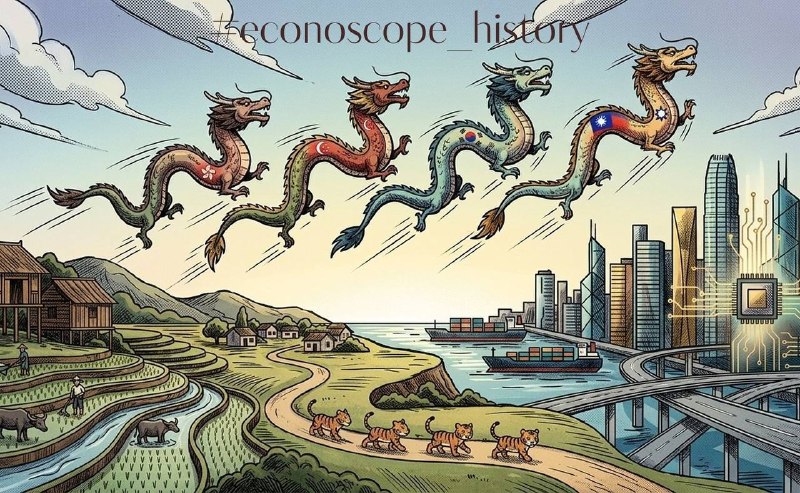
#econoscope_history

🐉 The Four Asian Dragons
The Four Asian Dragons refer to the high-growth economies of Hong Kong, Singapore, South Korea, and Taiwan. They have joined the ranks of the wealthiest economies worldwide due to their rapid industrialisation and export-oriented growth.

🏗️ 1960s
In the 1960s, they all had low average incomes, a large workforce, but few natural resources. Recognising the limitations of producing only for domestic markets, they shifted to export-oriented manufacturing. The Asian Dragons share common characteristics, such as a focus on exports, an educated population, and high savings rates.

🇭🇰 Hong Kong
Hong Kong succeeded through free-market policies, its large harbour, and its role as a gateway to China. Thanks to low taxes and open trade, it became a global financial centre, a base for light industry, and later a provider of high-value services.

🇸🇬 Singapore
Singapore transformed from a trading port into a modern, high-tech economy through careful government planning. Large foreign companies were attracted by significant public investments in infrastructure, education, and its port. The Central Provident Fund helped to finance local development through compulsory national savings.

🇰🇷 South Korea
The South Korean government directed cheap loans to chaebols (large family-run businesses). Guided by strong state-led industrial policies, South Korea initially focused on labour-intensive clothing and textiles, then shifted to shipbuilding, automobiles, and semiconductors. This strategy propelled it to become a global technology leader.

🇹🇼 Taiwan
Taiwan's success was driven by dynamic small and medium-sized energetic companies rather than giant companies. The government supported these firms by establishing technology parks and offering tax breaks. Initially, they focused on goods like plastics and textiles. Later, they moved into consumer electronics. The Taiwan Semiconductor Manufacturing Company (TSMC) played a key role in building the world's most advanced semiconductor fabrication plants.

🐅 Tiger Cub Economies
These are five developing Southeast Asian nations: Indonesia, Malaysia, the Philippines, Thailand, and Vietnam. The Tiger Cub economies developed steadily, but slower than the original Four Dragons.

📈 Outcomes
The Dragons became into wealthy economies. There was a significant increase in living standards, education, and life expectancy. Their export-led approach generated large trade surpluses, deeply integrating them into global production networks. They withstood the 1997 Asian financial crisis and the 2008 global financial crisis thanks to strong trade balances, flexible labour markets, and careful government spending management. Today, the Four Asian Dragons remain an example of successful economic development.

✍️ Written by Barkov Mark (1-IER)
  • ❤ 7
  • 👍 2
  • 🔥 2
Post #230 101
#econoscope_watch

Love, Greed, and the American Dream: A Review of the Documentary “Capitalism: A Love Story” (2009), directed by Michael Moore.

Michael Moore is an American filmmaker, author, and activist, best known for his provocative documentary style that blends investigative journalism with sharp political satire. “Capitalism: A Love Story” was released in the immediate aftermath of the 2008 financial crisis and serves as Moore’s most ambitious project — a full-frontal examination of the American economic system, who it serves, and who it leaves behind. The film grossed over $14 million worldwide and sparked widespread debate about wealth inequality and corporate power in the United States.

🧭 A System on Trial
Moore opens the film with a simple but devastating question: is capitalism, as practiced in the United States, actually a democracy — or an oligarchy dressed in democratic clothing? Travelling across America, he documents factory closures, home foreclosures, and families evicted onto their front lawns. The film is not subtle. But then again, neither was the crisis.

🔮 The Core Insights: What the Film Teaches Us About Capitalism

1️⃣ The Foreclosure Machine
Moore shows in visceral detail how millions of ordinary Americans lost their homes — not due to personal irresponsibility, but due to predatory lending practices engineered by financial institutions that knew exactly what they were selling. The system was not broken. For some, it was working precisely as intended.

2️⃣ Dead Peasant Insurance
One of the film’s most shocking revelations: major corporations, including Walmart and Bank of America, took out life insurance policies on their low-wage employees without their knowledge and collected the payouts upon their deaths. Workers were worth more dead than alive on a balance sheet.

3️⃣ The Revolving Door
Moore traces the seamless movement of key figures between Wall Street and the U.S. Treasury and Federal Reserve. The same people who built the financial instruments that caused the crisis were appointed to manage its aftermath. Deregulation was not an accident — it was lobbied for, methodically, over decades.

4️⃣ Socialism for the Rich
When the crisis hit, the U.S. government mobilized $700 billion in bailout funds for the very institutions responsible for the collapse — while ordinary homeowners received little to no relief. Moore frames this as the ultimate contradiction: the loudest advocates for free markets were the first to demand public money when their bets went wrong.

5️⃣ The Alternative Already Exists
Away from Wall Street, Moore finds worker-owned cooperatives, credit unions, and employee-run businesses that operate profitably and equitably. These models rarely make headlines, but they quietly demonstrate that there is no single inevitable form that capitalism must take.

Watching “Capitalism: A Love Story” is not a comfortable experience and that is entirely the point. Moore is a provocateur, and not every argument lands with equal force. But beneath the theatrics lies a serious and well-documented indictment of a system that privatizes gains and socializes losses. Nearly fifteen years later, the questions he raises have only grown more urgent.
  • ❤ 6
  • 👍 3
  • 🔥 3
Post #228 108

Forwarded from Oeconomicus Экономический клуб МГИМО

#oeconomicus_english by the @econoscopejrnl

The hero of today’s interview is Alexander Petrenko — the graduate of Moscow Aviation Institute and the Deputy General Director of the insurance company “PANDITRANS. Insurance solutions”. The company focuses on the transport logistics insurance.
We discussed when the company will not pay insurance, what were the most unusual cargoes, the longest and the shortest transit time for cargo that they have insured, the influence of sanctions on the company’s business and so on! Alexander highlighted the practical experience of the company, he recalled the most mind-blowing cases from frogs to surprising notes left by carriers. Alexander is sure that such things fuel interest in his work!

To immerse yourself into the insurance business read the full interview below! 👇

🗣️Interviewed by Vasilisa Shevchenko (1-IITSD)
  • ❤ 8
  • 👍 4
  • 🔥 2
Post #227 123
#econoscope_books

The Architecture of Human Thought: A Review of “Thinking, Fast and Slow” by
Daniel Kahneman

Daniel Kahneman is a psychologist and professor emeritus at Princeton University, winner of the 2002 Nobel Prize in Economics — remarkable, given that he is not an economist by training. In this landmark book, Kahneman synthesizes decades of research conducted alongside his late partner Amos Tversky to reveal the two systems that govern how we think, decide, and often deceive ourselves.

🧭A Map of the Mind Kahneman introduces a deceptively simple framework: our thinking is governed by two systems. System 1 operates automatically, quickly, and emotionally. System 2 is slow, deliberate, and rational — but also lazy. Most of what we believe to be careful reasoning is, in fact, System 1 in disguise.

🔮The Core Insights: How We Really Think

1️⃣The Two Systems: System 1 jumps to conclusions based on patterns, emotions, and associations. System 2 is capable of logic and analysis — but only when it bothers to engage. The uncomfortable truth: System 2 rarely takes over as often as we think it does.

2️⃣Anchoring Effect: When we are exposed to any number — even a random one — it silently shapes our subsequent estimates. Ask someone to spin a wheel that lands on 65, then ask them the percentage of African nations in the UN. Their answer will be higher than if the wheel had landed on 10. Numbers anchor us without our awareness.

3️⃣The Availability Heuristic: We judge the probability of events by how easily examples come to mind. Plane crashes feel more dangerous than car accidents not because the statistics say so, but because they dominate the news. Ease of recall distorts our perception of risk.

4️⃣Loss Aversion: Losses loom roughly twice as large as equivalent gains in our minds. This asymmetry explains why investors hold losing stocks too long, why negotiators make poor concessions, and why the fear of losing something we have far outweighs the joy of gaining something we don’t.

5️⃣The Planning Fallacy: Humans are constitutionally optimistic about the time, cost, and risk of future projects. We focus on our own plan and ignore the base rates of similar endeavors. The result: almost every large project — from personal renovations to government infrastructure — runs over budget and behind schedule.

6️⃣The Experiencing Self vs. The Remembering Self: We don’t evaluate our lives moment to moment. We evaluate them through memory — and memory is selective, dominated by peaks and endings. A vacation that ended poorly is remembered as worse than one that ended well, even if the overall experience was identical. We are not the sum of our moments; we are the story we tell about them.

Reading Thinking, Fast and Slow is less like finishing a book and more like being handed a mirror. It doesn’t just explain economic anomalies — it explains you. Kahneman has written what may be the most important popular science book of the 21st century: a rigorous, humbling, and ultimately liberating account of the minds we live inside.
  • ❤‍🔥 5
  • ❤ 3
  • 🔥 3
  • 👍 2
Post #226 102
#econoscope_history

The Japanese Economic Miracle (1955 – 1973)
This phenomenon describes the economic growth of Japan from the mid-1950s to the mid-1980s. As a result, this breakthrough transformed Japan from an industrial country which was devastated by the war to the second-largest economy after the USA.

🏗️Post-War Recovery (1945-1955)
After the capitulation, Japanese industry was totally destroyed. However, the US authorities implemented vital reforms: land redistribution, democratization of the economy, and labor reforms that initially encouraged and then regulated trade union activity. The Korean War (1950–1953) led to massive American military orders that poured into Japanese factories, providing them with work and capital.

🚀Main Phase (1955-1973)
This was the peak of the economic miracle. Annual GDP growth reached 10% on average. In nominal terms, Japan's GDP in US dollars increased nearly tenfold from 1960 to 1973, while real output tripled. Through MITI (Ministry of International Trade and Industry), the government aggressively directed resources into steel, shipbuilding, chemicals, and later into electronics and cars. Japan purchased Western licenses and improved their technologies (Sony transistors, Toyota cars). At that time a unique system called "keiretsu" emerged. These were large interlinked groups of producers, suppliers, and banks, like Mitsubishi, Mitsui, Sumitomo, Fuyo Group.

⚖️Stable Period (1973-1985)
The 1973 oil crisis caused energy prices to skyrocket. That was a serious hit for the economy, heavily dependent on oil imports. Japan focused on energy-efficient and high-tech industries, like robotics and microelectronics. The growth rate slowed to 4–5%, but the country maintained its global leadership. By the end of the 1980s, the value of land in Tokyo exceeded the value of all real estate in the United States.

📉Recession and Outcomes
In 1985, the Plaza Accord led to a sharp appreciation of the yen. To support exports, the Bank of Japan lowered interest rates to 2.5% (the lowest rate in Japanese history at the time), which inflated a massive asset bubble in the stock and real estate markets. In 1991, the bubble burst, which led to a period of deflation called "Lost Decades".
Nevertheless, Japan showed the world that strategic planning and national discipline can propel the economy to the very top.

✍️ Written by Barkov Mark (1-IER)
  • ❤‍🔥 6
  • ❤ 4
  • 👍 3
  • 🔥 1
Post #225 102
#econoscope_books

Akio Morita- “Sony: Made in Japan” (1986)

📚 Akio Morita’s “Sony: Made in Japan,” published in 1986, is much more than a book. It is a compelling statement on global competition, technological innovation, and the clash between Japanese and Western management philosophies, told by one of the most visionary industrialists of the 20th century.

💡The book emerged during Japan’s economic ascent, when Sony had already transformed from a tiny post-war repair shop into a global electronics icon. Morita uses his personal story to explain how creativity, risk-taking, and a consumer-first mindset can overcome resource poverty and cultural barriers.

🖥️At the heart of Morita’s message is the belief that innovation must serve human desire and convenience, not just technical possibility. He famously rejected market research for the Walkman — a product that had no precedent — because he trusted his own instinct about how people would want to listen to music privately.
For Morita, the engineer’s job is to imagine the unspoken need, while the manager’s job is to protect creativity from corporate bureaucracy:
→ hire people smarter than yourself
→ treat workers as family, not cogs
→ never compete on price alone — compete on value

Morita insisted that Sony should use its real name worldwide (unlike many Japanese firms that hid behind local distributors), fight frivolous patent lawsuits, and manufacture close to major markets to understand local tastes. He also criticised American short-term profit pressure and Japanese rigid lifetime employment, proposing a hybrid approach.


⚡️ “Sony: Made in Japan” remains an essential read for entrepreneurs, product managers, and anyone interested in how a company can build a global brand by staying curious, rebellious, and customer-obsessed. Morita’s voice is confident, witty, and full of practical wisdom — a fascinating counterpart to Henry Ford’s world of assembly lines and efficiency.

✍️ Written by Milena Apitsaryan (3-IER)
  • ❤ 9
  • 👍 4
  • 🔥 4
Post #224 99

Forwarded from Oeconomicus Экономический клуб МГИМО

#oeconomicus_english by the @econoscopejrnl

Today we’ve interviewed Vladimir Voroshilov - the CEO of the logistics company called “Bedford”. The company specialises in transportation of project industrial cargo and works on introducing airships (dirigibles) into logistics. Let’s get to know “Bedford”!

1. Could you please tell us about the geography of your transportation?


We work literally all over the world: with Africa, South America, North America, all of Asia, and even Australia. These are primarily countries with which we have economic relations, as trade is paramount, and we adapt to it by offering logistics services.

2. What services does your company provide, besides transportation?


Our company offers a variety of services. At one point, we analyzed a fleet for a potential purchase. The client was interested in the tanker market and we selected the best option and performed economic calculations. We also conducted an economic feasibility study to determine whether participation in a large Lukoil project in Iraq is profitable. We paid particular attention to the costs and risks associated with logistics. We made a similar case for companies that wanted to work with Syria.

3. What distinguishes your company in the market? Are there any special features or advantages?


I would like to emphasize that we don't limit ourselves to the technological aspect of our work. We are currently in full swing preparing to launch airships. To this end, we are actively engaged in research and negotiating with potential customers and investors to implement this project. 

4. Why did you decide to launch airships? How did this idea come about?


As a company that closely monitors various technologies used in transportation, we took notice of airships. They are very relevant for our country as they can take off from unprepared sites and deliver cargo to regions lacking transportation infrastructure. You know, roads definitely should be built, however, several conditions must be met. For example, the road's construction must be economically feasible and the traffic load must be guaranteed to be sufficient to justify the cost. Furthermore, climate conditions lead to limitations associated with permafrost. So an airship is an ideal means of transport as it does not require any roads and transport infrastructure to be built. “Bedford” is directly involved in the construction of airships. Our approach is about studying the technological aspects and the characteristics an airship must have. We were able to design it in collaboration with the Foundation for Advanced Research and with the assistance of its specialists. Our airship will perfectly match needs and demand in every way.

5. What modes of transport, other than airships, do you use and plan to continue to?

Any logistics company uses all modes of transport. These include helicopters, airplanes, trucks, rail, sea, and river transport. We utilize all modes of transport and have been delivering cargo in a multimodal manner for over 30 years. The client sets the task of delivering the cargo. As a result of our work, we determine the specific mode of transport required to meet all the client's requirements. We must consider all the conditions and a number of factors: the delivery time dictated by the client, the technical constraints imposed on the transportation process, the budget we must adhere to, technological limitations related to the weight and size of the cargo, and political risks, which are especially important to consider nowadays. 

6. Does your company have strategic business goals, and what are they, if it's not a secret?


Firstly, the goal is to make a profit. I believe the strategic goal is to ensure that when our employees come to work, they're sure they'll stay in the company for a long time. If this is taken into account, the company itself will only progress, and everything will be fine.
And this is crucial, because “Bedford” is committed to everything that's needed for our country and its successful development.

✍️Written by Vasilisa Shevchenko (1-IITSD)
  • ❤ 11
  • 👍 5
  • ❤‍🔥 4
Post #223 99
#econoscope_countries

The Odebrecht case: the biggest corruption case in South America

«Corruption is such a difficult thing to prove because it is done in whispers, surrounded by four walls with no witnesses.»

—Deltan Dallagnol, lead prosecutor for the Operation Car Wash investigation

We should start with Grupo Odebrecht's history. It started out as a small family construction group in the 1940s founded by Brazilians of German origin. It grew quickly and at its peak, around 2010, the company had 181,000 employees across 21 countries. Its focus is on building large projects, such as Caracas' metro, a port in Cuba and much of the infrastructure used by Brazil in the 2014 World Cup. Despite that such great history, in 2016 the Odebrecht confessed to offering numerous bribes to political leaders, political parties and public officials.

How did it happen?

Well, all construction companies were struggling for a contract with Petrobras. Moreover, they wanted to reach it with many benefits (get more money). To manage this complex web of illicit payments, Odebrecht created what was essentially a Department of Bribery, formally known as the Setor de Estruturações Estratégicas (Division of Strategic Investments). This was not a rogue operation but a systematic, shadow branch of the company with its own dedicated communications system, Drousys, designed to keep transactions invisible to auditors.

The scandal’s true gravity came to light in 2016 when the U.S. Department of Justice revealed that Odebrecht had paid approximately $788 million in bribes across 12 countries. The fallout was unprecedented:

In Brazil the "Lava Jato" (Operation Car Wash) investigation led to the imprisonment of top executives, including Marcelo Odebrecht, and sent shockwaves through the highest levels of the Planalto Palace. In Peru, the case implicated four former presidents, leading to a constitutional crisis. In Ecuador and Colombia, high-ranking ministers were ousted or jailed as the "whispers" Dallagnol spoke of turned into public testimony.

Also, beyond the legal penalties, the company was hit with a record-breaking leniency fine of $3.5 billion, leading to a massive restructuring and a rebranding of the firm to distance itself from its toxic past.

The Odebrecht case serves as a grim case study in institutionalized corruption. It demonstrated that when infrastructure projects are used as currency for political power, the ultimate price is paid by the taxpayers. Today, the case remains a watershed moment for compliance standards in global business, forcing a radical shift in how multinational corporations operate within emerging markets.

✍️ Written by Filkova Sofia - 1st year IR-IIEPD student
  • ❤ 10
  • 👍 5
  • 🔥 2
  • 💘 1
Post #222 93
#econoscope_markets


📈 Prospects of Anthropic IPO

Claude is a strong frontier AI model for coding, complex tasks, automating workflows and generating high-quality texts. Anthropic, the startup behind Claude, may consider an IPO (Initial Public Offering; based on Reuters report) in Q4 2026.
The following factors may influence the potential IPO.

What public investors might like about Anthropic:

1. The company does not longer sell only access to Claude. It monetizes through API usage, enterprise plans, distribution through AWS (Amazon Web Services), Google Cloud and Microsoft Azure, as well as vertical products for finance, education and government;
2. ✴️ Although Claude has been on the market for only 3 years, it has already been adopted by a large number of business customers. This fact strengthens company’s position on the market;
3. 🖥 Newly released “Mythos” suggests that Anthropic is capable of developing cutting-edge technology. Although the model is available only to a limited number of firms, talks and available information about its capacities greatly increased the company’s visibility in public disclosure even before the public release of Mythos. What is more, tightly controlled frontier models may increase enterprise trust, which allows for higher pricing, large contracts and strategic deployments.

However, Anthropic faces some problems:

1. 💻 Creating high-end gated LLMs like Mythos is great for valuation, but it does not help with short-term profits. Developing and maintaining such models takes a lot of resources, and Mythos probably won’t be monetized for some time because access remains restricted to a number of selected companies;
2. High run-rate revenue of Anthropic is a positive signal, but it is not the same as audited recurring revenue and may change, hence the success depends on Anthropic performance in the coming months;
3. ✴️ Anthropic may face additional competition for investor attention if OpenAI goes public at approximately the same time, which could affect pricing and post-list performance. Additionally, OpenAI has greater public visibility and probably more resources for PR and investor communications;
4. The company disclosures limited financial information at the moment. If it proceeds with an IPO, it would have to reveal more about revenue composition, costs, risk factors, governance, etc.
5. ✴️ Anthropic relies on a small number of partners for its critical infrastructure. Of course, Amazon, Google and Microsoft are credible enterprises, but dependence on few companies makes Anthropic vulnerable towards
changes in prices, policies or contracts and lowers its bargaining power.

💸 Overall, these are some of the factors that may affect the timing, valuation and market reception of an Anthropic future IPO. If the company does not rush going public (as it probably is currently), it could pursue one of the largest AI-related public offerings in the market.

Written by Mikhailov Dmitry (1-IER)
  • ❤ 8
  • 👍 4
  • 🔥 3
Post #221 107
#econoscope_countries

🇺🇸⚡️Crisis in the Middle
East and its Impact on the US Economy


🚨The recent conflict in the Middle East has affected not only Iran, Israel, and other countries in that region but also the whole world. The closure of the Strait of Hormuz, through which almost 20% of the global oil pass, caused oil prices to exceed US$100 per barrel and, as a result, led to a new energy crisis that had a great impact on the US economy.

⛽️The first good which price increased considerably was gasoline. Since the beginning of the conflict, its prices have exceeded US$4.00 (per gallon), compared to approximately US$2.98 (per gallon) just before the beginning of the hostilities.

📈Diesel prices have also risen by around US$1.70, impacting transport costs. As a result, prices of groceries and other goods increased dramatically: the consumer price index jumped 3.3%, reflecting higher costs of energy caused by disruptions in the Middle East.

🗽What’s more, some economists consider the further risk of stagflation in the United States significant in 2026. The combination of high inflation, especially due to rising energy prices, and slowing economic growth creates conditions that are similar to the 1970s, when the world economy faced a major crisis as well. The key risk factors are considered to be geopolitical tension and risky monetary policy.

🏜️To conclude, rising prices on oil, caused by the closure of the strait of Hormuz, have influenced the economy of the USA considerably. The US citizens have been forced to put up with the increasing prices of vital goods and gasoline. Right now, USA authorities have to deal with the growing pressure in society and stabilize the economy at the same time.

📝
Written by Ulyana Erofeeva 1-IIEPD
  • ❤ 7
  • 👍 5
  • 🔥 3
  • 💘 2
Older posts →

About this channel

How can I read @econoscopejrnl without a Telegram account?
TGViewer shows the public web preview Telegram publishes for The EconoScope Journal: recent posts, photos, videos and the subscriber count, with no app, login or account.
How many subscribers does The EconoScope Journal have?
The EconoScope Journal (@econoscopejrnl) has 185 subscribers on Telegram, refreshed roughly every 30 minutes.
Does The EconoScope Journal know I viewed it here?
No. Public channel previews carry no viewer identity, and TGViewer has no accounts or tracking of what you look up.
Threads Profile ViewerView any public Threads profile without an account.Open ThreadLook →Writing with AI? Make it sound human.Metric37 rewrites AI drafts so they read naturally. Free AI detector, 1,500 words free.Try Metric37 →