TGViewer
Channel Public Channel
Dhammapada - Buddha Dharma Teachings

Dhammapada - Buddha Dharma Teachings

@dhammapadas

Daily teachings of the Dhammapada, beloved and favorite teachings of the Buddha
Subscribers
1.47K
Photos
2.6K
Videos
0
Links
1.9K
Recent Posts 20 shown
Post #4466 16
As a water-drop on lotus plant,
as water does not stain a lotus flower,
even so the sage is never stained
by seen, heard, or whatever’s cognized.

Certainly the wise do not conceive
upon the seen, the heard, and cognized,
nor wish for purity through another,
for they are not attached nor yet displeased.

Partial excerpts from Snp 4.6 : Jara Sutta

Image: Red Lotus Lake (Talay Bua Daeng), Udon Thani, Thailand.
  • ❤ 1
  • 🍓 1
Post #4465 33

Forwarded from Words of the Buddha

Dhammapada Verses 54 and 55
Anandattherapanha Vatthu

Na pupphagandho pativatameti
na candanam tagara mallika va
satanca gandho pativatameti
sabba disa sappuriso pavayati.

Cadanam tagaram vapi
uppalam atha vassiki
etesam gandhajatanam
silagandho anuttaro.

Verse 54: The scent of flowers cannot go against the wind; nor the scent of sandalwood, nor of rhododendron (tagara), nor of jasmin (mallika); only the reputation of good people can go against the wind. The reputation of the virtuous ones (sappurisa) is wafted abroad in all directions.

Verse 55: There are the scents of sandalwood, rhododendron, lotus and jasmin (vassika); but the scent of virtue surpasses all scents.
  • 🕊 2
  • 🙏 1
  • 🍓 1
  • 🎄 1
Post #4464 42
19. Santakàyo santavàco
santavà susamàhito
Vantalokàmiso bhikkhu
upasanto' ti vuccati. 378.

HE IS PEACEFUL WHO IS FREE FROM ALL WORLDLY THINGS

19. The bhikkhu who is calm in body, calm in speech, calm in mind, who is well-composed, who has spewed out worldly things, is truly called a "peaceful one". 378.

Story

A monk was very calm and quiet and his composed demeanour attracted the attention of the other monks. The Buddha, hearing of his exemplary behaviour, advised the monks to emulate him and uttered this verse.
===
Ajahn Chah, Buddhist teacher of Thai forest meditation of Theravada Buddhism channel:


https://t.me/ajahnchah_buddhism
===
Telegram Ajahn Chah - Theravada Thailand Buddhism Collection of teachings of Venerable Ajahn Chah, a foremost meditation and Buddhist teacher from Thailand
  • 👍 1
  • 🙏 1
  • 👌 1
  • 💯 1
Post #4463 58
"How should we act, Lord, respecting the body of the Tathagata?"

"Do not hinder yourselves, Ananda, to honor the body of the Tathagata... At a crossroads also a stupa should be raised for the Tathagata. And whosoever shall bring to that place garlands or incense or sandalpaste, or pay reverence, and whose mind becomes calm there — it will be to his well being and happiness for a long time."

Partial excerpt from DN 16 : Maha-parinibbana Sutta
  • ⚡ 1
  • 🙏 1
  • 👌 1
  • 🏆 1
  • 😇 1
Post #4462 55

Forwarded from Words of the Buddha

Ulun Danu Tamblingan water temple, Lake Tamblingan, Bali, Indonesia during dry season. Ulun Danu = lakeshore, Tamblingan = heal the soul/ awareness. A place by the lakeside to heal the soul.
  • 🎄 2
  • 🍓 1
  • 👻 1
Post #4461 190
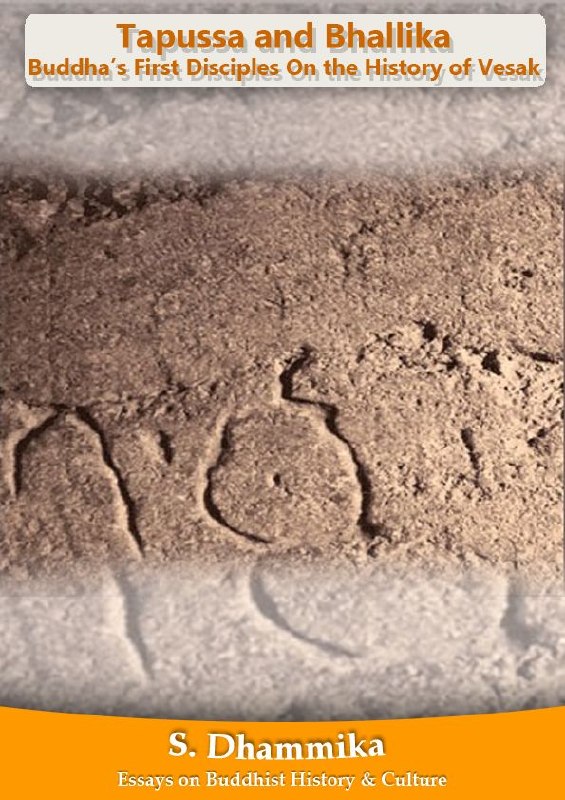
Free Buddha Dharma ebook

Tapussa and Bhallika the Buddha’s First Disciple

By Bhante Shravasti Dhammika

In the Mahavacchagotta Sutta of the Majjhima Nikaya the Buddha mentioned that he had many thousands of disciples, a good number of whom had attained one or another of the stages leading to enlightenment. However, the Buddha’s first disciples were the merchants Tapussa and Bhallika. During the Buddha’s fourth week at Uruvela, now called Bodh Gaya, these two men happened to be passing the outskirts of the village and saw him quietly meditating there. Impressed his serene looks and the aura of peace around him they approached him with an offering of barley gruel and honey balls. When the Buddha had finished eating the merchants asked if they could take refuge in him, i.e. become his disciples, and his Dhamma.

Free download available:

https://budblooms.org/tapussa-and-bhallika-the-buddhas-first-disciple/
===
  • 👏 1
  • 💯 1
  • 🏆 1
Post #4459 45
18. Vassikà viya pupphàni
maddavàni pamuñcati
Evam ràgañ ca dosañ ca
vippamuñcetha bhikkhavo. 377.

CAST OFF LUST AND HATRED

18. As the jasmine creeper sheds its withered flowers, even so, O bhikkhus, should you totally cast off lust and hatred. 377.

Story

Some monks, observing the falling of some withered jasmine flowers, were stimulated to practise meditation more strenuously. The Buddha, perceiving them, projected an image of Himself before them and uttered this verse.
===
Dhammapada, beloved and favorite teachings of the Buddha channel:

https://invite.viber.com/?g2=AQBLD6phsgvP%2F061YjEM3K%2BNeH1Yb372b9mtfQX2EmuBpgoLUoc99BDMfzHghrme
===
Viber Dhammapada - Buddha Dharma Teachings Daily teachings of the Dhammapada, beloved and favorite teachings of the Buddha
  • 🙏 2
  • 👌 1
  • 💯 1
Post #4458 59

Forwarded from Words of the Buddha

So I have heard. At Sāvatthī.

“Mendicants, form, feeling, perception, choices, and consciousness are impermanent.

Seeing this, a learned noble disciple grows disillusioned with form, feeling, perception, choices, and consciousness. Being disillusioned, desire fades away. When desire fades away they’re freed. When they’re freed, they know they’re freed.

They understand: ‘Rebirth is ended, the spiritual journey has been completed, what had to be done has been done, there is nothing further for this place.’”

SN 22.12 : Aniccasutta
  • 👏 2
  • 🔥 1
  • 🙏 1
  • 👌 1
  • 🕊 1
Post #4457 46

Forwarded from Buddha Dharma books

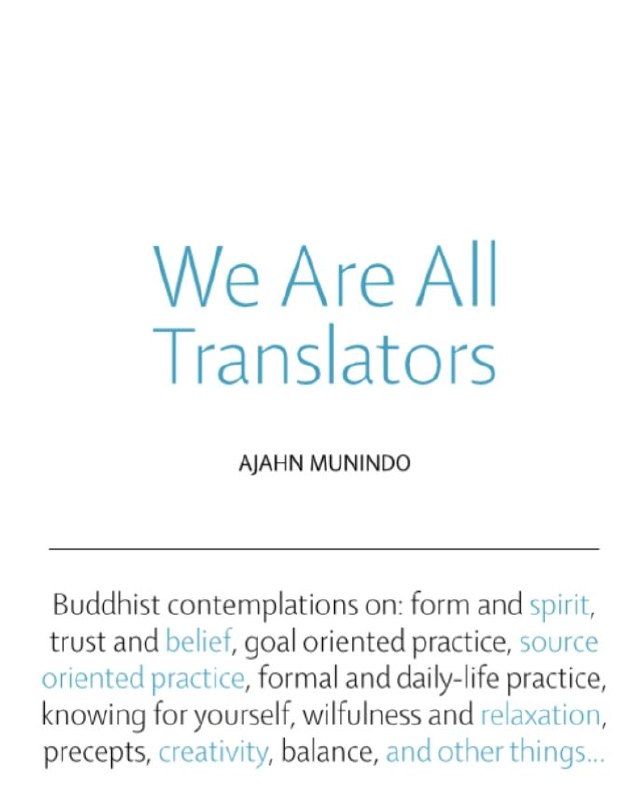
Free Buddhism ebook


We Are All Translators
By Ajahn Munindo

Buddhist contemplations on: form and spirit, trust and belief, goal oriented practice, source oriented practice, formal and daily-life practice, knowing for yourself, wilfulness and relaxation, precepts, creativity, and other things…


Free download here:

https://cdn.amaravati.org/wp-content/uploads/2021/08/14/we-are-all-translators-2021-08-11.pdf
===
  • ✍ 1
  • 👏 1
  • 💯 1
Post #4456 43

Forwarded from Buddha Dharma books

Free Buddhism ebook


We Are All Translators
By Ajahn Munindo

Buddhist contemplations on: form and spirit, trust and belief, goal oriented practice, source oriented practice, formal and daily-life practice, knowing for yourself, wilfulness and relaxation, precepts, creativity, and other things…


Free download here:

https://cdn.amaravati.org/wp-content/uploads/2021/08/14/we-are-all-translators-2021-08-11.pdf
===
  • 👏 1
  • 🕊 1
  • 🫡 1
Post #4455 61
Ghanasārappadittena
Dīpena tama-dhaṃsinā
Tiloka-dīpaṃ sambuddhaṃ
Pūjayāmi tamo-nudaṃ

Ghandha-sambhāra-yuttena
Dhūpenāhaṃ sugandhinā
Pūjaye pūjaneyyaṃ taṃ
Pūjābhajanamuttamaṃ

Pujemi Buddham kusumenanena
Puññenametena ca hotu mokkham
Puppham milāyāti yathā idam me
Kāyo tathā yāti vināsa-bhavam

With lights brightly shining
Abolishing this gloom
I adore the Enlightened One,
The Light of the three worlds.

With perfumed incense
And fragrant smoke
I worship the Exalted One,
Who is great and worthy of worship.

I worship the Buddha with these flowers;
May this virtue be helpful for my emancipation;
Just as these flowers fade,
Our body will undergo decay.
  • 🙏 2
  • 👏 1
  • 👌 1
Post #4453 75
9. Mettàvihàrã yo bhikkhu
pasanno Buddhasàsane
Adhigacche padam santam
saïkhàrupasamam sukham. 368.
10. Siñca bhikkhu imam nàvam
sittà te lahum essati
Chetvà ràgam ca dosañ ca
tato nibbànam ehisi. 369.
11. Pañca chinde pañca jahe
pañca c'uttari bhàvaye
Pañca saïgàtigo bhikkhu
oghatiuuo' ti vuccati. 370.
12. Jhàya bhikkhu mà ca pàmado
mà te kàmaguue bhamassu cittam
Mà lohaguëam gilã pamatto
mà kandi dukkham idan'ti dayhamàno. 371.
13. Natthi jhànam apaññassa
paññà natthi ajhàyato
Yamhi jhànañ ca paññà ca
sa ve nibbànasantike. 372.
14. Suññàgàram paviññhassa
santacittassa bhikkhuno
Amànusã rati hoti
sammà dhammam vipassato. 373.
15. Yato yato sammasati
khandhànam udayabbayam
Labhati pãti pàmojjam
amatam tam vijànatam. 374.
16. Tatràyam àdi bhavati
idha paññassa bhikkhuno:
Indriyagutti santuññhã
pàtimokkhe ca samvaro. 375.
17. Mitte bhajassu kalyàue
suddh' ájãve atandite
Pañisanthàravuty' assa
àcàrakusalo siyà
Tato pàmojjabahulo
dukkhass' antam karissasi. 376.

THE BHIKKHU WHO RADIATES LOVING-KINDNESS RADIATES PEACE

9. The bhikkhu who abides in loving-kindness, 6 who is pleased with the Buddha's Teaching, attains to that state of peace and happiness, 7 the stilling of conditioned things. 368.

GIVE UP LUST AND HATRED

10. Empty this boat, 8 O bhikkhu! Emptied by you it will move swiftly. Cutting off lust and hatred, to Nibbàna you will thereby go. 369.

FLOOD-CROSSER IS ONE WHO HAS GIVEN UP THE FETTERS

11. Five cut off, 9 five give up, 10 five further cultivate. 11 The bhikkhu who has gone beyond the five bonds 12 is called a "Flood-Crosser". 370.

MEDITATE EARNESTLY

12. Meditate, O bhikkhu! Be not heedless. Do not let your mind whirl on sensual pleasures. Do not be careless and swallow a ball of lead. As you burn cry not "This is sorrow". 371.

THERE IS NO WISDOM IN THOSE WHO DO NOT THINK

13. There is no concentration in one who lacks wisdom, nor is there wisdom in him who lacks concentration. In whom are both concentration and wisdom, he, indeed, is in the presence of Nibbàna. 372.

HE WHO IS CALM EXPERIENCES TRANSCENDENTAL JOY

14. The bhikkhu who has retired to a lonely abode, who has calmed his mind, who perceives the doctrine clearly, experiences a joy transcending that of men. 13 373.

HE IS HAPPY WHO REFLECTS ON RISE AND FALL

15. Whenever he reflects on the rise and fall of the Aggregates, he experiences joy and happiness. To "those who know" that (reflection 14) is Deathless. 374.

A WISE BHIKKHU MUST POSSESS HIS CARDINAL VIRTUES

16. And this becomes the beginning here for a wise bhikkhu: sense-control, contentment, restraint with regard to the Fundamental Code (Pàtimokkha 15), association with beneficent and energetic friends whose livelihood is pure. 375.

A BHIKKHU SHOULD BE CORDIAL IN ALL HIS WAYS

17. Let him be cordial in his ways and refined in conduct; filled thereby with joy, he will make an end of ill. 376.

Story

A monk, seated in a specially constructed pavilion was preaching the Dhamma one night to his mother and many others. Some robbers entered her house meanwhile. Their ring-leader shadowed the woman, intending to kill her if she should return home before they had done their fell work. Thrice a servant-maid came and informed her about the robbers, but she sent her away asking her not to disturb her while listening to the Dhamma. The ring-leader was impressed by her devotion. He went up to the robbers and ordered them to restore all the stolen property. Then they all came and asked forgiveness from the devout woman and all became monks. When they were engaged in meditation the Buddha projected an image of Himself before them and in admonition uttered these verses.
===
Words of the Buddha channel:

https://invite.viber.com/?g2=AQAFqzqlj7FmI061PX17rxWMAtZ%2BRuso%2FH2KmHKZSgnv7v9DD8X0bDkKnZDr9JDq
===
Viber Words Of The Buddha Daily teachings from Buddha Dharma
  • 🥰 1
  • 🙏 1
  • 😇 1
Post #4452 57

Forwarded from Words of the Buddha

These thoughts are often some expressions of “I am,” which in Pali is called mana, referring to the mind comparing oneself with others in one way or another or imagining oneself over time. Of note, mana is not uprooted from the mindstream until full enlightenment, so we do want to be mindful of it.

As mindfulness strengthens, we also become more aware of mental hindrances—desire, aversion, sloth and torpor, restlessness, and doubt. They are called hindrances because they obstruct the mind from developing wise discernment and concentration. Being mindful of these hindrances becomes a skillful and effective way of not being overcome by them.

Concentration

Along with mindfulness, concentration plays a critical role in stabilizing our understanding and realization of selfless nonduality. When concentration develops, it keeps the hindrances at bay, enabling us to see more clearly and explore more profoundly various aspects of the dharma.

The Buddha highlighted the necessity of developing concentration in one verse in the Dhammapada: “There can be no concentration in one who lacks wisdom. There can be no wisdom in one who lacks concentration. He who has concentration as well as wisdom is, indeed, close to nibbana.”

In a striking passage from the Pali canon, the Buddha tells Kassapa, one of his great disciples, about what leads to the longevity of the dharma: dwelling with reverence toward the Buddha, the dharma, the sangha, toward the training, and toward concentration—and how the absence of these five things leads to its decay. When I first came across this passage, I was surprised that of all the different mental qualities the Buddha might have mentioned with regard to a matter of such great import—the longevity of the teachings—he singled out concentration as being a key essential element for stabilizing awareness.
===
Joseph Goldstein is cofounder and a guiding teacher of the Insight Meditation Society in Barre, Massachusetts, and its Forest Refuge program, and helped establish the Barre Center for Buddhist Studies. His books include A Heart Full of Peace, One Dharma: The Emerging Western Buddhism, and Mindfulness: A Practical Guide to Awakening.
===
Part 1 of 3:

https://t.me/lorddivinebuddha/4964


Part 2 of 3:

https://t.me/dhammapadas/4446


Part 3 of 3:

https://t.me/wordsofbuddha/6209
===
Words of the Buddha channel:

https://t.me/wordsofbuddha
===
Telegram Words of the Buddha Daily teachings of Buddha Dharma
  • ⚡ 1
  • 😁 1
  • 🫡 1
Post #4451 53

Forwarded from Words of the Buddha

Liberation Through Non-Clinging Across Buddhist Traditions

How approaches from different Buddhist traditions can complement and support each other on the path to awakening
By Joseph Goldstein

Part 3 of 3

Mindfulness

The question then becomes: How to proceed? How do we practice stabilizing our glimpses of selfless awareness? We begin by strengthening the quality of mindfulness. Unless we have trained ourselves to observe our minds and what happens within them, we may not realize just how prevalent the continuous streams of thought are throughout the day. The effect of these unnoticed thoughts on the mind can be compared to a movie soundtrack. Often, we are hardly aware of it, being totally engrossed in the storyline. Yet the soundtrack is designed to manipulate our feelings in various ways—happy, tense, frightened, amused—all conditioned by a process we hardly notice.

Through practice, particularly in sessions of formal meditation, we may become somewhat adept at recognizing dramatic thoughts, those with a particular emotional charge. But much more frequently there are light thoughts that are brief and hardly leave a trace. While doing walking meditation on one recent retreat, I began to pay particular attention to these light and quickly passing thoughts. I was surprised to realize how often they arose and how many of them referenced a sense of self: a memory, a plan, a comment, or a judgment. It became clear that each time I was lost in one of these ephemeral thoughts, I was reinforcing a felt sense of self.

Dudjom Rinpoche, one of the most highly revered Dzogchen masters of the 20th century, wrote in A Heart-Jewel for the Fortunate:

When you are meditating, it is easy to identify your coarse thoughts when they arise suddenly. But until a few of your subtle thoughts have arisen and are recognized, you do not know that they are there. These are called “undercurrents of thought.” They are the sneaky thieves of meditation, and for that reason it is very important to post the guard of mindfulness.

All traditions teach the importance of cultivating and strengthening mindfulness. The Pali canon underscores the critical role of mindfulness in the well-known opening of the Satipatthana Sutta:

Bhikkhus, this is the direct path for the purification of beings, for the surmounting of sorrow and lamentation, for the disappearance of pain and grief, for the attainment of the true way, for the realization of nibbana—namely, the four foundations of mindfulness.

Dilgo Khyentse Rinpoche likewise highlights the importance of cultivating mindfulness in his commentary on The Lamp that Dispels Darkness:

Let the mind remain in a relaxed and open state. . . . Just as a young child cannot be left on its own but needs the constant attention of his parents so he won’t get lost, mindfulness is necessary so that the mind does not get lost in distraction. Mindfulness is not something that is acquired right away; perseverance is needed. It is necessary to be mindful not only while resting in the state of meditative evenness, but that mindfulness needs to be kept in any circumstances. While eating, while walking, etc., it is important to be constantly alert and vigilant in watching the condition of the mind.

Rinpoche continues:

So do not be satisfied by a mere glimpse of awareness but allow it to become unchangingly present. This is achieved through mindfulness and vigilance. At the beginning, vigilance means to pay constant attention to one’s state of mind, examining whether the mind is distracted or not from the recognition of awareness. This is a somewhat fabricated or contrived mindfulness. Mindfulness will develop gradually. . . . When the point is reached where a thought of desire or aversion arises, awareness is there at the same time, without having to purposefully arouse it. That is uncontrived, absolute mindfulness. At this stage, all thoughts will be liberated as they arise.
Telegram Words of the Buddha Daily teachings of Buddha Dharma
  • 👏 1
  • 💯 1
  • 🍾 1
Post #4450 52

Forwarded from Buddha

The Path of Insight Meditation by Joseph Goldstein
  • 👍 1
  • 👏 1
  • 🏆 1
Post #4449 70

Forwarded from Words of the Buddha

Aloka, the peace dog, is a stray dog which followed the monks during dhutanga in India in 2022. The monks then adopted the dog and brought him back to the United States. He has a distinctive heart‑shaped marking on his forehead. Aloka follows the monks on 108-day, 2,300-mile Walk for Peace Dhutanga journey starting from Fort Worth, Texas, passing through Louisiana, Mississippi, Alabama, Georgia, South Carolina, North Carolina, and Virginia.
  • ❤ 2
  • 👍 1
  • 🥰 1
  • 🤗 1
  • 😘 1
Post #4448 70

Forwarded from Buddha

A Heart Full of Peace by Joseph Goldstein
  • 🥰 1
  • 🍓 1
Post #4447 201
An interesting reflection here is what term we would use for two distinct but inseparable things. Are they two or are they one? For example, when we see something, we perceive both color and shape; the color has shape, and the shape has color. Two distinct attributes that cannot be separated in our perception, even as we might emphasize one aspect or the other.

It might be helpful to consider “dual” and “nondual” not as metaphysical statements describing some ultimate nature but as different ways of perceiving that serve a particular end—as complementary ways of understanding that each has its own value and efficacy. Both duality and nonduality are simply modes of viewing experience, and the measure of which is appropriate at any given time is whether the outcomes are beneficial or detrimental. To this end, there is an apt phrase often used in Madhyamaka and Zen teachings that emerged from the “thunderous silence” of Vimalakirti in the sutra of the same name: “Not one, not two.”

Stabilizing the Experience of Nonduality

I recently received an email from someone who asked an extremely important question. He wrote, “I consider myself quite fortunate to experience nondual awareness, but I’ve been hung up on the endeavor of what to do now.” This raises a question that many teachers have addressed over the centuries: how to stabilize this realization so that it informs the way we live and the choices we make. It is one thing to have experiences that provide a different perspective from our usual way of perceiving the world, and another to have those experiences transform our lives in a meaningful way. Many of us are familiar with having deep insights only to easily fall back into habitual modes of perception and understanding.
===
Part 1 of 3:

https://t.me/lorddivinebuddha/4964


Part 2 of 3:

https://t.me/dhammapadas/4446


Part 3 of 3:

https://t.me/wordsofbuddha/6209
===
Dhammapada, beloved and favorite teachings of the Buddha channel:

https://t.me/dhammapadas
===
Telegram Words of the Buddha Liberation Through Non-Clinging Across Buddhist Traditions How approaches from different Buddhist traditions can complement and support each other on the path to awakening By Joseph Goldstein Part 3 of 3 Mindfulness The question then becomes: How to proceed?…
  • ✍ 1
  • 👏 1
  • 🕊 1
Older posts →

About this channel

How can I read @dhammapadas without a Telegram account?
TGViewer shows the public web preview Telegram publishes for Dhammapada - Buddha Dharma Teachings: recent posts, photos, videos and the subscriber count, with no app, login or account.
How many subscribers does Dhammapada - Buddha Dharma Teachings have?
Dhammapada - Buddha Dharma Teachings (@dhammapadas) has 1.47K subscribers on Telegram, refreshed roughly every 30 minutes.
Does Dhammapada - Buddha Dharma Teachings know I viewed it here?
No. Public channel previews carry no viewer identity, and TGViewer has no accounts or tracking of what you look up.
Threads Profile ViewerView any public Threads profile without an account.Open ThreadLook →Writing with AI? Make it sound human.Metric37 rewrites AI drafts so they read naturally. Free AI detector, 1,500 words free.Try Metric37 →