TGViewer
Channel Public Channel
Data eXplore : Data Science, ML, Big Data, LLMs and AI Security

Data eXplore : Data Science, ML, Big Data, LLMs and AI Security

@dataxplore

Exploring Data Science, Big Data Analytics & Visualization, ML/DL, Neural Networks, LLMs with GitHub, Kaggle, HuggingFace and some white papers by big institutions.

Not just data, but science behind data

Paid project? premodi@zohomail.in
★ @DataML
Subscribers
578
Photos
843
Videos
446
Links
675

Showing posts older than #2124 · Back to latest

Older Posts 20 shown
Post #2123 251
This AI proxy reduces LLM costs by 50% 🤯

Plano acts as a "smart data plane", which automatically routes your requests to the appropriate model depending on the complexity of the task.

It operates on the basis of Arch-Router-1.5B, providing production-level routing, deployed on a large scale on Hugging Face.

- Smart routing of LLMs based on the complexity of the task
- Seamless orchestration of multi-agent scenarios
- Integrated guardrails and observability


100% open-source on GitHub

••••••••••••••••••••••••••••••••••••••
🤖 Data & ML | @DataXplore
Post #2122 374
A Python decorator is all you need to trace LLM applications (open-source).

Most LLM evaluations treat the application as an end-to-end black box.

However, LLM applications require evaluations and tracing at the component level, because the problem could be anywhere inside: in the retriever, tool call, or the LLM itself.

In DeepEval, this can be done in just 3 lines of code:

- Trace individual LLM components (tools, retrievers, generators) using the @observe decorator.
- Attach different metrics to each part.
- Get a visual breakdown of what works and what doesn't.

That's it.

No need to refactor existing code.

See the example below for an RAG application.

DeepEval is completely open-source (14k+ stars), and it's easy to deploy independently so that your data stays with you.

GitHub

••••••••••••••••••••••••••••••••••••••
🤖 Data & ML | @DataXplore
Post #2121 228
Google DeepMind created AI that writes AI algorithms better than human scientists and it completely evolves them on its own.

In a recently published article, they introduced AlphaEvolve. This system doesn't just tune basic hyperparameters — it gives LLMs access to the actual source code of complex multi-agent learning systems.

They view Python code as a genome and allow AI to mutate it.

The results are impressive: AI has invented completely new, non-intuitive mathematical mechanisms that human researchers hadn't even considered.

Here's Why this changes everything?

- Semantic code evolution: classic genetic programming simply applied random mutations to the code until something compiled. Here, the LLM agent reads the existing algorithm, understands its logic, and makes meaningful changes to the Python code.

- Non-human intuition: the agent discovered new algorithms (such as VAD-CFR and SHOR-PSRO) that use strange, non-intuitive mathematical mechanisms that humans completely overlooked.

- State-of-the-art results: the algorithms written by the AI don't just work — they empirically outperform the best solutions developed by humans in complex game theory tasks.

We're literally observing the recursive self-improvement of AI in real time.

Previously, human intuition was the bottleneck in the search for algorithmic breakthroughs. Now, it's enough to direct the LLM to the codebase, set a goal, and let it autonomously evolve the mathematics.


Article

••••••••••••••••••••••••••••••••••••••
🤖 Data & ML | @DataXplore
Post #2119 214
Microsoft introduced 3 models of the MAI family.

MAI-Transcribe-1 for speech recognition, MAI-Voice-1 for voice synthesis, and MAI-Image-2 for generating images from textual descriptions.

All of them are positioned as a solution for those who need production-level solutions with competitive inference costs.

➡️ Which three models?
MAI-Transcribe-1

A speech-to-text model with high-speed transcription for 25 languages, including Russian. On the FLEURS benchmark, it shows the best Word Error Rate among competitors: the average value is 3.86%.

The model outperforms Whisper in all 25 languages, and Gemini 3.1 Flash - in 22 out of 25. Supports WAV, MP3, and FLAC formats.

Real-time transcription, diary, and context biasing are not yet available - these features are planned for the future.

Cost: $0.36 per hour of audio.

MAI-Voice-1

A TTS model that generates realistic speech with emotional coloring, natural intonation, and the ability to clone a voice based on a reference.

Access to cloning requires Microsoft's approval and the upload of a recorded consent from the voice owner.

The declared generation speed is 1 minute of audio per second. The model supports emotional management at the level of individual phrases via SSML and is designed for long-form content: audiobooks, podcasts, lectures.

It currently only works with English, but support for more than 10 languages is planned in the future. Available in 3 Azure regions: Central US, Japan West, and Sweden Central.

Cost: $22 per 1 million characters.

MAI-Image-2

A diffusion model for generating images based on a textual prompt, which Microsoft tested in beta testing from March 20th.

The model contains from 10 to 50 billion parameters (excluding embeddings), accepts a context of up to 32K tokens, and generates images with a maximum resolution of 1024×1024 pixels.

According to internal estimates via the Elo rating, MAI-Image-2 scores 1190 ± 8 points compared to 1093 ± 4 for its predecessor MAI-Image-1, particularly strong in photo-realistic and portrait categories (1201 points). On the ArenaAI leaderboard, the model entered the top 3.

Cost: $5 per 1 million text input tokens, $33 per 1 million output tokens (images).

All models are available through Microsoft Foundry. To try them in an interactive environment MAI Playground, you can currently only do so from the USA.


••••••••••••••••••••••••••••••••••••••
🤖 Data & ML |
@DataXplore
Post #2118 210
Why most "agentic AI" systems look impressive in demos but then completely fail in real-world use?

It's called "Adaptation of Agentic AI" and it's most important work I've read this year.

Right now, everyone is obsessed with idea of creating autonomous agents. We give them tools, memory and a goal and expect them to do our work, but when deployed in real world, they start hallucinating tool calls.

Fail at long-term planning and break down.
➡️ The WHY?

We're trying to cram all the learning into the "brain" of the model.

When developers try to fix a broken agent, they usually just retrain the main model to make it better at outputting final answers.

Researchers have discovered a critical flaw in this approach.

If you only reward AI for the correct final answer, it starts to "lazy".

It literally learns to stop using tools. It tries to guess the answer instead of doing the calculations. It ignores the calculator and tries to calculate "in its head".

To fix this, the researchers proposed a new 4-part framework describing how agents should actually learn.

And the main conclusion completely overturns the current approach.

Instead of constantly retraining the large and expensive "brain" of the agent, the most reliable systems do the opposite.

They fix the model. And adapt the tools.

This approach is called Agent-Supervised Tool Adaptation.

Instead of forcing LLMs to memorize new workflows, the LLM itself is used to dynamically build more efficient memory systems, update its own search strategies, and generate custom sub-tools on the fly.

The base model remains unchanged. It's its execution environment that becomes smarter.

For the past two years, we've treated AI as a brilliant employee who needs to learn all the company's internal rules.

But the most effective employees don't memorize everything.

They simply build a more efficient system for storing and accessing information.


Paper by Stanford & Harvard

••••••••••••••••••••••••••••••••••••••
🤖 Data & ML |
@DataXplore
Post #2117 214
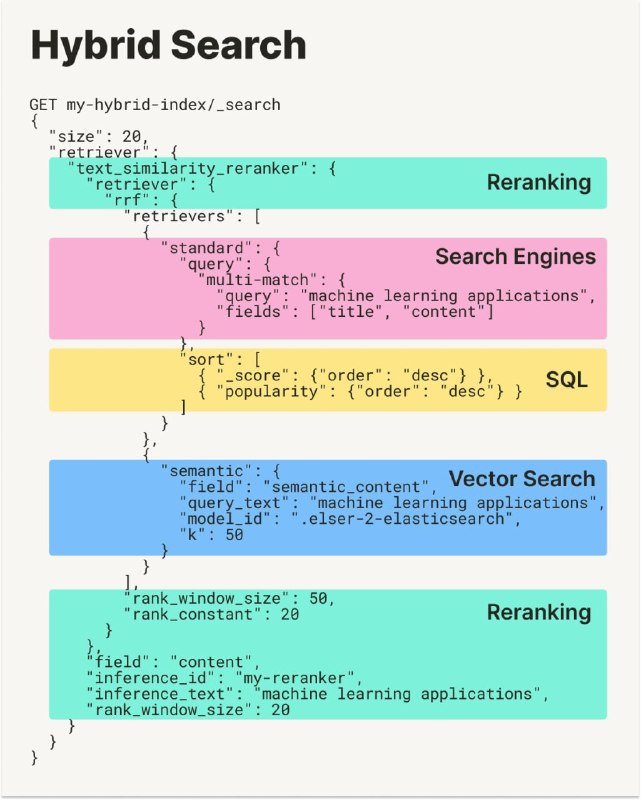
Hybrid search = the accuracy of lexical search + the "intuition" of semantic search.

With ES|QL and multi-stage retrievers, you can combine in a single query:
• lexical search,
• semantic search,
• filters, and
• reranking.

••••••••••••••••••••••••••••••••••••••
🤖 Data & ML | @DataXplore
Post #2116 239
Holo3 is an SOTA-agent model for managing desktop applications.

Parisian startup H Company released a family of multimodal Holo3 models designed for managing graphical interfaces.

➡️ Why Holo3 is interesting?
➜ Both models of the family on the Mixture-of-Experts architecture

The senior Holo3-122B-A10B is only available on the platform of H Company at a price of 40 cents per million incoming and $3 per million outgoing tokens.

The younger version Holo3-35B-A3B is available on Hugging Face under the Apache 2.0 license and is also available free of charge via the Inference API with a limit of 10 PRMs. In the paid mode - $0.25/1.8 per million incoming/outgoing tokens.

➜ Holo3 was trained in a closed loop of 3 stages

First, synthetic navigation examples are generated for interfaces according to specified scenarios.

Then the data is expanded beyond the initial conditions so that the model takes into account non-standard situations.

In the final stage, all examples undergo curated selection and reinforcement learning.

For training, H Company built a generator of synthetic corporate environments, in which agents create web applications according to scenario specifications, forming verifiable tasks of varying complexity.

Based on these environments, H Corporate Benchmarks was developed - a set of 486 multi-step tasks in 4 categories: e-commerce, business software, collaboration tools, and inter-application scenarios.

The latter require coordination between several systems at once (for example, extracting prices from a PDF, comparing them with employees' budgets, and automatically sending personalized letters with approval or rejection).

➜ Tests

The flagship Holo3-122B-A10B scored 78.85% on the OSWorld-Verified benchmark - this is the best result on the leading desktop interaction test.


Holistic AI founded by Charles Cantor (Ex Stanford researcher) and Laurent Cifre (Ex Google DeepMind, contributor AlphaGo project) closed seed round of $220 million in 2024 - one of largest in Europe. investors were Eric Schmidt, Yuri Milner, Bernard Arnault, Xavier Niel, as well as Amazon, Samsung, UiPath.

Apache 2.0 Licensing: Article, Model | #AI #ML #MMLM #Holo3 #HCompany

••••••••••••••••••••••••••••••••••••••
🤖 Data & ML | @DataXplore
Post #2115 221
found a version of tSNE for GPUs.

It works 33 times faster by changing just one line of code.

Within the GPU environment:

- Delete this line → from sklearn.manifold import TSNE
- Add this line → from tsnecuda import TSNE

Now, tSNE will run on the GPU for faster processing.

••••••••••••••••••••••••••••••••••••••
🤖 Data & ML | @DataXplore
Post #2114 227
NVIDIA proved,
Backpropagation is not only way to create AI.

They trained models with billions of parameters without using a single gradient.

Every AI you use today relies on backpropagation.

This requires complex calculations, enormous memory costs, and huge GPU clusters.

Meanwhile, an ancient method without gradients, called evolutionary strategies (ES), was considered impossible to scale.

But now everything has changed.

NVIDIA and Oxford have just introduced EGGROLL.

Instead of generating huge full-rank matrices for each mutation, they split them into two small ones.

The AI mutates. It tests. It preserves what works. Just like biological evolution.

But now it does this with hundreds of thousands of parallel mutations at once.

The performance is now the same as that of batch inference.

They pre-train models from scratch, using only simple integers.

No backpropagation. No decimals. No gradients.

We thought the future of AI required endless clusters of precision equipment.

It turned out we just needed to evolve.


Paper

••••••••••••••••••••••••••••••••••••••
🤖 Data & ML | @DataXplore
Post #2113 377
Vector Index vs Vector Database

••••••••••••••••••••••••••••••••••••••
🤖 Data & ML | @DataXplore
Post #2112 198
One of the most powerful open-source models for computer vision SAM 3.1 released

Model understands what is happening in an image or video and is able to find objects based on a text description. You can literally write "a person in a red T-shirt" and it will find necessary people.

➡️ How it works?
It works not only with pictures, but also with videos. The object can be specified once, and then the model will track it between frames.

The key idea - open-vocabulary. The model is not limited to fixed classes, like old systems. It operates with a huge number of concepts and can find almost any object.

Another important point is that you can combine control methods: text, clicks, frames, masks. This gives much more control and accuracy.

Under the hood a new architecture, where the tasks of object search and tracking are solved separately. Due to this, the model better distinguishes similar things and works more stably on video.

The repository already has everything for getting started: ready weights, code, examples, and notebooks.

In fact, this is no longer just a tool for labeling, but a full-fledged vision engine that can be integrated into real products from video analytics to data labeling automation.

Now the model can track up to 16 objects in one pass.

With multiplexing, all objects are processed simultaneously:

• fewer unnecessary calculations
• no memory bottlenecks


RESULT: video processing speed increases by approx 2 times, from 16 to 32 FPS on a single NVIDIA H100!

On new SA-CO benchmark, which includes 270 thousand unique concepts, SAM 3 achieves 75–80% of human level.

GitHub | #AI #ML #LLM #CV #python

••••••••••••••••••••••••••••••••••••••
🤖 Data & ML | @DataXplore
Post #2111 195
Building a Vectorless RAG System

(Without Embeddings & a Vector Database)

The construction of a Vectorless, Reasoning-Based RAG system using hierarchical page indexing.

➡️ What's inside?
The document is transformed into a tree, and the LLM traverses this tree to find an answer. Without embeddings. Without searching for similarity.

This is very similar to how we search for information in real life. When we need to find something in a textbook, we don't read all the pages in a row. First, we open the table of contents, find the needed chapter, then browse the sections and go directly to the required one.

PageIndex works similarly. You pass it a document, and it builds a tree where each branch is a section, and each leaf is the text itself. When you ask a question, the LLM traverses the tree level by level to find the correct answer.


Full code: GitHub

••••••••••••••••••••••••••••••••••••••
🤖 Data & ML | @DataXplore
Post #2110 338
Naive RAG vs Agentic RAG - an explanation at a glance

➡️ What are the well-known problems of naive RAG that Agentic RAG solves and how?

- It performs one retrieval and one generation. If the context is irrelevant, it cannot perform a second search.
- It handles all requests the same way. A simple lookup and a complex multi-hop task go through the same retrieve-then-generate pipeline.
- There is no validation. The system blindly trusts what the retriever returns.

Agentic RAG solves this by implementing decision loops at each stage.

Steps 1-2) A query rewriting agent reformulates the original query. This is not just about correcting typos - it optimizes the query for retrieval: clarifying vague formulations, decomposing complex queries into sub-queries, and expanding abbreviations.

Steps 3-5) A routing agent decides whether external context is needed at all. If not, the retrieval is skipped. If yes, a source selector chooses the best backend for the specific type of query.

Steps 6-7) The source selector directs the query to the most suitable source: vector DB for semantic search, web search for up-to-date information, or structured APIs for tabular data. The obtained context and the reformulated query are combined into a prompt.

Steps 8-9) The LLM generates the initial response.

Steps 10-12) A validation agent (also known as Corrective RAG) checks whether the response is relevant, grounded, and complete. If everything is ok - the response is returned. If not - the system returns to step 1 with a reformulated query.

This cycle is repeated several iterations until a satisfactory response is obtained or the system acknowledges that it cannot answer.

Why this works? each agent acts as a quality gate.

- The rewriter improves the accuracy of retrieval
- The router ensures the selection of the correct source
- The validator checks that the response is grounded

Errors at individual stages are caught and corrected, rather than silently being passed on through the pipeline.


Scheme in above media is just one of possible blueprints of Agentic RAG system. In production, Corrective RAG, Adaptive RAG, Self-RAG, and hybrid search (vector + lexical with reranking) are increasingly being combined depending on latency budget and accuracy requirements.

••••••••••••••••••••••••••••••••••••••
🤖 Data & ML | @DataXplore
Post #2109 198
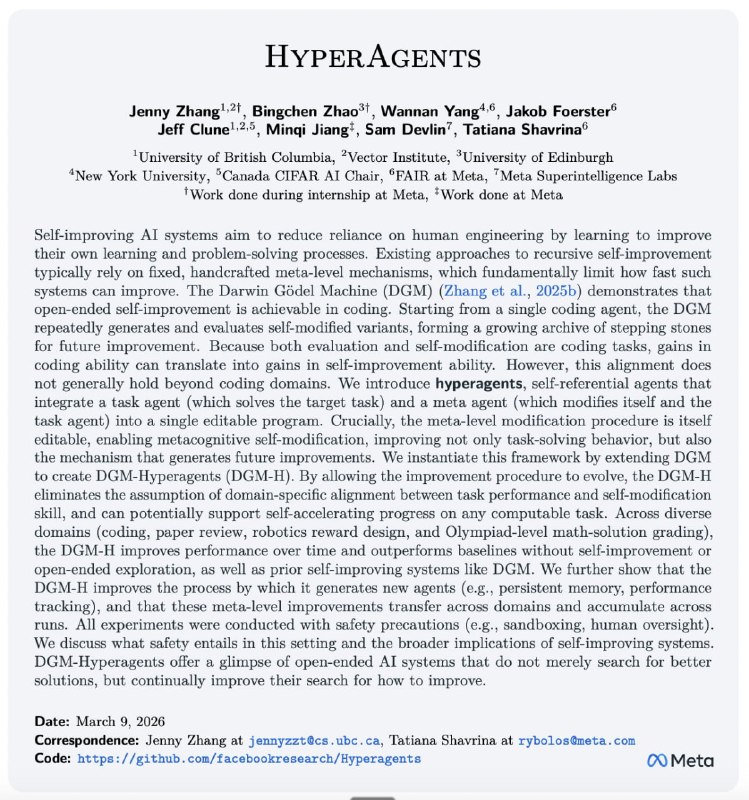
Hyperagents

An AI system that not only improves task solving, but also enhances the process of self-improvement itself.

➡️ What is it?

Darwin Gödel Machine (DGM) demonstrated that open self-improvement is possible through the iterative generation and evaluation of improved agents, but it relies on a key assumption: that improvements in task solving (for example, in programming) lead to improvements in the process of self-improvement itself. This correspondence persists in programming, where both evaluation and modification are expressed in the same subject area, but it is generally violated in other cases. As a result, previous systems remain limited to fixed, manually defined meta-level procedures that do not evolve on their own.

They introduce Hyperagents - self-referential agents capable of modifying both their behavior in task solving and the process that generates future improvements. This enables what they call metacognitive self-modification: learning not only to perform tasks better, but also to become better at the process of improvement itself.

This approach is implemented in the form of DGM-Hyperagents (DGM-H) - an extension of DGM, in which both the behavior of task solving and the self-improvement procedure are editable and subject to evolution. In various domains (programming, scientific paper review, design of reward functions in robotics, and evaluation of mathematical Olympiad tasks), hyperagents ensure continuous quality improvement over time and outperform basic approaches without self-improvement or open evolution, as well as previous self-improving systems (including DGM). DGM-H also improves the process of generating new agents itself (for example, through persistent memory and performance tracking), and these meta-level improvements are transferable between domains and accumulate from run to run.


Full article 🆗

••••••••••••••••••••••••••••••••••••••
🤖 Data & ML | @DataXplore
Post #2108 206
Claude Code Game Studios: 48 AI agents as a full-fledged game studio.

A solo developer with access to Claude Code can now deploy an entire game dev studio with a creative director, department leads, and specialized specialists.

The game design approaches are based on the MDA Framework, self-determination theory, and flow state design.

➡️ What is it & how it works?
Claude Code Game Studios is a template for Claude Code that organizes an AI session into a three-level hierarchy of 48 specialized agents.

At the top are 3 directors (creative, technical, and producer) working on the Opus model.

One level below are 8 department leads on Sonnet: game designer, lead programmer, art director, sound director, narrative director, and others.

The third level is specialists on Sonnet and Haiku: from gameplay programmers and economy designers to DevOps engineers and accessibility specialists.

The agents interact according to a clear protocol: vertical task delegation from top to bottom, horizontal consultations between agents of the same level, and conflict escalation to the overall leader.

Each agent works strictly within its domain and does not modify other agents' files without explicit instructions.

In addition to the agents, the template includes 37 teams covering the entire development cycle: sprint planning, code and design reviews, asset audits, idea generation, and release preparation.

A separate category is team workflows that coordinate the work of several agents on a specific feature: combat system, narrative, interface, or sound.

In parallel, 8 hooks are attached to git events and the session lifecycle. They trigger automatically: validate commits against hardcoded values and data correctness, warn about pushes to protected branches, load the current sprint's context at startup, and record results at completion.

Another layer is 11 rules attached to project paths. They are applied when editing files in the corresponding directories and set standards for each zone of the codebase.

➜ This is not an autopilot.

The agents ask questions, propose several options with pros and cons, and show a draft. But the final decision is always human, and nothing is fixed without their approval.

➜ template works with Godot 4, Unity, and Unreal Engine 5.

For each, there is a lead agent with a set of sub-specialists: for Godot, it's GDScript, shaders, and GDExtension; for Unity, DOTS/ECS, VFX, and UI Toolkit; for Unreal, GAS, Blueprints, and Replication.


Project is open to customization: agents can be added & removed, prompts can be edited and hooks can be reconfigured.

GitHub: License: MIT License: #AI #ML #Vibecoding #Gamedev #Claude

••••••••••••••••••••••••••••••••••••••
🤖 Data & ML | @DataXplore
Post #2107 199
Qianfan-OCR is an end-to-end model with 4B parameters for working with documents.

Main idea is one model instead of an entire pipeline.

➡️ What it can do?

• Document parsing in one pass
Without splitting into OCR → post-processing → extraction.
The model immediately outputs a structured result.

• Tables
Correctly extracts the structure of tables, rows, and values.

• Formulas
Recognizes mathematical expressions and converts them into a readable form.

• Charts & diagrams
Understands visual data and extracts meaning from it.

• Key information extraction
Automatically retrieves key fields: sums, dates, names, etc.


Previously, this required a complex stack: OCR → layout detection → table parser → rule-based extraction.

Now, all of this replaced by one model, which does everything at once. In fact, this is a step towards systems that can understand documents just like a human.

#AI #OCR #LLM #ML

••••••••••••••••••••••••••••••••••••••
🤖 Data & ML | @DataXplore
Post #2106 193
Google developed a KV-cache quantization algorithm without loss of accuracy.

Research division announced TurboQuant, a vector quantization algorithm that combines 2 other methods - QJL and PolarQuant, which solves the problem of increasing KV-cache when working with a long context.

TurboQuant will be presented at ICLR 2026, PolarQuant - at AISTATS 2026.

➡️ Why it matters?
The KV-cache stores intermediate representations of tokens so that the model does not recalculate them at each step of generation. With the growth of the context, it becomes a memory bottleneck.

Conventional vector quantization compresses this data, but it introduces overhead: for each block, it is necessary to store quantization constants in full accuracy, and this is plus 1–2 bits per element, which partially devalues the compression itself.

➜ TurboQuant is a two-stage pipeline.

First, PolarQuant: a random rotation aligns the geometry of vectors, after which they are translated from Cartesian coordinates to polar (radius and angle). The distribution of angles turns out to be predictable and concentrated, so normalization and storage of additional constants are no longer necessary.

At the second stage, QJL is connected, a method based on the Johnson-Lindenstrauss transformation, which encodes the residual error of the first stage with just one sign bit and, through a built-in estimation function, combines a high-precision query with low-precision compressed data, correctly calculating the attention score.

None of the methods requires training or retraining and works in the mode of "without preliminary analysis of the dataset".

The algorithms were tested on benchmarks for long context: LongBench, Needle In A Haystack, ZeroSCROLLS, RULER and L-Eval with the Gemma and Mistral models.

When quantizing the KV-cache to 3 bits, TurboQuant showed zero degradation in accuracy on all tasks: searching for a "needle in a haystack", QA, code generation, summarization.

The volume of the KV-cache at the same time decreased by 6 times. On H100, the four-bit TurboQuant accelerated the calculation of attention logits up to 8 times compared to 32-bit keys.


Area of application is not limited to KV-cache. In experiments with high-dimensional vector search, TurboQuant consistently surpassed PQ and RaBitQ methods in recall, despite fact that they used large code books and tuning to a specific dataset.

Article, Arxiv • #AI #ML #LLM #TurboQuant #Google

••••••••••••••••••••••••••••••••••••••
🤖 Data & ML | @DataXplore
Post #2105 203
Practice for PyTorch Interviews

TorchCode offers a structured environment for training programming skills needed for ML interviews. Solve problems implementing operators and architectures, receiving instant feedback and hints.

➡️ Key features:
- 40 tasks frequently encountered in interviews
- Automatic verification of correctness and performance
- Instant feedback on each test
- Hints and reference solutions for study
- Ability to run in the browser without installation


GitHub #Python

••••••••••••••••••••••••••••••••••••••
🤖 Data & ML | @DataXplore
Post #2104 172
DRAGOn methodology.

Russian researchers from SberAI, MWS AI, ITMO and HSE University, have presented the new approach to evaluating RAG systems, which underpin modern AI assistants.

➡️ Why Most AI Assistant Tests Don't Work in Reality?

The key idea is to move away from static tests to a dynamic environment with constantly updated data. The work was accepted at the EACL 2026 international conference.

Classic benchmarks quickly become outdated and poorly reflect real-world conditions. In business, AI works with live knowledge bases, where the relevance and coherence of facts are important, not just accuracy on a fixed dataset. DRAGOn proposes to test AI systems on fresh news, automatically collecting a "knowledge map" from them.

Instead of simple questions like "who/where/when", the system creates multi-level logical tasks. To answer, AI must match several facts from different news, not just copy a piece of text, and the neural network-judge checks the answers.

What this brings in practice:
- Tasks become multi-step, not trivial;
- The ability to link facts, not copy answers is tested;
- The evaluation takes into account completeness and factual accuracy, not just word matching.


Methodology can be deployed within a company and test AI on its own data before implementation. This allows comparing solutions in real scenarios and reducing the risk of errors, especially in tasks of analytics, support, and working with documents.

Article

••••••••••••••••••••••••••••••••••••••
🤖 Data & ML | @DataXplore
Post #2103 192
Autonomous AI research with autoresearch

This repository proposes concept of autonomous AI learning, where agent modifies code and conducts experiments on its own.

Key points:
- The autonomous agent modifies train.py to optimize the model.

- learning process takes place in a fixed timeframe of 5 minutes, after which it evaluates the results and continues the iterations.

- Using a simple interface program.md, users can configure the agent to optimize models without directly interfering with the code.
- Support for only one NVIDIA GPU.


GitHub #python

••••••••••••••••••••••••••••••••••••••
🤖 Data & ML | @DataXplore
Older posts →
Threads Profile ViewerView any public Threads profile without an account.Open ThreadLook →Writing with AI? Make it sound human.Metric37 rewrites AI drafts so they read naturally. Free AI detector, 1,500 words free.Try Metric37 →