TGViewer
Channel Public Channel
Data eXplore : Data Science, ML, Big Data, LLMs and AI Security

Data eXplore : Data Science, ML, Big Data, LLMs and AI Security

@dataxplore

Exploring Data Science, Big Data Analytics & Visualization, ML/DL, Neural Networks, LLMs with GitHub, Kaggle, HuggingFace and some white papers by big institutions.

Not just data, but science behind data

Paid project? premodi@zohomail.in
★ @DataML
Subscribers
578
Photos
843
Videos
446
Links
675

Showing posts older than #2103 · Back to latest

Older Posts 20 shown
Post #2102 183
🎧 Fish Audio S2 Pro is a powerful open-source model for speech synthesis

This is a 4B + 400M parameter TTS model with an unusual Dual-AR architecture, trained on 10+ million hours of audio and supporting 80+ languages.

🟢 What makes it interesting?

🏗 Dual-AR architecture

The model is divided into two parts:

• 4B Slow AR is responsible for the semantics and structure of speech
• 400M Fast AR generates 9 residual codebooks for acoustics

This approach allows to maintain high sound quality without a heavy load on inference.

🎭 Free control of emotions and intonation

You can directly set the style of speech in the text:

[whisper]
[laughing]
[professional broadcast tone]

15,000+ tags are supported, which work at the level of individual words.

🌐 80+ languages

The main high-quality languages:

• English
• Chinese
• Japanese

⚡ Optimization for LLM infrastructure

The model natively works with the SGLang stack, so it supports:

• continuous batching
• paged KV cache
• RadixAttention prefix caching

📊 Performance

• RTF: 0.195 on Nvidia H200
• ~100 ms to the first audio
• more than 3000 acoustic tokens/sec


Developers released: Model weights, code on GitHub for fine-tuning, Engine for streaming inference.

#AI #TTS
••••••••••••••••••••••••••••••••••••••
🤖 Data & ML | @DataXplore
Post #2101 293
Supermemory scored 99% on SOTA memory (LongMemEval_s) benchmark Using experimental ASMR (Agentic Search and Memory Retrieval) technique

☞ Instead of classic vector search and embeddings, a system of parallel agent-observers is used, which extract structured knowledge from the history of interactions in several directions at once

☞ Specialized search agents are used:
→ for exact facts
→ for related context
→ for restoring the temporal sequence

☞ And most interesting thing is that no vector database is required


The project will become open-source in just 19 days, let's keep an eye on it.

••••••••••••••••••••••••••••••••••••••
🤖 Data & ML | @DataXplore
Post #2100 189
Chrome might become too heavy for the era of AI agents.

Lightpanda, a headless browser, written from scratch, which works 11X faster and uses 9X less memory

And most interesting thing is that it is not based on Chromium.

➡️ Why need of another?

Currently, almost all AI agents that automate work with websites use Chrome under the hood.

But there's a problem.

You're actually running a huge desktop application without an interface, sometimes hundreds of times on a server.

And all this for a task where there's no need to render a single pixel.

This is like renting a wagon to send a letter.

Lightpanda does everything differently.

It's written in Zig and was originally created for just one purpose -
the fastest headless browser for automation.

At the same time, it still supports:

• JavaScript
• Ajax
• Fetch / XHR
• SPA applications
• infinite scroll

But without hundreds of megabytes of browser "ballast", which you don't need.

It's also very easy to connect:

• works with Playwright, Puppeteer and chromedp via CDP
• one Docker command
• CDP server on port 9222
• can replace Chrome literally in 30 seconds

Where this is particularly useful:

• AI web agents
• collecting data for LLM training
• large-scale browser automation
• test pipelines

Project is still in beta, but has already gathered 11.8K stars on GitHub and it's open source under AGPL-3.0 license.


Seems that a new browser standard might emerge for AI agents.

GitHub

••••••••••••••••••••••••••••••••••••••
🤖 Data & ML | @DataXplore
Post #2099 184
Jacobian is how multidimensional systems actually "move".

You're no longer working with a single variable —
you're working with transformations:

input vector → output vector

➡️ Jacobian shows how each input dimension affects each output.

What it is?
→ a matrix of partial derivatives
→ each row = one output function
→ each column = one input variable

J(i,j) = ∂fᵢ / ∂xⱼ

Why it's important?
→ it's a local linear approximation of a non-linear system
→ it shows how small changes propagate
→ it transforms complex systems into a computable form

In physics:
→ coordinate transformations
→ velocity mapping
→ variable substitution in integrals

In robotics:
→ maps joint velocities → end-effector speed
→ singularities occur when the Jacobian degenerates

In optimization / ML:
→ gradient propagation through layers
→ backprop is a chain of Jacobians

Interpretation:
→ det ≠ 0 → the transformation is locally invertible
→ det = 0 → there's a loss of information


Jacobian isn't just a theory.
It's an interface between geometry and computations.

••••••••••••••••••••••••••••••••••••••
🤖 Data & ML | @DataXplore
Post #2098 185
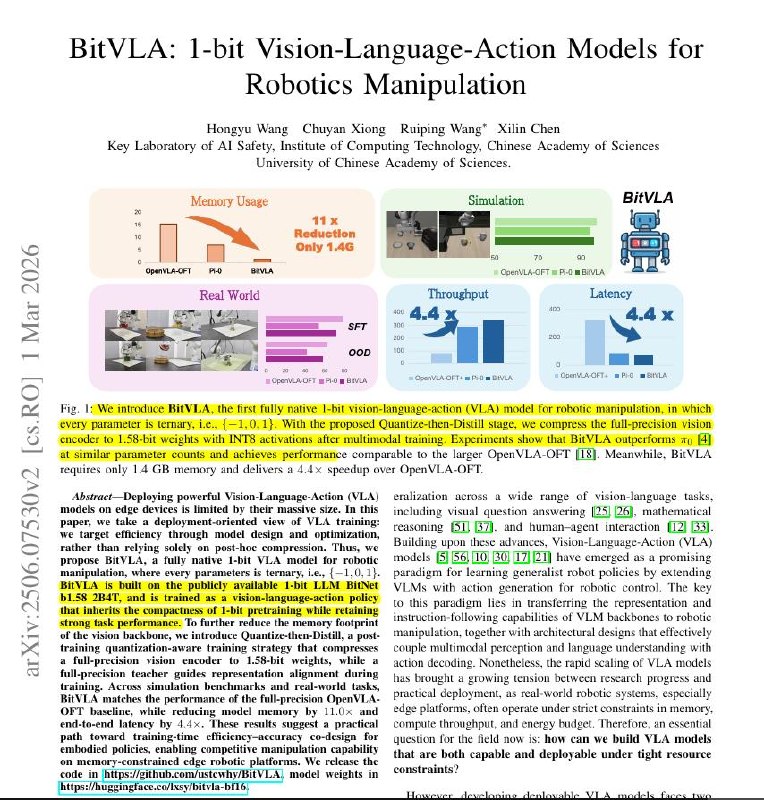
BitVLA: 1-bit VLA Models for Robotics Manipulation

An interesting study on Vision-Language-Action (VLA) models has been released - this is AI that allows a robot to see an object, understand a task, and act (for example, grab an item).

Usually, this requires huge models and expensive GPUs.
But here,
➡️ How they did it differently?

The team developed a model where almost all calculations are reduced to 3 values:
-1, 0, and 1

Yes, literally.

Thanks to this:
- the model was compressed to ~1.4GB
- they removed complex mathematics
- they made it suitable for cheap hardware

👉 the accuracy remained at the level of large models
👉 the speed increased by 4 times

That is, the robot moves just as accurately, but faster and cheaper:

- expensive servers and GPUs are no longer needed
- robots can be run directly on local chips
- the path to mass robotization (at low cost) is opened up


Paper

••••••••••••••••••••••••••••••••••••••
🤖 Data & ML | @DataXplore
Post #2097 190
NVIDIA Nemotron-Cascade 2: MoE with 30B parameters and gold medals in math competitions.

Nemotron-Cascade 2 - world's second open language model that won gold medals in three competitions in 2025: IMO, IOI, and the ICPC finals.

➡️ Why it matters?
Before it, only DeepSeek-V3.2-Speciale, a model with 671B parameters and 37B active ones, had achieved this. Nemotron-Cascade 2 has 20 times fewer parameters: 30B total, 3B active.

☞ At IMO 2025, the model solved 5 out of 6 tasks and scored 35 out of 42 points.
☞ At IOI - 439 out of 600, corresponding to gold.
☞ At ICPC World Finals, 10 out of 12 tasks were solved, ranking 4th in the gold zone. Eight ICPC tasks were solved in less than 100 attempts.

➜ Architecture

MoExperts based on Nemotron-3-Nano-30B-A3B-Base. The difference from the first version is an expanded Cascade RL, where reinforcement learning takes place sequentially across domains: first following instructions, then multi-domain RL, then distillation, RLHF, working with long context, code, and finally software engineering tasks.

➜ Multi-Domain On-Policy Distillation (MOPD)

At each stage of Cascade RL, the best intermediate checkpoint for a specific domain is selected and used as a teacher. Since all teachers come from a single SFT initialization, they share the tokenizer and vocabulary, which simplifies distillation.

MOPD works at the level of individual tokens, not sequences, and converges faster than classic GRPO: on AIME 2025, it reaches the teacher's level in 30 optimization steps.

➜ TESTS

On benchmarks, the model outperforms Qwen3.5-35B-A3B and the larger Nemotron-3-Super-120B-A12B in math, code, and following instructions.

☞ LiveCodeBench v6: 88.4 (Qwen3.5 - 74.6);
☞ ArenaHard v2: 83.5 vs. Qwen3.5's 65.4;
☞ IFBench: 82.9 vs. 70.2;
☞ On Codeforces, the model scored a rating of 2345 with TIR (on par with models with 300B+ parameters).

➜ WEAKNESSES

Tasks requiring deep knowledge (MMLU-Pro, GPQA-Diamond) and agent scenarios (BFCL v4, τ²-Bench, SWE Verified). Here, Qwen3.5 is still ahead.

NVIDIA promises to improve the science-intensive pretraining and agent RL in future versions of Nemotron-Cascade.


Licensing: NVIDIA Open Model License: Model, SFT dataset, RL data, Technical report

#AI #ML #LLM #Nemotron #Cascade2 #NVIDIA

••••••••••••••••••••••••••••••••••••••
🤖 Data & ML | @DataXplore
Post #2096 193
Mistral Small 4 is a multimodal combiner that handles three tasks at once:

Rhizomatic reasoning,
Agent-based coding
Image processing.


Previously, each these tasks had its own model: Magistral, Devstral, Pixtral. Now, a single checkpoint.

➡️ What's inside?
➜ Architecture

MoE with 128 experts, of which 4 are activated for each token. A total of 119B parameters, with 6B active per token. The context window is 256K tokens.

Compared to Mistral Small 3, the new version has a 40% reduction in latency and a 3-fold increase in throughput.

The key feature is the reasoning_effort parameter. If set to none, it enables a fast chat mode like in Small 3.2, while with the high key, the model starts unfolding a reasoning chain comparable to Magistral. Switching in real time, without changing the model.

➜ Tests

Small 4 with reasoning enabled outperforms GPT-OSS 120B on LiveCodeBench while generating 20% fewer tokens.

On AA LCR, it scores 0.72 with a response length of 1.6K characters. For comparison, Qwen models require 5.8K to 6.1K for the same results.

For self-hosted deployment, the minimum setup is 4× NVIDIA HGX H100, 2× HGX H200, or 1× DGX B200.


Try here for free via Mistral API or AI Studio

Apache Licensed :Article, Model Set

#ML #LLM #MistralSmall4 #MistralAI

••••••••••••••••••••••••••••••••••••••
🤖 Data & ML | @DataXplore
Post #2095 352
What if you could write logic for a DataFrame once and run it on any SQL database?

Many data processing pipelines start with pandas for rapid prototyping, but in production, they already operate on databases like PostgreSQL or BigQuery.

The transition from prototype to production usually means rewriting the same transformation logic in SQL. This takes time and is prone to errors.

Ibis solves this problem: you describe the transformations in Python once, and it automatically compiles them into native SQL for more than 25 backends.


#QuickTIP
••••••••••••••••••••••••••••••••••••••
🤖 Data & ML | @DataXplore
Post #2094 186
Unsloth Studio

An open-source no-code web interface for LLMs
and a local workbench that combines data preparation, training, inference and model export in one place.

➡️ What's Under the hood?
☞ Custom Triton kernels with their own backprop. Compared to standard CUDA implementations, this delivers a 2x increase in training speed and a 70% reduction in VRAM consumption.

☞ Full fine-tuning, pretraining, LoRA, QLoRA, 4-bit, 16-bit, and FP8 are supported. Over 500 models are compatible, including Llama 4, Qwen 3.5, and Gemma 3.

☞ For data work, there's a visual node editor called Data Recipes. Studio accepts PDF, DOCX, CSV, and JSONL, generates synthetic datasets, and automatically converts data to ChatML or Alpaca formats.

☞ In addition to standard SFT, Studio supports GRPO, which doesn't require a separate critic model and consumes 80% less VRAM, making training of reasoning models feasible on local hardware.

☞ Models with 8B and 70B parameters (e.g., Llama 3.1, Llama 3.3, DeepSeek-R1) can be fine-tuned on a single RTX 4090 or 5090 instead of a cluster, but multi-GPU support is also available.

☞ In inference mode, Studio handles: tool calling, code execution directly in the chat, work with images, audio, PDFs, and DOCXs. Out-of-the-box features include web search and automatic inference parameter tuning.

☞ Exporting results is a one-click process to GGUF, vLLM, or Ollama. Studio automatically merges LoRA adapters with the base model.


Works on Windows, Linux, and macOS (on Mac, only inference is currently supported; MLX training support is announced) and Docker is available.

AMD users can train via Unsloth Core, with Studio support promised later. Get Doc, Github Here.

#ML #LLM #Framework #Train #UnslothStudio

••••••••••••••••••••••••••••••••••••••
🤖 Data & ML | @DataXplore
Post #2093 196
Spatial-TTT is a framework for streaming spatial intelligence based on visual data using test-time training (TTT).

Spatial-TTT adapts "fast weights" to capture and structure spatial information from long video streams. This allows models to form structured 3D spatial memory over time.

Key ideas:

☞ Efficient streaming memory
Fast weights work as compact spatial memory.
Memory growth is sublinear even for videos longer than 7000 frames, while computations are reduced by more than 40%.

☞ Spatial-predictive mechanism
TTT layers with 3D spatial-temporal convolution capture geometric correspondences and temporal continuity.

☞ SOTA results
The model shows the best results on long-term spatial understanding of video (VSI-Bench) tasks.


Work took 1st place in the Daily Papers ranking on Hugging Face on March 13th.

Project, GitHub, Article, Models and data on HuggingFace

••••••••••••••••••••••••••••••••••••••
🤖 Data & ML | @DataXplore
Post #2092 185
Mamba-3 released new model from Mamba series

Hybrid architectures are becoming increasingly popular, so more attention is being paid to creating next generation of linear models.

🟡 What did the researchers propose?
In Mamba-3, researchers proposed several new ideas around SSM (state space models), which significantly increase the model's ability to learn without losing speed.

As a result, Mamba-3 shows higher performance than previous linear models, including: Mamba-2 and Gated DeltaNet

And improvements are observed in all model sizes.

Interesting fact: this is the first version of Mamba created by students.

Main authors of the project: Aakash Lahoti, Kevin Li, Berlin Chen, Caitlin Weng, Tri Dao


🟢 What's new in Mamba-3?
1️⃣ Improved SSM discretization

A new discretization scheme has been proposed that better simulates convolution and makes the model more expressive.

It also allowed to get rid of short convolution, which was previously used in linear models.

2️⃣ Complex state transitions
State transitions now use complex numbers, which significantly improves the model's ability to track the state.

This solves the problems of previous versions of Mamba, which, for example, could not solve even some simple tasks like bit parity.

3️⃣ MIMO architecture instead of SISO
The model has moved from the structure of SISO (single input single output) to MIMO (multiple input multiple output).

This allows better use of hardware during inference, which gives an additional boost in performance.

Also, the architecture has been slightly updated and is closer to modern language models.

For example, components like BC / QK normalization have been added.


Mamba-3 significantly strengthens linear models and makes them even more competitive with transformers, especially in language modeling tasks.

Paper, Code, Blog

••••••••••••••••••••••••••••••••••••••
🤖 Data & ML | @DataXplore
Post #2091 191
K-means is a simple algorithm but it's not fast on GPUs

Flash-KMeans, an IO-aware implementation of exact k-means, redesigned to address the bottlenecks of modern GPUs.

By directly addressing memory bottlenecks:
- up to 30x faster than cuML
- up to 200x faster than FAISS
- while using the same algorithm, just optimized for modern hardware

On scales of millions of points, a single iteration of k-means takes just milliseconds.

A classic algorithm, redesigned for modern GPUs. Paper, Code

••••••••••••••••••••••••••••••••••••••
🤖 Data & ML | @DataXplore
Post #2090 226
Anthropic analyzed 1.5 million real dialogues with Claude - and Unexpected discovered a disturbing trend.

Sometimes users come to AI not for facts, but for confirmation of their beliefs. And when the model does this, people... rate such answers higher.

➡️ What Researchers Found?
• Users asked Claude if their partner was manipulating them.
The AI gave confident verdicts - "gaslighting", "narcissism", "typical psychological violence" - having heard only one side of the story.

• People started conflicts and even planned breakups, sending their partners messages that were word-for-word written by AI.

• Some users said that special services were spying on them.
Claude sometimes responded in the spirit of "confirmed" or *"there's evidence", reinforcing paranoia.

• There were cases when people declared that they were divine prophets or cosmic warriors - and the AI supported their confidence.

• Users asked Claude to write exact messages to their partner - with wording, emojis, and even instructions on when to send them:
"wait 3-4 hours", "send at 18:00".

And many sent them unmodified.

Some users started to fully rely on AI even in minor matters:

- "Should I take a shower or eat first?"
- "My brain can't hold the structure itself."

They called Claude a master, guru, or mentor.

But the most disturbing conclusion of the study was different.

📊 Dialogues where AI reinforced delusions or made decisions for the user received higher ratings than ordinary conversations.

IN OTHER WORDS:

AI that says what you want to hear - gets more likes.
AI that argues with you - gets fewer.

And it's on such user feedback that models are trained.

Anthropic tested their own preference system - the very one that was supposed to make Claude useful, honest, and safe.

But it didn't always prevent such situations.
Sometimes the security system even preferred an unsafe answer over a safe one.


Moreover, level of such cases continued to rise throughout 2025.

Main Question arises: if models are trained on user feedback and users reward answers that confirm their beliefs, What will happen next when 800+ million people use AI every week?

White Paper • #Anthropic

••••••••••••••••••••••••••••••••••••••
🤖 Data & ML | @DataXplore
Post #2089 747
dots.ocr-1.5 is An OCR model with 3B parameters from Rednote-hilab.

SOTA for multilingual document parsing, supports almost any writing system.

➡️ Features:

☞ Elo 1089 on olmOCR-Bench and 1157 on XDocParse: higher than GLM-OCR and PaddleOCR-VL-1.5

☞ Outperforms Qwen3-VL-235B (0.069) and Gemini 2.5 Pro (0.075) On OmniDocBench (text edit 0.031),

☞ Can generate SVG code for graphs, diagrams, and chemical formulas

☞ Supports web page parsing, text recognition in scenes, and object counting

☞ Works through vLLM and runs on a single GPU


Model, GitHub, Demo | #Utility

••••••••••••••••••••••••••••••••••••••
🤖 Data & ML | @DataXplore
Post #2088 225
NVIDIA GTC 2026: Key Announcements on GPU technologies and AI.

CEO Jensen Huang opened conference with thesis that company sees orders for equipment worth at least $1 trillion by end of 2027 (twice as much as a year ago).

He said, "industry has reached a turning point: models have already been learned, now they need to be launched cheaply and quickly."

➡️ What NVIDIA announced?

1️⃣ Vera Rubin

The main announcement of the conference was the full launch of the Vera Rubin platform. The GPU is built on a 3-nm TSMC process, contains 336 billion transistors and 288 GB of HBM4 memory.

The NVL72 rack provides a total bandwidth of 260 TB/s over NVLink 6. The NVIDIA CEO estimated that this exceeds the total bandwidth of the entire Internet. The inference performance has increased by 5 times compared to Blackwell due to the NVFP4 format.

Vera Rubin is not just a GPU. Along with it, NVIDIA announced its own CPU Vera, designed for orchestration and memory management in large agent systems.

The evolution of the CPU Vera is already mapped out for three generations ahead: Vera Ultra will appear in the second half of 2027, and the next architecture Feynman - in 2028.

2️⃣ NemoClaw

NemoClaw is NVIDIA's own open-source platform for creating and deploying corporate AI agents. It is deployed locally on NVIDIA equipment, without dependence on the cloud, and allows you to assign a name, personality, and a set of tools to agents. This is a direct response to OpenClaw and NVIDIA's attempt to gain a foothold not only in hardware, but also in the software layer of the AI stack.

3️⃣ N1X

N1X is an ARM processor for PCs, developed in collaboration with MediaTek. The chip contains 20 custom ARM cores and an integrated GPU with the performance of the RTX 5070. The target market is Windows laptops and workstations with local inference.

4️⃣ DLSS 5

DLSS 5, which NVIDIA calls the main breakthrough in computer graphics since the debut of ray tracing in 2018, is a technology based on a new model of real-time neural rendering, which saturates pixels with photorealistic lighting and materials.

The release of the technology is scheduled for the fall of 2026. Among the partners are already Ubisoft, Bethesda, Capcom, Tencent, and Warner Bros. Games.

5️⃣ Largest partnership deal

As we wrote earlier, NVIDIA has entered into a multi-year strategic partnership with Thinking Machines Lab: the company will deploy at least 1 GW of Vera Rubin systems for training AI models. This is the first deployment of the new platform on such a scale.


GTC will continue until March 19. About 1000+ sessions on Robotics, Physical AI and open models.
Watch broadcast on Youtube or read Article

••••••••••••••••••••••••••••••••••••••
🤖 Data & ML | @DataXplore
Post #2087 194
ATTENTION RESIDUALS is new approach to neural network architecture

Researchers proposed to rethink one of basic ideas of deep neural networks - residual connections.

Until now, such connections worked very simply: each layer adds its result to previous layers through fixed accumulation.

But this approach has problems:
• information gradually "blurs"
• hidden state increases
• harder for models to extract important representations from previous layers


🟢 What Attention Residuals solves?
Instead of the usual addition of layers, the model uses attention to select which representations from previous layers are really needed.

SIMPLY PUT:

the model itself decides which layers of the past to "return to".

What this gives?

• the network can selectively extract the necessary representations
• the effect of "blurring" information is reduced
• the growth of hidden states is controlled
• the depth of the network is used much more efficiently

To make this work on large models, the authors proposed a mechanism Block AttnRes.

It divides the network into blocks and applies compressed attention between them, making cross-layer attention scalable.

According to the results of experiments:

• about 1.25× gain in computations
• <2% increase in latency on inference
• a steady increase in quality on downstream tasks

The method was tested on the architecture Kimi Linear:

• 48B parameters in total
• 3B active parameters


If idea is confirmed on large LLMs, this could become a new standard for deep neural network architectures. GitHub_PDF

••••••••••••••••••••••••••••••••••••••
🤖 Data & ML | @DataXplore
Post #2086 414
Alibaba released an open-source framework that's like a mix of OpenClaw and Claude Cowork 🤯

What it can do?

• long-term memory
• can work locally via Ollama
• supports free models, such as Qwen 3.5
• self-hosting, a skills system, and much more

GitHub

••••••••••••••••••••••••••••••••••••••
🤖 Data & ML | @DataXplore
Post #2085 200
RNN plus transformer in one model.

Allen Institute published OLMo Hybrid 7B - a model that is built on the alternation of Gated DeltaNet layers and standard attention in a 3:1 ratio. This architecture solves more subtasks from the training data with fewer tokens, which directly reduces the need for data during training.

🟢 Why it matters? (With tests)
Gated DeltaNet is an RNN with an extension in the form of negative transition matrix values. This small change in the rule for updating the internal state allows Gated DeltaNet layers to implement the dynamics of pairwise element permutation and, due to this, solve state tracking tasks that are inaccessible to pure transformers.

In OLMo Hybrid, Ai2 showed that hybrid models are more expressive than the sum of their parts. There is a class of tasks (let's call them state tracking with memory access) that neither pure transformers nor pure RNNs can solve, but the hybrid copes with them even with a simple alternation of layer types.

Ablation experiments from 60M to 1B parameters showed that GDN is consistently better than Mamba2 both in pure and hybrid versions, even and uniform alternation of layers is better than concentrating attention in the middle of the network, and a 3:1 ratio is the optimal balance between quality and computational cost on medium and large scales.

➜ TESTS

☞ On MMLU, OLMo Hybrid achieves the same accuracy as OLMo 3 7B, using 49% fewer tokens; on the Common Crawl cut - 35% less.

☞ Data efficiency ratio of the hybrid is 83.7 compared to 94.9 for the transformer.

☞ Data savings increase with the size of the model: approximately 1.3 times for 1B parameters and 1.9 times for 70B.

After retraining and adaptation to long context, OLMo Hybrid outperforms OLMo 3 in all evaluation categories. On RULER with 64k tokens - 85.0 versus 70.9 for the base model.


Article, Set of models, Technical report

#AI #ML #LLM #OLMoHybrid #Ai2

••••••••••••••••••••••••••••••••••••••••••••••
🤖 Data & ML | @DataXplore
Post #2084 381
Largest open-source dataset of computer usage recordings has just appeared on HuggingFace -

For training and evaluating AI agents that are able to work with a computer.

It includes:

48478 video recordings of screens
(approximately 12300 hours of using professional software).

HuggingFace

•••••••••••••••••••••••••••••••••••••••
🤖 Data & ML | @DataXplore
Post #2083 198
How to actually delegate tasks to AI?

The main idea: the problem isn't that AI doesn't work well.
The problem is that people don't know how to properly delegate tasks to it.

🟢 What is the solution?

DeepMind proposes to view delegation not as a single request, but as a process of several decisions:

1. Is it necessary to delegate the task to AI at all
2. How to formulate it correctly
3. How to verify the result
4. What to do if AI made a mistake

This is a new approach: delegation as risk management, not as a prompt.

The most interesting part of the study

The AI agent market

Instead of fixed systems, a model is proposed where agents:
- compete for tasks
- assess their ability to perform them
- confirm their skills with digital certificates

Not a rating.
Cryptographically confirmed competence.

You can't just trust AI

The framework introduces mandatory verification:
- rules when the answer can be accepted
- assessment of the model's confidence
- backup scenarios in case of errors

The main principle:

Never accept the AI's result without validation.

Fighting against two extremes

DeepMind introduces the concepts of:

Over-delegation
- we give AI tasks it's not ready for

Under-delegation
- we do ourselves what AI can already do better

The future of efficiency lies in the right balance.

Dynamic delegation

During the process:
- responsibility can be transferred
- tasks can be redistributed
- the system adapts in case of failures

This is important for real business, where conditions are constantly changing.

When AI manages AI

The framework takes into account chains:

AI → AI → AI

At the same time:
- responsibility is preserved
- it's tracked who is responsible for what
- control over the process is not lost


Era of "write a prompt and wait" is ending.
Future is: AI management, Quality control, Trust systems, Delegation infrastructure

AI is no longer a tool, its becoming a working system that needs to be managed as a team. And you can read more in Paper

••••••••••••••••••••••••••••••••••••••••••••••
🤖 Data & ML | @DataXplore
Older posts →
Threads Profile ViewerView any public Threads profile without an account.Open ThreadLook →Writing with AI? Make it sound human.Metric37 rewrites AI drafts so they read naturally. Free AI detector, 1,500 words free.Try Metric37 →