
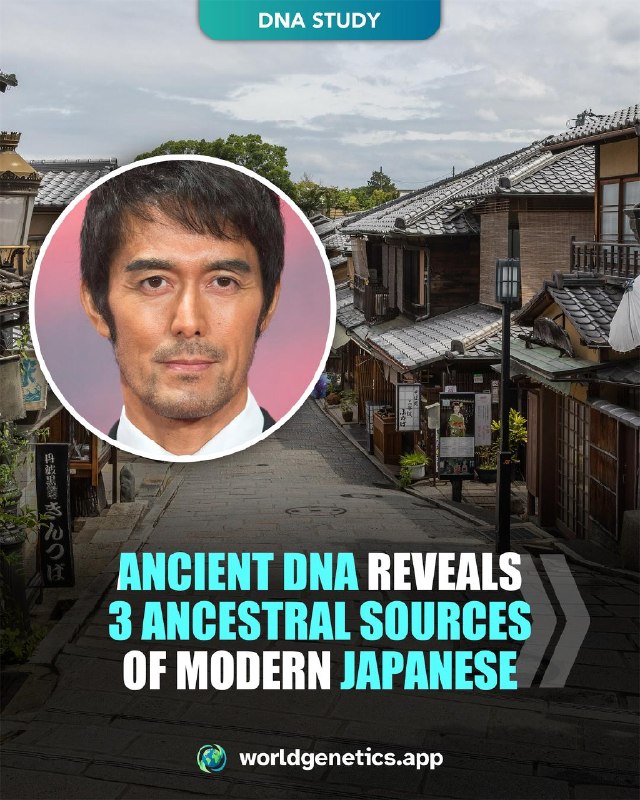
Ancient DNA has revealed that the origins of modern Japanese populations are more complex than the traditional two-way Jōmon + Yayoi model.
A Science Advances study analyzed 12 newly sequenced ancient Japanese genomes spanning around 8,000 years, alongside previously published Jōmon and Yayoi genomes.
The first major ancestry layer comes from the Jōmon, a deeply diverged population whose lineage became increasingly isolated from mainland Asia roughly 15,000–20,000 years ago. Genetic modeling suggests they maintained a very small effective population size of around 1,000 for thousands of years.
That isolation ended during the Yayoi period. Migrants carrying predominantly Northeast Asian-related ancestry entered Japan alongside wet-rice agriculture. At one site in northwestern Kyushu, Yayoi individuals were modeled as roughly 50–60% Jōmon, suggesting substantial assimilation rather than simple population replacement.
But the migrations did not stop there.
During the Kofun period, beginning around 1,700 years ago, another major influx introduced much more widespread East Asian-related ancestry, genetically distinguishable from the earlier Yayoi-associated migration.
By this period, Japan already carried the three ancestry components that remain foundational to mainland Japanese populations today: Jōmon, Northeast Asian and broader East Asian ancestry.
📚 Source: Cooke et al. (2021), Science Advances
Ancient genomics reveals tripartite origins of Japanese populations
🧬 Curious about your own ancestry?
🌍 Explore your DNA at https://www.worldgenetics.app/
Post #95
337
- ❤ 2
- 🥰 1